Biochemistry of Amino Acids - A. Meister 1961
Intermediary Metabolism of Amino Acids
Methionine and Cysteine
Transmethylation
The demethylation of Methionine to form homocysteine and its reverse conversion are crucial metabolic processes. Feeding experiments with rats demonstrated that both the D- and L-isomers of homocysteine can support growth in the absence of methionine [456, 490]. However, on certain methionine-deficient diets, homocysteine fails to support growth unless Choline or another methyl group donor is added [491–493]. METABOLISM/2.html">THE CONCEPT OF Methyl group transfer, or transmethylation, was first proposed by Hofmeister in 1894 [494] and was later experimentally confirmed through nutritional biochemistry studies. The conversion of methionine into homocysteine involves the generation of a reactive methyl group capable of methylating compounds such as guanidinoacetic acid to form creatine [495]. Other Examples of transmethylation include The transfer of a methyl group from choline to homocysteine, yielding methionine, and from methionine to carnosine, yielding anserine [1107]. According to Du Vigneaud and co-workers, the methyl group is transferred intact: the transfer of methyl residues labeled with carbon and hydrogen isotopes occurred without any loss of deuterium [496]. However, the concept that Dietary intake of methyl groups is strictly required had to be reconsidered when several observations showed that diets devoid of methionine or other methyl Donors, but containing homocysteine along with optimal amounts of vitamin B12 and Folic acid, could still support rat growth [493, 497–501]. It is likely that the diets used in earlier studies [40] were deficient in vitamin B12 and folic acid, which are now known to be essential for methyl group synthesis. Experiments with germ-free rats [501] (see also [502–607]) definitively proved that methyl group synthesis takes place within animal Tissues rather than through the action of intestinal microflora. In these experiments, sterile rats were maintained on a choline-free diet supplemented with D2O for 10–23 days. The deuterium concentration in the methyl groups of choline isolated from their tissues was significantly higher than the average deuterium concentration in the whole body, indicating that de novo synthesis of methyl groups occurred within the tissues [501].
The formation of methionine from homocysteine can proceed via the transfer of reactive methyl groups from various compounds, such as choline, betaine, and dimethylthetin. Borsook and Dubnoff [508] investigated methyl group transfer from choline to homocysteine using Liver tissue preparations and found that betaine is a more active methyl donor than choline. It was established that under anaerobic conditions, betaine—but not choline—can serve as the sole source of the methyl group [509], and that the reaction with choline requires the presence of choline oxidase in the incubation system [510]. Choline itself is not a direct methyl donor, but is first converted via betaine aldehyde into betaine, which subsequently serves as the methyl donor [511]. Upon incubation with rat liver preparations and homocysteine, choline is converted into dimethylglycine rather than dimethylethanolamine [510]. It has also been demonstrated that in higher plants, betaine synthesis occurs primarily through The oxidation of choline [512, 513]:
Class="center">
Studies using N15-labeled betaine have shown that the nitrogen atom of this compound serves as a precursor for Glycine, indicating the complete demethylation of betaine [514]. Transmethylation reactions involving thetins—such as dimethyl-β-propiothetin, dimethylthetin [515, 516], and methylmethionine sulfonium salts [517–519]—have also been described.
Transmethylation reactions involving "onium" compounds, such as betaine or dimethylthetin, do not require adenosine triphosphate (ATP) or other Energy Sources. In contrast, the methylation of nicotinamide by methionine [520, 521], the methylation of noradrenaline [522], and the methylation of guanidinoacetic acid [523–525] take place only in the presence of ATP. These reactions require the "activation" of methionine by ATP, which, as shown by Cantoni [526–530, 1108], proceeds According to the following equation:

"Active methionine" has the following Structure:

Cantoni purified the enzyme that catalyzes the activation of methionine and demonstrated that S-adenosylmethionine can serve as a methyl group donor in the absence of ATP. Specifically, the methylation of guanidinoacetic acid to form creatine proceeds as follows:

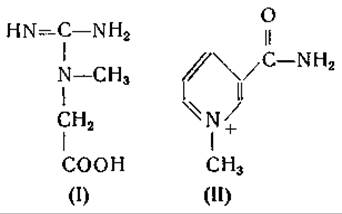
The reaction is catalyzed by the enzyme guanidinoacetic acid methylpherase. The formation of S-adenosylhomocysteine has been established, while the further transformations of this compound warrant further study. The methylation of nicotinamide to N'-methylnicotinamide proceeds via an analogous pathway, but is mediated by a different enzyme, nicotinamide methylpherase. The formation of creatine from guanidinoacetic acid is accompanied by the release of a hydrogen ion, a phenomenon not observed during the methylation of nicotinamide. Cantoni explains this difference by noting that the synthesis of creatine yields a tertiary amine (I), whereas the methylation of nicotinamide generates a new "onium" compound (II) containing a methylpyridinium moiety:
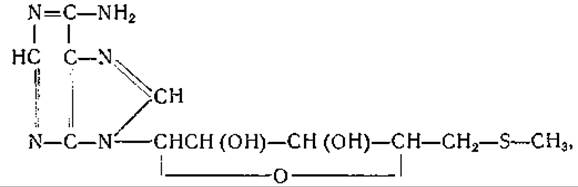
S-Adenosylmethionine is likely the precursor of 5'-thiomethyladenosine, which is found in various microorganisms, including Yeast [531–535]. In Aerobacter aerogenes, thiomethyladenosine apparently participates in methionine synthesis utilizing α-aminobutyric acid [536]. In yeast Cells, methyl mercaptan is utilized for the synthesis of methionine, S-adenosylmethionine, and thiomethyladenosine; in the presence of ethyl mercaptan, ethionine and thioethyladenosine are formed [537].
Methylmethionine sulfonium and methionine sulfoxide can support growth in rats and various microorganisms [517, 519]. Methionine sulfoxide appears to be reduced back to methionine in the process [538]. Regarding methylmethionine sulfonium, data indicate that it is utilized via the transfer of its methyl group to choline and creatine without the prior formation of free methionine [539]; however, further research is required to substantiate this hypothesis.
The aforementioned studies demonstrated the capacity for methyl group synthesis in rat tissues (p. 371). The relationship between Vitamins and folic acid in methyl group synthesis was revealed through dietary experiments with rats. Certain mutants of Escherichia coli require either methionine or vitamin B12 for growth. Both vitamin B12 and folic acid reduce the dietary requirement for choline, which is necessary to prevent Kidney damage in rats and perosis in chicks [501, 504]. As mentioned above, methyl groups can be synthesized via the reduction of "formate." There is evidence indicating that methyl alcohol and formaldehyde can also serve as precursors for reactive methyl groups. The involvement of folic acid derivatives in the transfer of reactive methyl groups and the interconversion of Serine and Glycine is well established (p. 327). Vitamin B12 likewise appears to play a role in one-carbon metabolism and in the synthesis of methyl groups utilizing the α-carbon atom of glycine. The latter reaction proceeds at a reduced rate during deficiencies of vitamin B12, folic acid, vitamin B6, or pantothenic acid [539]. The oxidation of methyl groups to CO2 in the intact Organism has also been proven [540, 581]. For example, following the administration of methionine labeled with C14 in its methyl group to rats, C14O2 was detected in the exhaled breath.
Last update: 06/08/2026
Editorial and Educational Adaptation: This material has been compiled based on the primary/original source text. The project team performed an editorial review, corrected technical inaccuracies, structured sections, and adapted the content for an educational format.
What was processed:
- elimination of formatting defects (OCR errors, structural breaks, corrupted characters);
- editorial organization of content;
- standardization of terminology in accordance with academic sources;
- verification of factual statements against the original source text.
All mentions of the author, publication year, and origin of the primary text have been preserved in accordance with the source.