Biochemistry - The Chemical Reactions of Living Cells Volume 2 - D. Metzler 1980
Biosynthesis: How New Molecules Are Formed
Metabolism of Triglycerides, Phospholipids, and Glycolipids
Ether-linked Lipids
Ether-linked Lipids are structurally very similar to triglycerides and Phospholipids. The only difference is that instead of one of the acyl groups, this group of compounds contains an alkyl (—OR) or alkenyl (—O—CH = CH—R) group [65]. Plasmalogens—lipids containing an alk-1-enyl group—were first discovered by Feulgen and Voit in 1924. While developing histological staining Methods, these authors found that treating tissue sections with acid releases aldehydes. Subsequent studies showed that these aldehydes are formed As a result of the Cleavage of lipids containing an alkenyl group:
Class="center">
Plasmalogens and alkyl-containing lipids account for approximately 10% and ~1%, respectively, of the total lipids in the human Central Nervous system. In Mollusks, the content of these lipids is particularly high, reaching 35% of the total phospholipids. Although ether-linked lipids are usually considered components of animal organisms, certain amounts of them have also been found in plants.
The initial step in The Biosynthesis of these lipids apparently involves the interaction of Fatty acids with dihydroxyacetone phosphate. This is presumably followed by the replacement of the acyl group (along with the oxygen atom to which this group was attached) by the alkoxy group of a long-chain fatty alcohol [equation (12-23), reaction a]. The oxygen atom of the alcohol (marked with an asterisk) is retained in the reaction product [66–68]. This reaction is of great interest because its mechanism differs significantly from the substitution processes discussed in Chapter 7. One of the hydrogen atoms (marked with a dagger) is exchanged during the reaction with environmental hydrogen, indicating that the process proceeds via an enolization stage [68]. However, how this facilitates the substitution process remains unclear. The involvement of a coenzyme in this process cannot be excluded:
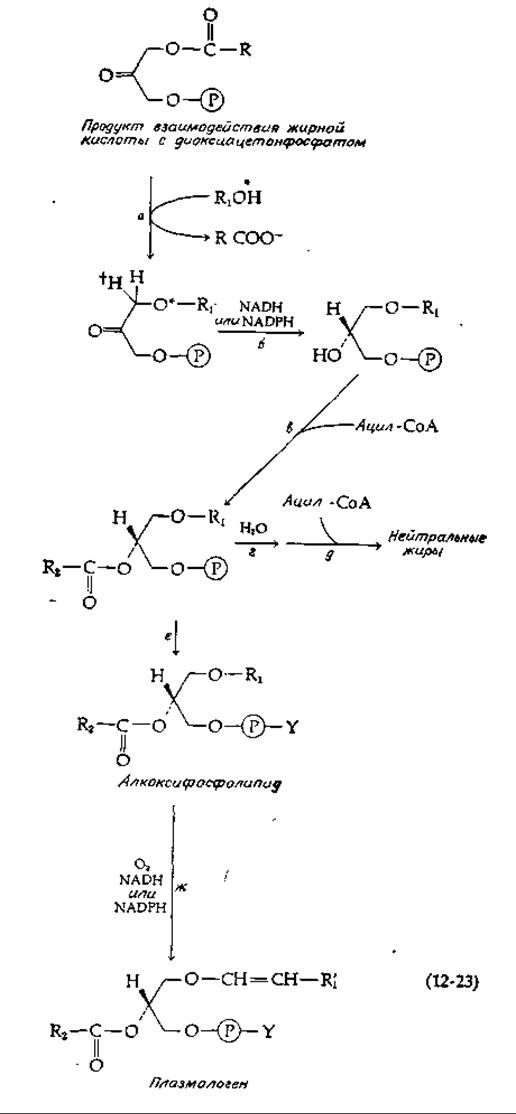
The resulting alkoxy derivative of dihydroxyacetone can subsequently undergo reduction, additional acylation, and conversion into various phospholipids or neutral fats. Reactions b through e, shown in equation (12-23), are very similar to those presented in Fig. 12-8. The conversion of alkyllipids into plasmalogens (alk-1-enylglycerolipids) proceeds via oxidative dehydrogenation with The formation of double bonds [equation (12-3), reaction g] [69].
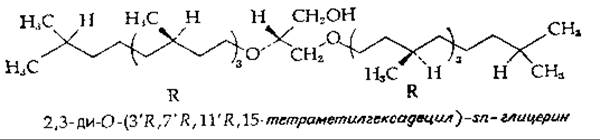
A final note regarding ether-linked lipids concerns specific, highly "halophilic" Bacteria that inhabit only saturated or nearly saturated NaCl solutions. These bacteria contain large amounts of an unusual glycerol ether with polyprenol:
Last update: 06/08/2026
Editorial and Educational Adaptation: This material has been compiled based on the primary/original source text. The project team performed an editorial review, corrected technical inaccuracies, structured sections, and adapted the content for an educational format.
What was processed:
- elimination of formatting defects (OCR errors, structural breaks, corrupted characters);
- editorial organization of content;
- standardization of terminology in accordance with academic sources;
- verification of factual statements against the original source text.
All mentions of the author, publication year, and origin of the primary text have been preserved in accordance with the source.