PLANT PHYSIOLOGY AND BIOCHEMISTRY
Lecture Notes
6. PLANT RESPIRATION
Sugars and other Organic compounds produced during Photosynthesis serve as essential nutrients for plant Cells. Cellular Respiration represents the most critical stage in the METABOLISM of these organic substances.
Cellular respiration is the oxidative breakdown (involving oxygen) of organic nutrients, accompanied by The formation of chemically active metabolites and the release of energy used by The Cell for vital life processes.
General Principles and the equation of respiration
In nature, There are two primary processes through which the solar energy stored by plants in organic matter is released: Respiration and Fermentation.
Respiration is the aerobic oxidative breakdown of organic compounds into simple inorganic substances, accompanied by energy release.
Fermentation is an anaerobic process of breaking down organic substances into simpler organic compounds, which also results in energy release.
In respiration, oxygen serves as the electron acceptor in redox reactions, whereas in fermentation, organic compounds fulfill this role.
The scientific foundations regarding The Role of O2 in respiration were established through the work of A. Lavoisier, J. Ingenhousz, I. Borodin, A. Bach, and C. Engler. In the second half of the 19th century, the joint efforts of scientists led to the proposal of the general equation for this process:
Class="center">С6Н12О6 + 6О2 = 6СО2 + 6Н2О + Е (2875 kJ/mol).
At the same time, A.N. Bach emphasized that Biological Oxidation involves the removal of electrons or protons from a substrate.
This hypothesis by A.N. Bach was later developed by V.I. Palladin into a coherent theory of respiratory chemistry. His postulates regarding the anaerobic and aerobic phases of respiration and the Role of Water in these processes have been fully confirmed.
Key tenets of The Theory of biological oxidation (the Bach-Palladin theory):
✵ water is an essential participant in respiration;
✵ water, together with the oxidation substrate, acts as a hydrogen donor;
✵ specific hydrogen activators are involved in the respiration process, extracting hydrogen from the substrate;
✵ the Initial Stages of respiration are anaerobic and do not require molecular oxygen;
✵ molecular oxygen is necessary at The final stage of respiration to regenerate hydrogen acceptors, resulting in the formation of water.
Experimental data regarding the participation of water in The oxidation of respiratory substrates and the role of O2 as the final hydrogen acceptor were obtained in the 1950s and highlighted in the works of B. Vartapetian and A. Kursanov.
Thanks to the research of Kostychev and Neuberg, it became evident that respiration and all forms of fermentation are interconnected via pyruvic acid, and that a genetic link exists between respiration and fermentation.
Respiration is a manifestation of Metabolic exchange between an Organism and its environment, resulting in the generation of energy in the form of ATP, reducing equivalents (NADH2, NADPH2), and the formation of intermediates for various biosynthetic reactions within the plant organism. The respiration process consists of three stages:
✵ Glycolysis,
✵ The Tricarboxylic Acid Cycle (Krebs cycle),
✵ of the Respiratory Chain.
During the first two stages (glycolysis, the tricarboxylic acid cycle), Coenzymes (NAD·H2, NADP·H2) are reduced; in the Third Stage, these are oxidized by atmospheric oxygen within the mitochondrial respiratory chain.
Respiration establishes a vital link between the breakdown and synthesis of key chemical compounds involved in metabolic processes. It also facilitates gas exchange with the environment: oxygen is consumed, while Carbon dioxide is released.
Main pathways of respiratory substrate oxidation
The oxidation of substrates (S) during respiration is mediated by Enzymes (E). As biocatalysts, enzymes possess several distinct characteristics: high activity, Specificity, and lability. These properties enable precise REGULATION OF METABOLISM at the enzymatic level.
There are four modes of oxidation:
1. electron removal (Fe2+ → Fe3+);
2. hydrogen removal (hydroquinone → quinone + 2е- + 2Н+);
3. oxygen addition (2Н2 + О2→ 2Н2О);
4. formation of an intermediate hydrated compound followed by the removal of two electrons and two protons:
СН3 — СОН + Н2О → СН3 - СН(ОН)2→ (-2е-, -2Н+) СН3СООН
Oxidoreductases
Since the oxidation of one substance—D (an electron or H+ donor)—is coupled with the reduction of another compound—A (their acceptor)—the enzymes catalyzing these reactions are termed redox enzymes, or oxidoreductases. All of them belong to the first class of enzymes and are subdivided into 17 subclasses:

There are several groups of oxidoreductases: anaerobic dehydrogenases, aerobic dehydrogenases, oxidases, and oxygenases.
Anaerobic dehydrogenases transfer electrons to various intermediate acceptors, but not to О2. These are two-component enzymes whose coenzymes can be NAD+ (alcohol, lactate, or malate dehydrogenases) or NADP+ (isocitrate or glucose-phosphate dehydrogenases). Upon substrate oxidation, NAD+ (NADP+) is converted into its reduced form, NADH (NADPH), while the second proton from the substrate dissociates into the medium. The oxidized and reduced forms of anaerobic dehydrogenase coenzymes can interconvert:
НАД1Н + НАД2+⇔ НАД1+ + НАД2Н.
Anaerobic dehydrogenases transfer hydrogen—that is, е- and Н+—to various intermediate carriers and aerobic dehydrogenases.
Aerobic dehydrogenases transport е- to various acceptors, including О2. These are also two-component enzymes known as Flavoproteins. In addition to the protein component, they contain a tightly bound prosthetic group derived from riboflavin (vitamin B2).
Two coenzymes are distinguished in this group: flavin mononucleotide (FMN), also known as Warburg's yellow respiratory enzyme, and flavin adenine dinucleotide (FAD) (succinate dehydrogenase). The active group of these enzymes is isoalloxazine. Electron acceptors for aerobic dehydrogenases include Quinones, Cytochromes, and О2.
Oxidases are capable of transferring е- exclusively to oxygen. This process results in the formation of:
water - 4е- are transferred to О2 (cytochrome oxidase, polyphenol oxidase);
hydrogen peroxide - 2е- are transferred to О2 (flavoprotein oxidases);
superoxide anion (О-2) - 1е- is transferred to О2 (xanthine oxidase).
Н2О2 and О-2 are toxic and are rapidly transformed into water and oxygen within cells. Among the oxidases, iron-containing enzymes and carriers belonging to the cytochrome system play a crucial role. This system includes cytochromes (b, c1, c) and cytochrome oxidase (cyt. a+a3). The entire system transfers е- from flavoproteins to the oxygen molecule. In the respiratory chain, the direction of е- transfer is determined by the Redox Potential of the cytochromes:
cyt. b → cyt. c1 → cyt. c → cyt. a+a3 → O2.
All Components of the cytochrome system contain an iron-porphyrin prosthetic group. Cytochrome oxidase inhibitors include CO, cyanide, and azide. Plant Mitochondria possess an oxidase that is not inhibited by these substances, known as alternative oxidase.
Plant Tissues also contain non-mitochondrial oxidases:
- polyphenol oxidase (transfers electrons and protons from phenols to oxygen);
- ascorbate oxidase (oxidizes ascorbic acid to dehydroascorbic acid);
- the peroxidase group (uses hydrogen peroxide as an oxidizing agent: AH2 + H2O2 → A + 2H2O; they can function as oxidases or anaerobic dehydrogenases);
- catalase (decomposes peroxide to produce molecular oxygen: 2H2O2 → 2H2O + O2 ↑).
Oxygenases activate oxygen, causing it to combine with organic substances:
- Dioxygenases incorporate two oxygen atoms;
- hydroxylases incorporate one oxygen atom (Monooxygenases).
NAD(P)H, FADH2, and Other Compounds serve as electron Donors for oxygenases. These enzymes are involved in the hydroxylation of various endogenous compounds (Amino Acids, phenols, sterols), as well as in the detoxification of foreign toxic substances.
Hydroxylases carry out the hydroxylation reaction According to the following scheme:
AH + O2 + DH2 → AOH + D + H2O.
Dioxygenases incorporate two oxygen atoms into A wide variety of groups:
HAH + O2 → HO-A-OH
HO-A-OH + O2 → HOO-A-OOH
A + O2 + DH2 → HO-A-OH + D etc.
Glycolysis
Glycolysis is The process of anaerobic glucose breakdown that occurs with the release of E, resulting in pyruvic acid (PA) as the final product. Glycolysis is a common stage for both aerobic respiration and all Types of fermentation.
Glycolytic reactions take place in the soluble part of the Cytoplasm and in Chloroplasts. In the Cytosol, glycolytic enzymes are organized into multienzyme complexes on active Cytoskeleton filaments, which ensures the directionality of the process. The English biochemist A. Harden and the Russian physiologist L. Ivanov established that glucose undergoes anaerobic breakdown only after phosphorylation. The entire process of glycolysis was fully elucidated by German biochemists G. Embden and O. Meyerhof and the Soviet biochemist J. Parnas.
Stages of glycolysis (biochemistry of the process)
The chain of glycolytic reactions can be divided into three stages.
1. Preparatory stage - phosphorylation of hexose and its Cleavage into two phosphotrioses. Glucose (the pyranose form of the molecule) is phosphorylated by ATP with the participation of hexokinase, converting into glucose-6-phosphate, which is isomerized by glucose phosphate isomerase into fructose-6-phosphate. This transition is necessary to form the more labile furanose form of the hexose molecule. Fructose-6-phosphate is phosphorylated with the participation of ATP by Phosphofructokinase. As a result, fructose-1,6-diphosphate is formed.
Fructose-1,6-diphosphate is a labile form with symmetrically placed phosphate groups that carry a negative charge and electrostatically repel each other. Such a Structure is easily cleaved by aldolase. Thus, The Essence of the preparatory stage lies in the activation of stable glucose through double phosphorylation and the transition to the furanose form, followed by breakdown into 3-phosphoglyceraldehyde (3PGA) and phosphodihydroxyacetone (DHA), which are easily interconverted (triose phosphate isomerase).
2. First substrate-level phosphorylation, which begins with 3PGA and ends with the formation of 3-phosphoglyceric acid (3PGAc).
The enzyme glyceraldehyde-3-phosphate dehydrogenase (an NAD-dependent SH-enzyme) forms an enzyme-substrate complex with 3-PGAL, within which the substrate undergoes oxidation, transferring e- and H+ to NAD+. During the oxidation of PGAL, a high-energy mercaptan bond (a bond with high Free energy of Hydrolysis) is formed within the enzyme-substrate complex.
Phosphorolysis of this bond releases the SH-enzyme, and inorganic phosphate attaches to the carboxyl group residue of the substrate (preserving the energy of 3-PGAL oxidation). As a result, 1,3-bisphosphoglycerate (1,3-BPG) is formed.
The high-energy phosphate group is transferred to ADP via phosphoglycerate kinase, yielding ATP and 3-phosphoglycerate (3-PGA).
Thus, in the Second Stage of glycolysis, 1 molecule of ATP and 1 molecule of reduced NADH are synthesized for every oxidized triose.
3. Second substrate-level phosphorylation, in which 3-PGA, through intramolecular oxidation, donates a phosphate group to form ATP.
3-PGA is converted to 2-PGA by phosphoglycerate mutase. Subsequently, enolase catalyzes the removal of a water molecule from 2-PGA, which is accompanied by energy redistribution within the molecule. This results in the formation of phosphoenolpyruvate, a compound containing a high-energy phosphate bond. This phosphate is transferred to ADP with the participation of Pyruvate kinase, and enolpyruvate converts to its more stable form, pyruvate.
Energy yield of glycolysis
In stages 2 and 3, 4 moles of ATP and 2 moles of NADH are produced, while 2 moles of ATP are consumed in The First stage. The oxidation of 1 mole of NADH is equivalent to the synthesis of 3 moles of ATP. Thus, 8 molecules of ATP are produced during the process of glycolysis.
The free energy of hydrolysis of 1 molecule of ATP is 41.87 kJ/mol (10 kcal), and 8 molecules of ATP yield 335 kJ/mol (80 kcal).
The reversibility of glycolysis is determined by the reversible action of most of its enzymes. However, the phosphorylation reactions of glucose and fructose, as well as the reaction forming pyruvic acid, which are carried out by Kinases, require the expenditure of energy from macroergic bonds. In these segments, the reverse process can occur through The Use of bypass pathways.
Functions of glycolysis in the cell:
- establishes a link between respiratory substrates and the Krebs cycle;
- supplies the cell with ATP and NADH (in anoxic conditions, it is the primary source of ATP);
- produces intermediates required for synthetic processes within the cell;
- in chloroplasts, it provides ATP and metabolizes starch into trioses, which are exported to the cytosol.
The Krebs cycle
Considering the results of his predecessors (T. Thunberg, A. Szent-Györgyi) and his own research, the English biochemist H.A. Krebs proposed a Scheme for the oxidation of di- and tricarboxylic acids to CO2 via the "Citric Acid Cycle" through hydrogen removal. Thus, the Krebs cycle was discovered in animal models in 1937, and its presence in plants was proven by the English researcher A. Chibnall in 1939.
In the Krebs cycle, in the presence of oxygen, pyruvate is completely oxidized to CO2 and H2O. All steps of this process are localized in the matrix or on the inner surface of the mitochondria. There are 8 stages.
1) It is not pyruvate itself that is oxidized directly in the cycle, but its derivative, acetyl-CoA. Therefore, the first stage is the formation of active acetyl during oxidative decarboxylation. This process is carried out by the pyruvate dehydrogenase multienzyme complex (consisting of 3 enzymes and 5 coenzymes: thiamine pyrophosphate, Lipoic Acid, coenzyme A, FAD, and NAD+). Through complex transformations involving intermediate coenzyme compounds, pyruvate is converted into acetyl-CoA (containing a high-energy thioester bond), CO2, and NADH.
2) The Krebs cycle begins with the interaction of acetyl-CoA with the enol form of oxaloacetic acid (oxaloacetate), which are converted into citric acid by the action of citrate synthase. This process consumes the energy of the thioester bond.
3) The next stage of the cycle contains two reactions and is catalyzed by the enzyme aconitase:
- the first: citric acid (citrate) undergoes dehydration to form cis-aconitic acid;
- the second: aconitate is hydrated to synthesize isocitric acid.
4) Under the action of NAD-dependent isocitrate dehydrogenase, isocitric acid is oxidized into an unstable compound, oxalosuccinic acid, which is then decarboxylated to form α-ketoglutaric acid.
5) α-ketoglutarate undergoes oxidative decarboxylation → α-ketoglutarate dehydrogenase multienzyme complex — resulting in the release of CO2, the formation of NADH, and succinyl-CoA, a high-energy thioester.
5’) Succinyl-CoA synthetase catalyzes The conversion of succinyl-CoA, ADP, and H3PO4 into succinic acid and ATP (substrate-level phosphorylation), with the regeneration of a CoA molecule.
6) Succinic acid (succinate) is oxidized to fumaric acid by the FAD-dependent enzyme succinate dehydrogenase.
7) Fumaric acid is converted into malic acid (malate) by fumarate hydratase through The addition of H2O.
8) Malic acid is oxidized to oxaloacetic acid by the NAD-dependent enzyme malate dehydrogenase; the product spontaneously shifts to its enol form, reacts with another molecule of acetyl-CoA, and the cycle repeats.
The Krebs cycle is essentially irreversible due to two highly exergonic reactions: the citrate synthase reaction [2nd reaction] and the succinyl-CoA synthetase reaction [5th reaction]. During one turn of the cycle, the Oxidation of Pyruvate releases 3 molecules of CO2 [reactions 1, 4, 5], involves the consumption of 3 molecules of H2O [reactions 2, 5', 7], and the removal of 5 pairs of hydrogen atoms [reactions 1, 4, 5, 6, 8].
Significance and Energy Yield
The Krebs cycle plays a vital role in plant metabolism. It serves as the final stage of oxidation not only for CARBOHYDRATES but also for Proteins, fats, and other compounds. The cycle releases the bulk of the energy stored in the substrate, with most of it being captured in high-energy phosphate bonds.
During the oxidation of pyruvate, 5 dehydrogenation steps occur, producing 3NADH [reactions 1, 5, 8], NADPH [reaction 4], and FADH2 [reaction 6] (1FADH2 = 2ATP), plus 1 molecule of ATP via substrate-level phosphorylation (reaction 5’) — totaling 15 ATP molecules per pyruvate, or 30 ATP molecules for 2 pyruvate molecules.
Thus, the Complete oxidation of glucose during respiration, involving both glycolysis and the Krebs cycle, yields 38 molecules of ATP, equivalent to 1591 kJ/mol (380 kcal/mol). This accounts for 55% of the total energy available in glucose.
The Significance of the Krebs cycle extends beyond energy production. Many of its intermediate products are utilized for the synthesis of various compounds (amino acids, fats, carbohydrates, polyisoprenes, etc.).
The Krebs cycle occupies a central position in cellular metabolism. It establishes a link between the metabolism of the three Major Groups of compounds: proteins, fats, and carbohydrates.
First described in 1957 by H. Kornberg and H. Krebs. It is absent in animals. The glyoxylate cycle can be viewed as a Modification of the Krebs cycle. It functions in germinating seeds of oil-bearing crops and in tissues where storage fats are converted into sugars (Gluconeogenesis).
Cycle diagram:

The glyoxylate cycle (glyoxylic acid cycle) is localized in specialized Microbodies called glyoxysomes. Two molecules of acetyl-CoA participate in the cycle, with the first being used for the synthesis of succinic acid. Succinic acid exits the glyoxysomes, is converted into oxaloacetate, and participates in gluconeogenesis (reverse glycolysis) and other biochemical processes. The cycle consists of at least 6 reactions.
The glyoxylate cycle allows for the utilization of storage fats, The breakdown of which produces large quantities of acetyl-CoA. Additionally, for every 2 molecules of acetyl-CoA, 1 molecule of NADH is regenerated in the glyoxylate cycle.
Pentose Phosphate Pathway of Glucose Oxidation (PPP)
Plant cells possess an alternative metabolic pathway for hexoses known as The pentose phosphate pathway (PPP), or apotomic oxidation.
All reactions occur in the soluble fraction of the cytoplasm, as well as in proplastids and chloroplasts. This pathway is particularly active in cells undergoing intensive synthetic processes. No ATP is produced during the PPP.
Stages of the PPP
I. Glucose oxidation - catalyzed by a dehydrogenase-decarboxylating system consisting of three enzymes:

Thus, the oxidation of each carbon atom (dehydrogenation) results in the formation of two NADPH molecules.
II. Recombination of sugars to regenerate the initial substrate.
Ribulose-5-phosphate is converted into xylulose-5-phosphate by epimerase, and into ribose-5-phosphate by isomerase.
The recombination of sugars, mediated by transketolase and transaldolase, leads to the formation of 3-PGA and sedoheptulose-7-phosphate, followed by erythrose-4-phosphate and fructose-6-phosphate.
Finally, fructose-6-phosphates are formed, which are isomerized (by hexose phosphate isomerase) into glucose-6-phosphate.
Ultimately, five molecules of glucose-6-phosphate are regenerated from six molecules of glucose-6-phosphate. The net equation for the PPP is as follows:
6Глюкозо6Ф +12 НАДФ+ + 7Н2О → 5Глюкозо6Ф + 6СО2 + 12НАДФН + 12Н+ + Н3РО4
Energy yield of the PPP and its significance
During the apotomic oxidation of glucose-6-P, NADPH is produced, which oxidizes more slowly than NADH. Typically, hydrogen atoms are transferred from NADPH to NAD+ before entering the Electron Transport Chain.
The energy yield of the PPP = 12NADPH = 12 · 3 ATP = 36 ATP. However, the primary Significance of the PPP lies not in energy production, but in biosynthetic metabolism. Several aspects can be highlighted here:
1) The PPP serves as the main non-mitochondrial source of NADPH, which is primarily used in synthetic reactions (synthesis of fats, Isoprenoids, and reduction of SH-compounds).
2) During the PPP cycle, pentoses are synthesized, which are essential components of NUCLEOTIDES, ATP, coenzymes (NAD+, FAD), coenzyme A, and other compounds.
3) The PPP is a source of carbohydrates with varying numbers of carbon atoms—from C3 to C7—which serve as precursors for aromatic amino acids, Vitamins, Tannins, growth substances, and other compounds.
4) Components of the PPP participate in dark CO2 fixation. In essence, the PPP is the reverse of The Calvin Cycle.
5) In chloroplasts, the PPP provides NADPH in the dark, as well as 3-PGA, thereby maintaining their levels.
Glucose oxidation via the PPP involves 12 reactions, whereas the dichotomous (glycolytic) pathway via pyruvate involves more than 30 reactions. All these cycles and pathways are interconnected.
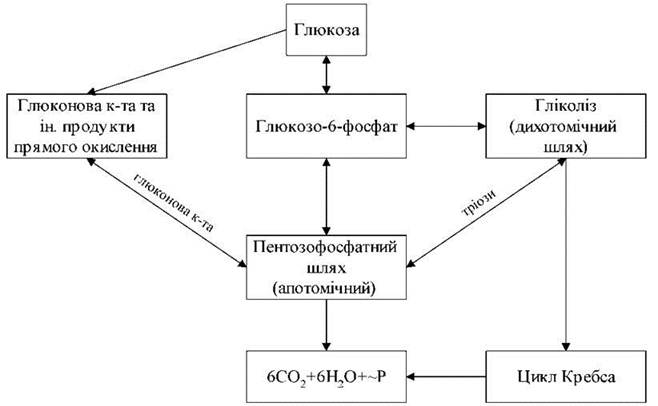
Fig. 15. Interrelationship of various glucose dissimilation pathways.
Direct oxidation of sugars
A pathway for the direct oxidation of glucose without prior phosphorylation has been identified in Bacteria, Fungi, animals, and Algae.
The oxidation of glucose to gluconic acid is carried out by a specific FAD-dependent oxidase. Through phosphorylation and a series of transformations, gluconic acid breaks down into trioses, which can then enter other cycles (the Krebs cycle, the PPP).
Interrelationship of various glucose dissimilation pathways
Biochemical transformations during respiration—glycolysis, the Krebs cycle, the PPP, and Direct Sugar Oxidation—form a system of interrelated processes. Figure 1 presents a schematic of these interrelationships.
In the cell, glycolysis and the PPP are not spatially separated and share common substrates. Under normal conditions, the PPP accounts for approximately 10–40% of total respiratory metabolism, depending on the tissue type and its physiological state.
Under anaerobic conditions, glycolysis dominates, whereas The activity of the apotomic oxidation pathway is higher in chloroplasts. PPP activity also increases under unfavorable conditions. In the cytoplasm, a large portion of PPP products is metabolized via glycolysis.
Last update: 07/08/2026
Editorial and Educational Adaptation: This material has been compiled based on the primary/original source text. The project team performed an editorial review, corrected technical inaccuracies, structured sections, and adapted the content for an educational format.
What was processed:
- elimination of formatting defects (OCR errors, structural breaks, corrupted characters);
- editorial organization of content;
- standardization of terminology in accordance with academic sources;
- verification of factual statements against the original source text.
All mentions of the author, publication year, and origin of the primary text have been preserved in accordance with the source.