PLANT PHYSIOLOGY AND BIOCHEMISTRY
Lecture Notes
5. PHOTOSYNTHESIS
The Cosmic Role of Plants
Photosynthesis is the only process on Earth that occurs on a grand scale, involving The conversion of solar energy into chemical bond energy. This cosmic energy, captured by green plants, forms the foundation for the life processes of all other heterotrophic organisms on Earth, from Bacteria to humans.
There are five key aspects to the cosmic and planetary role of plants.
1. Accumulation of organic mass
During photosynthesis, terrestrial plants produce 100–170 billion tons of biomass annually, while oceanic plants contribute 60–70 billion tons (in terms of dry matter). The total plant mass on Earth is approximately 2,400 billion tons (90% of which is Cellulose). The total mass of animals and microorganisms is 23 billion tons, which accounts for roughly 1% of the total plant biomass.
Throughout Earth's history, organic remains have accumulated and undergone modification. On land, these are found in the form of litter, humus, and peat, which, under specific conditions within the lithosphere, have formed coal.
In the oceans, organic remains became part of sedimentary rocks. As these remains were buried in deeper layers of the lithosphere, they were transformed into natural gas and petroleum.
The mass of organic matter in litter, peat, and humus is estimated at 190, 220, and 2,500 billion tons, respectively; oil and gas at 10,000–12,000 billion tons; and sedimentary rocks at 20,000,000 billion tons.
Particularly intense accumulation of dead organic matter occurred 300 million years ago during the Paleozoic era.
2. Maintaining stable atmospheric CO2 levels
The large-scale formation of rocks has removed significant amounts of CO2 from the carbon cycle. Atmospheric CO2 levels have steadily declined and now stand at only 0.03% (711 billion tons). During the Cenozoic era, the concentration of carbon dioxide in the atmosphere stabilized, with only seasonal fluctuations observed.
This stabilization is facilitated by the balanced global uptake (via photosynthesis) and release of CO2. The annual input of CO2 into the atmosphere is attributed to: Plant Respiration - 10; microbial Respiration and Fermentation - 25; animal and human respiration - 1.6; industrial activity - 5; and geochemical processes - 0.1 billion tons (totaling approximately 41.7 billion tons).
The World Ocean serves as a massive reservoir for carbon dioxide, containing 60 times more CO2 than the atmosphere.
Thus, photosynthesis, along with organismal respiration and the ocean's carbonate system, maintains a relatively stable level of CO2 in the air.
In recent years, an annual increase of 0.23% in atmospheric CO2 content has been observed.
3. The Greenhouse Effect
Carbon dioxide and Water vapor absorb infrared solar radiation, thereby retaining a significant amount of heat on Earth (the greenhouse effect). As mentioned above, living organisms contribute 85% of the CO2 released into the atmosphere annually.
The trend toward rising CO2 levels may lead to an increase in the Earth's average surface Temperature, which is likely to have a negative impact on the environment. However, it is quite possible that this will lead to an intensification of photosynthesis, which would help eliminate the excess CO2. In this way, plants mitigate the undesirable consequences of the greenhouse effect.
4. Accumulation of atmospheric oxygen
Initially, oxygen was present in the atmosphere in trace amounts; today, it accounts for 21%. The appearance and accumulation of O2 in the air are linked to The activity of green plants. They supply 70–120 billion tons of O2 to the atmosphere annually. This oxygen is essential for the respiration of All living organisms.
5. The Ozone Layer
An important outcome of oxygen release by plants is The formation of the ozone layer in the upper atmosphere at an altitude of 25 km.
Ozone (O3) is formed through the photodissociation of O2 molecules under METABOLISM/18.html">The Influence of solar radiation. Ozone absorbs the majority of ultraviolet rays (240–290 nm), which are detrimental to all living organisms.
The depletion of the ozone layer is a critical issue in biosphere conservation.
Class="center">
Fig. 6. The Leaf as an organ of photosynthesis.

Fig. 7. Visible light within the solar radiation spectrum.

Fig. 8. Absorption spectra of plastid pigments.
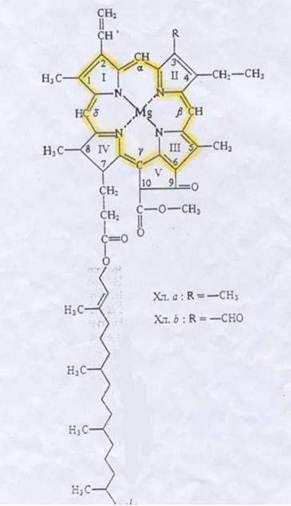
Fig. 9. Structural formula of chlorophyll a.
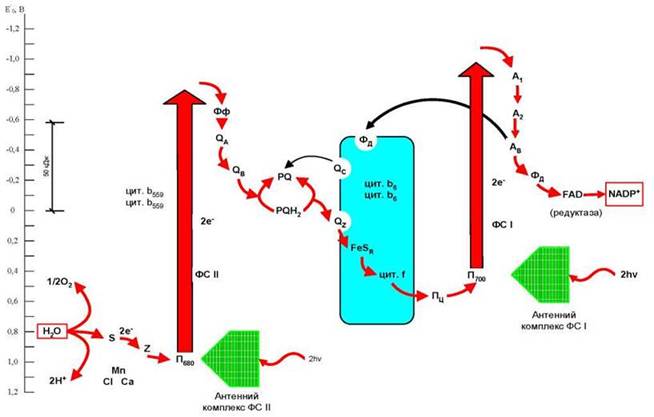
Fig. 10. The chloroplast Electron Transport Chain.
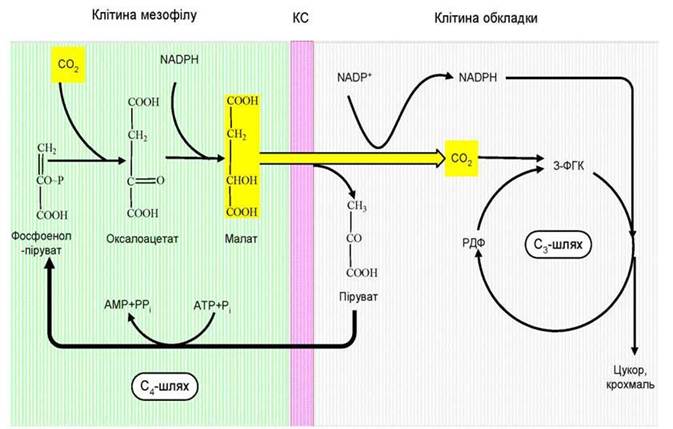
Fig. 11. The C4 photosynthetic pathway.
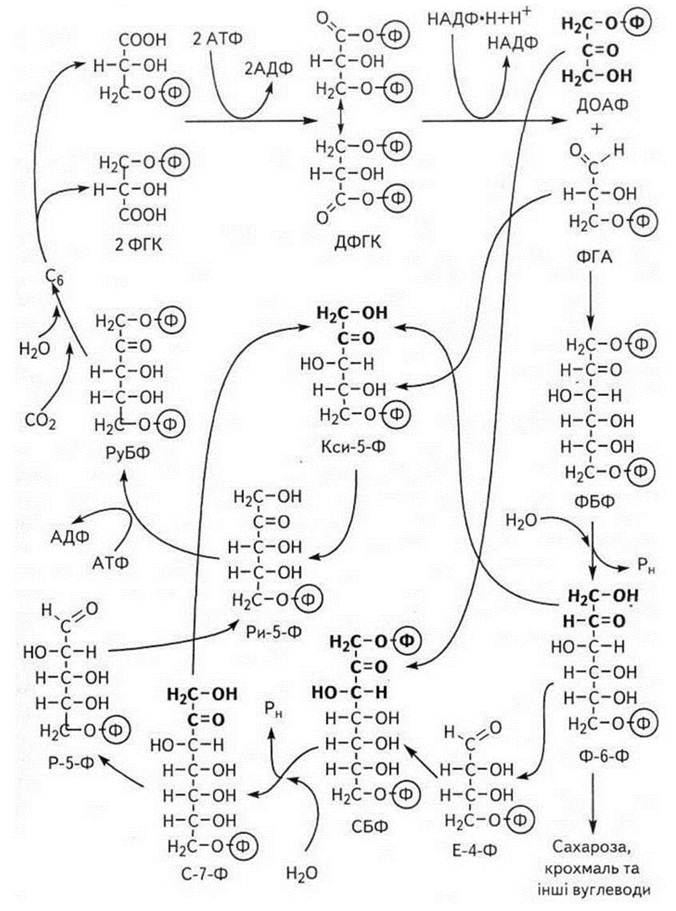
Fig. 12. The reductive pentose phosphate cycle of carbon in photosynthesis (Calvin cycle).

Fig. 13. Crassulacean Acid Metabolism (CAM).

Fig. 14. Photorespiration: interaction between three Organelles — Chloroplasts, Cell/35.html">Mitochondria, and Peroxisomes.
Last update: 07/08/2026
Editorial and Educational Adaptation: This material has been compiled based on the primary/original source text. The project team performed an editorial review, corrected technical inaccuracies, structured sections, and adapted the content for an educational format.
What was processed:
- elimination of formatting defects (OCR errors, structural breaks, corrupted characters);
- editorial organization of content;
- standardization of terminology in accordance with academic sources;
- verification of factual statements against the original source text.
All mentions of the author, publication year, and origin of the primary text have been preserved in accordance with the source.