Biochemistry - The Chemical Reactions of Living Cells, Volume 2 - D. Metzler 1980
Biosynthesis; how new molecules are formed
Biosynthesis of monomers
Glyoxylate cycle
Recall that the reductive carboxylation of acetyl-CoA to Pyruvate [equation (11-14)] occurs only in a few species of Bacteria. In contrast, the vast majority of organisms, ranging from bacteria to animals, feature the irreversible Oxidative Decarboxylation of pyruvate to acetyl-CoA, which has many significant consequences. For example, CARBOHYDRATES are readily converted into fat, and because this process is irreversible, excess calorie intake leads to fat accumulation. However, fat cannot serve as a Starting Material for The formation of most biosynthetic intermediates required for carbohydrate and Protein Synthesis, since these intermediates are derived primarily from C3 units.
Class="center">
FIG. 11-5. The "Serine pathway" for the assimilation of single-carbon compounds containing one carbon atom.
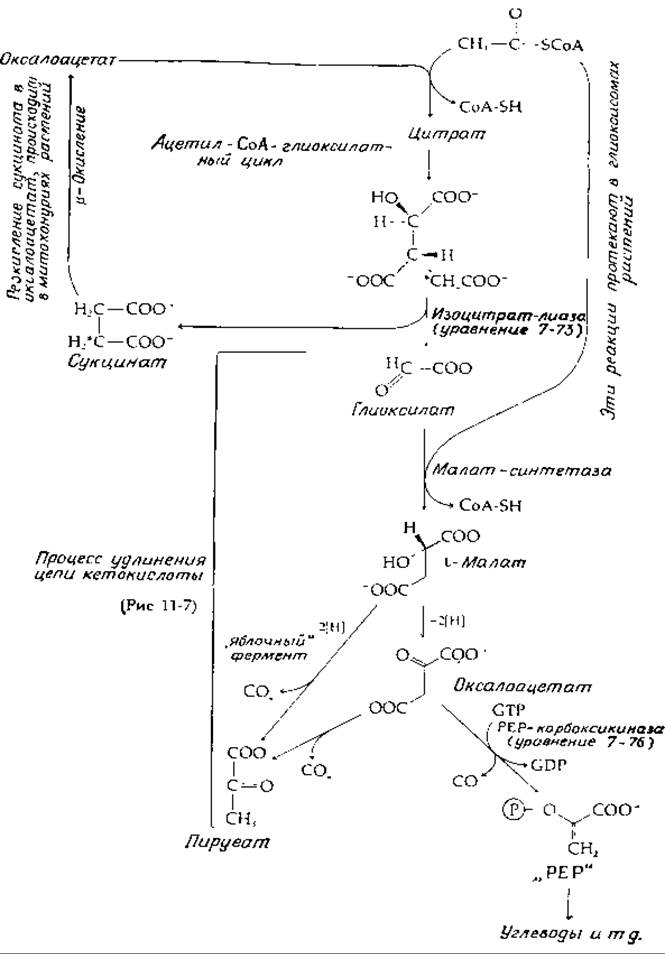
FIG. 11-6. The glyoxylate pathway. Asterisks indicate The pathway of labeled carbon from acetate.
This limitation on The conversion of C2 acetyl units into C3 metabolites is overcome in many organisms, including E. coli in particular, through the glyoxylate pathway. This sequence of reactions converts two acetyl units into a single C3 unit with the decarboxylation of the fourth carbon atom. This pathway enables many organisms (including E. coli and Tetrahymena) to survive on acetate as their sole or primary carbon source. The glyoxylate pathway is of particular importance in plants whose seeds store large amounts of fat (oilseeds). Thanks to the glyoxylate pathway, the fat in germinating seeds can be readily converted into sugar, Cellulose, and other carbohydrates necessary for plant growth.
The first part of the glyoxylate pathway can be viewed as a modified Tricarboxylic Acid Cycle designed to oxidize acetate to glyoxylate (Fig. 11-6, top left). This acetyl-CoA-Glyoxylate Cycle also serves to supply glyoxylate to the serine cycle shown in Fig. 11-5. The regenerating substrate of the acetyl-CoA-glyoxylate cycle is oxaloacetate, which acts as an efficient oxidant in converting the methyl group of acetyl-CoA into an aldehyde group. This four-electron oxidation proceeds via a mechanism involving the dehydration and subsequent rehydration by aconitase. Isocitrate is cleaved by isocitrate lyase [equation (7-73)] to yield glyoxylate. The other product, succinate, is reoxidized to regenerate oxaloacetate through a four-electron ß-Oxidation process that completes the cycle.
An independent pathway for the Synthesis of the regenerating substrate involves the malate synthase-catalyzed Condensation of glyoxylate with acetyl-CoA (Fig. 7-11), yielding malate, which is then oxidized to oxaloacetate (Fig. 11-6). This same sequence completes the glyoxylate pathway by supplying oxaloacetate for the synthesis of carbohydrates and other substances.
The glyoxylate pathway is often considered part of The Tricarboxylic Acid Cycle. The scheme presented in Fig. 11-6 provides a clear representation of its stoichiometry. In bacteria, the glyoxylate pathway does not appear to be spatially separated from the tricarboxylic acid cycle0. In certain plants, however, some of the Enzymes required for the glyoxylate pathway are localized in glyoxysomes, while the remainder are found in Cell/35.html">Mitochondria (Fig. 11-6).
Malate and oxaloacetate, Intermediates of the glyoxylate pathway, can be converted into pyruvate and phosphoenolpyruvate (PEP), as shown in Fig. 11-6. Pyruvate is required for the synthesis of compounds in the pyruvate family, whereas phosphoenolpyruvate can be converted into all other intermediates of biosynthetic pathways (Fig. 11-1).
An interesting Modification of the glyoxylate pathway has been discovered in Micrococcus denitrificans [16]. First, one molecule of glyoxylate undergoes Transamination to yield Glycine [equation (11-7)], after which this glycine condenses with a second molecule of glyoxylate in a PLP-dependent reaction to form ß-hydroxyaspartate; the elimination of an ammonia molecule and the tautomerization of the resulting enol yield oxaloacetate [equation (11-17)].
Last update: 06/08/2026
Editorial and Educational Adaptation: This material has been compiled based on the primary/original source text. The project team performed an editorial review, corrected technical inaccuracies, structured sections, and adapted the content for an educational format.
What was processed:
- elimination of formatting defects (OCR errors, structural breaks, corrupted characters);
- editorial organization of content;
- standardization of terminology in accordance with academic sources;
- verification of factual statements against the original source text.
All mentions of the author, publication year, and origin of the primary text have been preserved in accordance with the source.