Biochemistry - The Chemical Reactions of Living Cells, Volume 2 - D. Metzler 1980
Biosynthesis; how new molecules are formed
Biosynthesis of monomers
Biosynthesis from formate, formaldehyde, and methanol
Bacteria that utilize one-carbon compounds are capable of oxidizing them to CO2 to generate energy, employing formate dehydrogenase at The final stage (Chapter 9, Section B, 3). They also possess The ability to use CO2 as a Starting Material for biosynthetic purposes via The Calvin Cycle. However, it has been demonstrated that other pathways of one-carbon assimilation are characteristic of certain species. For example, pseudomonads studied by Quayle and co-workers [15] convert one-carbon compounds into acetate (via intermediates associated with tetrahydrofolic acid) and CO2 through the "Serine pathway" shown in Fig. 11-5. This is a cyclic process in which one molecule of formaldehyde (attached to H4Fol) plus one molecule of CO2 are converted into acetate. The regenerating substrate is glyoxylate 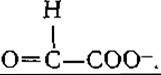 Prior to Condensation with "active formaldehyde" from methylene-H4Fol (Fig. 11-5), glyoxylate undergoes Transamination to be converted into Glycine. Glycine and formaldehyde combine to form serine, which is subsequently transaminated to hydroxypyruvate. It should be noted that glyoxylate and formaldehyde could potentially couple via a thiamine-dependent α-condensation; however, the two coupled transamination steps allow (as is the case in the γ-Aminobutyrate Shunt) The Use of a Pyridoxal phosphate-dependent reaction leading to The formation of a C—C bond.
The potential for reducing hydroxypyruvate to phosphoenolpyruvate (Fig. 11-5) depends on the availability of ATP; much like in Glycolysis (Fig. 9-7), this reaction can be accomplished via reduction to 3-phosphoglycerate followed by isomerization to 2-phosphoglycerate and elimination, yielding PEP.
The conversion of malate into acetate and glyoxylate via malyl-CoA (Chapter 7, Section K, 2, c) results in the formation of acetate as a reaction product and is accompanied by the regeneration of glyoxylate. As in other metabolic cycles, various intermediates, such as PEP, can be withdrawn and channeled into other biosynthetic pathways. Nevertheless, it is essential to have an independent route for synthesizing the regenerating substrate. Such a pathway is its formation from acetate (as illustrated in Fig. 11-5), which utilizes the cyclic process discussed in the previous section.
Last update: 06/08/2026
Editorial and Educational Adaptation: This material has been compiled based on the primary/original source text. The project team performed an editorial review, corrected technical inaccuracies, structured sections, and adapted the content for an educational format.
What was processed:
- elimination of formatting defects (OCR errors, structural breaks, corrupted characters);
- editorial organization of content;
- standardization of terminology in accordance with academic sources;
- verification of factual statements against the original source text.
All mentions of the author, publication year, and origin of the primary text have been preserved in accordance with the source.