Biochemistry: The Chemical Reactions of Living Cells, Volume 2 - D. Metzler 1980
Biosynthesis: How New Molecules Are Formed
Biosynthesis of Monomers
Starting from CO2
Cells containing the necessary Enzymes and the required ratio of reduced to oxidized ferredoxin can utilize reaction (11-14) to incorporate CO2 into Pyruvate. Succinyl-CoA can interact with CO2 in a similar manner to yield a-ketoglutarate (Chap. 8, Sec. K, 3). This renders reversible the single irreversible step in The Tricarboxylic Acid Cycle. Utilizing these reactions, photosynthetic Bacteria and certain anaerobic organisms carry out the reductive tricarboxylic acid cycle. Together with reaction (11-14), this cycle ensures the complete conversion of CO2 into pyruvate.
From a quantitative standpoint, a significantly more important pathway ensuring CO2 fixation is the reductive Pentose Phosphate Pathway, known as The Calvin Cycle (Supplement 11-A). This sequence of reactions takes place in the METABOLISM/14.html">Chloroplasts of green plants as well as in chemoautotrophic bacteria. The Calvin cycle is essentially the Reversal of the oxidative pentose phosphate cycle (Fig. 9-8), during which Complete oxidation of glucose occurs with the aid of NADP+ (utilizing one ATP molecule required to convert the initial glucose molecule into glucose-6-phosphate):
Class="center">
Due to the large positive Free energy change for green plants, the fixation of CO2 via interaction with photochemically generated NADPH, precisely along the pathway reverse to sequence (11-15), appears nearly impossible. To bypass this thermodynamic difficulty, the reductive pentose phosphate pathway was somewhat modified, resulting in synthesis coupled with the Cleavage of an additional amount of ATP.
In Fig. 11-4, the reductive carboxylation system is outlined by a dashed line. The initial compound in this system is ribose-5-phosphate, which in the first step is phosphorylated to ribulose-1,5-diphosphate, consuming one ATP molecule in the process. The resulting ribulose-1,5-diphosphate is subsequently carboxylated and cleaved into two molecules of 3-phosphoglycerate (this reaction was discussed in Chap. 7, Sec. K, 3, J). The reduction step (step b) of the system is driven by the combined use of NADPH and ATP. Aside from the fact that the NADP system is used here instead of the NAD system, this step represents the exact reversal of one of the Glycolysis steps catalyzed by phosphoglyceraldehyde dehydrogenase (Chap. 8, Sec. 3, 5). A careful examination of the first three steps of the process shown in Fig. 11-4 reveals that during the reductive pentose phosphate pathway, three ATP molecules are consumed for each incorporated CO2 molecule. At the same time, the oxidative direction of this process is not accompanied by the generation of ATP. Thus, the distinction between catabolic and biosynthetic pathways once again necessitates coupling the process with ATP Hydrolysis in order to make an irreversible sequence of reactions reversible.
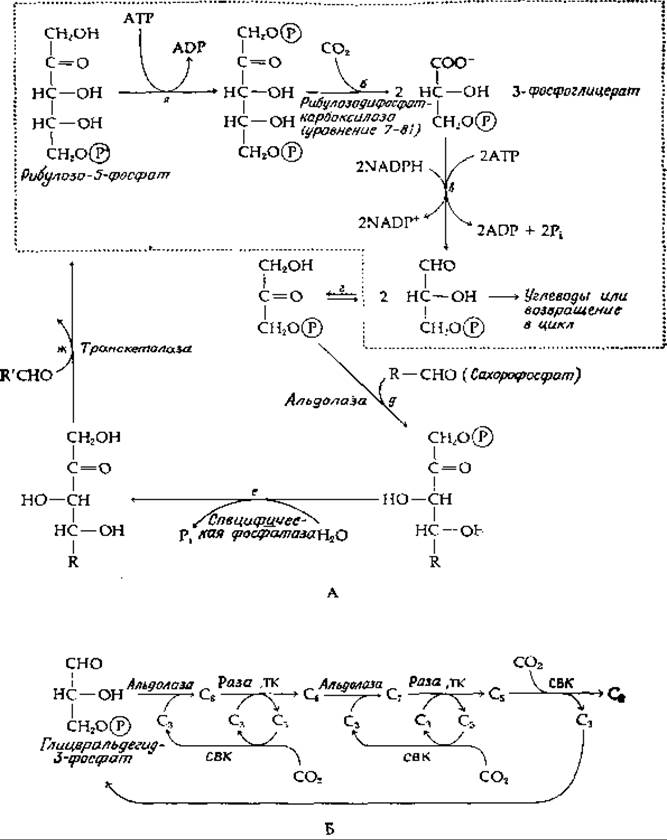
FIG. 11-4. A. Reductive carboxylation system used in the reductive pentose phosphate metabolic pathway. First, the reactions essential to this system are shown (outlined by a dashed line), followed by typical subsequent reactions. The phosphorylation–dephosphorylation cycle is completed by the action of a phosphatase. B. The reductive pentose phosphate cycle is depicted in a way that clearly illustrates how three CO2 molecules are fixed to yield one triose phosphate molecule. RCS — reductive carboxylation system.
The reactions outlined by the dashed line in Fig. 11-4 do not provide a complete picture of the coupling mechanism. At step a, a phosphate group is transferred from ATP and must be removed at one of the subsequent steps to complete hydrolysis. This is shown in general terms in Fig. 11-4 (at steps d, e, and f). Step f involves the action of specific Phosphatases that cleave phosphate groups from the seven-carbon sedoheptulose diphosphate and fructose diphosphate. In both cases, the resulting ketose monophosphate reacts with an aldose (via transketolase, step g), regenerating ribulose-5-phosphate, the CO2 acceptor. The overall reductive pentose phosphate pathway (Fig. 11.4, B) can be easily visualized as a process proceeding in the direction opposite to the oxidative pentose phosphate pathway, in which The oxidative decarboxylation system [Equation (9-15)] is replaced by the reductive carboxylation system shown in Fig. 11-4, A. The diagram in Fig. 11-4, B illustrates the incorporation of three CO2 molecules. The reductive carboxylation system (designated as "RCS" in the figure) Functions three times accordingly, ultimately yielding one triose phosphate molecule. In this cycle, as in other biosynthetic cycles (p. 323), any amount of any intermediate metabolite can be withdrawn and incorporated into various other metabolic pathways without interrupting the flow of substances through the cycle.
The overall reaction of CO2 reduction in the Calvin cycle can be described by the equation

The free energy measurement ∆G' (pH 7) is —378 kJ∙mol-1 instead of +278 kJ∙mol-1 required to reverse reaction (11-16).
Supplement 11-A
14C and the Calvin cycle
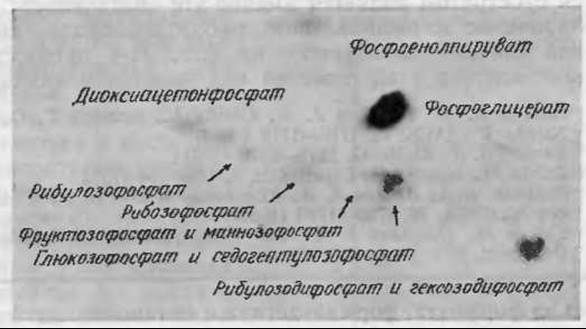
Chromatogram of an extract of the alga Scenedesmus obtained after Photosynthesis in the presence of 14CO2 for 10 s.
The Chemical Nature of photosynthesis has intrigued chemists for centuries, yet little was known about the details of this process until the radioactive isotope 14C became available. This isotope was discovered in 1940 by S. Ruben and M. Kamen, but it was not produced in sufficient quantities until 1945 as a nuclear Reactor product. That same year, M. Calvin and his coworkers initiated their research, which led to the elucidation of the mechanism by which CO2 is incorporated into Organic compounds; for this research, Calvin was awarded the Nobel Prize in 1961.
A key role in this research was played by the combination of two-dimensional paper Chromatography and radioautography Methods (Supplement 2-B). A suspension of the alga Chlorella (Fig. 1-9) carried out photosynthesis in a stream of regular CO2 in the light. After a certain period, an amount of H214CO3 was introduced into the system, and a few seconds later—during which photosynthesis proceeded with 14C—the algal suspension was transferred into methanol, which denatured Proteins and halted the reaction. Soluble substances extracted from the algal cells were concentrated and subjected to chromatographic Separation, after which radioautograms were taken from the chromatograms. It was found that when photosynthesis in the presence of 14CO2 lasted for more than 10 s, the Algae contained a dozen or even more compounds labeled with the 14C isotope, specifically malonic acid, aspartic acid, PEP, Alanine, triose phosphate, and other sugar monophosphates and diphosphates. However, if photosynthesis lasted for less than five seconds, the majority of radioactivity was detected in only a single compound: 3-phosphoglyceratea. This discovery suggested that phosphoglycerate represents the product of carboxylation—via 14CO2—of some regenerating two-carbon substrate occurring at an early stage of photosynthesis. The search for this two-carbon compound was unsuccessful for a long time, but A. Benson, a member of Calvin's laboratory, succeeded in identifying ribulose diphosphateb and proving through kinetic studies that this very compound is the regenerating substratec-d. The carboxylation and cleavagee of ribulose diphosphate constituted The First stage of the process shown in Fig. 11-4, which subsequently became known as the Calvin cycle.
a Benson A. A., Bassham J. A., Calvin M., Goodale T. C., Haas V. A., Stepka W., JACS, 72, 1710—1718 (1950).
b Benson A. A., JACS, 73, 2971—2972 (1951)
c Calvin M., Massini P., Experientia, 8, 445—484 (1952)
d Bassham J. A., Benson A. A., Kay L. D., Harris A. Z., Wilson A. T., Calvin M., JACS, 76, 1760—1770 (1954).
e Calvin M., Bassham J. A., The Photosynthesis of Carbon Compounds, Benjamin, New York, 1962.
Last update: 06/08/2026
Editorial and Educational Adaptation: This material has been compiled based on the primary/original source text. The project team performed an editorial review, corrected technical inaccuracies, structured sections, and adapted the content for an educational format.
What was processed:
- elimination of formatting defects (OCR errors, structural breaks, corrupted characters);
- editorial organization of content;
- standardization of terminology in accordance with academic sources;
- verification of factual statements against the original source text.
All mentions of the author, publication year, and origin of the primary text have been preserved in accordance with the source.