Biochemistry - The Chemical Reactions of Living Cells, Volume 2 - D. Metzler 1980
Biosynthesis: how new molecules are formed
Biosynthesis of monomers
The role of carbonyl groups in chain formation and cleavage
Let us consider the general problem of the Biosynthesis of monomers that make up Biopolymers.
With the exception of certain reactions proceeding in the presence of Vitamin B12, carbon-carbon bonds are rarely cleaved without the participation of carbonyl groups, which implies that carbonyl groups play a central role in biosynthetic mechanisms. The $\beta$-Condensation that occurs during biosynthesis is enabled by the activation of hydrogen atoms located at the $\beta$-position relative to the carbonyl groups. The condensation of carbonyl-containing compounds with Thiamine diphosphate facilitates $\beta$-condensation reactions. Aldol condensations require the involvement of two carbonyl compounds.
The important role of carbonyl groups in condensation reaction mechanisms indicates that The formation of both linear and branched carbon chains occurs through interactions of compounds in which the average oxidation state of carbon atoms is similar to that in CARBOHYDRATES (or in formaldehyde H2CO). The Diversity of Chemical Reactions in which compounds at this oxidation state can participate is maximized, which explains why carbohydrates and closely related compounds constitute the majority of biosynthetic precursors, and why the average oxidation state of carbon in most compounds found in living organisms is close to that of carbon atoms in carbohydrates [14].
Figure 11-3 shows several biologically active compounds arranged in order of increasing carbon oxidation state. It can be seen that the oxidation state of most biologically important intermediates differs from that of carbohydrates by only $\pm$2 electrons, with this difference even tending to decrease as the chain lengthens. It is exceptionally difficult to transition via enzymatic processes between compounds containing 2, 3, and 4 carbon atoms (i.e., vertically in Fig. 11-3) unless they are at the oxidation level of carbohydrates or of compounds positioned to the right at a slightly higher oxidation level. At the same time, it is often possible to move horizontally by readily utilizing redox reactions. For example, Fatty acids are "assembled" from acetate units, which reside at the same oxidation level as carbohydrates, and are subsequently reduced after assembly.
Figure 11-3 also shows that among compounds characterized by the same overall oxidation state, such as acetic acid and sugars, the oxidation state of individual carbon atoms can vary substantially. In a sugar, for example, each carbon atom can be viewed as derived directly from formaldehyde; however, in acetic acid, one end is oxidized to a carbonyl group while the other is reduced to a methyl group. Such internal redox reactions (Chapter 7, Section II, 6) play a vital role in the chemical manipulations required to "assemble" the carbon skeletons needed by The Cell. Students are encouraged to arrange Other Compounds in the same manner as in Fig. 11-3 and observe how the overall oxidation state of a compound changes as it proceeds along a metabolic pathway.
As noted above, the loss of carboxyl groups as CO2 (decarboxylation) is characteristic of many biosynthetic reactions. Returning once again to Fig. 11-3, It is interesting to note that many biosynthetic intermediates—such as Pyruvate, $\alpha$-ketoglutarate, or oxaloacetate—exhibit a higher oxidation state than carbohydrates. However, their decarboxylation products, which are incorporated into the synthesized molecules, shift closer to carbohydrates in their oxidation state.
1) This fact is consistent with the hypothesis that formaldehyde was a major component of the Earth's primordial atmosphere, as well as with the ability of formaldehyde to form carbohydrates via spontaneous condensation.
Class="center">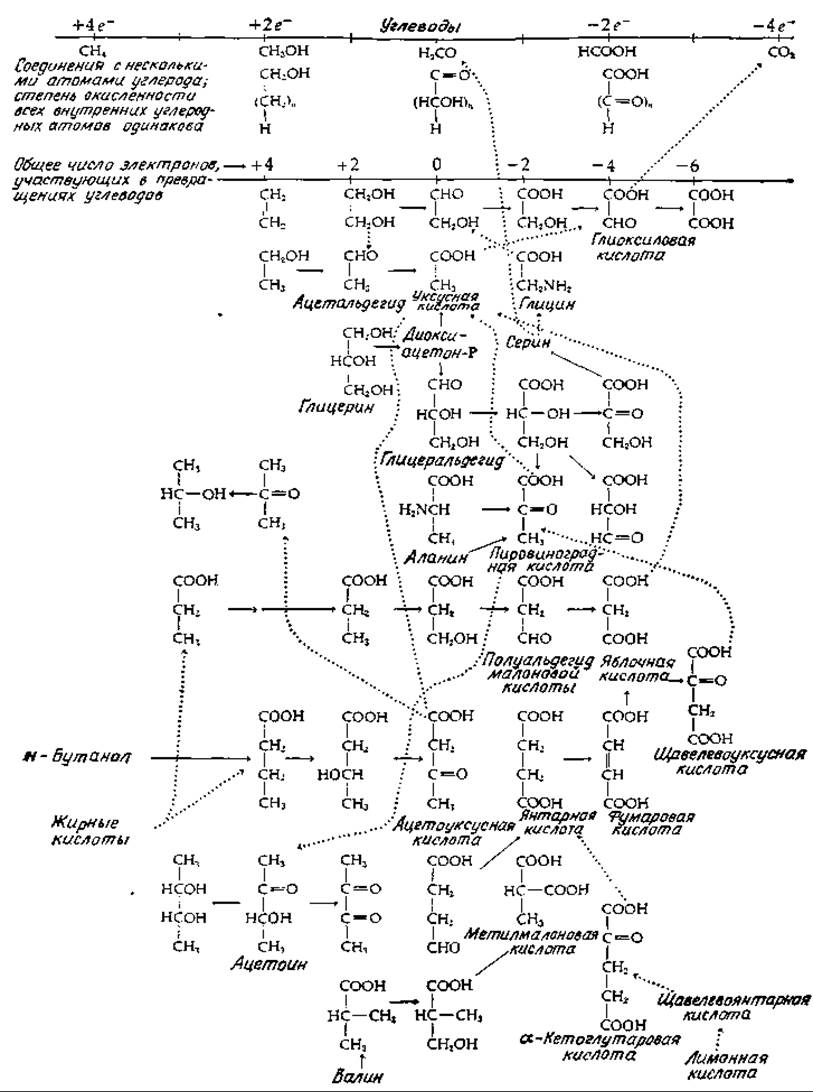
FIG. 11-3. Various biologically active compounds arranged According to the variation in the average oxidation state of their constituent carbon atoms.
In the following sections, we will examine the specific biosynthetic pathways of 3-phosphoglycerate—a three-carbon compound from which all other metabolites can be synthesized.
Last update: 06/08/2026
Editorial and Educational Adaptation: This material has been compiled based on the primary/original source text. The project team performed an editorial review, corrected technical inaccuracies, structured sections, and adapted the content for an educational format.
What was processed:
- elimination of formatting defects (OCR errors, structural breaks, corrupted characters);
- editorial organization of content;
- standardization of terminology in accordance with academic sources;
- verification of factual statements against the original source text.
All mentions of the author, publication year, and origin of the primary text have been preserved in accordance with the source.