PLANT PHYSIOLOGY AND BIOCHEMISTRY
Lecture Notes
6. PLANT RESPIRATION
The Respiratory Electron Transport Chain (ETC)
The Krebs cycle, The Glyoxylate cycle, and the Pentose Phosphate Pathway function only under conditions of sufficient oxygen availability. However, O2 does not participate directly in the reactions of these cycles. Oxygen is essential for The final stage of Respiration, which involves the Oxidation of reduced Coenzymes NADH and FADH2 within the Mitochondrial Electron Transport chain (ETC). The synthesis of ATP is coupled with The transfer of e- along the ETC.
Mitochondrial Electron Transport Chain (ETC)
B. Chance et al., (USA), 1950s.
The ETC is localized on The inner mitochondrial membrane. It serves to transfer e- from reduced substrates to oxygen, a process accompanied by the Transmembrane Translocation of H+ ions. Thus, the ETC (similar to that of thylakoids) Functions as a redox pump.
The Components of the ETC can be arranged in the following order:
Class="center">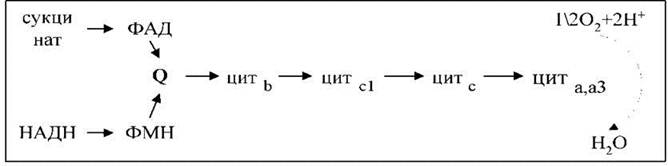
A pair of e- from NADH or succinate is transferred along The electron transport chain to oxygen, which is reduced to form Water.
According to current data, the ETC consists of four multi-enzyme complexes and two low-molecular-weight components: ubiquinone and cytochrome c.
Complex I facilitates The transport of e- from NADH to ubiquinone Q. The complex includes a flavin-dependent (FMN-dependent) NADH:ubiquinone oxidoreductase containing 3 iron-sulfur centers (FeSN 1-3). In an artificial phospholipid membrane, this complex functions as a proton pump.
Complex II catalyzes The oxidation of succinate by ubiquinone. This function is performed by a flavin-dependent (FAD-dependent) succinate:ubiquinone oxidoreductase, which also contains three iron-sulfur centers (FeSS 1-3).
Complex III transfers e- from reduced ubiquinone to cytochrome c, functioning as a ubiquinol:cytochrome c oxidoreductase. It contains Cytochromes b556 and b560, cytochrome c1, and the Rieske iron-sulfur protein. In the presence of ubiquinone, Complex III performs active transmembrane H+ transport.
In the terminal Complex IV, e- are transported from cytochrome c to oxygen; thus, this complex is a cytochrome c:oxygen oxidoreductase (cytochrome oxidase). It consists of four redox components: cytochromes a1, a3, and two copper atoms - CuA and CuB. Cytochrome a3 and CuB are capable of interacting with oxygen, to which e- are transferred from the cytochrome a-CuA complex. Electron transport through the fourth complex is coupled with The Active Transport of H+ ions. The function of the cytochrome a3-CuB center is inhibited by cyanide, azide, and CO.
It has been proven that complexes I, III, and IV span the membrane. On the inner surface of the membrane facing the matrix, 2 e- and 2H+ from NADH are delivered to the FMN of Complex I. Electrons are transferred to FeS centers and then to ubiquinone, which also accepts 2H+ to form semiquinone (2QH) and diffuses to Complex III. Here, the semiquinone receives another pair of e- from cyt b560, enabling the uptake of 2 additional H+ from the matrix to form 2QH2. Fully reduced ubiquinone (ubiquinol) donates 2e- to cytochrome b556 and another 2e- to the FeSR-cyt c1 complex. As a result, 4H+ are released into the mitochondrial intermembrane space.
Oxidized ubiquinone molecules diffuse back to Complex I, ready to accept e- and H+ from it (or from Complex II). Thus, cytochromes b serve as Donors of two e- for the transfer of two additional H+ across the lipid phase of the membrane. Water-soluble cyt c on the outer surface of the membrane, having received 2e- from FeSR-cyt c1, transfers them to the cyt a-CuA of the terminal complex (Complex IV). Cyt a3-CuB, by binding oxygen, transfers these 2e- to it, resulting in The formation of water with the participation of two H+ from the matrix.
Thus, from the mitochondrial matrix, during the transport of each pair of e- from NADH to 1\2 O2, at least 6H+ are transported across the membrane into the intermembrane space at three sites of the ETC.
The transfer of 2 e- from succinate to ubiquinone in Complex II is not accompanied by transmembrane proton transport.
A distinction between PLANT AND ANIMAL Cell/35.html">Mitochondria is the ability of plant mitochondria to oxidize exogenous NADH. They contain specialized flavin NADH dehydrogenases localized on the outer surfaces of both membranes. A second distinction is that the inner membrane, In addition to the main (cytochrome) electron transfer pathway, possesses an alternative pathway that is resistant to cyanide.
The transfer of e- from NADH to molecular oxygen via the mitochondrial ETC is accompanied by the release of Free energy. This process results in ATP synthesis. This was established through the work of V. Engelhardt, V. Belitser (USSR), and H. Kalckar (USA). The process of ADP phosphorylation to form ATP, coupled with e- transfer along the mitochondrial ETC, is known as oxidative phosphorylation.
It has been experimentally proven that the transfer of e- from NADH to oxygen is accompanied by the formation of at least three molecules of ATP, meaning the phosphorylation coefficient P/O=3. The same value for the phosphorylation coefficient is derived from the free energy gradients between different groups of carriers.
Regarding the Mechanism of Oxidative phosphorylation, there are three existing theories:
- chemical (via proteinaceous intermediates capable of forming complexes with high-energy bonds);
- mechano-chemical (conformational) - via Conformational Changes in the Actomyosin component (the enzyme stores E and contracts, followed by relaxation, during which E is released for ATP synthesis)

- the chemiosmotic theory, proposed by the British biochemist P. Mitchell (1961), is the most widely accepted.
Chemiosmotic Theory
The flow of e- through a system of carrier molecules is coupled with the transport of H+ ions across the inner mitochondrial membrane. This generates an electrochemical gradient of H+ ions across the membrane, which comprises both osmotic (chemical) and electrical components (Membrane Potential). This transmembrane Electrochemical Potential of H+ ions serves as the energy source for ATP synthesis through the reverse transport of H+ ions via the proton channel of the membrane-bound H+-ATPase.
Mitchell's theory posits that carriers are arranged within the membrane in an alternating fashion, such that e- and H+ can be transported in one direction, while only e- are transported in the reverse direction. As a result, H+ ions accumulate on one side of the inner membrane. The stored E is then utilized for ATP synthesis as the membrane discharges during the reverse transport of protons (down their concentration gradient) through the ATPase, which functions in this context as ATP synthase.
The coupling of proton diffusion with ATP synthesis is mediated by an ATPase complex known as the coupling factor F1.
F1 is a water-soluble protein composed of nine subunits of five different types. The F1 protein acts as an ATPase and is linked to the membrane via another protein complex, F0, which spans the membrane. F0 lacks catalytic activity and serves as a channel for the transport of H+ ions across the membrane to F1.
In recent years, Mitchell's chemiosmotic hypothesis has received substantial experimental support.
Diversity of e- and H+ transport pathways
The final stage of many oxidation processes involves the transfer of e- to oxygen, catalyzed by terminal oxidases. Such oxidase systems are localized in mitochondria, the ER, the Plasmalemma, and the Cytoplasm.
The primary redox System of the cell is the Respiratory Chain of the inner mitochondrial membrane. Its terminal oxidases are cytochrome oxidase and alternative oxidase.
Three redox systems function in the cytoplasm. One oxidizes/reduces NAD(P)H, Glutathione, and ascorbic acid ⇒ terminal oxidase → ascorbate oxidase; the second oxidizes NADH and polyphenols into Quinones ⇒ terminal enzyme → polyphenol oxidase.
The cytoplasm also contains flavoprotein oxidases, which oxidize various substrates.
Two redox chains are localized in the ER membranes. In one, the oxidation of NADH involving Flavoproteins and cytochrome b5 triggers an oxygenase reaction linked to hydroxylation, leading to the Formation of Unsaturated bonds in Fatty acids. In the second, NADPH serves as the substrate, and the chain is terminated by cytochrome P-450, which utilizes oxygen to hydroxylate A wide variety of compounds.
Terminal oxidases possess distinct characteristics and respond differently to changes in cellular conditions.
Respiratory substrates and the respiratory quotient
Plants primarily use CARBOHYDRATES, specifically free sugars, as their main respiratory substrate. When these are in short supply, reserve polymeric substances can serve as substrates for oxidation.
Reserve carbohydrates include starch (potatoes, cereals), inulin (dahlias, Jerusalem artichokes), and hemicelluloses. Some plants oxidize polyhydric alcohols: sorbitol (pears), mannitol (broomrape, olives, ash), and organic acids.
Reserve fats are utilized for respiration in seedlings developing from oil-rich seeds. Fat utilization begins with their breakdown by lipase into glycerol and fatty acids (spherosomes). Glycerol is then converted into GAP. Fatty acids are oxidized via the β-oxidation mechanism, which sequentially cleaves two-carbon residues in the form of acetyl-CoA. This process occurs in glyoxysomes. Subsequently, acetyl-CoA enters the glyoxylate cycle, the end product of which, succinate, leaves the glyoxysome and participates in the Krebs cycle within the mitochondria. Here, malate is synthesized, which is converted in the Cytosol to oxaloacetate and then to PEP (phosphoenolpyruvate).
PEP is the precursor for the Synthesis of glucose and fructose.
The process of forming glucose from non-carbohydrate precursors is called Gluconeogenesis. This process involves the interaction of spherosomes, glyoxysomes, mitochondria, Plastids, and cytosolic enzyme systems.
Reserve Proteins are utilized for respiration following Hydrolysis into Amino Acids and subsequent oxidative degradation into acetyl-CoA or keto acids, which are then incorporated into the Krebs cycle.
Energy is released during the oxidation of all substrates:
- hydrolysis of Biopolymers releases 1% of sugar energy;
- Glycolysis provides 20% of sugar energy;
- the Krebs cycle and the ETC → 80% of sugar energy;
- meanwhile, only up to 55% of sugar Energy is stored in ATP.
The ratio of the number of moles of CO2 released during respiration to the number of moles of O2 consumed is called the respiratory quotient (RQ = CO2/O2).
The amount of oxygen required to oxidize a substrate during respiration is inversely proportional to its oxygen content: the lower the amount of O2 in the substrate molecule, the more is consumed for oxidation. For hexoses, RQ = 1; for fatty acids, it is < 1; for organic acids, it is > 1 (≈ 3-4).
The RQ value is determined both by the amount of O2 contained in the substrate and by the oxygen supply to plant Tissues.
Under oxygen deficiency, Fermentation intensifies and the RQ increases. Overall, the RQ value reflects the Specific characteristics of the respiration process in a given tissue or organ under particular environmental conditions.
Last update: 07/08/2026
Editorial and Educational Adaptation: This material has been compiled based on the primary/original source text. The project team performed an editorial review, corrected technical inaccuracies, structured sections, and adapted the content for an educational format.
What was processed:
- elimination of formatting defects (OCR errors, structural breaks, corrupted characters);
- editorial organization of content;
- standardization of terminology in accordance with academic sources;
- verification of factual statements against the original source text.
All mentions of the author, publication year, and origin of the primary text have been preserved in accordance with the source.