Principles of Biochemistry Volume 1 - A. Lehninger 1985
Biomolecules
Cells
The cytoplasm also contains granular bodies
The eukaryotic Cytoplasm also contains granular elements that are not bound by membranes. The principal ones are Ribosomes (Fig. 2-19), some of which float freely in the cytoplasm while others are attached to The Endoplasmic reticulum. Although eukaryotic ribosomes are larger than prokaryotic ones, both share the same core function: the Biosynthesis of Proteins from Amino Acids.
Another type of granular Structure found in the cytoplasm of Eukaryotic Cells is Glycogen granules (Fig. 2-19), which are particularly abundant in Liver cells. Glycogen macromolecules consist of highly branched chains composed of glucose residues. Glycogen granules serve as energy storage reserves, especially within liver and Muscle cells. Certain Eukaryotic cells also contain lipid droplets, which likewise store energy-rich compounds.
Class="center">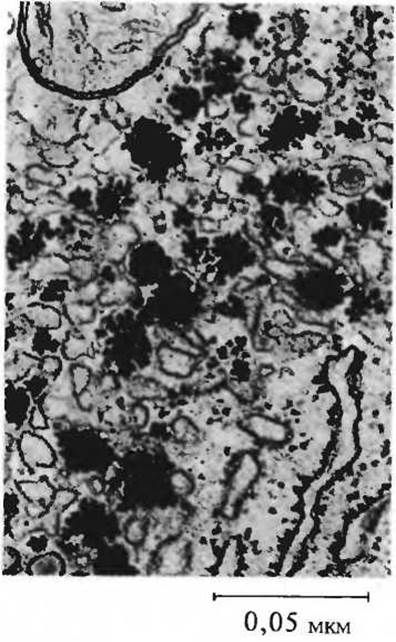
Fig. 2-19. Glycogen granules (heavily stained) in the cytoplasm of a hamster liver Cell.
The granules consist of large clusters formed by glycogen molecules. They are considerably larger than the ribosomes visible On the surface of the endoplasmic reticulum in the lower right corner.
Last update: 06/08/2026
Editorial and Educational Adaptation: This material has been compiled based on the primary/original source text. The project team performed an editorial review, corrected technical inaccuracies, structured sections, and adapted the content for an educational format.
What was processed:
- elimination of formatting defects (OCR errors, structural breaks, corrupted characters);
- editorial organization of content;
- standardization of terminology in accordance with academic sources;
- verification of factual statements against the original source text.
All mentions of the author, publication year, and origin of the primary text have been preserved in accordance with the source.