PLANT PHYSIOLOGY WITH ELEMENTS OF BIOCHEMISTRY - R. M. Prytuliak - 2016
Lecture Notes
TOPIC 5. PLANT RESPIRATION
Outline
1. General Concepts of Plant Respiration and its physiological role.
2. Theories of respiration by A. N. Bach and V. I. Palladin.
3. Enzymatic systems of respiration.
4. Interrelation between Fermentation and respiration processes.
5. Glycolysis as a preparatory stage of aerobic respiration and its energetics.
6. The Tricarboxylic Acid Cycle. Energetics of the Krebs cycle.
7. The Glyoxylate cycle.
8. The Pentose Phosphate Pathway.
10. Respiratory quotient and its dependence on The Nature of the respiratory substrate.
11. Plant respiratory gas exchange as a factor in the production process. Interrelation between Photosynthesis and respiration.
1. General concepts of plant respiration and its physiological role.
In nature, There are two primary processes through which the solar energy stored in organic matter is released: Respiration and Fermentation.
Respiration is the aerobic oxidative breakdown of Organic compounds into simple inorganic substances, accompanied by the release of energy.
Fermentation is an anaerobic process of breaking down organic compounds into simpler ones, which also results in energy release.
Respiration can be defined as The breakdown of metabolites via the glycolytic and/or oxidative Pentose Phosphate Pathways, followed by The oxidation of products in the tricarboxylic acid cycle and The Use of reduced pyridine NUCLEOTIDES to synthesize ATP during oxidative phosphorylation. Respiration is a controlled degradation or oxidation of organic molecules.
In most cases, CARBOHYDRATES serve as the primary source of energy and reducing power for plant metabolic activity. Intermediate compounds formed during oxidation are used as precursors for various synthetic reactions. Electrons removed during the oxidation of organic matter are used to reduce NAD and subsequently enter the Electron Transport Chain, where they are passed through a system of Cytochromes a, b, and c. At each stage, they transition to a lower energy level, eventually combining with oxygen to form Water.
Respiratory substrates in higher plants can also include Proteins, Amino Acids, and Lipids.
The released energy is utilized by the plant for the synthesis of complex organic substances during metabolic processes. Respiration is the driving force for plant growth, various synthetic reactions, the uptake of mineral nutrients, and the Transport of Assimilates. The Significance of respiration lies in the fact that this complex redox process provides the energy and labile compounds essential for the vital activities of the plant Organism. In other words, respiration facilitates the transformation of organic compounds synthesized during photosynthesis and their utilization for building plant biomass.
2. Theories of respiration by A. N. Bach and V. I. Palladin.
In 1845, the Swiss chemist C. F. Schönbein proposed a theory of oxidative processes, suggesting that plant Cells contain compounds capable of being easily oxidized in the presence of O, thereby activating molecular oxygen. However, he mistakenly believed that oxygen activation occurred through The formation of ozone.
Building on the work of A.N. Bach, these studies led to the formulation of The Theory of Biological Oxidation in 1897, known as the Bach peroxide theory. Its core premise is that atmospheric molecular oxygen (O = O) becomes activated upon interaction with unsaturated organic compounds: (— O — O —). This activated oxygen then combines with an oxidizable substance (A) to form a peroxide (AO2). This peroxide subsequently reacts with a second compound (B), oxidizing it by transferring one oxygen atom. This reaction can repeat, allowing the second oxygen atom to oxidize another molecule of substance B. The scheme of this process is as follows:
1. Activation of molecular oxygen:
The initial substance—the oxygen acceptor (A)—is fully reduced, while the substrate (B) is oxidized.
It is now understood that The pathway of oxygen incorporation into organic compounds, as proposed by Bach's peroxide theory, is not directly related to respiration; however, this theory played a pivotal role in the modern understanding of oxygen activation mechanisms. The determination of oxygen's role in substrate oxidation was facilitated by the research of German biochemist O.H. Warburg and English scientist D. Keilin, who in the 1920s established The Link Between oxygen uptake and the function of the cytochrome system.
Alongside the peroxide theory, A.N. Bach also proposed a second hypothesis, suggesting that biological oxidation could occur through the removal of previously activated hydrogen from a substrate. In this case, The Role of oxygen is to regenerate the primary hydrogen acceptor—quinone. The sequence of these reactions is as follows:
This hypothesis postulates the existence of specific compounds within The Cell (Quinones and quinone-like substances) that act as hydrogen carriers for the respiratory substrate. It was further developed in the theory of respiratory chemistry by V.I. Palladin (1912), who suggested the presence of specific respiratory mediators he termed respiratory chromogens. Upon releasing hydrogen, the chromogen is oxidized into a pigment, which can be reduced back to a chromogen by the substrate's hydrogen. According to V.I. Palladin, the respiratory substrate is oxidized with the participation of water, which serves as a hydrogen donor to reduce the respiratory pigment back to chromogen. The hydrogen from the oxidized substrate also participates in the reduction of the pigment. The oxygen from the water is used to oxidize the carbon of the substrate. Thus, carbon dioxide during respiration is produced anaerobically. According to Palladin's theory, the oxygen consumed during respiration is used to oxidize chromogens into pigments. The work of A.L. Kursanov and B.B. Vartapetyan later proved that the consumed oxygen is used to form water.
3. Respiratory enzyme systems.
The oxidative apparatus of plants possesses unique characteristics. Primarily, unlike in animals, it is defined by:
· delocalization of the respiratory apparatus (Mitochondria, Peroxisomes, Cytoplasm, etc.);
· multifunctionality, meaning the presence of catalysts with multiple properties;
· a principle where the organism contains not just one, but several Enzymes that catalyze the same or similar reactions.
As is well known, the biological oxidation of any substance involves the loss of electrons or electrons accompanied by protons. Various types of oxidative reactions occur within The plant cell.
- Reactions Involving the direct loss of an electron resulting from A change in valence. Such reactions are catalyzed by oxidase enzymes, which contain metals in their active sites:
Class="center">Fe2+ → Fe3+ + e
- Reactions involving the removal of hydrogen ions from the oxidized substance by hydroxylase enzymes. In such reactions, oxygen itself often serves as the proton acceptor:
АН2 + В → А + ВН2.
- Direct oxidation by molecular oxygen mediated by oxygenases or transferases:
АН2 + О2 → АО2.
- The formation of intermediate hydrated compounds followed by the removal of two electrons and two protons:
СН3СОН + Н2О → СН3СН(ОН)2 → СН3СООН
In biological systems, all these pathways are interconnected, and the loss of an electron during oxidation is typically accompanied by the loss of hydrogen. This is why the oxidation of a specific substance in living systems is coupled with the reduction of another.
The existence of alternative Mechanisms for the oxidation of organic substances enables plants to maintain the necessary effective level of respiration under adverse conditions.
To determine the direction of electron flow, METABOLISM/2.html">THE CONCEPT OF standard reduction potential (Eo) was introduced. The reduction potential of the following reaction is conventionally set to zero:
Н2 → 2Н+ + 2е-
Oxygen (O2) is a universal oxidant with a maximum positive potential (+0.817 V), while various organic substances serve as electron Donors. All electrons are transported to O2 via a multicomponent redox system, where the oxidation of one substance (the electron and proton donor) is coupled with the reduction of another compound (the electron and proton acceptor). Enzymes that catalyze these reactions are called oxidoreductases. There are three groups of oxidoreductases: anaerobic dehydrogenases, aerobic dehydrogenases, and oxidases.
4. The interrelation between fermentation and respiration processes.
Fermentation is a dissimilation process resulting in the formation of products of incomplete oxidation. Depending on the final product, we distinguish between alcoholic, lactic acid, acetic acid, butyric acid, and other Types of fermentation. Fermentation processes are characteristic primarily of lower heterotrophic organisms (Yeasts, other Fungi, Bacteria). In the Tissues of higher plants, alcoholic and Lactic acid fermentation can also occur in the absence of oxygen. Fermentation products contain a significant amount of energy. Therefore, the energy yield from fermentation is significantly lower than that from aerobic respiration:
С6Н12О6 → 2С2Н5ОН + 2СО2 + 117 kJ.
Such substrate oxidation due to bound oxygen is also referred to as intramolecular respiration. The accumulation of ethyl alcohol in tissues can cause poisoning and plant death. Furthermore, during Anaerobic respiration (fermentation), the plant does not obtain intermediate products that are typically generated during aerobic oxidation.
There is a sufficiently close connection between respiration and fermentation, as evidenced by the commonality of the first anaerobic stage (phase) of glucose transformation.
The First stage of both fermentation and respiration is the glycolytic breakdown of glucose into pyruvic acid (PA). The subsequent stage is aerobic. During respiration, pyruvic acid is broken down to form the final products CO2 and H2O. Under anaerobic conditions, it undergoes incomplete oxidation—fermentation.
The Unity of these processes is also confirmed by the fact that enzymes catalyzing Alcoholic Fermentation have been discovered in plants. Moreover, there are common intermediate products in the aerobic phase of respiration and fermentation, for example: malic, citric, and other organic acids.
5. Glycolysis as a preparatory stage of aerobic respiration and its energetics.
At the beginning of the 19th century, N. Saussure made an important observation: when grown in an oxygen-free atmosphere, green plants release CO2. Further study of this phenomenon allowed L. Pasteur to establish that under anaerobic conditions, plants not only release carbon dioxide but also accumulate alcohol and other products of alcoholic fermentation.
A fundamental role in determining the chemistry of sugar transformation was played by L.A. Ivanov's discovery of The phenomenon of anaerobic breakdown not of the inert glucose molecule, but of its phosphoric ester, which possesses high reactivity. The source of phosphoric acid is ATP. The transfer of the phosphoric acid residue to the glucose molecule is catalyzed by the enzyme hexokinase. Further activation of the hexose occurs through isomerization: glucose-6-phosphate is converted into fructose-6-phosphate. The isomerization process takes place with the participation of phosphohexoisomerase. The next stage is accompanied by The addition of another phosphoric acid residue from an ATP molecule, forming fructose-1,6-diphosphate with the help of the enzyme phosphohexokinase. Then, the fructose-1,6-diphosphate molecule, under the action of the enzyme aldolase, is split into two phosphotrioses: phosphodioxyacetone and 3-phosphoglyceraldehyde. This is the first stage of the glycolytic breakdown of glucose (glycolysis). Due to the presence of a specific enzyme, phosphotriose isomerase, in the cells, phosphodioxyacetone is converted into phosphoglyceraldehyde.
At the next stage of glycolysis, phosphoglyceraldehyde undergoes a series of reactions to be converted into phosphoglyceric acid. First, another phosphoric acid residue from ATP is added to the phosphoglyceraldehyde. The resulting 1,3-diphosphoglyceraldehyde is oxidized to 1,3-diphosphoglyceric acid with the help of a specific dehydrogenase. The energy released during this process is initially concentrated in one of the phosphate bonds of diphosphoglyceric acid and then transferred to ADP with the participation of transphosphorylase, thus forming an ATP molecule and a molecule of 3-phosphoglyceric acid. Next, the enzyme phosphoglyceromutase isomerizes 3-phosphoglyceric acid to 2-phosphoglyceric acid, from which a water molecule is then removed under the action of enolase. This reaction is accompanied by a redistribution of energy within the molecule, resulting in the formation of phosphoenolpyruvic acid, whose molecule contains a high-energy bond. This phosphate is transferred to ADP with the participation of Pyruvate kinase (forming ATP), and enolpyruvic acid, due to its instability, spontaneously converts into pyruvic acid—the final product of glycolysis. The process occurs in the cytoplasm.
Glycolysis is the first metabolic process to be studied. The term "metabolism" comes from the Greek language and means "change" or "act of scattering." This word defines the totality of chemical processes occurring in living organisms.
The transformation into pyruvic acid during the First and Second substrate phosphorylation steps is accompanied by the formation of four ATP molecules. However, two ATP molecules were consumed to activate glucose in the first stage. Therefore, the net yield of glycolytic substrate phosphorylation is two ATP molecules.
In the second stage of glycolysis, one molecule of NAD-H2 is reduced for each of the two phosphotriose molecules. The oxidation of one molecule of NAD-H2 in The electron transport chain of mitochondria in the presence of oxygen is coupled with the synthesis of three ATP molecules. Thus, calculated per one glucose molecule, six ATP molecules are synthesized. In total, eight ATP molecules are produced during The process of glycolysis. The Free energy of Hydrolysis of one ATP molecule is about 42 kJ/mol (10 kcal). Therefore, the total Energy balance of glycolysis is 42 · 8 = 336 kJ/mol, or 80 kcal.
6. The tricarboxylic acid cycle. Energetics of the Krebs cycle.
The final product of the glycolytic breakdown of glucose—pyruvic acid (CH3COCOOH)—undergoes further transformations under aerobic conditions and is oxidized to carbon dioxide and water in the respiratory Krebs cycle (the di- and tricarboxylic acid cycle).
The Essence of these transformations lies in the sequential, stepwise decarboxylation and dehydrogenation of pyruvic acid. This oxidation, as proven by the English biochemist H. Krebs, is accompanied by the formation of di- and tricarboxylic acids and their subsequent oxidation to CO2 through the removal of hydrogen.
According to V. Palladin's theory of oxidation, the oxygen of the water involved in these transformations is used to oxidize the carbon of pyruvic acid, while the hydrogen, together with the hydrogen from PA, is directed to the atmospheric oxygen activated by oxidases with the participation of dehydrogenases. An important component of the oxidation cycle is oxaloacetic acid, which facilitates the Complete oxidation of pyruvic acid.
It is not pyruvic acid (PA) itself that undergoes direct oxidation, but its derivative—acetyl-coenzyme A (acetyl-CoA), which is formed through The oxidative decarboxylation of PA with the participation of coenzyme A (CoA) and NAD+. Further oxidation of acetyl-CoA occurs in a cyclic process. Acetyl-CoA condenses with oxaloacetic acid and water. This produces citric acid and two electrons, which begin their journey toward oxygen, and a CoA molecule is regenerated. Citric acid, through sequential transformations (cis-aconitic, isocitric, oxalosuccinic, alpha-ketoglutaric, succinyl-CoA, succinic, fumaric, and malic acids), yields oxaloacetic acid (regeneration) and completes the cycle. This cycle contains 13 main reactions, in five of which energy is released and fixed in the form of pyrophosphate bonds of adenosine triphosphate (ATP). These are the following redox reactions: the Formation of Acetyl-CoA, the oxidation of citric acid and isocitric acid via cis-aconitic to oxalosuccinic acid; alpha-ketoglutaric to succinyl-CoA; succinic to fumaric; and malic to oxaloacetic.
All Reactions of the cycle can be divided into three stages:
1. Decarboxylation of pyruvic acid and activation with the formation of acetyl-coenzyme A.
2. Oxidation of pyruvic acid.
3. Regeneration of oxaloacetic acid.
With each turn of the cycle, one molecule of pyruvic acid disappears, three molecules of CO2 and five pairs of hydrogen atoms (electrons) are removed from various Components of the cycle, and three molecules of water are incorporated. Through a system of carriers, the electrons interact with the cytochrome system or other oxidases (e.g., polyphenol oxidase) and, ultimately, with oxygen. The energy of the electrons is used to form 12 ATP molecules. The regenerated oxaloacetic acid re-enters the chain of the aforementioned processes.
Plants constantly contain almost all organic acids that are part of the di- and tricarboxylic acid cycle, as well as all enzyme systems involved in the transformation of these compounds. The site of enzyme localization is the mitochondrial matrix. It also contains enzymes for Fatty acid oxidation and others.
According to the glycolysis pathway, the anaerobic breakdown of glucose into pyruvic acid results in the synthesis of 10 ATP molecules. However, the first stage of glycolysis involves a double phosphorylation of glucose molecules. Consequently, the net Energy yield during glycolysis amounts to eight high-energy bonds.
The subsequent conversion of pyruvic acid in the presence of oxygen occurs through the sequential removal of hydrogen atoms along with electrons, as well as CO2, facilitated by dehydrogenases and Decarboxylases, respectively. By accepting hydrogen from the substrate, dehydrogenases transfer it through intermediate oxygen systems. These transformations are cyclic in nature (the Krebs cycle). Organic carboxylic acids play a crucial role here, serving as precursors for various synthetic processes. During one full turn of the Krebs cycle, five pairs of hydrogen atoms are oxidized. Two of these pairs are derived from the pyruvic acid molecule, while the other three pairs come from water, which is added to the acids throughout the cycle.
The conversion of pyruvic acid in the Krebs cycle is accompanied by energy release. The movement of electrons along the chain is coupled with phosphorylation. The five pairs of electrons generated during the oxidation of each pyruvic acid molecule drive the synthesis of approximately 30 ATP molecules. The energy transformed during the aerobic phase is: 10 kcal · 30 = 300 kcal. One mole of glucose contains 674 kcal of energy. Thus, the energy efficiency of this process is about 52%.
7. The Glyoxylate Cycle.
The glyoxylate cycle is localized not in the mitochondria, like the Krebs cycle, but in specialized Microbodies called glyoxysomes. Unlike the Krebs cycle, the glyoxylate cycle involves two molecules of acetyl-CoA rather than one. In this process, acetyl-CoA is used not for oxidation, but for the synthesis of succinic acid.
Citric acid is synthesized from oxaloacetic acid and acetyl-CoA, followed by the formation of cis-aconitic and isocitric acids, just as in the Krebs cycle.
Subsequently, isocitric acid, with the participation of the enzyme isocitrate lyase, breaks down into glyoxylic and succinic acids. Under the action of malate synthase, glyoxylic acid reacts with a second molecule of acetyl-CoA, leading to the formation of malic acid, which is then converted into phosphoenolpyruvic acid, and the latter into carbohydrates.
8. The pentose phosphate Pathway.
In plant cells, alongside the breakdown of glucose via glycolysis and the Krebs cycle, which is the primary energy supplier, a second important pathway for its conversion occurs: the pentose phosphate pathway.
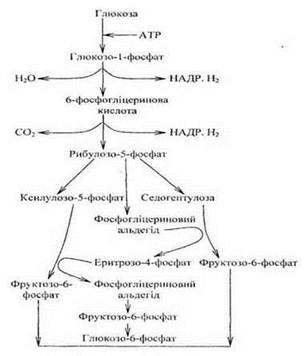
In this case, the breakdown of glucose is preceded by the formation of a monophosphate ester, followed by what is essentially the Cleavage of the first carbon in the chain.
Accordingly, the pentose phosphate pathway is often called apotomic oxidation, in contrast to the glycolytic cycle, which is termed dichotomic due to the formation of two trioses.
Glucose oxidation via the pentose phosphate pathway occurs in the Cell Cytoplasm as well as in Plastids. The activity of the pentose phosphate respiratory pathway is particularly high in Cells and Tissues undergoing active synthetic processes. Like glycolysis, glucose breakdown begins with its phosphorylation. With the help of the enzyme hexokinase and ATP, glucose-6-phosphate and ADP are formed. Six molecules of glucose participate in the reactions of the pentose phosphate cycle; five are regenerated, and one is oxidized according to the equation:
С6Н12О6 + 6О2 → 6СО2 + 6Н2О + 2867 кДж.
This cycle can be divided into two stages:
a) oxidation of glucose;
b) regeneration of the initial substrate.
The reactions of the first stage are catalyzed by a dehydrogenase-carboxylase system consisting of three enzymes. First, glucose-6-phosphate is dehydrogenated by the enzyme glucose-6-phosphate dehydrogenase, which contains NADP as an electron acceptor in its active group. The resulting 6-phosphogluconic acid undergoes oxidative decarboxylation and dehydrogenation to ribulose-5-phosphate.
The Second Stage of the cycle is associated with the regeneration of glucose-6-phosphate. Ribose-5-phosphate is formed from ribulose-5-phosphate under the action of isomerases. Then, two phosphopentoses undergo recombination through the sequential participation of the enzymes transketolase and transaldolase to form first the seven-carbon sugar sedoheptulose and phosphoglyceraldehyde, and then erythrose-4-phosphate and fructose-6-phosphate. Through isomerization, fructose-6-phosphate is converted into glucose-6-phosphate.
For each turn, the summary equation of the pentose phosphate cycle is:
6Г-6-Ф+12НАДФ7 Н,0 > 5Г-6-Ф+6СО2+12НАДФ2+Н3РО4.
As follows from this equation, the complete oxidation of one molecule of glucose-6-phosphate results in the formation of 12 molecules of NADPH2. The oxidation of 12 pairs of protons from NADPH2 during oxidative phosphorylation provides for the synthesis of 36 ATP molecules, which amounts to 41.87 kJ * 36 = 1507 kJ/mol, a value that is practically on par with the energy yield of the glycolytic respiratory pathway.
Glucose oxidation via the pentose phosphate pathway has been identified in various plant Organs. It is the main source of pentoses used by the cell for the synthesis of Nucleic Acids. This cycle also supplies ribose, which, in the form of ribulose-1,5-bisphosphate, serves as the carbon dioxide acceptor in the Dark Phase of photosynthesis.
9. Oxidative Phosphorylation.
The transformation of energy released during dissimilation processes occurs via two pathways:
1) substrate-level phosphorylation during oxidation by dehydrogenases;
2) oxidative phosphorylation in submitochondrial systems.
Substrate-level phosphorylation. In this type of phosphorylation, the free
energy of biological oxidation is captured in the form of high-energy bonds between the substrate and phosphate. The most well-studied example of substrate-level phosphorylation is one of the reactions of glycolysis:
GAP + NAD+ → PGA + NADH + H+.
The process occurs in two stages, forming an intermediate product, diphosphoglyceric acid, which contains a high-energy acyl phosphate bond. In the second stage, the phosphoric acid residue with its macroergic bonds is transferred to ADP, thereby conserving energy.
Oxidative phosphorylation in submitochondrial systems. The energy released during the breakdown of organic substances is converted into the energy of ATP phosphate bonds. ATP formation follows the scheme:
ADP + Pi → ATP.
Phosphorylation of ADP to form ATP occurs only during the oxidation of substances. This process is called oxidative phosphorylation. Oxidative phosphorylation in the Respiratory Chain is driven by the sequential movement of electrons between electron transport chain (ETC) carriers. If ATP synthesis is impossible for any reason (e.g., ADP deficiency), electron flow through the ETC ceases. This phenomenon is crucial for regulating oxidative metabolism and is known as respiratory coupling. According to the chemical coupling hypothesis, during phosphorylation—that is, while electrons move along the ETC—intermediate high-energy compounds, known as coupling factors, are generated.
10. Respiratory quotient and its dependence on the Nature of the oxidative substrate.
The respiratory quotient provides insight into the Chemical Nature of the substrate undergoing oxidation. The respiratory quotient (RQ) characterizes The ratio of the volume of carbon dioxide released during respiration to the volume of oxygen consumed:

According to Avogadro's law, one gram-molecule of any gas occupies the same volume. Therefore, during the oxidation of glucose, according to the reaction C6H12O6 + 6O2 → 6CO2 + 6H2O, the respiratory quotient is equal to:

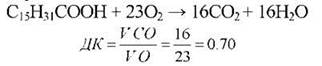
In other words, the number of molecules of carbon dioxide released corresponds to the number of carbon atoms in the substrate molecule, while the number of oxygen molecules consumed increases with the number of hydrogen atoms and decreases with the number of oxygen atoms in the molecule being oxidized. Consequently, when oxidizing fats and proteins, whose molecules contain relatively high amounts of hydrogen and low amounts of oxygen, the respiratory quotient is less than unity (for fats, it is approximately 0.7; for proteins, approximately 0.8).
For instance, when oxidizing palmitic fatty acid (a component of fats), the respiratory quotient is:
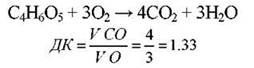
If respiration is fueled by organic acids, the RQ will be greater than unity:
The RQ value can also be influenced by metabolic processes unrelated to respiration. For example, during the germination of oilseeds, Fatty acids are converted into carbohydrates, which causes the respiratory quotient to decrease:

Under conditions of oxygen deficiency, aerobic respiration may be accompanied by anaerobic respiration, which also releases carbon dioxide. Therefore, in this case, the respiratory quotient increases. This can be observed when germinating seeds are submerged in water. The resulting products of incomplete oxidation can exhibit toxic effects at certain concentrations.
Thus, the respiratory quotient value reflects not only the type of substrate undergoing oxidation but also the Specific characteristics of the respiration process in a given tissue or organ, depending on their physiological state and the Influence of External environmental conditions.
11. Respiratory Gas Exchange in plants as a factor in the production process. Interrelation between photosynthesis and respiration
The level of the production process depends significantly on the intensity of respiration, specifically its components: growth respiration and maintenance respiration. Photosynthesis is the first stage of the energy and matter exchange cycle in the cell. The energy-rich active metabolites formed during light reactions—ATP and NADPH2—are converted in the dark phases into energy-rich but less active storage compounds, such as proteins, carbohydrates, and fats. For the cell to utilize the energy stored in carbon compounds, this energy must be transformed into the energy of macroergic ATP phosphate bonds. This is precisely what occurs during respiration, which serves as the second stage of plant Energy Metabolism.
Consequently, both photosynthesis and respiration are linked by energy transformation, forming a unified energy cycle.
At first glance, photosynthesis and respiration appear to be opposing processes. Photosynthesis occurs in Chloroplasts under illumination; it involves energy storage, the uptake of CO2 with its subsequent reduction into organic compounds, and the release of oxygen.
Respiration is light-independent and takes place in the mitochondria. During respiration, organic substances are oxidized, resulting in the release of energy, CO2, and water.
However, these processes share many common features. Water is an essential participant: in photosynthesis, it serves as a donor of H2, while in respiration, the oxidation of substances occurs through the oxygen derived from water.
Photosynthesis and respiration share common intermediate compounds, such as PGA, G3P, DHAP, ribulose, and F-1,6-BP.
Yet, There are also distinct differences. Both respiration and photosynthesis provide ATP. However, in photosynthesis, the energy source for ATP synthesis is solar radiation, whereas in respiration, it is the energy derived from the oxidation of organic matter. Photosynthesis is exclusive to organisms containing chloroplasts, making it a unique process. Conversely, respiration is a universal process inherent to All living organisms.
Last update: 07/08/2026
Editorial and Educational Adaptation: This material has been compiled based on the primary/original source text. The project team performed an editorial review, corrected technical inaccuracies, structured sections, and adapted the content for an educational format.
What was processed:
- elimination of formatting defects (OCR errors, structural breaks, corrupted characters);
- editorial organization of content;
- standardization of terminology in accordance with academic sources;
- verification of factual statements against the original source text.
All mentions of the author, publication year, and origin of the primary text have been preserved in accordance with the source.