Plant Physiology - Musienko, M. M. 2001
Respiration
Energy yield during the conversion of glucose to pyruvic acid
As a result of Glycolysis, each glucose molecule yields two molecules of pyruvic acid, which still retain a total energy content of 2,238 kJ, meaning the major part of the energy originally present in the glucose molecule (2,812 kJ). Through the First and Second substrate-level phosphorylations, 4 ATP molecules are produced; however, it should be borne in mind that in the initial stage, 2 ATP molecules cover the cost of the initial substrate activation in phosphorylation reactions. Therefore, the net ATP yield from glycolysis is 2 ATP molecules. In addition, glycolysis releases four hydrogen atoms, The Fate of which we will discuss later. Suffice it to say that this hydrogen is transported via NAD dehydrogenases into the Mitochondrial Electron Transport chain (ETC). The oxidation of one NADH molecule in the mitochondrial ETC in the presence of O21, as will be shown below, yields an additional three ATP molecules; thus, per one glucose molecule and taking the oxidation process into account, a total of 8 ATP molecules are formed (Table 10).
Table 10. Energy yield from the oxidation of a glucose molecule during glycolysis
|
Total utilization |
Total yield |
Total utilization |
Total yield |
|
1 glucose molecule (6C) |
2 Pyruvate molecules (2×3C) |
4ADP |
4 ADP |
|
2 ATP |
4 ATP |
2×NADP |
2×NADPH2 |
|
2×Pi |
2×H20 |
The ultimate fate of pyruvic acid depends on the availability of oxygen within The Cell. If oxygen is present, it is oxidized to carbon dioxide and Water via aerobic Respiration in the Mitochondria. Under anaerobic conditions, it undergoes Fermentation and is converted into ethanol or lactic acid.
ROLE OF GLYCOLYSIS AND ITS REGULATION
Glycolysis establishes the conditions for converting glucose into pyruvic acid, serving as an intermediate link before The Tricarboxylic Acid Cycle and The final stage of respiration—the oxidation of H2 in the mitochondrial Respiratory Chain, during which the greater part of the Free energy of the starting products is conserved. Glycolytic breakdown of glucose provides the cell with energy (2 ATP and 2 NADPH2 molecules) as well as metabolic intermediates for the synthesis of cellular components, such as Fatty acids, and phosphoenolpyruvate for The Biosynthesis of phenols and Lignin.
Glycolysis is a common phase for both aerobic and Anaerobic respiration. Under anaerobic conditions, it presumably acts as the primary source of cellular ATP. This is frequently observed during Hypoxia caused by flooding or soil compaction. The operation of this process in METABOLISM/14.html">Chloroplasts ensures NADPH-independent ATP synthesis and also facilitates The breakdown of starch into trioses, followed by their export from the chloroplast via a shuttle mechanism. The rate of glycolytic breakdown is regulated to ensure the aforementioned plant cell Functions (Fig. 89).
Class="center">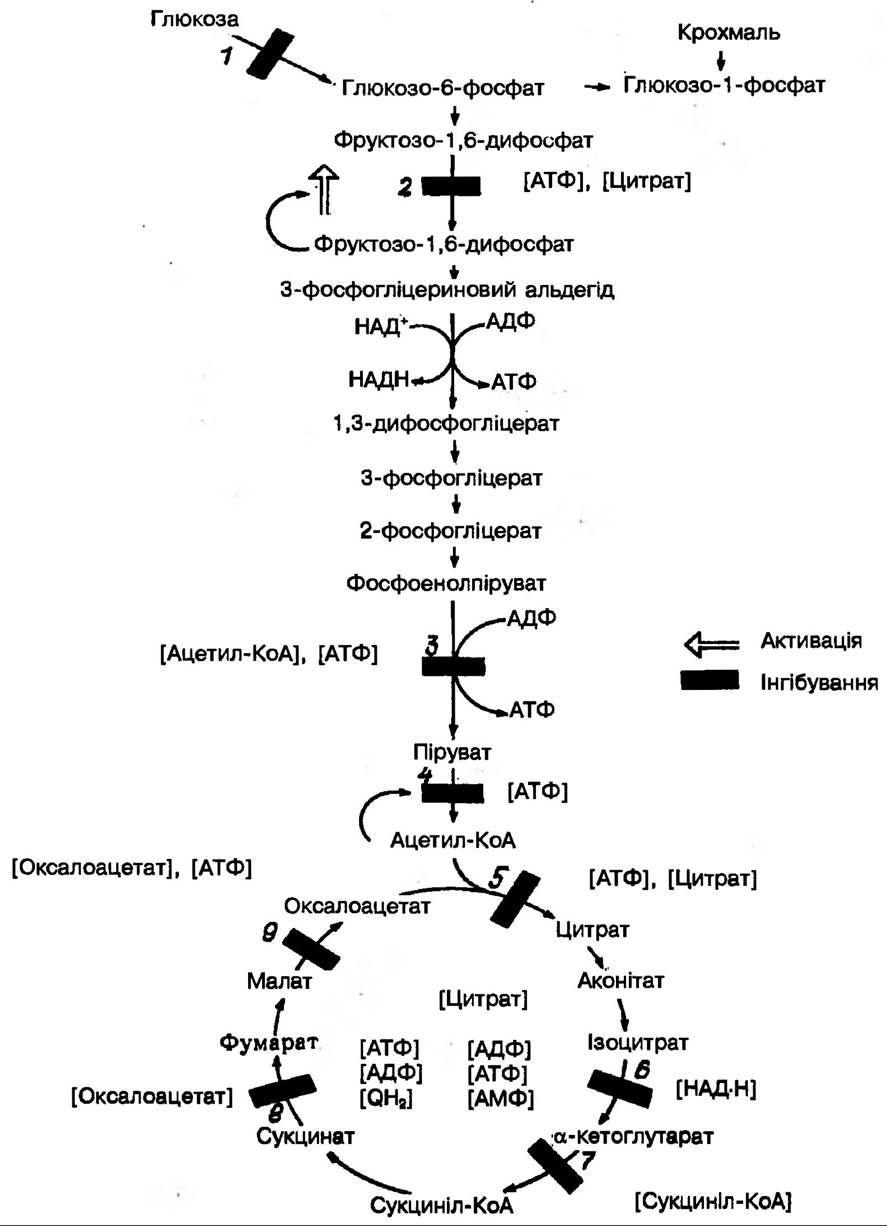
Fig. 89. Regulation scheme of glycolysis and the di- and tricarboxylic acid cycles:
1 — hexokinase, 2 — Phosphofructokinase, 3 — pyruvate kinase, 4 — pyruvate dehydrogenase complex, 5 — citrate synthase, 6 — isocitrate dehydrogenase, 7 — α-ketoglutarate dehydrogenase, 8 — succinate dehydrogenase, 9 — malate dehydrogenase
The Enzymes catalyzing irreversible reactions (hexokinase, phosphofructokinase, and pyruvate kinase) simultaneously play a regulatory role. It should be noted that phosphofructokinase is the most critical regulatory component of glycolysis. It is inhibited by high concentrations of ATP, which reduce its affinity for fructose 6-phosphate. The activity of this enzyme increases at low ratios of
ATP to AMP, meaning glycolysis is stimulated under conditions of low cellular energy status. Glycolysis also supplies carbon skeletons for biosynthetic processes. Accordingly, phosphofructokinase is inhibited upon receiving signals about an excess of the corresponding metabolic building blocks. As it turns out, this enzyme is inhibited by citrate, an early product of the subsequent tricarboxylic acid cycle.
Thus, the enzyme phosphofructokinase is of paramount importance when the cell requires energy or appropriate intermediates for biosynthesis. If these factors are in excess, enzyme activity drops sharply.
Hexokinase and pyruvate kinase are also involved in regulating the rate of glycolysis. However, the first irreversible reaction unique to glycolysis—and therefore the rate-limiting step—is the phosphorylation of fructose-6-phosphate to fructose-1,6-bisphosphate. Hence, Structure/19.html">The Importance of this enzyme lies in its being the primary factor in the Regulation of glycolysis, given that The enzyme catalyzing the decisive step in a given metabolic pathway simultaneously acts as its most vital regulatory element.
Last update: 07/08/2026
Editorial and Educational Adaptation: This material has been compiled based on the primary/original source text. The project team performed an editorial review, corrected technical inaccuracies, structured sections, and adapted the content for an educational format.
What was processed:
- elimination of formatting defects (OCR errors, structural breaks, corrupted characters);
- editorial organization of content;
- standardization of terminology in accordance with academic sources;
- verification of factual statements against the original source text.
All mentions of the author, publication year, and origin of the primary text have been preserved in accordance with the source.