General Microbiology - Schlegel, H. 1987
Types of Fermentation
Lactic Acid Fermentation and the Family Lactobacillaceae
Lactic acid Bacteria are grouped under the family Lactobacillaceae. Although this group is morphologically heterogeneous—comprising long and short rods as well as cocci—its physiological characteristics are quite well-defined. All bacteria belonging to this family are Gram-positive, non-spore-forming (with the exception of Sporolactobacillus inulinus), and overwhelmingly non-motile. They all utilize CARBOHYDRATES as an energy source and produce lactic acid. Unlike Enterobacteriaceae, which also produce lactate, lactic acid bacteria are strictly fermentative; they lack Hemoproteins (such as Cytochromes and catalase). Despite this, Lactobacteriaceae can grow in the presence of atmospheric oxygen; being anaerobes, they are nevertheless aerotolerant. If a bacterium grows under aerobic conditions but does not produce catalase, it can be classified as a lactic acid bacterium with a high degree of probability.
Growth factor requirements. Another distinguishing feature of lactic acid bacteria is their requirement for growth factors. Not a single representative of this group is able to grow on a medium containing only glucose and ammonium salts. Most of them require a range of Vitamins (riboflavin, thiamine, pantothenic acid, nicotinic acid, Folic acid, and biotin) and Amino Acids, as well as Purines and Pyrimidines. These bacteria are cultivated primarily on complex media containing relatively large amounts of Yeast extract, tomato juice, whey, and even Blood. Unexpectedly, some lactic acid bacteria (along with other fermentative organisms) form cytochromes when grown on blood-containing media and may even be capable of carrying out Respiratory Chain phosphorylation. Consequently, lactic acid bacteria cannot synthesize Porphyrins; however, if porphyrins are added to the nutrient medium, some of these species are capable of forming the corresponding hemin pigments.
Thus, lactic acid bacteria are a kind of "metabolic cripple" which, presumably As a result of specialization (growing in milk and other media rich in nutrients and growth factors), have lost The ability to synthesize many metabolites. On the other hand, many of them possess an ability that most other microorganisms lack: they can utilize milk sugar (lactose). In this respect, they are similar to many enteric bacteria (such as Escherichia coli). Lactose apparently does not occur in the plant kingdom; it is synthesized by mammals, secreted in milk, and ingested accordingly. Therefore, the ability to utilize lactose can be regarded as an adaptation to the environment characteristic of the mammalian intestine. Lactose is a disaccharide that must be hydrolyzed before it can enter the hexose catabolic pathway:
Class="center">
Following phosphorylation, galactose is converted into glucose-6-phosphate.
Due to The production of large amounts of lactic acid, the nutrient medium for lactic acid bacteria must be well-buffered. Calcium carbonate is most commonly added for this purpose. On an Agar medium containing a suspension of CaCO3 ("chalk agar"), acid production is detected by clear halos surrounding the colonies.
Distribution and habitats. The distribution of lactic acid bacteria in nature is determined by their complex nutritional requirements and their energy-yielding mechanism (Fermentation only). These bacteria are almost never found in soil or aquatic environments. Under natural conditions, they occur:
a) in milk, milk-Processing facilities, and dairy products (Lactobacillus lactis, L. bulgaricus, L. helveticus, L. casei, L. fermentum, L. brevis; Streptococcus lactis, S. diacetilactis);
b) on plants and decaying plant residues (Lactobacillus plantarum, L. delbrückii, L. fermentum, L. brevis; Streptococcus lactis, Leuconostoc mesenteroides);
c) in the intestine and on the mucous membranes of humans and animals (Lactobacillus acidophilus, Bifidobacterium; Streptococcus faecalis, S. salivarius, S. bovis, S. pyogenes, S. pneumoniae).
Streptococcus faecalis is a common inhabitant of the human intestine; S. bovis is prevalent in the digestive tract of ruminants. Many streptococci are harmless inhabitants of the Oral Cavity, respiratory and urinary tracts, and genital Organs; however, among streptococci, There are also blood parasites—highly virulent disease agents.
Due to the production of large amounts of lactic acid, to which they themselves are largely tolerant, lactic acid bacteria can multiply quite rapidly under favorable conditions, outcompeting other microorganisms. For this reason, they are easily cultivated on selective media and readily isolated. "Natural enrichment cultures" of these bacteria are found in sour milk and dairy products, sourdough, sauerkraut, silage, etc.
Carbohydrate Catabolism and fermentation products. Depending on whether glucose fermentation yields only lactic acid or also other organic products and CO2, lactic acid bacteria are conventionally subdivided into homofermentative and heterofermentative (Table 8.2). This traditional Classification reflects fundamental differences in their pathways of sugar catabolism.
Homofermentative lactic acid fermentation. Homofermentative lactic acid bacteria produce practically exclusively lactic acid (accounting for at least 90% of all fermentation products). They catabolize glucose via the fructose bisphosphate pathway (possessing all the necessary Enzymes, including aldolase), and the hydrogen released during the dehydrogenation of glyceraldehyde-3-phosphate is transferred to Pyruvate:
Table 8.2. Lactic acid bacteria grouped by Cell Morphology (cocci or rods) and fermentation type
|
Cocci |
Rods |
|
Homofermentative fermentation: |
С6Н12О6 → 2CH3 — СНОН — СООН |
|
Streptococcus lactis S. faecalis S. salivarius S. pyogenes S. cremoris S. thermophilus S. diacetilactis |
Thercobacteria (optimum Temperature 40°C; do not grow at 15°C) L. lactis L. helveticus L. acidophilus L. bulgaricus L. delbrückii |
|
Pediococcus cerevisiae |
Streptobacteria (optimum temperature 30–37°C; grow at 15°C) Lactobacillus casei L. plantarum Sporolactobacillus inulinus |
|
Heterofermentative fermentation: С6Н12О6→ СН3—СНОН—СООН + СН3 —CH2OH + CО2 (or CH3 —COOH) |
|
|
Leuconostoc mesenteroides ( = Betacoccus) L. cremoris |
Betabacteria Lactobacillus brevis L. fermentum L. viridescens Bifidobacterium bifidum |
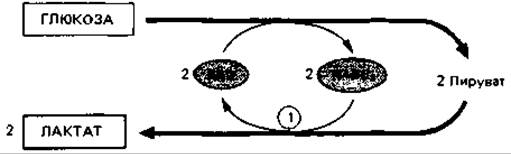
The stereospecificity of Lactate dehydrogenase (a) and the presence of lactate racemase determine whether D(-)-, L(+)-, or DL-lactic acid is formed. Only a small fraction of pyruvate undergoes decarboxylation to yield acetic acid, ethanol, CO2, and acetoin. The amount of by-products formed apparently depends on oxygen availability.
Heterofermentative lactic acid fermentation. Heterofermentative lactic acid bacteria lack the Key Enzymes of the fructose bisphosphate pathway—aldolase and Triosephosphate isomerase. The initial conversion of glucose proceeds exclusively via the Pentose Phosphate Pathway, i.e., through glucose-6-phosphate, 6-phosphogluconate, and ribulose-5-phosphate (see Figs. 7.4 and 8.2). Under the action of epimerase, ribulose-5-phosphate is converted into xylulose-5-phosphate, which is then cleaved in a thiamine pyrophosphate-dependent reaction catalyzed by phosphoketolase to yield glyceraldehyde-3-phosphate and acetyl phosphate:

Non-growing, washed Cells of Leuconostoc mesenteroides ferment glucose almost stoichiometrically According to the equation

yielding lactate, ethanol, and carbon dioxide. Thus, in these bacteria, acetyl phosphate is reduced via acetyl-CoA and acetaldehyde to ethanol (Fig. 8.2). Other heterofermentative lactic acid bacteria convert acetyl phosphate partially or entirely into acetic acid, a process coupled with The transfer of a high-energy phosphate bond to ADP to form ATP. In this case, excess hydrogen is transferred to glucose, resulting in The formation of mannitol. Glyceraldehyde-3-phosphate is converted into lactate via pyruvate. Leuconostoc mesenteroides ferments ribose into lactate and acetate.
When fructose is fermented by heterofermentative bacteria, lactate, acetate, CO2, and mannitol are produced:

Here, fructose acts as an acceptor for excess reducing equivalents:

Lactobacillus plantarum (= pentosus or arabinosus) ferments glucose via the homofermentative pathway, whereas it cleaves pentoses using phosphoketolase, converting them into lactate and acetate. It is worth noting that even such a typical homofermentative bacterium as Lactobacillus casei ferments glucose homofermentatively yet converts ribose into acetate and lactate via a heterofermentative pathway. Ribose induces the synthesis of phosphoketolase in this Organism. If cells grown on a ribose-containing medium are washed, they will subsequently ferment glucose like heterofermentative bacteria.
Fermentation by Bifidobacterium bifidum. The heterofermentative lactic acid bacterium B. bifidum gets its name from its characteristic V- or Y-shape (Latin bifidus, cleft)1. It is well known for predominating in the intestines of infants, particularly breastfed babies. This dependence of its distribution on the infant's feeding method could be linked to the bacterium's requirement for carbohydrates containing N-acetylglucosamine, which are found exclusively in human milk and are absent in cow's milk. All Representatives of the genus Bifidobacterium are obligate anaerobes; they cannot tolerate oxygen and require an atmosphere containing 10% CO2 for growth. Since these features, unusual for lactic acid bacteria, became known, bifidobacteria have been discovered in the intestinal flora of adults and in numerous other environments, even in putrid sludge, and many species within this genus are now recognized. Bifidobacteria cleave glucose according to the equation

that is, they ferment it via the phosphoketolase shunt pathway. They lack both aldolase and glucose-6-phosphate dehydrogenase, but contain active phosphoketolases that cleave fructose-6-phosphate and xylulose-5-phosphate into acetyl phosphate and erythrose-4-phosphate or glyceraldehyde-3-phosphate. Hexoses undergo the following transformations:


Fig. 8.2. Heterofermentative Lactic acid fermentation carried out by Lactobacillus brevis and Leuconostoc mesenteroides. Enzymes involved (circled numbers): 1, glucose-6-phosphate dehydrogenase; 2, phosphogluconate dehydrogenase; 3, epimerase; 4, phosphoketolase. Acetyl phosphate is either cleaved by acetate kinase with the phosphorylation of ADP (L. brevis) or reduced to ethanol (L. mesenteroides). Oxidation of glyceraldehyde phosphate proceeds via the conventional pathway (see Section 7.2.1 on the fructose bisphosphate pathway). PK, phosphoketolase; TA, transaldolase; TK, transketolase; Ac ~ P, acetyl phosphate; GA-3-P, glyceraldehyde-3-phosphate.
1 The genus Bifidobacterium is now classified among actinomycetes rather than the family Lactobacillaceae. — Ed. note.
Applications of lactic acid bacteria in household practices, agriculture, and food production. If a non-sterile solution containing sugars along with complex nitrogen sources and growth factors is left sealed from the air, or if a sufficiently large volume of such a solution is simply poured into a vessel, lactic acid bacteria will soon appear in it. They lower the pH to values below 5, thereby suppressing the growth of other anaerobic bacteria that cannot thrive in such an acidic environment. Which specific lactic acid bacteria will proliferate in these enrichment cultures depends on other prevailing conditions. Owing to their sterilizing and preserving action, which is based on acidification of the medium, lactic acid bacteria are widely used in agriculture, households, and the dairy industry.
Silage making. Lactic acid bacteria inhabiting plants play a major role in preserving livestock feed. Sugar beet leaves, corn, potatoes, grasses, and alfalfa are used for silage production. The plant material is pressed and supplemented with molasses to increase the C/N ratio, as well as formic acid or another inorganic acid to give lactobacilli and streptococci a competitive growth advantage from the outset. Under these conditions, a controlled lactic acid fermentation takes place.
Sauerkraut production. Sauerkraut is another product whose preparation involves lactic acid bacteria. Finely sliced white cabbage, sprinkled with salt (2–3%) and tightly packed, undergoes spontaneous lactic acid fermentation under anaerobic conditions, involving initially Leuconostoc (with the formation of CO2) and later Lactobacillus plantarum.
Dairy products. Lactic acid bacteria, which produce acid and impart specific flavors to products, find widespread application in the dairy industry. Sterilized or pasteurized milk or cream is fermented by inoculating pure starter cultures of lactic acid bacteria. Cultured butter is made from cream soured using Streptococcus lactis, S. cremoris, and Leuconostoc cremoris. Diacetyl produced during fermentation (see p. 289) gives butter its characteristic aroma.
Starter cultures containing Streptococcus lactis or Lactobacillus bulgaricus and Streptococcus thermophilus induce the coagulation of casein during the production of quark and German cheeses (such as Harzer and Mainz cheese). In the manufacturing of hard cheeses (unlike acid-curd cheeses), rennet is used to coagulate casein. Lactic acid bacteria (Lactobacillus casei, Streptococcus lactis) together with propionic acid bacteria participate only during the cheese-ripening stage.
For the preparation of Fermented milk products (Table 8.3), starter cultures of lactic acid bacteria that produce acid and specific Aromatic Compounds are likewise employed. Aromatic buttermilk is produced using the aforementioned starter cultures utilized for cultured butter production. Alongside lactic acid, buttermilk also contains acetic acid, acetoin, and diacetyl. Yogurt is made from pasteurized homogenized whole milk inoculated with Streptococcus thermophilus and Lactobacillus bulgaricus (after inoculation, the milk is incubated for 2–3 hours at 43–45°C). Biogurt is a commercial name for sour milk fermented with Lactobacillus acidophilus and Streptococcus thermophilus. Kefir is a fermented milk product containing both acids and ethanol; it is produced from milk (cow, ewe, or goat). The starter is prepared using so-called kefir grains, which consist of a not yet fully understood microbial community comprising lactobacilli, streptococci, micrococci, and Yeasts. Milk fermentation is carried out at 15–22°C for 24–36 hours. Kumis is prepared using mare's milk1, which is inoculated with a culture containing Lactobacillus bulgaricus and yeasts of the genus Torula.
Table 8.3. Commercial fermented dairy products and their corresponding microbial starter cultures
|
Dairy product |
Starter cultures involved |
Incubation temperature and duration |
|
Sour cream and buttermilk |
Streptococcus lactis, S. cremoris, Leuconostoc cremoris or S. diacetilactis |
22°C, 18 h |
|
Yogurt |
Streptococcus thermophilus, Lactobacillus bulgaricus |
43–45°C, 2.5–3 h |
|
Biogurt |
Streptococcus lactis, S. cremoris, Lactobacillus acidophilus |
37–40°C, 24 h |
|
Kefir and kumis |
Streptococcus, Lactobacillus, yeasts |
15–22°C, 24–36 h |
|
Quark (cottage cheese) |
Streptococcus lactis, S. cremoris, Leuconostoc cremoris |
22°C, 18 h or 35°C, 5 h |
Pure lactic acid, used for various industrial purposes and as a food additive, is obtained through fermentation. Milk or whey is fermented using Lactobacillus casei or L. bulgaricus. For the fermentation of glucose and maltose, L. delbrückii, L. leichmannii, or Sporolactobacillus inulinus are employed. Molasses and malt serve as sources of essential growth factors.
Acid development in sourdough, used for leavening bread, is also driven by lactic acid bacteria, particularly Lactobacillus plantarum and L. coryneformis. Starter cultures of lactobacilli and micrococci are additionally used in the production of dry-cured sausages (salami, cervelat). By producing lactic acid and lowering the pH, lactic acid bacteria protect uncooked sausage varieties from spoilage.
1 Kumis is traditionally prepared from mare's milk (less frequently from camel's milk). — Ed. note.
Last update: 13/08/2026
Editorial and Educational Adaptation: This material has been compiled based on the primary/original source text. The project team performed an editorial review, corrected technical inaccuracies, structured sections, and adapted the content for an educational format.
What was processed:
- elimination of formatting defects (OCR errors, structural breaks, corrupted characters);
- editorial organization of content;
- standardization of terminology in accordance with academic sources;
- verification of factual statements against the original source text.
All mentions of the author, publication year, and origin of the primary text have been preserved in accordance with the source.