BIOLOGY Volume 2 - A Guide to General Biology - 2004
12. MICROBIOLOGY AND BIOTECHNOLOGY
12.12. Food and Drink
12.12.2. Lactic Acid Fermentation - Dairy Products
A wide variety of products known as dairy products can be obtained through the Fermentation of milk. Milk contains lactic acid Bacteria which, via Anaerobic Respiration, break down lactose (milk sugar) into lactic acid. These bacteria can be destroyed during pasteurization; therefore, if fermentation is required, they are added back into the milk. Depending on the fermentation conditions, additives used, as well as the composition and source of the milk, different products are formed. The consistency and taste of these products vary greatly, which is evident even from their range, encompassing all types of cheese, butter, yogurt, sour cream, and cottage cheese (Fig. 12.19).
Class="center">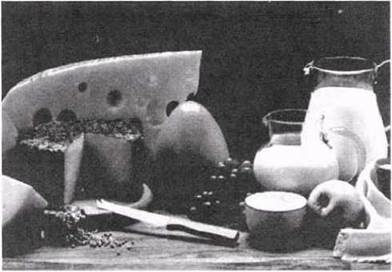
Fig. 12.19. Dairy products.
Yogurt
Unlike cheese, for The production of which a specific milk fraction is used (see below), yogurt is made by fermenting whole milk. Initially, yogurt was more liquid and acidic, but its taste and consistency were later substantially modified in Western countries to suit national preferences. Because yogurt is acidic by nature (pH 3.7–4.3), fruit is added to enhance the flavor.
Yogurt can be made using any type of milk, individually or combined, including whole, skimmed, semi-skimmed, condensed, and powdered milk. Each combination yields a distinct type of yogurt. Low-fat varieties are the most popular. The manufacturing process is outlined in Fig. 12.20.

Fig. 12.20. Outline of yogurt manufacturing.
In the UK, all milk undergoes heat Treatment (pasteurization), which is typically carried out at 72 °C for 15 s. This is necessary to eliminate pathogenic (disease-causing) microorganisms. While they are not necessarily present in milk, because milk is an ideal medium for Microbial growth, there is always a risk of contamination by harmful bacteria, such as Salmonella, or Fungi. Furthermore, some harmless bacteria, having multiplied in milk, can affect its quality. For several reasons outlined in the flowchart in Fig. 12.20, additional heat treatment is required during yogurt production. To replace the lactic acid bacteria destroyed by heating, a "starter culture" is added. This is a culture of selected bacteria that carry out controlled and predictable fermentation. The starter culture typically contains Lactobacillus bulgaricus, which produces lactic acid and alcohol to give yogurt its characteristic flavor, and Streptococcus thermophilus, which imparts a distinctive buttery note. These bacteria can be seen in roughly equal proportions in a Gram-stained sample of yogurt (sec. 12.9.2). Both bacterial species are Gram-positive and therefore stain red. If you attempt to count the bacteria, you will find approximately 108 Cells per gram for each of these species.
Cheese
Before cheese-making, milk is separated into curds and whey. To achieve this, a starter culture containing the desired microorganisms is introduced into the milk under carefully controlled, sterile conditions. The lactic acid produced during fermentation begins to sour the milk, causing the coagulation (solidification) of casein, a soluble protein found in milk. This is precisely what happens during milk "clotting". The addition of rennet, which contains rennin, accelerates coagulation and allows for tighter control. Rennet is typically derived from calf stomachs; however, a proteinase with similar properties can be isolated from certain fungal species or genetically modified bacterial strains. The advantage of these novel Enzymes is that they can be used to produce kosher and vegetarian cheeses.
The curd is separated, pressed into the desired shape, and dried. Whey can be used as a nutrient source for growing Yeast, which, after specific Processing, can in turn be added to livestock feed. This product is rich in protein and several Vitamins.
To impart a characteristic flavor and texture to cheese, various microorganisms are added during the ripening process: bacteria (Cheddar), Molds (Roquefort and other blue cheeses), or combinations thereof (Camembert). All these processes are carried out under controlled conditions, which vary depending on the cheese variety being produced. Some cheeses, such as cottage cheese and cream cheese, remain unripened.
Butter
Butter is made from cream skimmed off fresh milk and, by law, must contain at least 80% fat. The cream is first pasteurized and then churned.
Last update: 06/08/2026
Editorial and Educational Adaptation: This material has been compiled based on the primary/original source text. The project team performed an editorial review, corrected technical inaccuracies, structured sections, and adapted the content for an educational format.
What was processed:
- elimination of formatting defects (OCR errors, structural breaks, corrupted characters);
- editorial organization of content;
- standardization of terminology in accordance with academic sources;
- verification of factual statements against the original source text.
All mentions of the author, publication year, and origin of the primary text have been preserved in accordance with the source.