Biochemistry - The Chemical Reactions of Living Cells, Volume 2 - D. Metzler 1980
Organization of Metabolism: Catabolic Pathways
Catabolism of Sugars
Pentose Phosphate Pathways
Important metabolic pathways involving five-carbon pentose sugars are called either The pentose phosphate pathways, the phosphogluconate pathway, or the hexose monophosphate shunt. Historically, the first data on the existence of such pathways were obtained in Warburg's Experiments on the oxidation of glucose-6-phosphate to 6-phosphogluconate. Recall that NADP+ was discovered precisely during The Study of this reaction (Ch. 2, Sec. 3). For many years, this oxidation was considered an enzymatic reaction independent of any specific metabolic pathways. At the same time, it was hypothesized that this reaction is part of an alternative glucose breakdown pathway. This hypothesis gained strength after it was discovered that tissue Respiration continues in the presence of high concentrations of fluoride ions—known Inhibitors of the enolase reaction—which are capable of almost completely blocking Glycolysis. In certain Tissues (particularly the Liver), this alternative respiratory pathway proves to be especially active. We now know that the pentose phosphate pathways are diverse and multifaceted. Not only do they occupy a substantial place in catabolic processes, but when functioning in reverse (the reductive Pentose Phosphate Pathway), they serve as key reactions of Photosynthesis leading to The formation of sugar.
During the oxidative pentose pathways, carbon atoms are successively cleaved from the sugar carbon chain one by one and released as CO2. The Enzymes required for this purpose form three distinct systems, all of which are present in the Cytosol of living Cells: I) the dehydrogenase-decarboxylase system, II) the isomerizing system, and III) the sugar rearrangement system. The dehydrogenase-decarboxylase system breaks down glucose-6-phosphate into CO2 and pentose phosphate [ribulose-5-phosphate; equation (9-12)]. This requires three enzymes, the first of which is glucose-6-phosphate dehydrogenase [equation (9-12), step a; see also equation (8-42)]. The immediate reaction product, the lactone, can hydrolyze spontaneously, but gluconolactonase [equation (9-12), step b] significantly accelerates ring opening. The second dehydrogenation is catalyzed by 6-phosphogluconate dehydrogenase [equation (9-12), step c]; this is immediately followed by a ß-decarboxylation catalyzed by the same enzyme [by analogy with equation (7-75)]. The Standard Free energy change ∆G0 for The oxidation of glucose-6-phosphate to ribulose-5-phosphate by NADP+ according to equation (9-12) is —30.8 kJ∙mol-1 — a sufficiently large negative value so that at equilibrium the [NADPH]/[NADP+] ratio exceeds 2000 at a partial pressure of CO2 of 0.05 atm.
Class="center">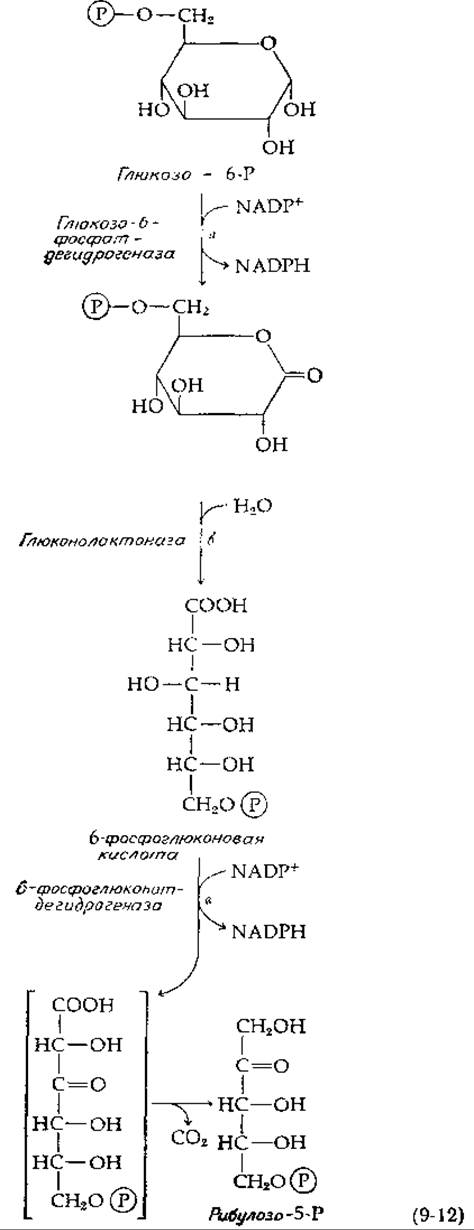
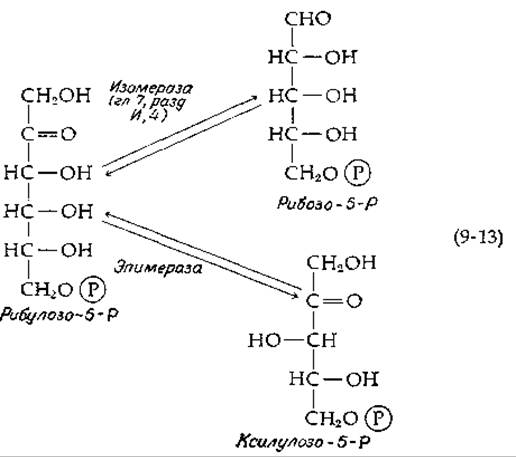
The isomerizing system, consisting of two enzymes, ensures the interconversion of the three pentose phosphates [equation (9-13); in the formula given, ribulose-5-P contains a typo carried over from the original: one CHOH group is superfluous. — Ed.]. As a result, an equilibrium mixture of these three pentose phosphates is formed. Xylulose-5-phosphate and ribose-5-phosphate participate in subsequent reactions.
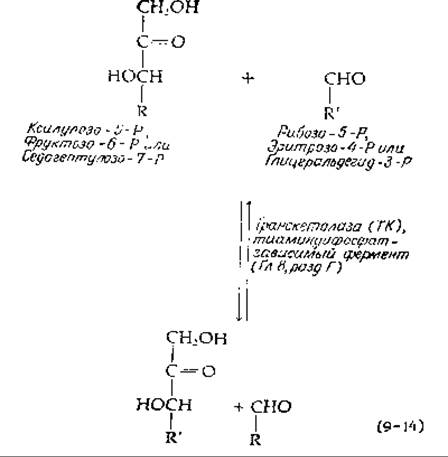
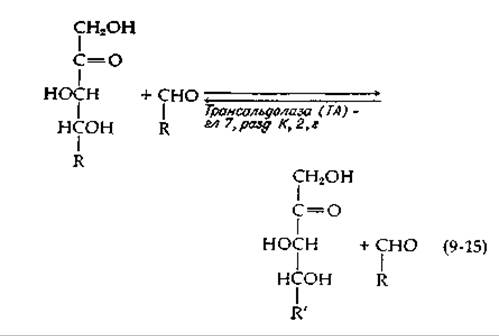
The sugar rearrangement system includes two enzymes: transketolase and transaldolase. Both enzymes catalyze chain Cleavage and transfer reactions [equations (9-14) and (9-15)] on the same group of substrates. These enzymes carry out two MAIN TYPES OF C—C bond cleavage at two positions: adjacent to the carbonyl group (a) and at the carbon atom adjacent to the carbonyl group (ß). Just as in The Tricarboxylic Acid Cycle, both types of chain cleavage are essential for the pentose phosphate pathways.
a. The oxidative pentose phosphate cycle
By combining all three systems together, we can construct the hexose phosphate oxidation cycle. As a result of three decarboxylation stages (Fig. 9-8, A), a three-carbon triose phosphate is formed. However, since the dehydrogenase system acts only on glucose-6-phosphate, the rearrangement system must function between the three stages of oxidation. Note that the C5 sugar (ribose-5-phosphate) used in the first transketolase-catalyzed reaction is regenerated at the end of the entire sequence of reactions. Thus, in this cycle, the C5 sugar acts as a regenerating substrate. As indicated by the dashed lines, it can be readily obtained in any required quantity via the oxidation of glucose-6-phosphate. Before the C5 sugar produced at each oxidation step can be involved in rearrangement reactions, it must be isomerized from ribulose-5-phosphate to xylulose-5-phosphate; similarly, the C5 sugar formed at The final stage (Fig. 9-8) can be reused as a regenerating substrate only after isomerization to ribose-5-phosphate. The system is quite complex. Note also that in the diagram in Fig. 9-8, A, the same C5 substrates appear in several places. Thus, the substrates formed at different Stages of the cycle become mixed, and as a result, the breakdown process of different hexose molecules does not follow a uniform pattern.
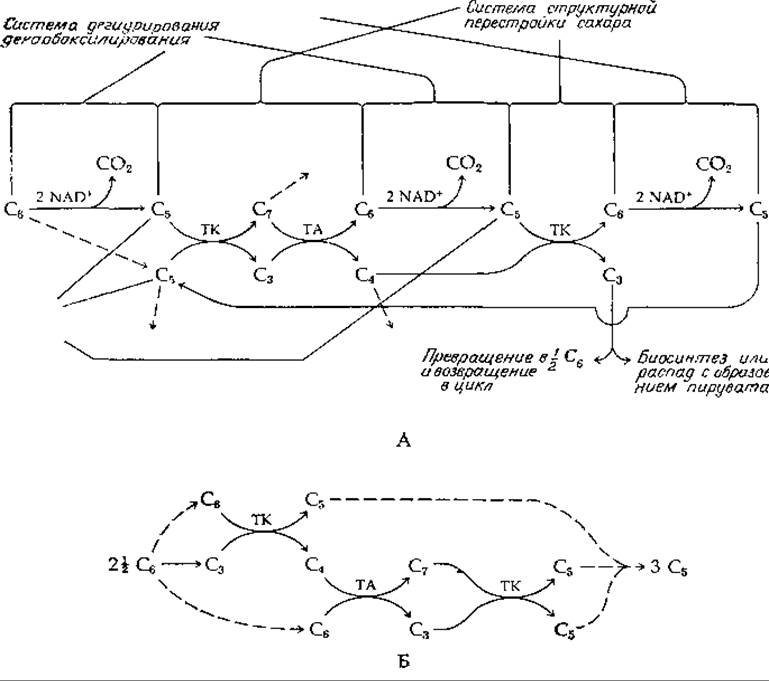
FIG. 9-8. Pentose phosphate pathways. A. Oxidation of hexose (C6) to three molecules of CO2 and a three-carbon fragment, with the possibility of C3, C4, and C7 products entering biosynthetic processes (dashed arrows). B. Non-oxidative pentose pathways: 21/2C6→3C5, or 2C6→3C4, or 31/2C6→3C7.
The pentose phosphate cycle is often viewed as a process of Complete oxidation of hexoses to CO2. To achieve such oxidation, the C3 molecules considered as products in Fig. 9-8, A must be converted back into glucose-6-phosphate (by the action of aldolase, phosphatase, and hexose phosphate isomerase), which then re-enters the cycle. However, there are Other pathways for The breakdown of the C3 product—glyceraldehyde-3-phosphate. For example, through the action of glycolytic enzymes, it can be oxidized to Pyruvate and subsequently to CO2 in the tricarboxylic acid cycle.
As a rule, catabolic reactions involve NAD+, making it somewhat unusual for NADP+ to act as the oxidant in such reactions. Nevertheless, in mammals, the Enzymes of the pentose phosphate cycle are specific for NADP+. It has been suggested that this is due to the cellular demand for NADPH in biosynthetic processes (Ch. 11, Sec. B). This makes the functioning of the pentose phosphate pathway in tissues with high biosynthetic activity (liver, mammary gland) readily understandable. It is possible that in these tissues, the C3 products of the cycle are diverted into biosynthetic pathways, as shown in Fig. 9-8, A. Furthermore, the reader should already appreciate that any product from C4 to C7 can be withdrawn from the cycle in any desired quantities without disrupting its operation. For instance, we know that the C4 product erythrose-4-phosphate, formed at an intermediate stage, is used by Bacteria and plants (though not by animals) for the synthesis of aromatic Amino Acids. Similarly, ribose-5-phosphate is essential for the formation of Nucleic Acids and Certain amino acids.
b. Non-oxidative pentose phosphate pathways
The sugar rearrangement system, together with glycolytic enzymes (which convert glucose-6-phosphate into glyceraldehyde-3-phosphate), can effect The conversion of hexose phosphates into pentose phosphates (Fig. 9-8, B) [34]. The overall process is described by the equation:

The reader can easily demonstrate that the same enzymes can catalyze the conversion of hexose phosphate into erythrose-4-phosphate and sedoheptulose-7-phosphate:

Studies on the METABOLISM of the lipid-producing red Yeast *Rhodotorula gracilis* (which lacks Phosphofructokinase and is therefore incapable of breaking down sugars via The Glycolytic Pathway) indicate that 20% of glucose is oxidized via the pentose phosphate pathway, whereas 80% enters the non-oxidative pentose phosphate pathway reactions1) [35, 36] [equation (9-16)]. Certain Types of Fermentation are also associated with the pentose phosphate pathways (Sec. E, 6).
Evaluating the contributions of the glycolytic, pentose phosphate, and other metabolic pathways to the Energy balance of The Cell is fraught with many difficulties, although attempts to obtain such estimates continue to be made [35, 36].
1) It still remains a mystery where the C3 molecules necessary for the functioning of the non-oxidative pathway come from under conditions where glycolysis is blocked (Fig. 9-8, B). It is possible that further breakdown of pentose phosphate into three-carbon and two-carbon units may occur.
Last update: 06/08/2026
Editorial and Educational Adaptation: This material has been compiled based on the primary/original source text. The project team performed an editorial review, corrected technical inaccuracies, structured sections, and adapted the content for an educational format.
What was processed:
- elimination of formatting defects (OCR errors, structural breaks, corrupted characters);
- editorial organization of content;
- standardization of terminology in accordance with academic sources;
- verification of factual statements against the original source text.
All mentions of the author, publication year, and origin of the primary text have been preserved in accordance with the source.