Human Anatomy and Physiology - I. V. Gayvoronsky 2011
Metabolism and Energy
Types of Metabolism
The main substances entering the body are Water, mineral salts dissolved in it, Proteins, fats, CARBOHYDRATES, and Vitamins. Each of these substances has a specific purpose for the body and its own characteristic metabolic pathways. Accordingly, METABOLISM is classified into the following types: Water and Mineral Metabolism, Protein metabolism, Lipid Metabolism, and Carbohydrate Metabolism. Vitamins primarily act as catalysts for biochemical processes, as most of them are integral components of Enzymes.
Water and mineral metabolism. Water accounts for anywhere from 10% (in adipose tissue) to 90% (in Blood AND LYMPH) of various Tissues. On average, it makes up 65–70% of total body weight.
Under normal conditions, a person typically consumes 1.5–2.5 liters of water per day. An equal amount is excreted by the Kidneys as urine, through the Skin as sweat, and via the Lungs as water vapor. However, the volume of water excreted by the kidneys depends on the ambient Temperature and can increase or decrease several-fold.
Water cannot serve as an energy source for the body, but it performs A number of other vital Functions:
1) it acts as a universal solvent—practically all substances in Cells and extracellular structures are dissolved in water, which is why fundamental metabolic processes take place in an aqueous medium;
2) it ensures the delivery of dissolved minerals and Water-Soluble Vitamins into the body;
3) it prevents the body from hypothermia due to its high heat capacity;
4) it protects the body from overheating through evaporation from The surface of the skin and mucous membranes;
5) it is incorporated into crucial biochemical processes and is produced during their course.
Minerals are likewise not sources of energy. They perform a variety of functions. Of all minerals, our body is richest in sodium. It is found in the extracellular space and Blood Plasma in significantly larger quantities than inside cells. It is associated with such a complex process as the conduction of impulses within The Nervous system. Sodium plays a key role in excretion processes and is essential for maintaining the Osmotic Pressure of Body Fluids. The excess hydrostatic pressure applied to a solution—separated from a pure solvent by a semipermeable membrane—that halts diffusion across the membrane is referred to as osmotic pressure.
Unlike sodium ions, potassium ions are located predominantly in the Cell Cytoplasm. Potassium is also required by the body for Nerve Impulse Conduction and the normal functioning of The Heart Muscle.
Calcium and phosphorus are found in large quantities in bones; calcium, phosphorus, and fluorine are present in tooth enamel. Calcium is also essential for Muscle contraction and the synaptic transmission of nerve impulses, and it serves as one of the clotting factors in the blood system. Iron is a component of Hemoglobin; its deficiency leads to iron-deficiency anemia.
Iodine anions play a vital role in the humoral regulation of body functions because they are part of THYROID Hormones. Chlorine is the primary anion of the body's intracellular and extracellular fluids. It plays a role in nerve impulse transmission, synaptic transmission, and The formation of Hydrochloric acid in gastric juice. Zinc, copper, magnesium, cobalt, and iron are components of numerous enzymes.
A deficiency in the intake of any of these chemical elements leads to diseases accompanied by severe Metabolic Disorders.
Protein metabolism. F. Engels noted that "life is the mode of existence of protein bodies." Indeed, all living matter on the planet consists of nitrogen-containing compounds that form the structural basis of proteins.
Proteins are composed of Amino Acids. In The Human Body, There are 20 Proteinogenic Amino Acids, 10 of which are non-essential and 10 essential. Non-Essential Amino Acids can be synthesized by body cells from Other Amino Acids, whereas essential ones cannot be synthesized from other substances and must be obtained through diet. Dietary proteins containing a full Complement of Amino acids are called complete proteins. As a rule, complete proteins are of animal origin. An incomplete protein lacks at least one essential amino acid. The prolonged absence of even a single amino acid from the diet leads to severe illness.
In the Oral Cavity, Pharynx, and Esophagus, proteins are not exposed to specific enzymes. Protein Digestion begins in The Stomach under the action of Pepsin, which breaks them down into smaller molecules (Polypeptides).
In the Small Intestine, polypeptides are acted upon by enzymes from intestinal and pancreatic juices (Trypsin, Chymotrypsin, carboxypeptidase, aminopeptidase). These enzymes break down proteins into amino acids, which are then absorbed into the bloodstream in the small intestine. Carried by the bloodstream, they pass through the Liver, where hepatocytes synthesize blood proteins—including clotting factors—from a portion of the incoming amino acids. Afterward, the amino acids enter the general Circulation and are transported to all Organs and tissues. Within cells, they are primarily required to build the body's own specific proteins. Protein Synthesis takes place on Ribosomes (Polysomes) under The Influence of various enzymes. Genetic information regarding The Structure of the body's proteins is encoded on a "template"—the DNA molecule. Following the completion of Primary Structure synthesis, secondary and tertiary structures are formed within the Golgi apparatus.
Nitrogen is an obligatory component of amino acid molecules; therefore, by determining The amount of nitrogen ingested with food and excreted from the body, one can characterize protein metabolism. On average, the human body requires 100–110 g of protein per day. The ratio between the amount of nitrogen entering the body and that eliminated from it is called the nitrogen balance. In a healthy adult, the amount of protein ingested normally equals the amount broken down. This state is defined as nitrogen equilibrium. Under nitrogen equilibrium, the amount of nitrogen entering the body via proteins corresponds to the amount excreted in urea and other substances.
In childhood, due to growth processes, the amount of protein intake exceeds its breakdown; consequently, a child's body consumes more nitrogen than it excretes. This level of protein metabolism is also observed in recovering patients and in a number of other situations. This phenomenon is known as a positive nitrogen balance. In old age, during prolonged fasting, and in debilitated patients, protein breakdown processes prevail over protein intake—nitrogen is excreted from the body in larger quantities than it enters. In this case, a negative nitrogen balance, or nitrogen deficit, occurs.
Overall, proteins perform the following primary functions in the body:
1) plastic/structural (they are essential for building cell membranes, Organelles, and extracellular structures);
2) enzymatic (all enzymes in nature are proteins);
3) regulatory (certain proteins act as hormones, such as Insulin; hormones or Neurotransmitters like adrenaline, noradrenaline, and dopamine can also be synthesized from specific amino acids within the body);
4) energy—proteins can serve as Energy Sources: The breakdown of 1 g of protein yields 17.6 kJ of energy;
5) specific functions (Actin and Myosin in Muscle tissue perform a contractile function, blood serum fibrinogen acts in blood clotting, blood IMMUNOGLOBULINS provide defense, etc.).
It should be noted that proteins cannot be synthesized from carbohydrates or fats. At the same time, if the body lacks fats or carbohydrates, Proteins can be used to synthesize these substances. Proteins are not stored in the body, and in the event of their deficiency, blood proteins (such as Antibodies) or protein structures in various organs and tissues are broken down. The amino acids released in the process serve as building blocks to sustain the vital activity of the remaining body cells. Under normal conditions, proteins are practically never used as an energy source; they are primarily involved in plastic metabolism (anabolism).
The ultimate Breakdown of Proteins yields water, carbon dioxide, and ammonia, which is subsequently converted into urea.
Protein metabolism is regulated by various humoral factors. Growth Hormone (somatotropin), along with thyroid hormones (thyroxine, triiodothyronine), exerts an anabolic effect on protein metabolism. Conversely, glucocorticoids and Glucagon inhibit cellular PROTEIN SYNTHESIS AND increase The rate of nitrogen excretion from the body.
Carbohydrate metabolism. Glucose is the primary carbohydrate for the human body. Carbohydrates enter the body mainly as Polysaccharides (starch and Glycogen) and Disaccharides (such as sucrose). Under the action of amylase contained in saliva, as well as intestinal and pancreatic juices, they are broken down into Monosaccharides (glucose, fructose, etc.), which are absorbed in the intestine. Through the HEPATIC PORTAL VEIN, glucose is transported to the liver. Here, the greater part of it is converted into glycogen, a high-molecular-weight polymer of glucose. As the body's demand for glucose increases, residues of this monosaccharide are cleaved from glycogen and released into the bloodstream for delivery to organs and tissues. Glycogen is also synthesized in muscle tissue and, in small amounts, in other Internal Organs, with the exception of the Brain.
The uptake of glucose into cells is regulated by the hormone insulin, which increases its intracellular levels while lowering its concentration in blood plasma. Insulin stimulates active glycogen synthesis, thereby regulating glucose utilization. Hormones that increase the level of free glucose in blood plasma include adrenaline, glucagon, and others. The normal concentration of this monosaccharide in the blood is 4.2–6.4 mmol/L. A drop in blood glucose below 4.2 mmol/L is referred to as hypoglycemia, whereas an elevation above normal is termed hyperglycemia. In healthy individuals, glucose is not excreted in the urine. However, when its blood concentration rises to 10 mmol/L, it appears in the urine, a condition observed in Diabetes Mellitus.
In body cells, the majority of glucose is utilized to meet energy demands. The breakdown of 1 g of glucose releases 17.6 kJ of energy. The end products are excreted via the kidneys (Н2О) and lungs (СО2). The brain has a higher demand for glucose than any other organ. Its breakdown occurs via Glycolysis (anaerobic, oxygen-Free Oxidation) and The Citric Acid Cycle (Krebs cycle)—an aerobic, oxygen-dependent pathway—yielding 2 and 36 molecules of ATP, respectively (for a total of 38 ATP molecules). In addition to energy production, carbohydrates can be used by the body for synthesis, such as the formation of Glycoproteins. In the event of fat deficiency, a portion of carbohydrates may be diverted to fat synthesis; however, they cannot be used to synthesize amino acids. Conversely, when dietary carbohydrates are scarce, they can be synthesized from fats and proteins.
An adult should consume 400–500 g of carbohydrates daily, making them the primary component of the human diet by weight.
Lipid metabolism. Fats consist of glycerol and higher carboxylic acids. They are hydrophobic compounds, meaning they are poorly soluble in water. Following mechanical and chemical Processing in the Oral Cavity and stomach, chyme contains fats in the form of large clusters and droplets. In this state, they are inaccessible to the digestive enzymes of digestive juices. Bile acids present in bile emulsify the fats, breaking them down into smaller droplets. Lipases from intestinal and pancreatic juices then act upon them, sequentially cleaving fatty acid residues from glycerol. This results in the formation of three molecules of higher carboxylic acids and one molecule of glycerol, which are transported from the intestinal lumen into the epithelial Cells of the small intestine villi. There, they are re-synthesized into lipid molecules specific to the Organism. Once synthesized, these endogenous fats pass from the epithelial cells primarily into the lacteals (lymphatic capillaries) of the intestinal villi. Carried by the lymph flow and bypassing the liver, the Lipids enter the bloodstream and are distributed to all Cells and Tissues. The highest concentration of lipids is found in adipose tissue (up to 90%). The main fat reserves in the body are located in the subcutaneous adipose tissue and the fascial spaces of the Abdominal cavity.
Lipids perform several crucial functions in the body:
1) they serve as Structural components of cell structures (e.g., membrane Phospholipids);
2) their breakdown into СО2 and Н2О yields a large amount of energy (1 g of fat provides 38.9 kJ of energy), and during undernutrition, fats are utilized by the body as an energy reserve;
3) many hormones are lipid-derived;
4) fats act as carriers for the absorption of certain Fat-soluble vitamins (A, D, E, K) into the body;
5) subcutaneous fat has poor thermal conductivity and thus helps maintain the body's temperature Homeostasis.
Lipid synthesis in the body is stimulated, for example, by insulin. Conversely, the breakdown of fats in cells is activated by hormones of The adrenal medulla (adrenaline, noradrenaline) and thyroid hormones (thyroxine and triiodothyronine).
It should be noted that excessive fat consumption (the norm is about 100 g per day) leads to fat accumulation in storage depots and results in obesity, which is accompanied by severe metabolic disorders. Fats play a major role in the formation of atherosclerotic plaques. When blood plasma lipid levels (especially Cholesterol) are high, lipids deposit on the blood vessel walls. The resulting plaques narrow or block the vessels, impeding normal blood flow.
Excessive carbohydrate consumption can also contribute to this condition, as carbohydrates can be converted into fats via complex biochemical pathways.
Fats can be synthesized from carbohydrates and proteins. Generally, the pathways of nutrient interconversion can be represented by the following diagram:
Class="center">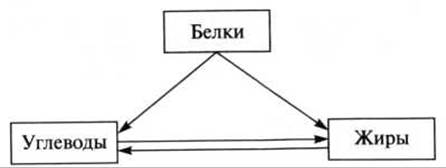
For the normal functioning of the human body, not only the intake of an adequate amount of nutrients is essential, but also their optimal ratio. The most nutritionally balanced ratio of proteins, fats, and carbohydrates is considered to be 1:1:4.
Last update: 08/08/2026
Editorial and Educational Adaptation: This material has been compiled based on the primary/original source text. The project team performed an editorial review, corrected technical inaccuracies, structured sections, and adapted the content for an educational format.
What was processed:
- elimination of formatting defects (OCR errors, structural breaks, corrupted characters);
- editorial organization of content;
- standardization of terminology in accordance with academic sources;
- verification of factual statements against the original source text.
All mentions of the author, publication year, and origin of the primary text have been preserved in accordance with the source.