HUMAN MEDICAL BIOLOGY, ANATOMY, PHYSIOLOGY AND PATHOLOGY - Y.I. Fedoniuk 2010
BIOLOGY
SECTION 1. BIOLOGICAL BASES OF HUMAN VITAL ACTIVITY
1.2. CELL. TISSUES. CONCEPT OF AN ORGAN, ORGAN SYSTEM, AND ORGANISM
BLOOD AND LYMPH
Blood and Lymph are the Tissues that form the internal environment of the Organism. They have a fluid consistency.
Blood consists of Cells (formed elements of blood) and intercellular substance (plasma).
The main Functions OF BLOOD are transport, protective, and homeostatic (see Section VI).
Blood Plasma is a colloidal system containing 90 to 93% Water and 7-10% dry matter. Of the dry matter, approximately 6.6-8.5% consists of protein substances, and 1.5-3.5% comprises other organic and mineral compounds.
Plasma contains Proteins, fats, CARBOHYDRATES, and other Organic compounds, as well as final metabolic products such as urea, uric acid, creatinine, etc., which enter the blood from tissues and are transported via the bloodstream to the Kidneys and, partially, to the Skin. Plasma Proteins include albumins, globulins, and fibrinogen, whose composition and quantity in the blood remain constant. Most plasma proteins are synthesized by Liver cells. Fibrinogen occupies a special place among blood proteins because it has The ability to become insoluble under certain conditions and acquire a fibrous Structure, converting into fibrin. This process is called blood clotting. Plasma also contains Mineral Substances—sodium, potassium, calcium, magnesium, chlorine, phosphorus, iodine, zinc, etc., which are predominantly bound to proteins or other organic compounds.
Formed elements of blood (Fig. 1.17). The formed elements of blood include erythrocytes, platelets, and leukocytes. Among them, only leukocytes are true cells. Erythrocytes and platelets are non-cellular structures of living matter.
Class="center">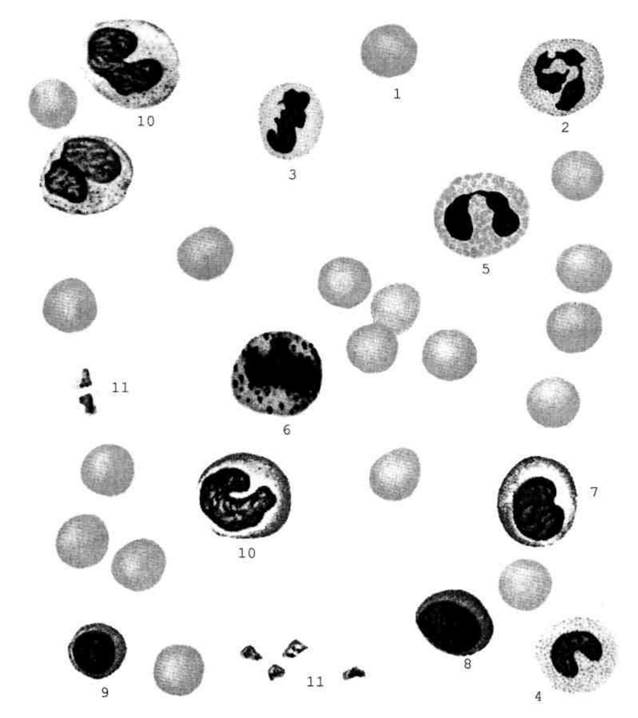
Fig. 1.17. Human blood smear (Romanowsky staining) Х 900: 1 - erythrocyte; 2 - segmented neutrophil leukocyte; 3 - band neutrophil leukocyte; 4 - metamyelocyte (young neutrophil leukocyte); 5 - eosinophil leukocyte; 6 - basophil leukocyte; 7 - large lymphocyte; 8 - medium lymphocyte; 9 - small lymphocyte; 10 - monocytes; 11 - Blood Platelets.
Erythrocytes (Fig. 1.18), or red Blood Cells, are the most numerous formed elements of blood. In humans, they are post-cellular structures that have lost their Nucleus and almost all Organelles during development. Erythrocytes are formed in the Cytology/practical/86.html">Red Bone Marrow, and their lifespan is 100-120 days. They are degraded by macrophages of the Spleen and (to a lesser extent) The Liver and red bone marrow.

Fig. 1.18. Erythrocytes (red blood cells).
The functions of erythrocytes are performed within the vascular bed. They include:
1. Respiratory function, which is provided by Hemoglobin.
2. Transport function — erythrocytes adsorb A number of BIOLOGICALLY ACTIVE SUBSTANCES On the surface of their Plasmalemma (Amino Acids, IMMUNOGLOBULINS, immune complexes, certain drugs).
Erythrocytes of atypical shapes (poikilocytes) are sometimes encountered: spherical (spherocytes), with a flat surface (planocytes), and spiky cells (echinocytes). When up to 20% of various erythrocyte shapes are found in peripheral blood, it is referred to as physiological poikilocytosis. When their number exceeds this indicator, it is considered pathological poikilocytosis (Fig. 1.19).
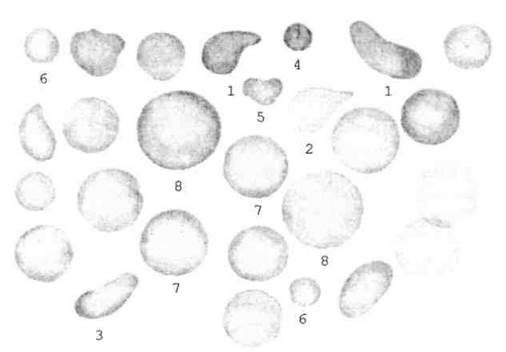
Fig. 1.19. Poikilocytosis and anisocytosis (Romanowsky staining) x 900:
1, 2, 3, 5 - poikilocytes; 4, 6 - microcytes; 7 - normocytes; 8 - macrocytes.
Platelets (thrombocytes) are small anuclear corpuscles of round, oval, or spindle shape. These are post-cellular structures formed As a result of the fragmentation of the Cytoplasm of giant bone marrow cells—megakaryocytes. They are the smallest formed elements of blood (2-3 µm), performing functions both inside and outside the vascular bed. Platelets participate in Blood Coagulation (their enzyme thromboplastin converts fibrinogen into fibrin) and form a thrombus upon vessel damage (platelets disintegrate, and fibrin threads form around them). Platelets reduce the permeability of vessel walls and contain substances that constrict Blood Vessels when damaged.
The lifespan of platelets is 5-8 days. Due to their property of agglutination (clumping), platelets are found in groups in blood smears.
Leukocytes (white blood cells) comprise a group of morphologically and functionally diverse formed elements that circulate in the blood and participate in the body's defense reactions. All leukocytes are nucleated, spherical structures. These cells are capable of active amoeboid movement via pseudopodia (cytoplasmic extensions), changing their shape in the process. Leukocytes play a vital role in protecting the body against microorganisms and foreign bodies that invade the bloodstream or tissues. When a foreign body is small, leukocytes phagocytose and digest it by breaking it down with their Enzymes. In addition, leukocytes are involved in The production of immune bodies.
The Classification of leukocytes is based on several criteria, the primary one being the presence of specific granulation in their cytoplasm. Based on this feature, all leukocytes are divided into granulocytes and agranulocytes.
Lymph is a slightly yellowish fluid that flows through lymphatic capillaries and vessels. It consists of lymphoplasma and formed elements (Fig. 1.20). In its chemical composition, lymphoplasma is similar to blood plasma, but contains less protein. Among the protein fractions, albumins predominate over globulins. Lymphoplasma also contains neutral fats, simple sugars, solutions of mineral salts NaCl, Na2Cа3, as well as various compounds containing calcium, magnesium, and iron.
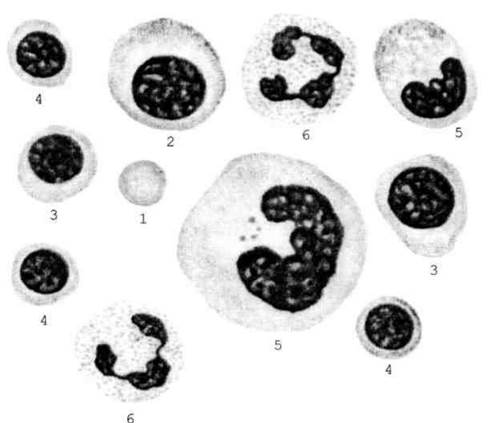
Fig. 1.20. Lymph smear (Romanowsky staining) x 900: 1 - erythrocyte; 2 - large lymphocyte; 3 - medium lymphocyte; 4 - small lymphocyte; 5 - monocyte; 6 - neutrophilic granulocyte.
The formed elements of lymph include lymphocytes (98%), monocytes, and a small number of other leukocyte types. Erythrocytes are rarely encountered.
Lymph is formed in the lymphatic capillaries of tissues and Organs by the absorption of tissue fluid. From the capillaries, lymph flows into peripheral Lymphatic vessels, then into Lymph Nodes, and further into major lymphatic vessels before emptying into the bloodstream. Consequently, the composition of lymph varies. For instance, lymph draining from the gastrointestinal tract is rich in fats, proteins, and sugars. Lymph passing through the lymph nodes becomes enriched with agranulocytes and other cells. Therefore, a distinction is made between peripheral lymph (before the lymph nodes), intermediate lymph (after passing through the lymph nodes), and central lymph (from the thoracic and right lymphatic ducts).
The process of Lymph formation is closely related to the Movement of water from the blood into the intercellular space and the Formation of tissue fluid. Humans produce about 1.5 liters of lymph per day.
Last update: 08/08/2026
Editorial and Educational Adaptation: This material has been compiled based on the primary/original source text. The project team performed an editorial review, corrected technical inaccuracies, structured sections, and adapted the content for an educational format.
What was processed:
- elimination of formatting defects (OCR errors, structural breaks, corrupted characters);
- editorial organization of content;
- standardization of terminology in accordance with academic sources;
- verification of factual statements against the original source text.
All mentions of the author, publication year, and origin of the primary text have been preserved in accordance with the source.