Review of Medical Physiology - William F. Ganong 2002
Endocrine System, Metabolism, and Reproduction
Hormonal Regulation of Calcium Metabolism and Bone Physiology
Calcium and Phosphorus Metabolism
Calcium
The body of a young adult contains about 1,100 g (27.5 mol) of calcium, 99% of which is located in the Skeleton. Plasma calcium, normally 10 mg/dL (5 mEq/L, 2.5 mmol/L), is partly bound to Proteins and partly soluble (Table 21-1). Its cellular distribution is described in Chapter 1.
Free, ionized calcium in Body Fluids is a vital secondary messenger (see Chapter 1) and is required for Blood Coagulation, Muscle contraction, and nerve function. A decrease in extracellular Ca2+ elicits an ultimate excitatory effect in nerve and muscle Cells in vivo (see Chapter 2). This results in hypocalcemic tetany, accompanied by severe Skeletal Muscle spasms, including those of the extremities and the Larynx. Laryngospasm can be so severe that the airway becomes completely obstructed, leading to fatal asphyxia. Ca2+ ions play a crucial role in blood clotting (see Chapter 27); however, the in vivo level of Ca2+ at which lethal tetany occurs is nevertheless higher than the level at which blood coagulation defects become apparent.
Because the degree of Ca2+ binding to Plasma Proteins is proportional to the plasma protein level, knowing this level is essential when evaluating total plasma calcium. Ionized plasma calcium can be measured using a calcium-sensitive electrode. The level of Ca2+ is influenced by electrolytes and pH. For example, symptoms of tetany appear at significantly higher calcium levels when a patient undergoes hyperventilation, which leads to an increased plasma pH. Plasma proteins are more ionized at high pH values due to The formation of a greater number of protein anions available to bind Ca2+.
Bone calcium exists in two forms: a readily exchangeable reservoir and a much larger pool of stable calcium that undergoes only slow turnover. There are two distinct, independent homeostatic systems that interact and influence bone calcium. One system regulates plasma Ca2+, with 500 mmol of Ca2+ turning over daily through the readily exchangeable bone calcium pool (Fig. 21-1). The other system is associated with bone remodeling through the continuous interplay between bone resorption and formation (see below), accounting for 95% of Bone Formation in adults. However, the exchange of Ca2+ between the plasma and this stable pool amounts to 7.5 mmol per day.
A large amount of calcium is filtered by the Kidneys, but 98% to 99% of it is reabsorbed. About 60% of reabsorption occurs in the proximal tubules, with the remainder taking place in the ascending limb of the Loop of Henle and the distal tubules of the nephron. Reabsorption in the distal tubules is regulated by parathyroid hormone.
Class="center">Table 21-1. Normal distribution of calcium in human Blood Plasma, mmol/L
Total diffusible |
1,34 |
|
Ionized (Ca2+) |
1,18 |
|
Complexed with HCO3-, citrate, etc. |
0,16 |
|
Total non-diffusible (protein-bound) |
1,16 |
|
Bound to albumin |
0,92 |
|
Bound to globulin |
0,24 |
|
Total plasma calcium |
2,50 |
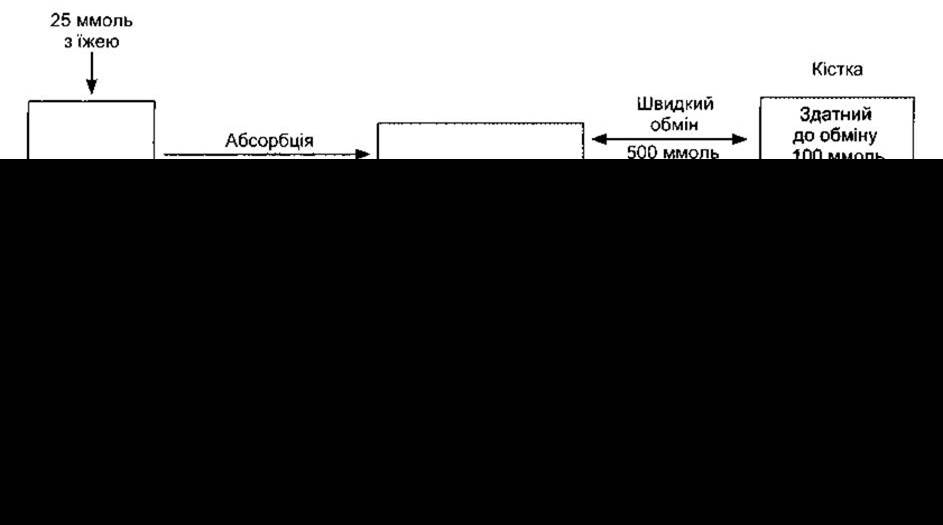
Fig. 21-1. Calcium METABOLISM in an adult human consuming 25 mmol (1000 mg) of calcium per day.
Absorption of Ca2+ from the gastrointestinal tract is described in Chapter 25. Ca2+ cations are actively transported from the intestine by a brush border epithelial Cell transport system that includes a calcium-dependent ATPase; this process is regulated by 1,25-dihydroxycholecalciferol (see below). Some absorption also occurs via passive diffusion. When Ca2+ intake is high, the level of 1,25-dihydroxycholecalciferol decreases due to the elevation of plasma Ca2+. Ultimately, Ca2+ absorption exhibits adaptation; that is, it is high when Ca2+ intake is low and decreases as Ca2+ levels rise. Calcium absorption is also reduced by substances that form insoluble salts with Ca2+ (such as phosphates and oxalates) or by alkalis that promote the formation of insoluble calcium soaps. A high-protein diet enhances absorption in adults.
Phosphorus
Phosphate is a constituent of ATP, cAMP, 2,3-diphosphoglycerate, many proteins, and other vital cellular compounds. Protein phosphorylation and dephosphorylation are involved in the Regulation of cellular Functions (see Chapter 1). Therefore, it is not surprising that phosphate metabolism is tightly regulated. Total body phosphorus is 500-800 g (16.1-25.8 mol), with 85-90% of it contained in the skeleton. Total plasma phosphorus is about 12 mg/dL, two-thirds of which is in Organic compounds, while the remaining inorganic phosphorus (Pi) is present predominantly as PO43-, HPO42-, and H2PO4-.
The amount of phosphorus normally entering the bone is approximately 3 mg (97 µmol)/kg/day, which is equivalent to the amount leaving it via reabsorption.
Filtration of plasma Pi occurs in the renal glomeruli, and 85-90% of the filtered Pi is reabsorbed. Active Transport in the proximal tubules accounts for the majority of this reabsorption, a process strongly inhibited by the action of parathyroid hormone (see below).
Absorption of Pi in the duodenum and Small Intestine occurs via both active transport and passive diffusion. However, unlike Ca2+ absorption, Pi absorption is linearly proportional to its dietary intake. Many factors that enhance Ca2+ absorption, including 1,25-dihydroxycholecalciferol, also promote Pi absorption.
Last update: 10/08/2026
Editorial and Educational Adaptation: This material has been compiled based on the primary/original source text. The project team performed an editorial review, corrected technical inaccuracies, structured sections, and adapted the content for an educational format.
What was processed:
- elimination of formatting defects (OCR errors, structural breaks, corrupted characters);
- editorial organization of content;
- standardization of terminology in accordance with academic sources;
- verification of factual statements against the original source text.
All mentions of the author, publication year, and origin of the primary text have been preserved in accordance with the source.