THEORETICAL FOUNDATIONS OF FISH FARMING - I.M. Sherman - 2011
2. THEORETICAL FOUNDATIONS OF THE FORMATION AND UTILIZATION OF FISH PRODUCTIVE PROPERTIES
2.4. Ecological and physiological foundations of natural and artificial fish reproduction
Unlike warm-blooded wild and domestic animals and birds, fish breeding has considerable specific features due to their species diversity combined with the exceptionally high significance of abiotic, biotic, and anthropogenic factors. At the same time, the First and Second groups of factors can affect fish directly, whereas the third group—production factors—can act both directly and indirectly through Changes in the quantitative and, consequently, qualitative CHARACTERISTICS OF THE conditions of habitat, reproduction, and rearing of fish. Unfortunately, objective reality indicates that the intensity of anthropogenic factors tends to increase due to the expansion of human economic activity on regional and planetary scales. Hydrological regimes and the physicochemical parameters of continental and marine waters are changing, which objectively and negatively affects the species composition, Abundance, and biomass of hydrobionts, and fish in particular.
At the same time, it is necessary to consider the fact that the Criteria for the ecological plasticity of a certain fish species must be differentiated in connection with their respective life cycles. With this approach, it becomes apparent that the fish reproduction process is characterized by a rather narrow ecological plasticity and is exceptionally conservative, which is typical for the vast majority of valuable fish species. This considered biological feature is actually reflected in the population dynamics of fish when the ecology of reproduction is disrupted, resulting in low-yield generations appearing in certain years. Thus, the disappearance of certain fish species from commercial fisheries occurs over a rather long period, followed by a series of low-yield generations of juveniles, with each successive generation lower in yield than the previous one. If this trend persists in time and space, the prospect is quite negative, namely the complete cessation of reproduction and the disappearance of the species not only from commercial fisheries but also from the ichthyofauna COMPOSITION OF THE respective Water body.
Under such conditions, the fishery significance of a water body can be preserved through well-grounded re-acclimatization work combined with the rational exploitation of the reservoir based on the principles of pasture aquaculture, which has found Structure/175.html">Implementation in the practice of modern global fish farming.
However, the aforementioned practice of preserving the fishery significance of water bodies has become a reality only because theoretical foundations were developed for artificial fish breeding and the rearing of hardy fish stocking material used as introducents for the targeted formation of ichthyofauna in natural and anthropogenic water bodies while preserving the native ichthyofauna.
Returning to the specific reproductive features of each species, it is advisable to consider this process from an adaptive perspective. The Specificity or species-Specific features of this process are nothing other than adaptations to specific conditions of reproduction and juvenile development, ensuring the cyclicity of replenishment necessary for the preservation of the species and the maintenance of its population size within the range.
The size of replenishment and its qualitative parameters depend on the quality of the spawning population, as well as the conditions of Embryogenesis and early postembryogenesis.
Fish reproduction has its specific features characteristic of aquatic animals and determined by living in water, which must be taken into account during breeding. At the same time, unlike warm-blooded animals living in water, in the absolute majority of fish, egg Fertilization occurs outside the maternal Organism, specifically in the external environment. Eggs and spermatozoa remain in the water for some time before fertilization, outside the individual spawners, where the penetration of spermatozoa into the egg and The formation of the zygote take place, which signifies the act of fertilization.
Based on the foregoing, it is clear that environmental factors directly influence the reproduction process under natural conditions, being of paramount importance in fish breeding. At the same time, It is worth remembering that spawning is an exceptionally weighty component of reproduction, but it is a peculiar finale preceded by The process of forming the Reproductive System. The duration of this process and the quality of sex products depend not only on species-specific features; abiotic and biotic environmental factors and the degree of their dependence on anthropogenic factors acquire significant importance here.
To obtain high-grade sex products formed in the respective Gonads, it is necessary to have information regarding the process taking place in the gonads until sexual maturity is reached.
Stage I - sexually immature (juvenile) young individuals. The gonads appear as thin, transparent cords adjacent to the body cavity walls. The sex Cells of females may be represented by oogonia or young oocytes of the protoplasmic growth period, while the sex cells of males are represented by spermatogonia.
Oogonia, or the primary germ cells of females, are formed from the germinal epithelium throughout life. These cells are round and small in size, making it impossible to detect them visually. For this purpose, histological preparations are made and examined under a Microscope at high magnification. They are transparent and have a relatively large Nucleus surrounded by a thin layer of protoplasm (Fig. 2.1, 2.2).
Class="center">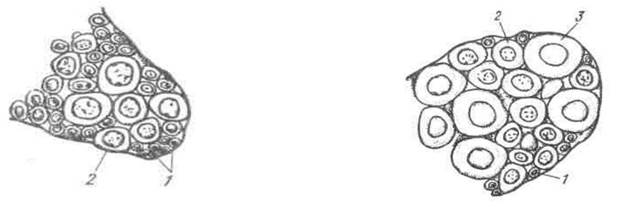
a b
Fig. 2.1. - Areas of Ovaries of maturity stage I (a) and II (b):
1 - oogonia; 2 - oocytes at the beginning of protoplasmic growth; 3 - oocytes at the end of protoplasmic growth
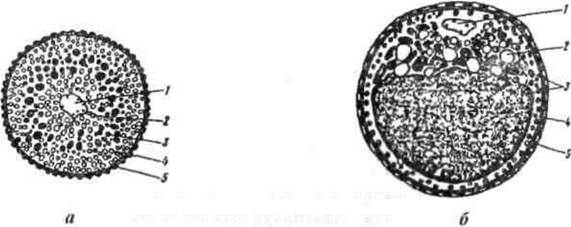
Fig. 2.2. - Oocytes from ovaries of maturity stage III (a) and IV (b): 1 - nucleus; 2 - fat droplets; 3 - yolk; 4 - vacuoles; 5 - oocyte membrane.
Oogonia develop and divide, leading to an increase in their number. This period in germ Cell development is called the period of oogonia division. Thereafter, some of the oogonia cease the division process, undergo a period of transformations in The Nucleus (the so-called synaptinemal path), and begin to increase in size (growth). The sex Cells of the growth period are called oocytes. The growth of young oocytes occurs due to an increase in The amount of protoplasm — this period of their development is called the period of protoplasmic, or minor, growth (2.3).

Fig. 2.3. - Cross-section of Testis tubules at various maturity stages (a - I; b - II; c - III; d - IV stages): 1 - Blood vessel with erythrocytes; 2 - spermatogonium; 3 - division of spermatogonium; 4 - testis membrane; 5 - cyst with primary spermatocytes; 6 - cyst with mature spermatocytes; 7 - spermatozoa; 8 - cyst with spermatids; 9 - cyst with divided secondary spermatocytes; 10 - follicular epithelium
Spermatogonia are primary Male Germ Cells formed from the peritoneal epithelium. They are present in males at any time of the year and at any stage of the sexual cycle. These are the largest cells in the Testes, characterized by a round shape and a relatively large nucleus surrounded by a thick layer of Cytoplasm.
Stage II - maturing individuals or individuals in which The Development of sex products takes place after spawning. The ovaries are transparent, practically colorless. A large blood vessel with branches runs lengthwise. In the ovaries of certain fish, particularly sturgeons, a significant amount of Adipose tissue is present. When examining ovaries under magnification, oocytes of the protoplasmic growth period are clearly distinguishable, making up the bulk of the sex cells. A significant number of oocytes undergo the final phases of this period. They are relatively large in size due to the enlargement of the nucleus and the volume of the cytoplasm (2.4).

Fig. 2.4. - Scheme of oogenesis and Spermatogenesis
Individual oocytes have completed protoplasmic growth and can already be distinguished with the naked eye. A layer of follicular cells, originating from the ovarian germinal epithelium, begins to form around the oocytes. This marks the beginning of the Formation of the follicular envelope. Along with the oocytes that have passed through the period of protoplasmic growth, the ovaries also contain oogonia and oocytes in the initial Phases of the minor growth period. These germ cells act as a reserve pool that can be utilized by the females of polycyclic fish species (those spawning multiple times throughout their life) after upcoming spawning, during the next maturation cycle of reproductive products.
The testes appear as rounded cords or thin grayish or pinkish-white filaments. In migratory herrings, salmon, and certain other fish species, the testes may acquire various shades from pink to crimson-red due to the intensive Development of Blood Vessels. The male germ cells are represented by spermatogonia in a state of proliferation.
Spermatogonia divide several times, which increases their number while decreasing their size. Thus, from each initial large spermatogonium, a group of smaller spermatogonia enclosed in a common envelope is formed. These groups of germ cells are called cysts. The proliferation of spermatogonia leads to an increase in the size of the testis, accompanied by its clouding and loss of transparency.
Stage III — the gonads are well developed. The ovaries occupy half the volume of the Abdominal cavity AND contain oocytes visible to the naked eye. The oocytes increase in size due to the expansion of protoplasm volume and the accumulation of trophic substances, represented by yolk granules and lipid droplets. This period of oocyte development is designated as the trophoplasmic, or major growth, period. The completion of the growth period is characterized by oocytes reaching sizes that vastly exceed (by many tens of times) the initial dimensions of the oogonia. At the same time, the oocytes lose transparency, become turbid, and acquire a coloration ranging from light yellow with various shades to bright orange due to lipid droplets and yolk granules, leading to a general change in the color of the ovaries. In sturgeons, due to the accumulation of small brownish-black pigment granules in the upper layer of the cytoplasm, the oocytes acquire their characteristic dark coloration. In addition to lipid droplets and yolk granules, vacuoles containing carbohydrate-like substances appear in the oocytes of teleost fish.
At this stage, the formation of the oocyte envelope takes place. Initially, microfunnels form on the oocyte surface, at the base of which a thin layer of homogenous, structureless material develops, directly contacting the oocyte surface and situated at some distance from the follicular cells. As the accumulation of yolk inclusions increases, an additional layer consisting of bundles of tubular structural elements is formed within the oocyte. It is located directly between the thin homogenous layer and the cytoplasmic surface. Subsequently, the inner structural layer transitions into a homogenous outer layer, and both layers form a single envelope. In sturgeons, chum salmon, Baltic herring, perch, Atlantic and Pacific herrings, and certain other fish species, this envelope consists of two layers: outer and inner. In many other species, as a rule, it has only a single layer. The envelope is pierced by canaliculi containing oocyte microvilli. Under a microscope, a characteristic radial striation is visible on the oocyte envelope, formed by the finest pores of the canaliculi, which is the basis for its name — the zona radiata. The envelope itself is represented by an intercellular substance penetrated by radial canaliculi through which the oocyte microvilli pass. Thus, the oocyte with the formed zona radiata is surrounded by follicular cells that form the follicular envelope, or follicle. The outer surface of the follicle is covered by a Connective Tissue layer. Above the zona radiata, an additional outer envelope—which may be homogenous or villous in structure—forms in the oocytes of A number of fish species. At the same time, specific features can be observed across different fish types. The roach has a villous outer envelope; in sturgeons, a second envelope forms On the surface of the zona radiata, consisting of radially arranged columns (alveolar layer). Such an envelope is referred to as reticular, gelatinous, or alveolar. A number of fish species are characterized by the formation of outgrowths on the zona radiata in the form of ridges and threads. In some fish species, these outgrowths are distributed uniformly across the entire zona radiata, whereas in others they are localized to specific areas. The Structural Features of oocyte envelopes in different fish species are due to adaptations of the egg to embryogenesis conditions developed in the course of phylogeny. Thus, in fish whose eggs develop in the water Column, the risk of mechanical injury is minimal, and maximum
buoyancy of the eggs is required; therefore, the oocytes have a very simple envelope structure, represented solely by the zona radiata, or covered additionally on top by a very thin homogenous layer. In fish that spawn on the bottom and submerged vegetation, where the probability of mechanical damage is quite high, oocytes possess a zona radiata and an outer envelope, or, in the absence of the latter, outgrowths on the zona radiata. When the egg enters the water, the outer envelope or the outgrowths swell, become sticky, and act as a specific organ ensuring the fixation of the eggs to the substrate.
Obviously, the Third Stage of ovarian maturity is characterized by the presence of oocytes undergoing trophoplasmic growth. Alongside this, germ cells of the reserve pool, represented by oogonia and oocytes in the protoplasmic growth period, are present in the ovaries of polycyclic fish.
The testes at the third stage of maturity significantly increase in volume, becoming dense and firm. At the beginning of this stage, their color is pinkish-gray, and by the end, yellowish-white. The seminiferous tubules are filled with cysts and germ cells. Having passed through the proliferation period In the second stage of testicular maturity, the spermatogonia enter the growth period and transform into primary spermatocytes. A certain increase in the size of these cells is observed, accompanied by complex nuclear transformations that play a rather significant role in heredity. Afterward, the male germ cells enter the maturation period and undergo two successive divisions. The result of this division is the formation of two secondary spermatocytes from each primary spermatocyte, and subsequently four spermatids, which differ from the initial cells by their smaller size and a relatively large nucleus surrounded by the thinnest layer of cytoplasm. As a result of this double division, the chromosome number in the spermatids is halved, which is closely linked to heredity. The resulting spermatids enter the differentiation period and gradually transform into mature spermatozoa. The shape of the spermatozoan HEAD varies among different fish species. In most teleost fish, the head shape is spherical, oval, or acorn-like; in sturgeons and certain other species, the head is rod-shaped (Fig. 2.5).
The bulk of the spermatozoan head is represented by the nucleus; in sturgeons, a small cap-like structure called the acrosome is located at the anterior part of the head, whereas in other species, an analogous structure is absent. Adjoining the posterior part of the head is the midpiece of the spermatozoan, in the formation of which The Cell center, Mitochondria, and spermatids participate. The midpiece, in turn, passes into the tail, which is formed by a central axoneme surrounded by a layer of cytoplasm and covered on the surface by The Plasma Membrane. The tail provides the motility of the spermatozoan. Upon completion of formation of the spermatozoa within the cysts, the cyst envelope breaks down, and they lie freely in the seminiferous tubule. The spermatozoa are immotile in the seminal fluid and acquire the capacity for movement only upon contact with water.
These are the smallest cells among all the initial germ cells produced by the testes.
Summarizing the above, it should be emphasized that the testes at the third stage of maturity initially contain spermatogonia, Primary and secondary spermatocytes, and spermatids, while by the end of the stage, separate groups of mature spermatozoa appear.
Stage IV — the eggs are large, have practically reached their corresponding size and mass, and occupy the greater part of the body cavity. The color of the ovaries varies widely among species. Usually, it is yellow-orange, and in sturgeons, gray or almost black, which is associated with the degree of oocyte pigmentation. Even in females of the same fish species, the color of the ovaries can differ. The ovaries contain oocytes that have completed trophoplasmic growth and are ready for ovulation during spawning in the reproductive season. In the ovaries at this stage in certain fish species, along with these germ cells, oogonia and protoplasmic growth oocytes are also present, forming a distinctive reserve pool. Oocytes that have completed trophoplasmic growth and reached the dimensions characteristic of the eggs of a given fish species enter the maturation period, specifically the phase that completes germ cell development. A characteristic diagnostic sign of this phenomenon is the Displacement of the oocyte nucleus toward the micropyle. Teleosts have a single micropyle, whereas sturgeons have several. The micropyle is a canal that pierces the zona radiata and the gelatinous envelope (if present in the oocyte). This canal has the shape of a funnel-like depression on The surface of the envelope(s), terminating in a short terminal tubule that opens into the cytoplasm inside the zona radiata. The displacement of the nucleus within the oocyte leads to a polar arrangement of the nucleus and yolk: at one pole — the animal pole — lie the nucleus and the bulk of the cytoplasm, while at the other — the vegetative pole — lies the yolk. Subsequently, the complete or partial coalescence of yolk and fat imparts transparency to the oocytes (Fig. 2.6).

Fig. 2.6. - Micropyle of a mature oocyte of the largemouth buffalo:
1 - oocyte funnel; 2 - micropyle funnel; 3 - micropyle tubule; 4 - chorion.
At the Fourth Stage of maturity, the testes reach their maximum size, acquire a milky-white color, and spermatogenesis is completed within them. The seminiferous tubules of the gonads contain mature spermatozoa that have emerged from the cysts. At the same time, a reserve pool of germ cells, represented by spermatogonia, is preserved in the testes. Upon Palpation of the fish's abdomen, droplets of semen having the consistency of thick sour cream emerge from the genital opening.
Stage V — reproductive products are fluid, and spawning is underway. Upon gentle palpation of the fish's abdomen, eggs and sperm flow freely from the genital opening. This stage completes the process of oocyte preparation for fertilization. In the oocytes of sturgeon fish, the nucleoli of the nucleus dissolve, and its envelope becomes folded on the vegetative side, through which karyoplasm partially escapes into the cytoplasm. In this part of the oocyte, a large lacuna forms, filled with material lacking yolk granules. The nucleus rapidly decreases in size, the plasma mixes substantially with the cytoplasm, and its insignificant portion is represented by surviving islands that form a peculiar sprawling network. Upon completion of this process, the nuclear envelope dissolves, and meiotic division begins. The process concludes with the release of the oocytes from the follicular and connective tissue envelopes. The follicles rupture, and the oocytes in most fish species are shed into the ovarian cavity, whereas in salmonids and sturgeons, which have open ovaries, they are shed into the body cavity.
Follicular rupture and release into the ovarian or body cavity (ovulation) occurs synchronously in some fish species, while in others this process is protracted over time. The ruptured follicles remain in the ovaries, where they are eventually resorbed. In the ovaries of polycyclic fish, aside from the ruptured follicles, germ cells of the reserve pool are also present.
At the fifth stage of maturity, seminal fluid is produced in the testes, which dilutes the concentration of spermatozoa and facilitates their free outflow. The semen has the consistency of milk or liquid sour cream; the testes are soft, and their size decreases as the semen is discharged.
Stage VI - II — reflects the post-spawning state of the gonads, with eggs and spermatozoa having been discharged during spawning. During this period, the ovaries are small in size and characterized by flaccidity and inflammation. A crimson-red color, caused by hemorrhages associated with follicular ruptures, is typical. Empty follicles and individual mature eggs that remain unspawned are resorbed during the post-spawning period. Polycyclic fish are characterized by the presence of a reserve in the ovaries, represented by immature germ cells. Such a phenomenon is absent in monocyclic fish, which spawn only once in their lifetime. The composition of the germ cells forming the reserve pool of polycyclic fish species is represented by structures corresponding to the Second Stage of ovarian maturity. Thus, the next cycle in this case begins with the second stage of ovarian maturity (Fig. 2.7).

Fig. 2.7. - Stages of gonad development in fish: a - monocyclic and first-spawning fish; b - polycyclic and iteroparous fish.
Naturally, under conditions of normal progression through the respective stages of gonad sexual maturity, high-quality reproductive products will be obtained.
At the same time, abiotic environmental factors acquire exceptional importance, especially their specific parameters that ensure normal Nutrition under natural conditions, whereas in artificial environments, this process can be adjusted through feeding.
Examining the eco-Physiological foundations of natural and artificial fish reproduction, it must be emphasized that the core lies in the highly complex biology of reproduction, whose species-specific regulation is neurohumoral in nature. There are two functional components: the presence of sexually mature females and males, on the one hand, and the suitability of spawning conditions, which encompass a combination of abiotic and biotic factors, on the other.
The ichthyofauna includes eurybiont species that generally adapt easily to various reproductive conditions; however, the vast majority of economically valuable species are stenobionts, which easily lose their reproductive capacity amidst changing abiotic and
biotic environmental factors.
In this regard, the historical context is that since ancient times, specialists involved in the domestication of various fish species have encountered varying levels of reproductive capacity in captivity, which was a critical factor in selecting species suitable and feasible for cultivation.
For a long time, specialists focused their efforts on creating conditions as close to natural as possible in order to achieve successful reproduction in captivity. While some success was achieved along this path, for many desired fish species the problem remained far from resolved, which gave rise to METABOLISM/2.html">THE CONCEPT OF ecological Methods for holding broodstock to ensure sexual maturity. Prolonged research into the effectiveness of ecological methods for stimulating and ripening gonads revealed the limitations of this approach, and its complete unsuitability for certain fish species in aquaculture operations.
In the 1930s and 1940s, the concerted efforts of specialists in physiology, ichthyology, and pisciculture significantly broadened the understanding of The Mechanism of fish spawning in the wild, opening up new opportunities for fish cultivation under aquaculture regimes.
The Essence of this mechanism is that broodstock of certain fish species, having gonads at the completed stage IV of maturity, begin migrating toward spawning grounds upon the onset of spawning temperatures in the natural environment. Along this path, a gradual transition from stage IV to stage V of maturity takes place. However, the completion of this stage occurs exclusively at the spawning grounds, provided that all relevant abiotic and biotic factors are present.
The aggregate of these relevant factors, in terms of their Qualitative and quantitative characteristics, is perceived by the fish's Sensory Organs, which transmit corresponding signals to the Brain. There, the signals reach a critical mass and prompt the brain to influence the appropriate endocrine gland. Acting upon this neural signal, the Pituitary Gland—which serves as this gland—secretes or releases pre-synthesized gonadotropic hormone into the bloodstream. Carried by the blood, the gonadotropic hormone reaches the gonads of sexually mature individuals, ensuring the transition from completed stage IV to stage V of maturity. A clear visual criterion of this phenomenon is the free discharge of eggs and milt, respectively, which ensures fertilization upon their direct contact.
Immediately after fertilization, spermatozoa activated by water penetrate the oocyte, forming a zygote—the onset of embryogenesis.
In artificial maintenance conditions, a number of stenobiotic species may fail to reach completed stage IV maturity, while others do reach this stage depending on housing conditions. Alongside this, the transition to stage V is quite problematic, and not every species demonstrates this capability. Maximizing the ecologization of maintenance conditions in aquaculture does not provide appropriate guarantees for a number of fish species, and certain species practically fail to respond to such measures; the transition from completed stage IV to stage V does not occur, ruling out the possibility of obtaining high-quality Gametes.
The inability of certain fish species to spawn in natural conditions is due to the fact that their sensory organs are unable to receive the appropriate stimuli, no corresponding signals reach the brain, and consequently, the brain fails to issue the specific command to the pituitary gland. In turn, the pituitary gland, as an endocrine gland, remains passive and does not release gonadotropic hormone into the blood, which—by saturating the bloodstream—would otherwise drive the transition of the gonads from completed stage IV to stage V. Eggs and milt are not expelled into the external environment, precluding artificial reproduction.
Comprehending the aforementioned information allows us to state that without an adequate concentration of pituitary gonadotropic hormone in the blood of fish, the transition of gametes from completed stage IV to stage V of maturity—where gametes flow freely into the external environment—is fundamentally impossible.
A conceptual examination of the objectively existing spawning mechanism leads to the Conclusion that to ensure reproductive success, it is necessary to achieve an optimal concentration of pituitary gonadotropic hormone in the blood of sexually mature individuals. This makes it possible to advance the gonads from completed stage IV to stage V of maturity, which ensures the free release of gametes into the external environment. Their subsequent mutual contact is regarded as fertilization, under which the probability of potential fertilization arises, in turn requiring appropriate conditions and demonstrating varying efficiency.
Guided by the above, so-called pituitary injections using preparations of natural origin, obtained from sexually mature individuals of a specific species taken from the wild, were proposed. Proceeding along this path, scientists and practitioners eventually explored The Use of preparations from other fish species. In both the first and second cases, the pituitary hormone can be obtained exclusively from sexually mature individuals and preferably during the pre-spawning period.
Considering the possibility of achieving spawning in artificial conditions and relying on the trend of ecologizing broodstock maintenance during the pre-spawning period in aquaculture, this method became known as the ecological method. An objective evaluation of this method demonstrates its significant limitations, which act as an obstacle to industrial application.
When examining the possibility of achieving spawning in artificial conditions through the artificial administration of a pituitary preparation and its delivery into the blood of sexually mature individuals, a positive result was far from always observed in all fish species.
For fish, as poikilothermic animals, the trigger for the onset of pre-spawning migration, which transitions into spawning migration, is water Temperature. For thermophilic fish species with spring-summer spawning, this is an increase in water temperature approaching spawning thresholds. For cold-water fish species with autumn-winter spawning, this is a drop in water temperature approaching spawning levels.
When the thermal regime corresponds to the species requirements and a number of other abiotic factors are within species-normal ranges, the action of the artificially administered pituitary gonadotropic hormone is adequate and ensures the transition of the gonads to stage V maturity.
Thus, it became clear that The Effect of the pituitary gonadotropic hormone upon artificial administration yields a positive outcome exclusively in the presence of certain (partial, yet essential) abiotic environmental parameters, among which water temperature dominates.
Based on the presented information, it became evident that the effectiveness of the physiological component can only yield positive results under conditions where specific abiotic environmental parameters are met.
For this reason, we believe it is appropriate to replace the existing term "combined method" with the "eco-physiological method" for stimulating the transition of fish gonads from stage IV to stage V in order to obtain high-quality gametes in artificial conditions.
Today, alongside naturally derived gonadotropic hormone, synthesized preparations with analogous action are widely available. Such widespread availability of stimulators has made it possible to utilize optimal conditions for respective fish species, and the method itself has become widespread in modern pisciculture practice.
In practical fish breeding work, essential components include knowledge of The Theory of fish fertilization, fertilization selectivity, The impact of sperm quality on progeny development, the specifics of broodstock Selection to ensure high-quality offspring, and The Influence of broodstock age on breeding performance indicators.
When reviewing the theory of fish fertilization, it is appropriate to provide a brief Historical Overview that sheds light on the evolution of views related to understanding the very essence of fertilization.
It should be noted here that in the eighteenth century, scientists lacked a clear understanding of the reproductive processes of aquatic organisms. Even the most prominent naturalists of that era were mistaken about The Role of spermatozoa in egg fertilization, viewing them as extraneous and negligible components of male germ cells.
In his works, S. L. Jacobi set out to determine whether fish lay eggs that have already been fertilized as a result of mating, similar to birds laying fertilized eggs. To answer this question, working with trout, he kept females and males separately, which made it possible to collect eggs spawned by females in the absence of males. These eggs were transferred to water where all the necessary conditions for the normal development of fertilized eggs were provided. However, repeated iterations of this experiment over several years failed to produce offspring from the eggs obtained from females kept away from males. This convinced the researcher that fertilization in fish occurs outside the maternal organism. Today, this is an entirely self-evident phenomenon, but at the time it was crucial in determining the approaches to solving The problem of artificial fish breeding.
Having acquired fundamentally new information of inestimable value, S. L. Jacobi continued his research, focusing his efforts on identifying the locations and specific features of fish fertilization in natural conditions.
After observing the natural reproduction of trout for many years, the researcher established that from November to February, males and females gather in schools and congregate in shallow stream areas. These trout concentration sites are characterized by a fast current and gravel-strewn stream beds. Here, individuals of both sexes use their bellies to push the gravel aside, creating depressions where the females deposit their eggs and the males release milt. "Since every drop of semen contains many hundreds of 'animalcules' (spermatozoa), the water of such a stream in those places and at the time when trout spawn is filled with them. Hence, it is not surprising that an animalcule penetrates each egg and fertilizes it." By expressing his thoughts in this manner, S. L. Jacobi left posterity in no doubt that he had objectively articulated and clearly grasped the essence of fish egg fertilization in natural conditions. Moreover, his achievements led him to the original idea of replicating the fish fertilization process in a vessel of water, where mixing eggs and milt resulted in fertilization.
The obtained results effectively became one of the methods of artificial egg insemination, which, other things being equal, ensures a high percentage of fertilization and is successfully used to this day.
Emboldened by his research findings, S. L. Jacobi scaled up his work. Working with the milt and eggs of salmon and other fish, he performed repeated replications of the experiments, yet consistently obtained identical results, thereby eliminating any doubts regarding their reliability. Thus, the natural process was replicated artificially, proving the fundamental feasibility of artificial fish egg insemination, which subsequently ensures fertilization.
The theoretical studies of prominent nineteenth-century naturalists were of exceptional importance for understanding the fertilization process, laying the foundations of modern Embryology. In this regard, the insight formulated by leading scientists—"every mature egg that comes into contact with the seminal fluid of an animal of the same species is fertilized, and embryonic development ensues, provided the egg is in favorable conditions"—is truly profound. Expanding and generalizing the previously formulated concept, K. M. Baer wrote: "In any case, it is clear that all eggs intended by nature for fertilization and development outside the maternal body can very easily be artificially fertilized." K. M. Baer's observation regarding the term "Artificial Insemination" is also of clear interest and note; scientists use it to mean the artificial application of male gonadal fluid to the egg, bypassing the act of mating. Thus, it is evident that There is a fundamental difference between insemination and fertilization, regardless of whether the phenomenon occurs in natural or artificial conditions.
In any case, insemination can be either natural or artificial, whereas fertilization is exclusively natural.
Regarding the artificial fertilization of fish eggs, great interest attaches to the observations of renowned aquaculture specialists who, while working empirically on artificial mink breeding, discovered that unfertilized eggs differ from fertilized ones by being loose, turbid, and lacking adhesiveness, though this does not affect their size. This observation confirmed existing data and provided practical fish farming with criteria for egg quality.
Starting in 1854, the prominent fish culturist V. P. Vrassky devoted his life to pressing problems in fish breeding. Alongside exceptionally significant fundamental research, he also contributed greatly to practical fish propagation; recognizing its practical importance, he set himself the goal "at all costs to unlock the secrets and improve the techniques of artificial fertilization." No less interesting are his practical Conclusions, which remain relevant today, regarding the fertilizability of eggs: "If, when stripping eggs, blood does not come out with them and they emerge easily, one can be sure that the eggs are fully mature and normally separated from the Ovary; and even if not all eggs have matured yet, the immature ones will not come out." V. P. Vrassky believed "that failure in fertilization must be attributed to some other cause" rather than to the females releasing incompletely matured eggs.
Summarizing his research and the specialized literature available at the time, V. P. Vrassky wrote that eggs lie in the abdominal cavity in a neutral (inactive) state, and that this neutral state ceases the moment they enter the water; here, the most obvious changes occur: the egg begins to absorb water, causing its outer membrane to swell and become significantly thicker and harder... Once this absorption is complete, spermatozoa can no longer penetrate the egg...". Regarding the fertilizability of spermatozoa, the researcher noted that under certain conditions, they can remain in the testes for a fairly long time, "but... once extracted from the fish and mixed with water, in the first moments after mixing, although they exhibit very vigorous movement under the microscope, it soon weakens to such an extent that after just 1-2 minutes, only a few of them show convulsive, so to speak, dying movements, which continue for quite a long time."
Concluding that an effective fertilization process is possible only if there is a minimal time gap between the release of eggs and spermatozoa into the water and their contact with each other, V. P. Vrassky wrote: "...I became convinced that the greater the time interval between the release of eggs and milt into the water and their mixing, the fewer eggs were fertilized."
V. P. Vrassky's research was of immense theoretical significance and made a major contribution not only to understanding the principles of fish fertilization, but also to laying the foundations of modern fish culture. A significant portion of the principles he established forms The basis of contemporary artificial propagation methods for many fish species.
Regarding the general problem of fish breeding, it must be noted that modern fisheries literature sometimes exhibits dual interpretations and Definitions of certain terms, and in some publications, we even encounter erroneous treatments of specialized terminology. First and foremost, this concerns concepts such as insemination and fertilization, which necessitates their clarification; otherwise, the subsequent comprehension of this section's material will be severely impaired.
Insemination is the contact and meeting of sperm with eggs (spermatozoon with ovum). The essence of this process remains unchanged and does not depend on whether the male releases sperm onto eggs spawned by the female in a natural water body, or whether a fish culturist facilitates the contact between the ovum and spermatozoa in artificial aquaculture. Thus, insemination can be natural or artificial.
Fertilization is the fusion of female and male gametes, giving rise to a new entity—the zygote—which in turn gives birth to new life.
This process cannot be artificial. It is a natural process whose essence boils down to the following: a spermatozoon penetrates the interior of the ovum through the micropyle, where the male and Female Germ Cells fuse. As a result, a zygote is formed, carrying both male and female heritage. Through complex divisions during embryogenesis, it develops into a multicellular embryo.
Upon entering the water, eggs rather quickly lose their capacity for fertilization. For most fish species, this period does not exceed 2–3 minutes, and sometimes even less. Fish spermatozoa are characterized by the absence of directed taxis; in other words, they are incapable of actively searching for ova. The efficiency of sperm-egg contact is driven not by their individual activity, but by their sheer numbers and motility. Upon contact with water, sperm motility increases sharply, peaking after 50–150 seconds, and then gradually declines. V. A. Amineva and A. A. Yarzhombek offer a physiological perspective on the process of fertilization. In our opinion, this approach allows for a much better understanding of the phenomenon and helps broaden the conventional view in a somewhat unconventional way.
During its short lifespan, a spermatozoon can travel a distance not exceeding 20–100 times its own length, i.e., no more than 1 centimeter. As is known, the penetration of the spermatozoon into the ovum occurs through the micropyle—a characteristic funnel-shaped opening in the outer membrane.
Along with the micropyle, the eggs of teleost fish typically feature A large number of tiny pores piercing them all the way through. In cross-section, these pores look like striations, which is why the egg membrane is also known as the *zona radiata*. The pores of this membrane are easily permeable to water molecules while excluding macromolecules. The perivitelline space in the egg forms independently of fertilization. Water penetrates beneath the egg membrane and causes the Swelling of cortical alveoli—special vesicles filled with colloid. The alveoli rupture, and the colloid swells and increases in volume, stretching the elastic *zona radiata*. Beneath it, the perivitelline space forms, functionally protecting the embryo from mechanical damage. Once formed, the perivitelline space enables the penetration of the spermatozoon and, consequently, fertilization.
Ovulated eggs can retain their fertilizing capacity for some time if kept directly inside the body of a captured fish or in ovarian fluid. Trout and salmon eggs can maintain fertilization capability for several days at zero temperature, whereas whitefish and cyprinid eggs retain it for several hours.
From this, it can be concluded that for the vast majority of ichthyofauna representatives, the insemination and fertilization of eggs take place in water, outside the maternal organism. This mode of insemination and fertilization is termed external, which is duly reflected in specialized literature. However, certain fish species are characterized by internal insemination and fertilization. This process occurs inside the maternal body. In such species, males possess specialized mating organs, which in their simplest form are represented by an anal papilla. Sharks and rays feature a specialized intromittent organ—the clasper—formed from the modified posterior inner rays of the pelvic fins. These rays enlarge to form a massive outgrowth on the inner side of each fin, featuring a groove. During mating, the male brings both outgrowths together and inserts them into the female's cloaca.
Among teleosts, there is a substantial number of live-bearing species, notably within the order Cyprinodontiformes. These fish are characterized by modified anal fin rays (usually the third and fourth) transformed into a rather complex copulatory organ known as the gonopodium. In the armored catfish *Trachelyichthys*, the release of fertilized eggs occurs immediately following internal fertilization. Internal fertilization in certain genera of rockfish also precludes intrauterine development. The sperm of these fish is stored in the female's body cavity until the ova mature. Presumably, in this case, internal fertilization facilitates the fertilization of a larger mass of eggs. Following fertilization, within a short period, the eggs are spawned into the external environment, where subsequent Development of the offspring takes place.
Thus, it is evident that contemporary ichthyofauna, shaped through phylogeny, exhibits considerable species diversity and enormous Variability in external and internal Morphology, as well as in the Organ Systems of specific species and their ADAPTATION TO ENVIRONMENTAL conditions, which has also significantly impacted fish reproduction.
It is appropriate to conclude that fertilization is a natural process, but a prerequisite for fertilization and zygote formation is the penetration of the spermatozoon into the ovum, which is only possible through direct sperm-egg contact. This principle is universal and independent of the mode of insemination. It holds true for both external and internal insemination, for natural reproduction in the wild, and for artificial aquaculture. Knowledge of the GENERAL PATTERNS OF fertilization and its species-specific features across various systematic groups not only allows for a conscious approach to optimizing artificial fish breeding technologies, but also dramatically improves the conditions for the reproduction of valuable fish species in natural and artificial water bodies, which is exceptionally important for fisheries management amid growing anthropogenic impact.
Based on the foregoing, it is advisable to present a differentiation of spermatozoa according to existing criteria, based on the sperm concentration per 1 mm3. Along with this, the duration of sperm motility is evaluated using the established Classification:
score 5 – all spermatozoa are motile, forward movement, very high motility;
score 4 – clearly defined forward movement, individual spermatozoa exhibit zig-zag or oscillatory movements;
score 3 – zig-zag movements predominate over forward progression, some spermatozoa are immobile;
score 2 – forward movement is almost absent, only oscillatory movements are present, individual specimens demonstrate vibrating motions, zig-zag movements are rare, up to 75% of spermatozoa are immobile;
score 1 – all spermatozoa are immobile.
When evaluating sperm, attention is paid to consistency, coloration, and the absence of excrement particles, excess fluid, or blood, which significantly reduces shelf life and fertilizing capacity.
Sperm from different fish species retains its motility, and consequently its fertilizing ability, for varying periods. When properly stored, sperm can retain its fertilization capacity for several days.
Naturally, selective fertilization exists and depends on the qualitative characteristics of the spermatozoa. At the same invigorating time, taking into account the egg's readiness for fertilization, attention must be focused on all paternal and maternal traits. Individuals reaching sexual maturity for the first time usually produce sperm of suboptimal quality, which does not rule out similarly mediocre sperm quality in older broodstock age groups. Summarizing this point, it must be emphasized that high sperm quality—under equal environmental factors and egg-fertilizing capacity—is typical of middle-aged broodstock, which form the backbone of artificial reproduction facilities and natural spawning populations.
One of the main indicators of broodstock quality is the quality of the offspring. Based on this postulate, it is clear that the quality of reproductive products, and spermatozoa in particular, directly influences the formation of qualitative, quantitative, exterior, and interior traits. At the same time, the maternal component must also be taken into account, as it significantly modulates and can neutralize the Influence of the male parent.
In keeping with the subject matter, it is appropriate to cite a traditional professional saying: "Bad seed yields no good breed." Consequently, the efficiency of fertilization and its inherent selectivity are directly linked to sperm quality, which points to the unreliability of natural and modified aquatic habitats in this regard, and necessitates strict artificial selection based on the age of sexually mature individuals when building replacement and brood stocks on fish farms.
When examining the problem of broodstock selection to shape an appropriate conceptual framework, it is necessary to interconnect closely related theoretical and technological measures, namely the methods of selection and culling/matching.
Breeding success depends on the accurate evaluation of fish during selection for reproduction. The offspring of selected fish should either match or surpass the parental traits. Thus, selection serves as the driving force for improving the hereditary qualities of animals. The effectiveness of selection is determined by the magnitude of variability, heritability, and selection intensity. With low variability, a breeder may simply fail to find individuals in the stock that meet their requirements. Excessive variability is also undesirable because, manifesting in each successive generation, it causes a high rate of regression—a return to the population average in the offspring of animals previously selected for a desired trait. The higher the heritability, the more reliable the genotype prediction of the breeding fish during selection.
Depending on the method of evaluating selected individuals, there are two main selection methods: mass selection and individual selection.
Mass selection is the primary method of fish breeding. In this approach, evaluation and selection are carried out based on body weight, exterior, and other phenotypic traits, under the assumption that "good" phenotypes also possess "good" genotypes. Individuals that best match the desired type are retained for breeding, while the rest are culled. The traits used for selection can be highly diverse, and their choice depends on the breeding objectives.
The main advantage of mass selection is its relative simplicity, making it accessible not only to specialists but also to experienced practitioners. The breeder works with large numbers of fish, which helps achieve high and sufficient efficiency. However, phenotypic evaluation in mass selection has certain flaws; it does not allow for a reliable conclusion regarding the genetic value of the selected individual. This can only be achieved through individual selection.
Individual selection is based on evaluating the phenotype of close relatives. The indirect value of the relatives' phenotypes allows for the Determination of the selected individual's genetic value; therefore, individual selection is often referred to as selection by genotype. In animal breeding, where the highest performance levels have been achieved, Three types of individual selection are used: pedigree selection, family selection, and progeny testing.
Pedigree selection takes into account the productivity of relatives, which requires systematic record-keeping and fish pedigrees. In family selection, offspring from different pairs or small groups of broodstock are raised under maximally identical conditions. The quality of these families is then assessed, and the best ones are chosen for further rearing and breeding. Families are evaluated based on average values calculated for each family. The tasks of family selection and individual selection differ slightly, as the former aims to find the best families, while the latter aims to find the best individual sires/dams. It is considered desirable to combine these two forms of selection into a single process, which significantly accelerates goal achievement and enhances overall impact.
These approaches should not be pitted against each other; the use of individual selection does not diminish the role of mass selection. Based on established scientific concepts, it is advisable to implement combined selection, which involves sequentially conducting family selection, mass selection, and individual selection within a single generation.
Progeny testing (selection by offspring) is the most effective method of individual selection, providing an objective assessment of broodstock quality. In this case, the evaluated broodfish (female or male) is mated with several partners of the opposite sex, and the breeding value of the individual is determined based on the productivity and performance of the offspring.
The results of broodstock evaluation experiments depend on the physiological state of the fish, body weight, and condition factor. Larger and well-conditioned broodfish produce superior offspring. Furthermore, maternal and paternal effects are particularly strong in offspring during early developmental stages: in carp, the influence of males is primarily manifested until the offspring reach 1–2 months of age, while the influence of females extends until the end of the first year of rearing. The phenotypic value of the trait used to judge the breeding value of animals depends to some extent on the combination of hereditary factors and environmental conditions. The "genotype-environment" interaction is particularly pronounced in traits with low heritability, such as growth rate and survival. In fish, varying stocking densities during rearing, for instance, can exert a powerful influence on the evaluation of the relative value of different groups.
At the same time, a number of conditions—or the technological parameters of the Background environment in which selection takes place—are of exceptional importance. The production technology used in fish breeding must mirror the technology of potential commercial fish farming. Otherwise, breeding farms will develop types of fish unsuited for commercial operations, which, unfortunately, often happens, neutralizing the efforts of breeders.
Selection for the same trait under different conditions promotes the creation of individuals that differ significantly in their hereditary traits.
The aforementioned requirements for the rearing conditions of selected material apply only to the period preceding primary selection—for example, when selecting carp by body weight, until the fish reach two years of age. Thereafter, the primary task becomes rearing physiologically full-fledged broodstock, which is achieved by optimizing environmental conditions: maintaining an optimal Physical and Chemical water regime, low stocking densities, feeding with high-quality compound feeds against the backdrop of a well-developed natural food base. Broodstock raised under such conditions can fully express their hereditary differences in reproductive traits (such as maturation rate and fecundity), enabling selection based on these vital traits as well.
A crucial aspect in organizing mass selection and evaluating broodstock through progeny testing is the standardization of environmental conditions: stocking density, feeding regime, and rearing duration. Both joint and separate rearing of fish are acceptable, provided that the experiments are replicated at least three times. When co-rearing fish from different lines, families, and groups, the average initial stocking weight must be equalized. If this is not feasible, a correction factor must be determined and applied to the growth increments. Experimental fish groups must be marked in a manner that guarantees they will not mix throughout the experimental period.
The foundation of all existing forms of selection rests on THE PRINCIPLE OF utilizing genetic variability. The response to selection for polygenic traits is determined by two main parameters: the heritability of the trait under selection and the selection differential.
The effectiveness of selection is largely determined by the application of rational rearing systems for replacement stock. The juvenile fish rearing system must ensure normal organismal GROWTH AND DEVELOPMENT while promoting the most complete realization of the genotype.
Methods of mating. The purpose of mating is to pair male and female breeders to obtain offspring with desired traits. Mating is the culmination of all preceding work on rearing, identifying commercial and breeding value, and selecting the best individuals for reproduction. It is a synthesis through which the breeder aims to optimally combine the core desired traits of the selected male and female parents in the progeny.
The mating of broodstock is based on differences in the degree of expression of desired traits between the paired individuals. The mating of males and females that differ in the degree of a trait's expression is known as heterogenic (heterogeneous) mating. Its primary objective is guided by the concept that 'crossing the worst with the best yields better.' Mating can be heterogeneous or homogeneous regarding age, exterior, and the environmental conditions under which the paired individuals were raised. All these factors must be taken into account during mating, though the primary determinants of its viability are the breeders' productivity indicators and the potential for their enhancement through a given combination.
Homogeneous mating involves pairing males and females that exhibit a similar degree of expression for a given trait. This technique reliably reproduces the breed traits, type, and individual productive qualities of the parents in the offspring, and enhances trait heritability.
Depending on the differentiation of mating and the number of paired females and males, a distinction is made between individual and group mating.
Individual mating. This is utilized in specialized breeding farms where individual performance records of broodstock are well-maintained, and it is carried out by highly qualified specialists. When employing this method, it is necessary to determine which female should be paired with which male to elicit new qualities in the expected progeny.
Group mating. This approach has gained widespread popularity and is increasingly used in animal husbandry, including fish farming. In specialized breeding farms, working with lines, families, and other related groups is becoming the primary method of animal improvement.
A line is maintained through males, as maximum selection—especially in animals with low fecundity—is only feasible among males without compromising the overall population size of the bred animals. The most crucial task for a breeder working with a line is to preserve the valuable and rare genetic combinations of the line's founder.
The goal of line breeding is to develop and fix the valuable traits of the superior animals in their descendants to produce a succeeding generation with stable heredity, the use of which will accelerate the improvement of the herd or breed. Achieving this requires not only rigorous
selection of individuals most similar to the founder, but also moderate Inbreeding. The application of inbreeding makes it possible to utilize the obtained valuable genetic combination to create more or less uniform groups. Therefore, the properties inherent to these groups must be considered during mating. Knowledge of the hereditary characteristics of a related group provides a more reliable foundation for mating and predicting its outcomes.
It should also be kept in mind that during individual development, regular changes in the morphological, physiological, biochemical, and other characteristics of the organism occur, with the timing and sequence of these ontogenetic changes being determined by the organism's heredity. In both same-age and mixed-age carp broodstock pairings, offspring quality and marketable yield also depend on the age of the fish. Utilizing extreme age groups (first-time spawners and older fish) in reproduction leads to offspring with reduced viability.
Alongside the foregoing, the Biological Significance of intra-herd variability in fish is of considerable theoretical and practical interest. This feature serves as the basis for broodstock mating and technological components, which is crucial in practical fish farming.
The formation of highly productive broodstocks requires a high level of heterogeneity, which serves as the biological foundation for improvement and progress toward domestication, as well as the formation of breed groups and breeds. To ensure this condition during breeding work, the specialist constantly strives to maintain an optimal ratio of sex and age groups, paying close attention to heterogeneity regarding relevant traits, based on the desirability of its provision and accumulation.
When performing technological operations in egg fertilization, females and males are selected using appropriate parameters of heterogeneity. Practically speaking, the implementation of this established concept boils down to the fact that in order to obtain high-quality juveniles capable of
demonstrating high resilience and productive qualities, it is necessary across all technological stages—from reproduction to the subsequent generation of broodstock—to focus on creating a broodstock population with diverse positive traits that correlate with quality characteristics, thereby ensuring appropriate heredity.
The creation and long-term application of methods used for many years have focused on maintaining an optimal qualitative structure of females and males in the broodstock, based on the requirement of so-called 'refreshing the blood.' This implies introducing similar broodstock from other farms, different regions, or captured from natural water bodies.
In practical fish farming, farms exchange broodstock, but it is often more convenient to exchange the sperm of respective males or fertilized eggs, which eliminates significant transportation costs for live broodstock as well as the associated trauma and mortality during transit.
From prerequisite specialized disciplines, particularly the course on 'Fish Breeding,' it is well known that THE ECOLOGICAL AND Physiological aspects of the biotechnology of Artificial and natural reproduction share a common neurohormonal basis. At the same time, while this effect is achieved in natural conditions without human intervention, in artificial settings lacking the proper environmental preconditions, humans intervene actively, yet this intervention remains natural in its origin and mode of action.
The proposed theoretical justification is of a fundamental nature and essentially serves as the basis for modern concepts regarding reproductive processes in natural, transformed, and artificial environments.
Based on the foregoing, a Brief Overview of the ecological and physiological aspects of fish reproduction biotechnology is desirable. The effectiveness of reproduction, as well as the fact of reproduction itself, can vary or may fail to occur altogether; this depends on numerous environmental factors closely tied to the PHYSIOLOGICAL AND BIOCHEMICAL processes of the broodstock, which are particularly pronounced in poikilothermic animals such as fish.
Artificial reproduction, or fish culturing, involves the application of specific biotechnology, which in turn is based on a sequence of technological operations. A distinction is made between general technology, which lacks species-specific features of particular fish types, and special technology for the artificial reproduction of specific fish species.
The ecological and physiological aspects of fish breeding and propagation biotechnology presuppose the presence of appropriate environmental factors on the one hand, and sexually mature individuals on the other, which guides certain principles.
Naturally, under natural conditions where the absence of negative human impact is ensured by the preservation of the biological norm, reproduction occurs against a generally positive background. Regarding the natural dynamics of environmental factors, in the vast majority of cases, species individuals have adapted to such phenomena during phylogeny.
In artificial environments, when facing breeding challenges, it becomes necessary to artificially establish environmental parameters within acceptable limits. This allows for successful work with species that are undemanding regarding spawning conditions and are predominantly eurybionts. When working with fish species classified as stenobionts, the management of environmental parameters within available capabilities does not ensure effective reproduction, necessitating the use of targeted physiologically active substances.
The preliminary information allows us to move directly on to the general technological processes involved in fish farming and aquaculture.
- The availability of sexually mature males and females, which can be kept directly at the facility or harvested from natural (modified) water bodies.
- Pre-spawning maintenance of broodstock under conditions as close to natural as possible.
- Upon reaching the pre-spawning temperatures for a specific species, release them into the spawning area, having previously ensured the presence of a suitable substrate. For species with specific spawning requirements that cannot be met in artificial environments, it is advisable to use physiologically active gonadotropic agents.
- Guided by species-specific traits and water temperature dynamics, gametes are collected a certain period after injection.
- Depending on the species' characteristics, fertilization is carried out using one of the existing methods to create optimal conditions for successful fertilization.
- Depending on the species, the type of incubation apparatus, and whether egg fertilization is required, the eggs are loaded into incubators where embryogenesis takes place.
- Collection and rearing of pre-larvae or free embryos until they transition to the larval stage of development.
- Transfer of larvae into artificial and natural water bodies, depending on the intended purpose.
Given equal conditions in natural and artificial spawning, its efficiency and the quality of the offspring undoubtedly depend on strict adherence to artificial reproduction biotechniques, natural spawning conditions, pre-spawning feeding conditions of the broodstock, and the quality of the broodstock and their gametes. Against this background, practice often encounters performance indicators that deviate significantly from standard norms in terms of: egg fertilization rate and the yield of free embryos, which are influenced by sperm concentration, the duration of sperm-egg contact, and the inevitable human factor.
For broodstock participating in spawning, especially spring- and summer-spawning species, body condition and fat reserves are of paramount importance. This requirement is based on the fact that, in the vast majority of cases, broodstock do not feed during winter and actively deplete their fat reserves. Lacking adequate fat reserves accumulated during summer feeding, the fish become exhausted, fall ill, and fail to produce high-quality oocytes and sperm, which underscores the need to provide proper conditions for the broodstock during the intensive feeding period.
An Analysis of the eco-physiological foundations of natural and artificial fish reproduction convincingly shows that, alongside objective biological prerequisites, a crucial component is the skilled operator, whose expertise directly determines the successful execution of technological operations.
High-quality gametes can be ruined by careless handling during collection, storage, or application. Specifically, the injection Procedure requires a certain level of qualification to prevent injury to the fish while ensuring no loss of the drug into the external environment following the injection.
Special attention must be paid to handling the broodstock directly, using appropriate equipment and applying professional skills.
A broodstock fish is the product of years of dedicated human labor; its preservation and participation in multiple spawning seasons demonstrate the professionalism of the specialist working with it, reflecting a conscious commitment to artificial fish breeding techniques that goes beyond mere formal compliance and looks toward future sustainability.
Last update: 08/08/2026
Editorial and Educational Adaptation: This material has been compiled based on the primary/original source text. The project team performed an editorial review, corrected technical inaccuracies, structured sections, and adapted the content for an educational format.
What was processed:
- elimination of formatting defects (OCR errors, structural breaks, corrupted characters);
- editorial organization of content;
- standardization of terminology in accordance with academic sources;
- verification of factual statements against the original source text.
All mentions of the author, publication year, and origin of the primary text have been preserved in accordance with the source.