Cytology, General Histology and Embryology - V. K. Napkhanyuk 2002
Fundamentals of General Embryology
Germ Cells
Male Germ Cells
Progenesis is The process of formation, development, and maturation of male and Female Germ Cells.
Germ cells, or Gametes, develop in the Gonads of an adult Organism and, unlike somatic cells, possess a haploid set of Chromosomes. All chromosomes of gametes, with the exception of a single sex chromosome, are called autosomes, while the sex chromosome is referred to as a gonosome.
Male germ cells (spermatozoa) contain either X or Y Sex Chromosomes and are produced in the male gonads in extremely large numbers (several million per milliliter of seminal fluid).
A spermatozoon, or sperm Cell (spermium), consists of a HEAD, a neck, and a tail (Fig. 20).
The sperm head (caput spermatozoidi) contains a small, dense Nucleus with a haploid set of chromosomes. The anterior pole of The Nucleus is covered by a cap containing the acrosome. The acrosome houses a set of Enzymes—primarily proteases and hyaluronidase—capable of dissolving the egg cell membranes.
The neck of the spermatozoon contains the proximal and distal centrioles. The axial filament, or axoneme, originates from the distal centriole and consists of two central and nine pairs of peripheral microtubules (9+2).
The tail of the spermatozoon is packed with Mitochondria that form a mitochondrial sheath spiraling around the axoneme. It contains the axoneme surrounded by a tonofibrillar sheath. Single contractile filaments are located in the terminal region of the tail.
Class="center">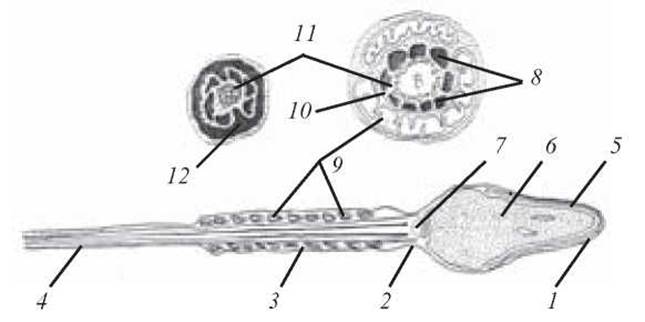
Fig. 20. Structure of a mammalian spermatozoon (after D. W. Fawcett):
1 — head; 2 — neck; 3 — body; 4 — tail; 5 — acrosome; 6 — nucleus; 7 — centriole; 8 — dense fibrils; 9 — mitochondria; 10 — white line; 11 — microtubules; 12 — fibrous sheath
Last update: 10/08/2026
Editorial and Educational Adaptation: This material has been compiled based on the primary/original source text. The project team performed an editorial review, corrected technical inaccuracies, structured sections, and adapted the content for an educational format.
What was processed:
- elimination of formatting defects (OCR errors, structural breaks, corrupted characters);
- editorial organization of content;
- standardization of terminology in accordance with academic sources;
- verification of factual statements against the original source text.
All mentions of the author, publication year, and origin of the primary text have been preserved in accordance with the source.