General Microbiology - Schlegel H. 1987
Basic mechanisms of metabolism and energy transformation
Key general concepts
When examining the carbon cycle, we have previously contrasted two processes: Photosynthesis, which fixes CO2 and releases O2, and the Mineralization of organic matter, which involves the consumption of O2 and the liberation of CO2. These processes are opposites. From the standpoint of mass balance, the most crucial aspect is the transition of carbon from a gaseous inorganic substance into semi-solid and solid Organic compounds, and the reverse of this process. However, when considering both processes from the perspective of energy exchange—i.e., energy transformation—carbon is less significant than hydrogen. J. R. Mayer (1848) formulated the principle: "Plants absorb one force—light—and create another—chemical difference" ("force" being used here in the sense of "energy"). During photosynthesis, the radiant energy of the Sun is converted into chemical energy; simultaneously, Water is decomposed into oxygen and hydrogen, with the latter being transferred into a metastable state through bonding with carbon (from CO2) (see diagram). Most of this stabilized hydrogen is temporarily stored in the form of CARBOHYDRATES. The potential difference established by plants between hydrogen and oxygen serves as a source of energy for all oxygen-breathing living organisms. Within their bodies, hydrogen is once again released from its bond with carbon and combines with oxygen in a "biochemical oxyhydrogen reaction" accompanied by the release of energy. This hydrogen oxidation is a multistage process during which the liberated energy can be converted into biochemical energy in discrete portions. On a global scale, the "phototrophic plants - organotrophic living creatures" system is incorporated into The process of converting radiant energy into heat, leading to a deceleration in the growth of Entropy.
Class="center">
METABOLISM and Metabolic Pathways. Both during growth and in a resting state, vegetative Cells require a continuous supply of energy. A living Cell is a highly organized matter. Energy is necessary not only to create such Organization but also to maintain it. The Organism obtains this energy through metabolism, i.e., via regulated transformations that various substances undergo within cells. Nutrients supplied from the external environment serve as sources of energy. Inside cells, these substances undergo a series of changes resulting from sequential enzymatic reactions that form the steps of specific metabolic pathways. Such pathways perform two main Functions: first, they supply precursor Materials for the construction of cellular components, and second, they provide energy for cellular syntheses and other energy-requiring processes.
Cellular transformations of substances (metabolism), resulting in The formation of new cellular material from relatively simple precursors—such as glucose, long-chain Fatty acids, or Aromatic Compounds—can, for the sake of simplicity, be subdivided into three main groups. Initially, nutrients are broken down into small fragments (breakdown, or Catabolism), and then, through intermediate metabolism or amphibolic reactions, they are converted into a series of organic acids and phosphate esters. These two pathways transition seamlessly into one another. Diverse low-molecular-weight compounds constitute the substrate from which the fundamental Building Blocks of The Cell are synthesized. By "building blocks," we mean Amino Acids, purine and pyrimidine bases, phosphorylated sugars, organic acids, and other metabolites—the End products of biosynthetic chains, which are sometimes long. These serve to construct the polymeric macromolecules (Nucleic Acids, Proteins, storage substances, Cell wall components, etc.) that comprise the cell. These two stages of cellular substance Biosynthesis—the synthesis of building blocks and the synthesis of polymers—constitute the synthetic branch of metabolism, or anabolism (Fig. 7.1).
Biochemical Unity. THE PRINCIPLE OF "biochemical unity" is one of the few dogmas accepted in our century. According to this principle, all living creatures inhabiting Earth are fundamentally similar in biochemical terms. This principle is manifested, for example, in the uniformity of building blocks (including the identical nature of their optical rotation), the universal role of adenosine triphosphate (ATP) as the elementary quantum of biological energy, the universality of The Genetic Code, and The Unity of sugar conversion pathways and The Nature of the Respiratory Chain. The Major Metabolic Pathways are also nearly identical across All living organisms. There are only a few groups of Bacteria in which the core metabolic schemes are modified in one way or another—certain pathways predominate while others are shortened or otherwise altered. All variations of microbial metabolism can easily be reduced to a general scheme. Metabolic pathways apparently evolved over the course of evolution, and one might assume that the biochemical apparatus typical of aerobic organisms emerged relatively late, when oxygen appeared in the atmosphere. At present, it is difficult to determine whether shortened metabolic pathways represent primitive traits or the result of degradation.

Fig. 7.1. Scheme of metabolism in aerobically respiring cells cleaving hexoses.
Carbohydrate Catabolism. As already noted in the Description of the carbon cycle, carbohydrates are the primary product of plant photosynthesis. At the same time, they serve as the main nutrients for the majority of microorganisms. Therefore, in our subsequent Structure/133.html">Discussion of nutrients as substrates of cellular metabolism, we will focus primarily on glucose. Other natural substances utilized by microorganisms as substrates will be discussed later in connection with other phenomena (Chap. 14). Macromolecules are generally first broken down outside the cell by extracellular Enzymes (exoenzymes) secreted by the cell into monomeric and dimeric building blocks and are absorbed by the cell only in this form.
After a series of preliminary steps, hexoses are split "in half." The Cleavage products are converted into pyruvic acid (Pyruvate), which occupies a key position in Intermediary Metabolism, as it serves as a starting compound in numerous Synthesis and degradation processes. As a result of pyruvate decarboxylation, C2 compounds are formed, which first bind to a suitable acceptor molecule (oxaloacetate) and are then gradually oxidized to CO2 in The Tricarboxylic Acid Cycle, also known as The Citric Acid Cycle. Oxaloacetate is regenerated during this cyclic process. Hydrogen atoms (or reducing equivalents) cleaved at various stages of organic substance oxidation enter the ATP-regenerating System of the respiratory chain (Oxidative Phosphorylation). With each turn of the tricarboxylic acid cycle, two molecules of CO2 and four pairs of 2[H] are formed from a single C2 compound (acetyl-coenzyme A). These reactions balance the accounting of the tricarboxylic acid cycle.
Intermediary compounds of the tricarboxylic acid cycle include organic acids that supply Starting Material for biosynthetic processes (2-oxoglutarate, succinate, oxaloacetate). Thus, the tricarboxylic acid cycle not only participates in the terminal oxidation of nutrients but also serves as an important "distributor" supplying starting compounds for the Synthesis of the main structural units ("building blocks") of the cell. If these acids were continuously drained from the cycle, the regeneration of the acceptor molecule would fail, and the cycle would be disrupted. So-called anaplerotic reaction sequences ensure the replenishment of the tricarboxylic acid cycle with new quantities of intermediates to replace those consumed in biosynthesis. These anaplerotic sequences are of particular importance for organisms that grow at the expense of simple one- or two-carbon compounds or other substrates that degrade into similarly simple compounds.
The Role of Enzymes. Chemical transformations are carried out in the cell with the aid of enzymes. A specific enzyme is responsible for each conversion of one metabolite into another. Enzymes are proteins possessing a catalytic function. The Fundamental properties of an enzyme protein lie in its ability to recognize specific metabolites, catalyze their transformations, and ensure the Regulation of Catalytic activity.
An enzyme-catalyzed reaction begins with the binding of a specific metabolite (substrate) to the enzyme protein. As a rule, each enzyme interacts with only a single metabolite—its substrate—and catalyzes its conversion into another metabolite until equilibrium is established. Thus, each enzyme is characterized by a specific substrate Specificity (interacting with only one metabolite and its reaction product) and a specific catalytic specificity (catalyzing only one of the numerous transformations that a given metabolite may undergo). Recognition of the substrate by the enzyme occurs during the binding process. The substrate attaches to a strictly defined region of the enzyme protein molecule—the so-called catalytic center. The steric Properties of the substrate and the charge distribution within its molecule serve as the cues by which the substrate is recognized by the enzyme. Substrate and enzyme fit together like a lock and key.
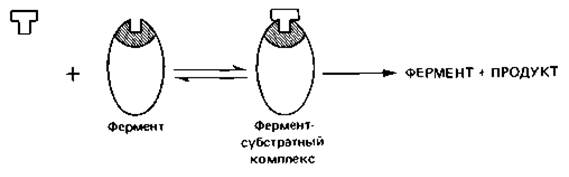
Enzyme proteins act as biocatalysts by lowering the activation energy. Chemical transformations of a metabolite on an enzyme proceed at normal temperatures. Thus, enzymes enable reactions to occur that, in their absence, would require high temperatures or other non-physiological conditions incompatible with cell survival.
The reaction rate catalyzed by an enzyme is approximately 10 orders of magnitude higher than that of a non-enzymatic reaction; a 1010-fold increase in rate shortens the half-life of a given reaction from 300 years to one second.
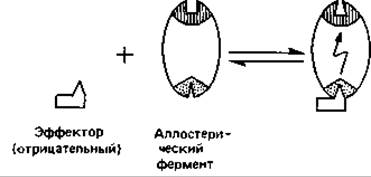
A very important property of enzymes, established definitively only relatively recently, is that their catalytic activity is subject to regulation. This regulatability of enzyme activity is one of the possible explanations for the harmonious progression of all metabolic processes within the cell. At least some enzymes (at least one in each specific biosynthetic pathway) are subject to regulatory influences. Such enzymes utilize their catalytic center to recognize the substrate, and another center to recognize the end product of a given reaction chain or other low-molecular-weight substances that influence their activity in a specific manner. These enzymes possess a second binding site—the regulatory center. The binding of end products or other metabolites, also known as effectors, affects the catalytic center, altering its activity. End products act as negative effectors. Positive effectors enhance enzyme activity. Thus, the concentrations of metabolites playing the role of effectors determine the enzyme's activity and, consequently, The rate of the corresponding transformations. Effectors share no structural similarity with enzyme substrates; they are sterically distinct from them. Therefore, they are referred to as allosteric effectors, and the centers responsible for regulation are called allosteric centers of enzymes.
Coenzymes and Prosthetic Groups. Alongside enzyme proteins, low-molecular-weight compounds—so-called coenzymes and prosthetic groups—participate in the binding and subsequent transfer of individual substrate fragments, such as hydrogen, methyl groups, amino groups, etc. (Table 7.1, Fig. 7.2). Coenzymes and prosthetic groups are bound to enzymes with varying degrees of firmness. Substances that attach a substrate fragment to themselves on the enzyme protein and subsequently dissociate from it in order to transfer this fragment from one enzyme protein to a second compound are termed coenzymes (a more precise term would be cosubstrates or carriers). Low-molecular-weight compounds firmly bound to the protein moiety of the enzyme and not dissociating from it during the attachment and transfer of substrate fragments are called prosthetic groups of these enzymes.
Table 7.1. Coenzymes and prosthetic groups functioning as carriers of hydrogen, various groups, or electrons, and their relation to Vitamins
|
Coenzyme or prosthetic group1 |
Function (what is transferred) |
Vitamin |
|
|
NAD (Р) |
(221) |
Hydrogen, e- |
Nicotinic acid |
|
FMN |
(237) |
Hydrogen, e- |
Riboflavin |
|
FAD |
(219) |
Hydrogen, e- |
Riboflavin |
|
Ubiquinone |
(237) |
Hydrogen, e- |
|
|
(237) |
e- |
Heme derivatives |
|
|
Biotin |
Carboxyl groups |
Biotin |
|
|
(432) |
Amino groups |
Pyridoxine |
|
|
Tetrahydrofolic acid |
(301) |
Formyl groups |
Folic acid, 4-aminobenzoic acid |
|
Coenzyme A |
(219) |
Acyl groups |
Pantothenic acid |
|
(219) |
Acyl groups and hydrogen |
Lipoic acid |
|
|
Thiamine pyrophosphate |
(219) |
Aldehyde groups |
Thiamine |
|
Coenzyme B12 |
Carboxyl groups (intramolecular rearrangement); methyl groups |
Cobalamin |
|
1 Numbers in parentheses indicate the page where the chemical formula is given.

Fig. 7.2. Structural formulas of certain coenzymes and prosthetic groups. Active groups are highlighted in bold.
Coenzymes are of particular importance because many organisms are incapable of synthesizing them and must acquire them from food in the form of vitamins. Many lactic acid bacteria, soil and aquatic bacteria, as well as other unicellular organisms, require specific vitamins listed in Table 6.2, or their precursors, added to the nutrient medium in order to grow.
Energy Transformation. The metabolic pathways briefly outlined above (glucose conversion, the tricarboxylic acid cycle, the respiratory chain) lead to The oxidation of sugar to CO2 and water. This releases the same amount of energy as the combustion of sugar; however, because glucose oxidation is broken down into a series of individual enzymatic reactions that are theoretically fully reversible, the energy liberated during oxidation can be converted into a biochemically accessible form without a significant rise in Temperature.
Many reactions release only negligible amounts of energy. Such minimal energy yields are useful to the cell only when the reaction equilibrium is shifted toward product formation. In certain transformations accompanied by the release of a large amount of Free energy (- ∆G = 40–60 kJ/mol, or 10–15 kcal/mol), this energy is conserved via substrate-level phosphorylation in the form of ATP and can subsequently be used in energy-requiring reactions. Both substrates (intermediates) and enzymes participate in this ATP regeneration. However, the majority of The energy released during the oxidation of nutrients is converted into a cell-accessible form (high-energy ATP bonds) via oxidative phosphorylation within The electron transport (respiratory) chain.
Metabolites. Even a superficial look at the substances involved in cellular metabolism reveals that many of them exist in a phosphorylated state, i.e., as phosphoric acid esters. Unphosphorylated intermediates typically contain carboxyl groups or ionizable basic groups. It appears that enzymes can act only on metabolites that possess an ionized, i.e., charged, group. Uncharged molecules or groups are always bound to coenzymes or prosthetic groups of enzymes; some form Schiff bases with the diamino acid Lysine located in the Active Site of the enzyme protein. Only compounds at the very beginning or end of metabolic pathways remain unstudied or un-ionized; these include many substrates and certain Metabolic waste products excreted by the cell (glucose, fructose, ethanol, acetone, 2-propanol, butanol, glycerol, etc.). The question of whether the presence of ionized intermediates is related to enzyme function or to a specialized cellular mechanism for retaining such metabolites remains open.
Dehydrogenation and pyridine NUCLEOTIDES. The oxidation of organic compounds occurs through The transfer of electrons from a donor to an acceptor. Biological Oxidation of a substrate most commonly involves the simultaneous transfer of two electrons, accompanied by the detachment of two protons (H +) from the substrate. Such substrate oxidation, formally proceeding with the removal of two hydrogen atoms, is termed dehydrogenation. Frequently, the terms hydrogen donor and electron donor are used interchangeably, as are hydrogen acceptor and electron acceptor, oxidation and dehydrogenation, and reduction and hydrogenation.
Enzyme proteins that remove hydrogen atoms from substrates are called dehydrogenases, and the names of some explicitly indicate their hydrogen donor (e.g., Lactate dehydrogenase, malate dehydrogenase). Many dehydrogenases transfer hydrogen to one of two coenzymes: nicotinamide adenine dinucleotide (NAD) or nicotinamide adenine dinucleotide phosphate (NADP).
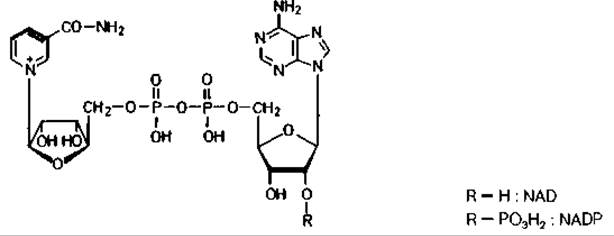
The functional group common to both coenzymes is nicotinamide. One hydrogen atom is transferred from the substrate along with a pair of electrons (as a hydride ion) to the pyridine ring, while the second proton passes into solution. This transfer is stereospecific: certain enzymes (such as Alcohol dehydrogenase and lactate dehydrogenase) transfer hydrogen to one face of the pyridine ring, whereas others (such as glyceraldehyde-3-phosphate dehydrogenase) transfer it to the opposite face. For brevity, such reversible dehydrogenation is depicted as follows:

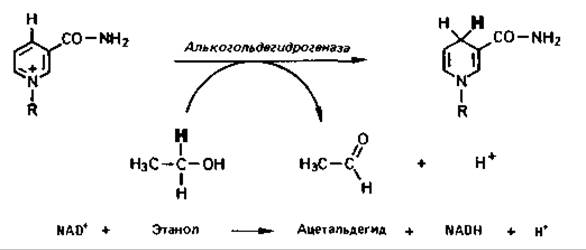
In contrast to their oxidized forms, the reduced forms of both coenzymes exhibit an absorption maximum at 340 nm. Therefore, the reduction and oxidation of coenzymes can be monitored by measuring changes in absorption within the corresponding spectral region. This forms The basis of many optical Methods for determining enzyme activity.
Both coenzymes dissociate freely—meaning they detach from one dehydrogenase protein and, after binding to another dehydrogenase, transfer hydrogen to a different acceptor. For this reason, they are also referred to as hydrogen carriers. NADH2 primarily transfers hydrogen to precursors of Fermentation end products or feeds it into the respiratory chain, whereas NADPH2 is mainly involved in the reductive steps of biosynthetic processes.
ATP and other high-energy compounds. Energy-consuming processes in the cell are driven by adenosine triphosphate (ATP). Through ATP, the energy harvested via photosynthesis, Respiration, or fermentation becomes accessible and utilizable by the cell. ATP acts as a universal carrier of chemical energy between energy-yielding and energy-consuming reactions (often called the "energy currency" of the cell). ATP serves as the direct energy source for diverse cellular activities, including the Synthesis of Macromolecular structural components, mechanical movement, and osmoregulation. The pyrophosphate bonds linking the phosphate groups are "energy-rich," meaning they possess a high group-transfer potential. Forming these bonds requires more energy than forming a standard ester bond; conversely, their cleavage releases a substantial amount of energy (Hydrolysis results in a Standard Free Energy change of AG'0 ≈ −30 kJ), which can then be conserved in reaction products (Table 7.2).
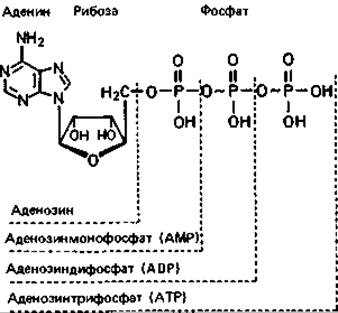
Table 7.2. Energy-rich and energy-poor compounds of biochemical significance. Values indicate standard Free energy of hydrolysis — ∆G'0 at pH 7.0 under standard conditions
|
Substrate |
-∆G'0 |
|
|
kJ |
kcal |
|
|
Acetyl phosphate |
44.0 |
10.5 |
|
Acetoacetyl-CoA |
44.0 |
10.5 |
|
Acyl-AMP |
55.7 |
13.3 |
|
Creatine phosphate |
37.7 |
9.0 |
|
Phosphoenolpyruvate |
54.4 |
13.0 |
|
Simple phosphate esters |
12.6 |
3.0 |
|
12.6 |
3.0 |
|
|
Sucrose |
27.6 |
6.6 |
|
UDP-glucose |
31.8 |
7.6 |
|
Aldose-1-phosphate |
20.9 |
5.0 |
|
ATP (→ ADP + Pi) |
31.0 |
7.4 |
|
ATP (→ AMP + PPi) |
31.8 |
7.6 |
ATP as a coenzyme in metabolite activation. Many intermediates require activation via group transfer. ATP cleavage can occur in three distinct ways:
1. Sugars are activated by conversion into their corresponding phosphorylated derivatives:
Glucose + ATP → Glucose phosphate + ADP
2. Ribose-5-phosphate is activated through the transfer of a diphosphate (pyrophosphate) moiety:
Ribose-5-phosphate + ATP → Phosphoribosyl diphosphate + AMP
3. Certain inorganic acids, all amino acids, and inorganic sulfate are activated by attaching an AMP group with the release of pyrophosphate:
Fatty acid + ATP → Acyl-AMP + Pyrophosphate
Amino acid + ATP → Aminoacyl-AMP + Pyrophosphate
Sulfate + ATP → Sulfate-AMP + Pyrophosphate
Reaction completion (i.e., driving the transformation forward) is ensured by the Enzymatic hydrolysis of the resulting pyrophosphate by pyrophosphatase, which removes it from the reaction equilibrium. Thus, the activation of these metabolites costs the cell two high-energy bonds.
The information provided above is likely sufficient to clearly demonstrate the universal importance of ATP and to prepare the reader for understanding the various types of bacterial metabolism. When exploring these metabolic pathways, it should be kept in mind that the cell, utilizing available nutrients under given conditions, always strives to generate the maximum possible amount of ATP.
The synthesis (regeneration) of ATP is carried out primarily through three processes: photosynthetic phosphorylation (sec. 12.2), oxidative phosphorylation (phosphorylation in the respiratory chain, sec. 7.4), and substrate-level phosphorylation (sec. 7.2.1). The first two processes share the common feature that ATP is formed with the participation of ATP synthase. Substrate phosphorylation can occur in various intermediary metabolic reactions. In Carbohydrate Metabolism, the key reactions leading to ATP regeneration are catalyzed by phosphoglycerate kinase, pyruvate kinase, and acetate kinase. Sugar-fermenting bacteria and Yeast rely solely on the ATP generated by these enzymes. In all such phosphorylation processes (with rare exceptions), adenosine diphosphate (ADP) serves as the phosphate acceptor. Adenosine monophosphate (AMP), before being phosphorylated to ATP, must first be converted into ADP in a reaction catalyzed by adenylate kinase (AMP + ATP → 2ADP).
Below is a Brief Overview of the four major stages of Glucose Catabolism—the initial breakdown into C3 compounds, the tricarboxylic acid cycle, pyruvate oxidation, and the respiratory chain—along with the functions of these processes. We will also examine certain details essential for understanding various SPECIALIZED METABOLIC PATHWAYS. For a more in-depth exploration of metabolic physiology and microbial biochemistry, readers should consult standard biochemistry textbooks.
Last update: 13/08/2026
Editorial and Educational Adaptation: This material has been compiled based on the primary/original source text. The project team performed an editorial review, corrected technical inaccuracies, structured sections, and adapted the content for an educational format.
What was processed:
- elimination of formatting defects (OCR errors, structural breaks, corrupted characters);
- editorial organization of content;
- standardization of terminology in accordance with academic sources;
- verification of factual statements against the original source text.
All mentions of the author, publication year, and origin of the primary text have been preserved in accordance with the source.