General Microbiology - Schlegel, H. 1987
Main mechanisms of metabolism and energy transformation
Pathways of hexose catabolism
Several pathways lead from glucose to C3 compounds and, among them, to Pyruvate, one of the most crucial metabolic intermediates. The most frequently used degradation route involves the Formation of fructose-1,6-bisphosphate; this is known as the fructose bisphosphate pathway, glycolytic degradation, Glycolysis, or (after the researchers who studied it) the Embden-Meyerhof-Parnas pathway (Fig. 7.3). Another series of reactions, which can be carried out by most organisms, forms a cycle known as the oxidative Pentose Phosphate Pathway, the Hexose monophosphate pathway, or the Warburg-Dickens-Horecker scheme (Fig. 7.4). The reverse sequence of reactions in this pathway comprises important steps leading to the regeneration of the CO2 acceptor during autotrophic carbon dioxide fixation. The Entner-Doudoroff Pathway—also referred to as the KDPG pathway (named after its characteristic intermediate, 2-keto-3-deoxy-6-phosphogluconate; Fig. 7.5)—appears to occur exclusively in Bacteria. Other similar hexose degradation mechanisms are of more specialized significance.
Class="center">
In The Cell, glucose is first phosphorylated, typically at position 6, with hexokinase acting as a catalyst and ATP serving as the phosphate donor. Glucose-6-phosphate represents the metabolically active form of glucose within the cell and serves as the starting point for any of the three aforementioned degradation pathways.

7.2.1 Fructose-1,6-bisphosphate Pathway (Glycolysis)
In the fructose bisphosphate pathway (Fig. 7.3), glucose-6-phosphate is isomerized by glucosephosphate isomerase into fructose-6-phosphate in preparation for Cleavage; this is followed by phosphorylation at position 1, catalyzed by Phosphofructokinase at the expense of ATP. The resulting fructose-1,6-bisphosphate is cleaved by fructose-bisphosphate aldolase into dihydroxyacetone phosphate and glyceraldehyde-3-phosphate. Both triose phosphates exist in mutual equilibrium, a balance maintained through catalysis by Triosephosphate isomerase. Dihydroxyacetone phosphate can be reduced by glycerol-phosphate dehydrogenase to glycerol phosphate, which is subsequently hydrolyzed by glycerol-1-phosphatase to yield glycerol and orthophosphate. Typically, however, the dihydroxyacetone phosphate formed by the action of aldolase is first converted into glyceraldehyde-3-phosphate, which is then oxidized.
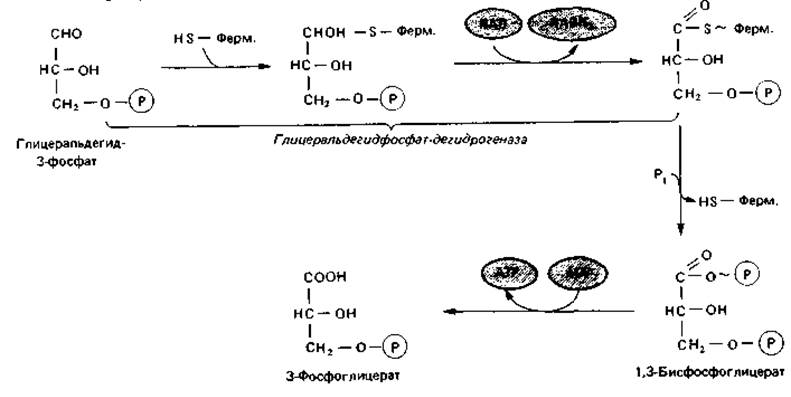
The subsequent dehydrogenation is energetically the most critical step of this pathway, as well as of other routes leading to the Formation of glyceraldehyde-3-phosphate. Part of The energy released during The oxidation of glyceraldehyde-3-phosphate to 3-phosphoglycerate (AG0' = —67 kJ) is conserved in the form of a high-energy phosphate. First, the aldehyde group attaches to the SH group of glyceraldehyde-phosphate dehydrogenase, followed by the cleavage of hydrogen, which is transferred to NAD. The resulting acyl-S-enzyme represents an energy-rich thioester. Through phosphorolysis (whereby the acyl group is detached from the enzyme with the attachment of orthophosphate), this energy is conserved in 1,3-bisphosphoglycerate. With the participation of phosphoglycerate kinase, the high-energy phosphate group is transferred to ADP to yield 3-phosphoglycerate and ATP. This type of process is termed substrate-level phosphorylation. In addition to the enzyme, the preceding oxidation of glyceraldehyde-3-phosphate requires both orthophosphate and ADP. In their absence, glucose degradation halts at this stage—a phenomenon important for the REGULATION OF GLUCOSE Catabolism (the "Pasteur Effect").
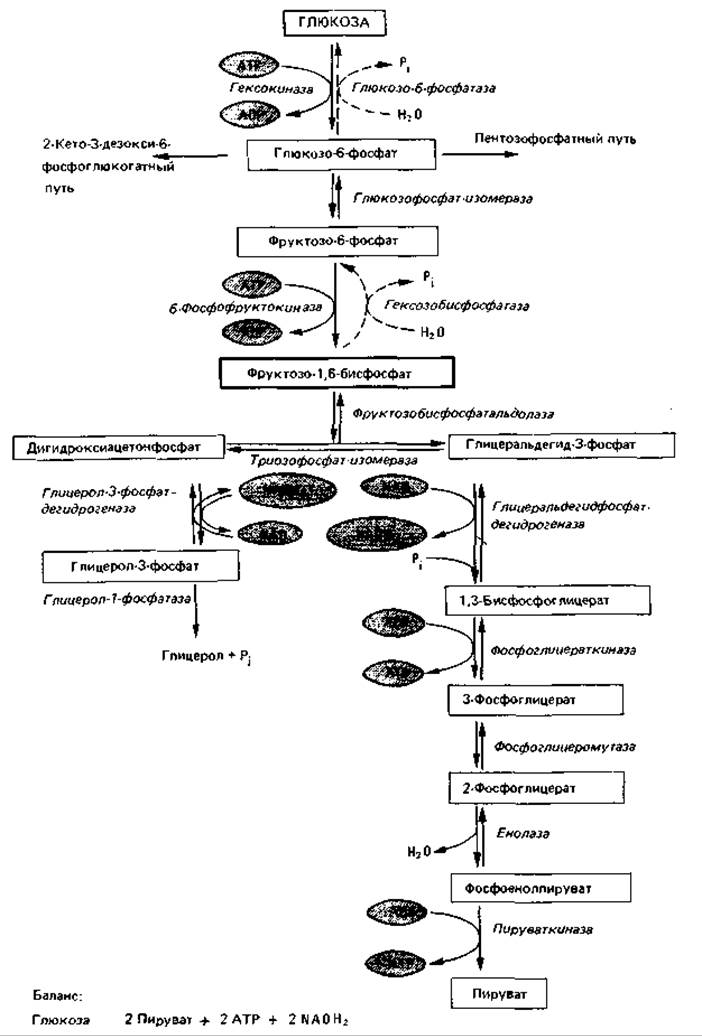
Fig. 7.3. Fructose-1,6-bisphosphate pathway of glucose degradation (glycolysis).
Catalyzed by phosphoglyceromutase, 3-phosphoglycerate is converted into 2-phosphoglycerate, which undergoes dehydration (catalyzed by enolase) to form phosphoenolpyruvate. This is another high-energy phosphate from which the high-energy phosphate group is transferred by pyruvate kinase to ADP, thereby being conserved. The resulting pyruvate serves as the starting point for further degradation, transformation, and synthesis processes. All Reactions of the fructose-1,6-bisphosphate pathway, with the exception of three (those catalyzed by hexokinase, 6-phosphofructokinase, and pyruvate kinase), are completely reversible.
The overall equation for the catabolism of glucose via the fructose-1,6-bisphosphate pathway yields two molecules of pyruvate, two (4 minus 2) molecules of ATP, and two molecules of NADH.
Both energy-releasing reactions involved in The conversion of triose phosphate to pyruvate serve as essential energy-supplying steps for anaerobic organisms. Under anaerobic conditions, virtually all carbohydrate-fermenting microorganisms (with few exceptions) utilize the energy derived from the oxidation of glyceraldehyde phosphate to pyruvate.
7.2.2 Pentose Phosphate Pathway
In The pentose phosphate pathway (Fig. 7.4), glucose-6-phosphate is dehydrogenated by glucose-6-phosphate dehydrogenase; in the process, hydrogen is transferred to NADP, yielding 6-phosphogluconolactone, which is hydrolyzed spontaneously or via enzymatic action (gluconolactonase) to 6-phosphogluconate. The latter is subsequently dehydrogenated by a dehydrogenase to 3-keto-6-phosphogluconate, which then undergoes decarboxylation to form ribulose-5-phosphate. This marks the completion of the oxidation process proper.

Fig. 7.4. Pentose phosphate pathway of the oxidative degradation of glucose-6-phosphate. The pentose phosphate cycle is shown at the top. The oxidative steps culminate in The formation of ribulose-5-phosphate. Ribulose-5-phosphate is in equilibrium with ribose-5-phosphate and xylulose-5-phosphate, a balance maintained by Enzymatic Catalysis. Pentose phosphates are converted by transketolase and transaldolase into two fructose phosphates and one glyceraldehyde phosphate. This sequence of reactions is fully reversible and, in the reverse direction, is integrated into the ribulose bisphosphate CO2 fixation cycle, the ribulose monophosphate formaldehyde fixation cycle, and other cycles. Participating Enzymes (circled numbers): 1 - glucose-6-phosphate dehydrogenase; 2 - lactonase; 3 - 6-phosphogluconate dehydrogenase; 4 - phosphoriboisomerase; 5 - ribulose-5-phosphate-3-epimerase; 6 - transketolase; 7 - transaldolase.
Subsequent reactions should be viewed merely as processes converting pentose phosphates into hexose phosphates and vice versa. Through the incorporation of such a reaction sequence, the oxidative pentose phosphate pathway forms a closed cycle. Ribulose-5-phosphate is in equilibrium with ribose-5-phosphate and xylulose-5-phosphate. Ribose phosphate is an essential precursor in the synthesis of NUCLEOTIDES and Nucleic Acids. Mediated by transketolase and transaldolase, pentose phosphates are converted into two molecules of fructose-6-phosphate and one molecule of glyceraldehyde-3-phosphate. As a result of the isomerization of fructose-6-phosphate to glucose-6-phosphate and the Condensation of two triose phosphate molecules into a hexose phosphate, all the aforementioned reactions form a closed cycle. During a single turn of this cycle, three molecules of glucose-6-phosphate yield two molecules of fructose-6-phosphate, one molecule of glyceraldehyde-3-phosphate, three molecules of CO2, and three pairs of NADPH2 molecules. In many (if not most) bacteria, the enzymes glucose-6-phosphate dehydrogenase and phosphogluconate dehydrogenase transfer hydrogen from substrates not only to NADP but also to NAD.
The cycle described is clearly a shunt pathway whose significance lies in supplying vital starting Materials (pentose phosphates, erythrose-4-phosphate, glyceraldehyde-3-phosphate) as well as generating reducing equivalents (NADPH2) for biosynthetic processes. Pentose phosphates—the precursors of nucleotides and nucleic acids—are formed through the dehydrogenation and decarboxylation of glucose-6-phosphate, as well as via transketolase and transaldolase reactions involving fructose-6-phosphate.
7.2.3 2-Keto-3-deoxy-6-phosphogluconate Pathway
Glucose-6-phosphate is first dehydrogenated to 6-phosphogluconate, exactly as described above for the pentose phosphate pathway. Action of phosphogluconate dehydratase splits off Water to yield 2-keto-3-deoxy-6-phosphogluconate (Fig. 7.5). Ketodeoxyphosphogluconate is cleaved by a specific aldolase into pyruvate and glyceraldehyde-3-phosphate. The latter is subsequently oxidized to pyruvate in the same manner as in the fructose bisphosphate pathway.
Regarding the generation of ATP, NADH2, and NADPH2, there are notable differences among the described carbohydrate Catabolic pathways. For every mole of glucose oxidized to pyruvate via the fructose-1,6-bisphosphate pathway, 2 moles of ATP and 2 moles of NADH2 are produced, whereas the 2-keto-3-deoxy-6-phosphogluconate pathway yields one mole each of ATP, NADH2, and NADPH2. Thus, in the latter case, 1 mole of ATP and 1 mole of NADH2 are replaced by one mole of NADPH2, which is equivalent. This equivalence is consistent with the finding that The transfer of hydrogen from NADH2 to NADP, mediated by transhydrogenase, frequently requires an energy input and proceeds with the consumption of ATP.
Microorganisms vary considerably in the extent to which they utilize one or another of these pathways (Table 7.3). The Enzymes of the fructose bisphosphate pathway are generally constitutive cellular components, although in many bacteria this pathway operates only in the reverse direction (with irreversible steps catalyzed by alternative enzymes). The pentose phosphate pathway likewise appears to have universal significance. The 2-keto-3-deoxy-6-phosphogluconate pathway is very widespread among bacteria and is of fundamental importance for the utilization of gluconate. For instance, while glucose is degraded via the fructose bisphosphate pathway in Escherichia coli and Clostridium species, gluconate enters their Intermediary METABOLISM through the 2-keto-3-deoxy-6-phosphogluconate pathway.

Fig. 7.5. 2-Keto-3-deoxy-6-phosphogluconate pathway of the oxidative degradation of glucose (Entner-Doudoroff pathway). Participating enzymes (circled numbers): 1 - hexokinase; 2 - glucose-6-phosphate dehydrogenase; 3 - phosphogluconate dehydrogenase; 4 - phospho-2-keto-3-deoxygluconate aldolase. 6-phosphogluconolactone, which is formed as an intermediate during the dehydrogenation of glucose-6-phosphate, is not shown in the diagram.
Table 7.3. Contribution of different pathways to hexose catabolism (in percent)
|
Species |
Fructose-1,6-bisphosphate pathway |
Pentose phosphate pathway |
2-Keto-3-deoxy-6-phosphogluconate pathway |
|
Candida utilis |
70-80 |
30-20 |
|
|
Streptomyces griseus |
97 |
3 |
|
|
Penicillium chrysogenum |
77 |
23 |
|
|
Escherichia coli |
72 |
28 |
|
|
Bacillus subtilis |
74 |
26 |
|
|
Pseudomonas aeruginosa |
29 |
71 |
|
|
Gluconobacter oxydans |
100 |
||
|
Pseudomonas saccharophila |
100 |
||
|
Alcaligenes eutrophus |
100 |
Clostridia and certain aerobic bacteria utilize a specialized variant of the 2-keto-3-deoxy-6-phosphogluconate pathway for gluconate catabolism: first, gluconate is converted into 2-keto-3-deoxygluconate by gluconate dehydratase, and phosphorylation by ATP occurs only at this stage through the action of ketodeoxygluconokinase; 2-keto-3-deoxy-6-phosphogluconate is then cleaved by phospho-2-keto-3-deoxygluconate aldolase.
7.2.4 Pyruvate Oxidation
Pyruvate occupies a central position in intermediary metabolism and can serve as a precursor for a diverse array of products. Many organisms oxidize the majority of the pyruvate generated during catabolism to acetyl-coenzyme A. Three reactions play a critical role in bacteria:

Reaction (1) is catalyzed by the pyruvate dehydrogenase multienzyme complex. This enzyme is present in almost all aerobic organisms and serves primarily to generate acetyl-CoA, which subsequently enters The Tricarboxylic Acid Cycle (Fig. 7.6); its function will be described in detail below.

Fig. 7.6. Reaction scheme for pyruvate dehydrogenation (details in the text).
Reaction (2) is catalyzed by pyruvate:ferredoxin oxidoreductase, an enzyme of particular importance in many anaerobic bacteria (such as clostridia).
Reaction (3) is catalyzed by pyruvate formate-lyase. This enzyme occurs in many anaerobic bacteria that produce formic acid ("Formic acid Fermentation", Section 8.4), notably within the Enterobacteriaceae, but is also found in phototrophic bacteria.
Yeasts and certain ethanol-producing bacteria possess a fourth enzyme that oxidizes pyruvate:
(4) Pyruvate → Acetaldehyde + СО2
This enzyme, pyruvate decarboxylase, cleaves pyruvate into acetaldehyde and СО2. Acetaldehyde is subsequently reduced to ethanol.
Dehydrogenation of pyruvate by pyruvate dehydrogenase. This multienzyme complex converts pyruvate into acetyl-coenzyme A and СО2 with the involvement of Cofactors [see reaction (1) above and Fig. 7.6].
The multienzyme complex consists of three Proteins: pyruvate dehydrogenase (E1), dihydrolipoamide acetyltransferase (E2), and dihydrolipoamide dehydrogenase (E3):

In the initial step (E1), pyruvate interacts with the C-2 atom of the thiazole ring (1) of thiamine pyrophosphate (TPP), resulting in the release of СО2. The resulting hydroxyethyl-TPP (2) reacts with lipoate (3) attached to E2, which is reduced in the process, retaining the acetyl residue (4) at its secondary SH group. E2 then catalyzes the transfer of the acetyl group to coenzyme A, leaving dihydrolipoate (5), which is reoxidized back to lipoate by E3 with the simultaneous reduction of NAD.
Strictly anaerobic bacteria lack the pyruvate dehydrogenase multienzyme complex.
Last update: 13/08/2026
Editorial and Educational Adaptation: This material has been compiled based on the primary/original source text. The project team performed an editorial review, corrected technical inaccuracies, structured sections, and adapted the content for an educational format.
What was processed:
- elimination of formatting defects (OCR errors, structural breaks, corrupted characters);
- editorial organization of content;
- standardization of terminology in accordance with academic sources;
- verification of factual statements against the original source text.
All mentions of the author, publication year, and origin of the primary text have been preserved in accordance with the source.