THEORETICAL FOUNDATIONS OF FISH FARMING - I.M. Sherman - 2011
2. THEORETICAL FOUNDATIONS FOR THE DEVELOPMENT AND UTILIZATION OF PRODUCTIVE TRAITS IN FISH
2.6. Theoretical aspects of fish nutrition and feeding
Intensive fish production requires The Use of formulated feeds, while intensification itself is accompanied by an increase in stocking density per unit of Water area or volume. By analogy with livestock farming, this can be viewed as an indoor (stall-fed) system for raising agricultural animals, which relies on the efficient use of artificial feeds.
Under these conditions, natural feeds—namely PLANT AND ANIMAL matter, along with their detritus, which form The basis of the diet for certain fish species within their natural range—are practically absent or present in negligible quantities that cannot significantly impact fish Nutrition. An even more complex situation arises when utilizing waste-heat and thermal waters. The use of such waters satisfies the objective of optimizing the thermal regime to extend the effective growing season through the natural acceleration of physiological processes, which is characteristic of poikilothermic animals. These physiological processes, in turn, demand adequate energy supply, necessitating higher feed inputs while simultaneously ensuring an efficient increase in the biomass of the cultivated species.
Today, feed accounts for the lion's share of production costs in intensive fish farming; therefore, The Significance of this issue, encompassing both its theoretical and practical dimensions, can hardly be overestimated in modern pond and industrial aquaculture.
Feeding is the most potent and effective tool for intensifying fish culture in specialized industrial-type fish ponds, as well as in small and medium-sized reservoirs, ensuring maximum fish productivity provided that critical abiotic environmental parameters are maintained.
When addressing this issue and seeking solutions, one must possess a sound understanding of the fundamental regularities governing the nutrition and feeding of various fish species.
Based on Current Concepts of fish nutrition, it must be emphasized that nutrition is the leading factor determining the survival and existence of a species within its habitat. At the same time, it is a well-known fact that no Organism can increase its body mass beyond the dry matter intake provided by the feed components of its diet. Moreover, the assimilation efficiency of various dietary components—both Artificial and natural—varies significantly. The efficiency of nutrition is determined by two main components. The first is the feed conversion ratio (FCR), which characterizes The amount of feed required to produce a unit of body weight gain. The second component depends on the fish species, its biological traits, and its ability to accumulate and transform feed into its own biomass. As fish age and grow, the FCR increases even with a diet of identical nutritional composition, a factor that must be taken into account during feeding management. Any mismatch between feed quality and the Nutritional Requirements of the fish leads to an elevated FCR, resulting in overall feed waste. A similar situation occurs when feeding fish under conditions where the Physical and Chemical parameters of the aquatic environment are disrupted.
While the term "feed conversion ratio" is useful solely for a general assessment of feed quality, aquaculture places paramount importance on a criterion that reflects the actual feed expenditure per unit of production for the cultivated fish species, namely the feed cost per unit of output.
Returning to the Theoretical aspects of fish feeding, we emphasize The Nature of fish nutrition, which has evolved throughout ontogeny and must be accounted for when determining the Qualitative and quantitative parameters of the diet across time and space.
Tracing the phylogeny of fish nutrition theory, It is worth noting that the primary producers of organic matter are chemosynthetic Bacteria, although the lion's share of producers in modern aquatic ecosystems is represented by phytoplankton and macrophytes. Flora serves as food for numerous invertebrates, as well as certain fish species. Invertebrates, in turn, act as food organisms (hydrobionts) for many species classified as peaceful, non-predatory (omnivorous/carnivorous) fish. Predators, accordingly, predominantly consume peaceful herbivorous and carnivorous fish. These complex trophic interactions form food chains characterized by specific qualitative and quantitative parameters.
For many fish species, a shift in food objects during ontogeny is typical. Early post-Embryogenesis is characterized by feeding on small organisms of a low trophic level, with a gradual transition to larger prey of a higher trophic level as the fish grow. Consequently, the Biological Significance of this mechanism lies in the fact that intra-population food competition intensifies progressively with age, remaining minimal during the early Stages of Ontogeny.
Examining the situation typical of natural water bodies, It is important to consider that the number of individuals declines with age due to natural mortality combined with environmental and anthropogenic factors, against which Background food competition decreases.
A fraction of the population may perish during early ontogeny at the transition from endogenous (yolk-sac) feeding to exogenous feeding. In this regard, the availability of yolk reserves for free embryos or pre-larvae is of critical importance, which in turn depends on the feeding conditions of the broodstock during the preceding season.
Within faunistic complexes, the intensity of food competition among species consuming similar diets is mitigated by a high degree of dietary specialization across different organism types. However, under drastic environmental changes, the species forming a particular complex can switch to atypical food items, which may lead to heightened competition with overlapping competitor species within that complex.
Through a prolonged phylogenetic process, each species has developed the necessary adaptations for the efficient utilization of food resources—specifically, transforming a portion of them into a food base that aligns with age- and sex-related changes. Regarding the ability of many fish species to feed on similar food during early post-embryogenesis, it should be noted that while this phenomenon may formally be viewed as interspecific competition, it is actually virtually non-existent.
This Concept of the practical absence of food competition is due to the fact that different fish species exhibit staggered spawning times across time and space, meaning their embryogenesis does not occur simultaneously. As a result, the periods of early post-embryogenesis, when dietary habits are formally identical, do not coincide temporally, thereby ensuring a complete absence of competition during matching Developmental Stages of different fish species.
Such biological traits of various fish species serve as the foundation for utilizing their species-specific feeding habits in aquaculture systems designed for polyculture. Furthermore, understanding these nutritional characteristics allows for the effective optimization of polyculture technology across different latitudes in industrial fish farming.
To summarize, it must be emphasized that while intra- and interspecific competition objectively exists in nature, it is tempered by the biological traits of the ichthyofauna in specific water bodies and latitudes. The objective nature of trophic processes in the wild provides specialists with a powerful tool for developing feeding technologies tailored to specific species and age groups, taking into account the unique conditions of specialized fish farms.
Based on their feeding habits, the world's ichthyofauna is conventionally divided into euryphagous and stenophagous species, which is of exceptional importance for the stability of natural ichthyocenoses and guides scientists and practitioners in creating highly productive artificial ichthyocenoses. Given this, when examining the biological significance of euryphagy and stenophagy, it is worthwhile to focus on General Concepts regarding fish nutrition.
Depending on the nature of their diet, the global ichthyofauna is broadly divided into herbivorous, carnivorous (animal-feeding), and predatory species.
Herbivorous species are those whose diet is based on green plants, represented by phytoplankton and macrophytes (hence their specific designations: phytoplanktivores and macrophytophages). Carnivorous fish feed on invertebrates that are either sessile or slow-moving, inhabiting the water Column (zooplankton) or the bottom substrate (zoobenthos), and are referred to in specialized terminology as zooplanktivores and zoobenthos-feeders. Predators feed primarily on fish, though they may also consume vertebrates such as amphibians, birds, reptiles, and mammals.
It is worth emphasizing that this Classification is somewhat conventional. Under certain circumstances, peaceful carnivorous fish may consume the fry of various fish species, and cannibalism is not excluded. Many predators are capable of consuming zooplankton and zoobenthos, while numerous species exhibit mixed feeding habits. Furthermore, certain fish species can alter their feeding habits depending on the time of day, season, or year, and latitudinal variations also occur.
Against this backdrop, ecological groups such as eurybionts and stenobionts are of particular interest. Eurybionts predominantly inhabit small, shallow freshwater bodies characterized by frequent and drastic fluctuations in physical and chemical environmental parameters, which directly impact the biological Components of the broader hydroecosystem. The vast majority of native flora and fauna easily withstand such conditions, adapting rapidly and thriving amidst dynamic abiotic changes. Stenobionts, on the other hand, mainly inhabit large water bodies—primarily seas and oceans—where abrupt shifts in abiotic environmental parameters are absent.
Based on the foregoing, it is evident that among eurybionts, the vast majority of species, owing to appropriate adaptation mechanisms, are capable not only of withstanding changes in abiotic environmental parameters but also of efficiently consuming food resources against this background, transforming them into a food base in accordance with the species composition, Abundance, and biomass of aquatic organisms. For stenobionts, such a situation can be critical—changes in physico-chemical living conditions can adversely affect the species composition, abundance, and biomass of food hydrobionts, which consequently causes strain in meeting the biological needs of the organism, and this may be compounded by the physiological component of feeding and assimilating food hydrobionts.
When operating under aquaculture technological regimes and cultivating eurybionts and stenobionts, it is undoubtedly necessary to take into account the biological
Features of the ecological groups of fish under consideration and to create appropriate conditions during the feeding process.
Against the background of their belonging to certain ecological groups, fish typically exhibit a certain selective capacity in the feeding process. This is rather conditional, as it largely depends on the conditions in which specific groups of fish find themselves. Proceeding from this, fish food can be classified in relation to the fish as preferred, substitute, and forced. Under optimal conditions, fish prefer preferred food, which dominates in the gut and Stomach. When preferred food is absent, scarce, or inaccessible, the fish switch to consuming substitute food, and in the absence of the latter, they resort to forced food.
The biological characteristics of fish to manifest various traits of their ecology and ethology form The ability to consume food during relatively prolonged absences of appropriate provisions and to alter their feeding spectrum According to the availability of suitable feeds, with prolonged starvation not being excluded.
Throughout their life cycle, various fish species are capable of exhibiting specific feeding patterns of an adaptive nature that incorporate age- and sex-related components, which makes the application of these features in fish farming highly relevant.
The vast majority of the world's ichthyofauna exhibits a diverse Anatomical Structure of Organs and systems directly related to feeding processes. The divergence of body structure and individual Organ Systems is the result of prolonged phylogeny, which has ensured The Diversity of the ichthyofauna's species composition by enhancing the adaptive capabilities of various fish species against the background of rather specific environmental factors.
The specific anatomical structure of various fish species exhibits characteristic features with age; in the Cytology/cytology/16.html">Early stages of post-embryonic development, convergence is minimal, and PHYSIOLOGICAL AND BIOCHEMICAL processes share much in common qualitatively, which guides the vast majority
of natural ichthyocene components toward consuming the same food hydrobionts.
Approaching the proposed concept formally, the question arises as to how all components of the ichthyocene can jointly consume the same types of food hydrobionts if food organisms are sufficient for everyone. The fact is that we are talking about zooplankton, which forms the basis of the natural diet for practically all fish species during the early post-Embryonic period. Therefore, doubts regarding the possibility of providing zooplankton to all inhabitants of a given water area are quite problematic.
In the course of prolonged phylogeny, various ecological groups of fish capable of coexisting in the same water body have formed. One component of this process is an objective reality—the existence in high and middle latitudes of fish species with spring-summer and autumn-winter spawning periods and, accordingly, varying durations of embryogenesis. Such a feature significantly reduces the burden on zooplankton, as well as its small, medium, and large forms, ensuring the Separation of feeding spectra not just formally, but in both time and space.
At the same time, within each ecological group discussed above, under virtually equal environmental factors, There is a sufficiently rigid differentiation regarding spawning temperatures, which ensures a positive temporal divergence in the spawning of different fish species. Furthermore, the process under consideration incorporates such a factor as the varying duration of embryogenesis. The above objectively indicates that identical stages and phases of early post-embryogenesis for the vast majority of fish in a given ichthyocene occur with a significant gap in time and space, which largely eliminates or substantially reduces actual interspecific competition in feeding. Intraspecific food competition is significant, but it is smoothed out due to the extended range of spawning temperatures for individuals of the same species but belonging to different age groups, which may exhibit varying physiological states of the Reproductive System.
The foregoing indicates that competition between different species does exist, but it is significantly mitigated by the biological traits of species and ecological groups during early post-embryogenesis.
Gradually, with age, all fish species transition to a diet typical of their specific species, which serves as the basis for classifying a particular species according to its feeding habits as a phytoplanktophagous or macrophytophagous organism that directly consumes flora considered the primary producer of organic matter. Alongside herbivorous fish species, which are few in number, there are carnivorous fish species that feed on zooplankton, zoobenthos, and detritus. As emphasized above, they are grouped into peaceful carnivores and are represented by zooplanktivores, zoobenthivores, and detritivores. Predators form a separate category, with their diet based on vertebrates, predominantly fish, birds, frogs, reptiles, and mammals.
When cultivating various fish species, it is advisable to pay attention not only to species-specific feeding habits but also to the sex-related components of the feeding process, which are associated with the anatomical STRUCTURE OF THE respective organs and physiological matching systems.
Based on the foregoing, we consider it appropriate to present rather concise information on the anatomy and physiology of fish feeding as directly related to fish farming.
The Anatomical Features of fish feeding are represented by a specific system of feeding and digestive organs, consisting of the Mouth opening, Oral Cavity, Pharynx, Esophagus, stomach, and intestine. Efficient Digestion in fish is ensured by large secretory glands—The Liver and Pancreas. However, environmental conditions and nutritional requirements have forced fish to adapt to a broader feeding spectrum, resulting in considerable diversity in the structure and functioning of the Digestive System. The consumption of food objects found exclusively in the aquatic environment has fostered The Development of individual adaptations absent in terrestrial animals.
In accordance with their feeding habits, Anatomical and physiological components possess distinct features and characteristics associated with the consumption and assimilation of nutrients from various food hydrobionts. Most herbivores consume a limited number of plants and possess specialized structures for grinding food, designed to extract the maximum amount of nutrients from this low-energy feed type. It should be emphasized that detritivores are only conditionally classified as herbivorous fish; they consume detritus masses consisting of the remains of dead plant and animal hydrobionts, saprotrophic microorganisms, and mineral particles, which allows detritivores to be classified as fish with mixed feeding habits.
The diet of omnivorous fish includes organisms of both animal and plant origin; their presence in the ration depends on the availability of individual food organisms, the season, and the physiological state of the fish.
The consumption of food components with varying energy values and unequal amounts of ballast substances has led to differences in The structure of the digestive organs of herbivorous, carnivorous, and omnivorous fish. First and foremost, this is reflected in the length of the digestive tract relative to the fish's body length, as well illustrated by the data in Table 2.1. In addition to the diet, the length of the fish's digestive tract is influenced by feeding intensity, age and seasonal changes, and the availability of food organisms.
Class="center">Table 2.1. Relative length of the digestive tract in fish with different feeding types
Fish species |
Feeding type |
Relative length of the digestive tract |
|
Average |
Range |
||
Pike |
Ichthyophages |
1.0 |
0.80-1.20 |
Zander |
— |
0.8 |
0.70-0.85 |
Perch |
— |
1.1 |
0.95-1.15 |
Asp |
— |
0.95 |
0.90-1.15 |
Pikeperch (Chinese) |
— |
0.6 |
0.55-0.70 |
Gudgeon |
Zoophytophages |
0.8 |
0.75-0.90 |
Crucian carp |
— |
2.0 |
1.90-2.20 |
Carp |
— |
2.7 |
2.60-3.00 |
Bream |
Zoobenthivores |
1.2 |
1.10-1.25 |
Roach |
— |
1.3 |
1.10-1.35 |
Grass carp |
Macrophytophages |
3.1 |
2.50-3.80 |
Silver carp |
Phytoplanktivores |
11.5 |
8.50-13.00 |
Mullet (Pilengas) |
Detritivores |
4.5 |
4.45-4.60 |
The structure of the oral apparatus in fish is closely related to their diet. The shape, size, and position of the mouth opening, the structure of the Teeth, and the gill arches are determined by the type of feeding, the size of their food objects, and the conditions of the aquatic environment. There are three MAIN TYPES OF mouth position (Fig. 2.8): superior mouth—the lower jaw is larger than the upper and the mouth opening is directed upward—found in fish that feed from upper water layers; terminal mouth—when both jaws are equal—found in fish that feed in the water column; inferior mouth—when the upper jaw is larger than the lower and the mouth opening is directed downward—found in benthic fish.
Depending on the size of food objects, their spatial density, and the method of food capture, the size of the mouth opening and the oral apparatus are formed. According to Structure and function, several types of fish mouths are distinguished: gripping—terminal or superior, large with sharp teeth on the jaws and often on the Vomer and palatine bones, with short, sparse, and sharp gill rakers; suction—inferior, tubular, often protrusible (Fig. 2.9), generally toothless, used for feeding on bottom invertebrates; crushing—terminal, with robust teeth in the form of plates or spines, used for crushing the hard shells of invertebrates; planktonoid—terminal or superior, usually large and typically non-protrusible, with small teeth or more often completely absent, and long gill rakers acting as a sieve; periphytonoid—located on the lower part of the HEAD in the form of a transverse slit, the lower lip has a sharp cutting edge, sometimes covered with a horny sheath, and teeth are generally absent.
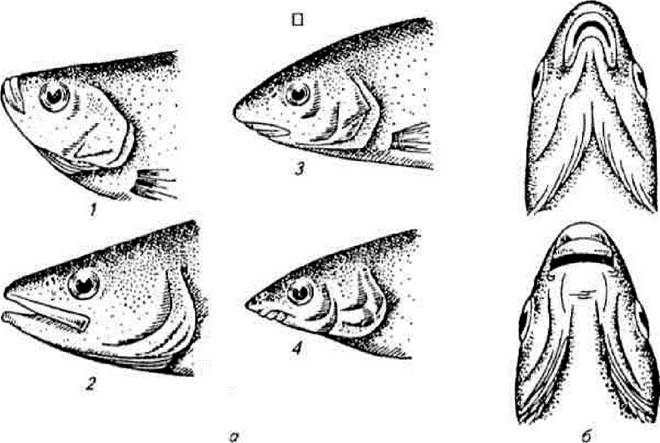
Fig. 2.8. Types of mouth positions:
1 — terminal (superior); 2 — terminal; 3,4 — inferior (a — lateral view, b — ventral view)
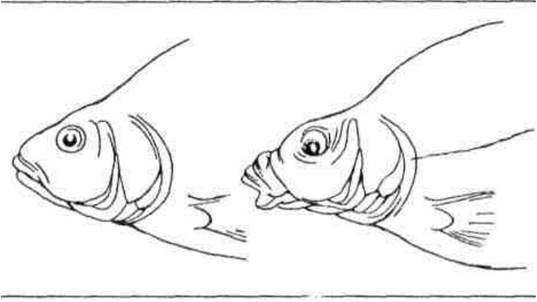
Fig. 2.9. Suctorial (protrusible) mouth
The oral cavity, considered the anterior section of the digestive tract in fish, transitions into the pharynx. This is a muscular channel, developed to varying degrees, into which gill rakers project through respective openings in its anterior part. Depending on the feeding spectrum, they form either a filtering or a pushing apparatus of various structures. In the posterior section of the pharynx in many teleost Fishes, pharyngeal teeth are present, which ensure mechanical Processing, grinding of food, and the preliminary Formation of the food bolus. The pharynx connects the oral cavity to the esophagus, which appears as a short, wide passage with a ring of striated Muscles, ensuring the propulsion of food into The Stomach or directly into the anterior section of the intestine in agastric fish. In the esophagus, additional taste reception occurs via taste buds, along with the moistening of the food bolus by mucous gland secretions.
In stomach-bearing fish, food passes from the esophagus into the stomach, which appears as an expanded digestive tube where mechanical and chemical Processing of the food bolus takes place. Its size and shape depend on the feeding habits of the fish. Fish that consume large prey (macrophages) at relatively long intervals have a large sac- or siphon-shaped stomach. Fish that feed on small food organisms (microphages) at short intervals possess a small, lump-shaped stomach. The stomach cavity is lined with a single-layered mucous epithelium featuring fine folds, in the depressions of which open the ducts of glandular tubes through which digestive Enzymes enter. Agastric fish lack a stomach; its Functions are performed by the anterior section of the intestine.
The fish intestine consists of anterior, middle, and posterior sections. As noted previously, its length depends on the Nature of the diet and mostly ranges from 20 to 1200% of the fish's body length. Furthermore, the relative length of the fish intestine generally increases with age. The intestinal wall consists of four layers: mucous, submucous, muscular, and serous. The internal single-layered epithelial mucosa is formed by cylindrical absorptive Cells with microvilli, interspersed with goblet and pear-shaped secretory cells. In the anterior section of the fish intestine, the mucosa forms longitudinal folds, while in more posterior sections, it forms a complex reticular structure. In lower-organized fish (cartilaginous, sturgeon, salmon-like), a spiral valve is preserved at the border between the middle and posterior sections of the intestine due to the twisting of the epithelium and muscular layer, thereby increasing the "working" surface area of the intestine. In certain stomach-bearing fish (herring, salmon, cod-like species), well-developed and sometimes quite numerous (up to 400 in salmon) blind outgrowths of the gut—pyloric appendages—are present at the beginning of the anterior intestinal section, increasing its digestive surface. The mucosa of these outgrowths lacks secretory cells that produce digestive enzymes.
The digestion of the food bolus is facilitated by specialized structures—the liver and the pancreas. Divided into several lobes, the fish liver synthesizes a fluid secretion known as Bile, which accumulates in the Gallbladder and enters the anterior section of the intestine via specialized ducts as nutrients arrive there. In the intestine, bile promotes the breakdown, saponification, emulsification, and absorption of fats and Fat-soluble Vitamins, activates enzymes, and exerts an antiseptic effect. Small ducts of the pancreas, which has a diffuse structure and consists of separate scattered and branched lobules or tubules, adjoin the anterior section of the intestine.
The anatomical features of fish bodies are a consequence of phylogenetic specificities, which have not only ensured a high level of ADAPTATION TO ENVIRONMENTAL conditions but also the evolutionary success and widespread distribution of fish across the planet's aquatic environments.
To understand the theoretical aspects of fish nutrition and feeding, it is necessary to examine the physiological component, specifically the PHYSIOLOGICAL CHARACTERISTICS OF fish feeding.
The requirements of the fish organism for energy, plastic Materials, and elements necessary to sustain all life functions are met by their digestive system. It comprises both organs that directly perform the digestive function and those that regulate it. The organs performing the digestive function are integrated into the gastrointestinal or intestinal tube with associated compact secretory glands, referred to as the alimentary canal. The regulatory function is provided by two levels of The Nervous system: locally by enteric nerve endings, and centrally by corresponding structures of the Central Nervous System.
Goal-directed feeding behavior in fish is formed with the participation of the Hypothalamus and other Brain regions. The ultimate result of the digestive system's activity is the Hydrolysis of nutrients (Proteins, fats, CARBOHYDRATES) into monomers (Amino Acids, monoglycerides, Fatty acids, Monosaccharides) and their Transport from the alimentary canal to the internal environment of the organism. The physicochemical processes that ensure this outcome reflect The Essence of DIGESTION AND ABSORPTION. They are realized when the alimentary canal performs functions that include: temporary storage of the food bolus, breakdown of nutrients under the action of compounds produced by secretory cells, motor-evacuation action on the food bolus by the muscular layer of cells located in the alimentary canal wall, absorption of monomers by intestinal epithelial cells, and incretory elimination of undigested residues into the external environment.
One of the most critical characteristics of digestive system efficiency is The rate of food passage through the gastrointestinal tract. It should be noted that the throughput capacity of the gastrointestinal tract is significantly lower than that of the swallowing apparatus. The anterior part of the digestive system acts as a storage reservoir for the food mixture, gradually passing small portions of pre-processed and liquefied food—chyme—into the narrower distal part. This increases the degree of food bolus digestion and facilitates the subsequent absorption of nutrients. However, this prolongs the time food spends in the digestive system, which is influenced by Temperature conditions, food quality, and the physiological state of the fish (Table 2.2).
Table 2.2. Evacuation time of the digestive tract in certain fish species
Temperature, °C |
Evacuation time, h |
||
Carp |
Silver carp |
Channel catfish |
|
12 |
60 |
— |
90 |
17 |
35 |
16 |
35 |
20 |
30 |
13 |
28 |
24 |
24 |
10 |
20 |
28 |
- |
7 |
- |
30 |
— |
5,5 |
- |
The rate of digestive tract evacuation in herbivorous fish is higher than in omnivorous and carnivorous ones. The digestive tract of herbivorous fish is adapted to passing large quantities of low-nutrition food through the intestine, from which they extract a minor fraction of digestible substances. A fish diet consisting of more energetically valuable animal feed is retained in the digestive tract significantly longer, digested more slowly, and undigested residues are eliminated later. There is a clear inverse relationship whereby as the energetic value of food decreases, feeding frequency, digestion intensity, and the rate of waste elimination correspondingly increase.
Based on intensity, the digestive process is divided into two phases: the "effective" phase, during which easily digestible food components are broken down, and the "residual" phase, associated with The breakdown of hard-to-digest food components. During the first phase, up to 80% of the food bolus mass is digested. In carnivorous fish, this process takes about 3 days; in peaceful carnivorous-leaning fish, about 2 days; and in herbivores, less than 1 day. "Residual" digestion lasts from 1.5 to 3 days.
Digestive efficiency differs significantly between stomach-bearing and agastric fish. The stomach provides a larger receiving capacity for the digestive system, which is why stomach-bearing fish feed with a more pronounced periodicity. Thus, while the feeding periodicity of stomach-bearing fish is 1–2 days, for agastric fish it is 6–15 hours.
The rate of food DIGESTION IN THE fish stomach is significantly influenced by the mass of ingested food. As the volume of the food bolus increases, the efficiency of digestion and feed utilization decreases, intestinal motility is inhibited, and the proportion of nutrients that fail to be absorbed and are eliminated outwardly increases. The amount of food a fish can consume in a single meal varies considerably depending on the fish species, average weight, season, and ecological feeding conditions. Deep-sea predators are capable of swallowing prey fish much larger than themselves. The stomach capacity of ambush predators is about 50% of their body weight. Typically, predatory fish consume from 5 to 25% of their own body weight in a single meal. The ration of peaceful fish is considerably smaller, ranging from 0.5 to 1.2% of their body weight.
It should be borne in mind that the duration of food retention in the digestive system increases with the fish's age. The digestive tract empties fastest in fish larvae; in trout larvae at a water temperature of 8 °C, the intestine empties in 45–50 hours, in fry weighing 2.5 g—on average in 60 hours, and in fingerlings weighing 150 g—in 150–200 hours.
The process of food digestion in fish is ensured by the functioning of corresponding secretory structures. Mucus, which contains no digestive enzymes and merely protects Epithelial Tissues and facilitates the passage of the food bolus, is secreted into the oral cavity, pharynx, and esophagus of fish. Digestive enzymes begin to be secreted in subsequent sections of the alimentary canal, but the level of their enzymatic activity, energy, and kinetic characteristics vary depending on the diet type, food composition, and physiological state of the organism. Unlike higher vertebrates, fish enzymes are less heat-stable and more sensitive to changes in
environmental temperature. The temperature optimum for fish enzymatic activity lies within the range of 20–40 °C. In summer, it is twice as high as in winter, which holds true for regions with distinct seasons.
In stomach-bearing fish, an acidic gastric juice is produced (pH = 1.2...5). The acidity of gastric juice in predatory fish is higher than in omnivorous fish. Stomach enzymes are represented by several types of proteases, among which Pepsin plays a leading role. The effective action of this enzyme is observed at pH = 2...4. Optimal conditions for the digestive activity of pepsin are provided by the secretion of Hydrochloric acid, the amount of which depends on the nature of the food, its volume, and temperature. In agastric fish, neither pepsin nor hydrochloric acid is secreted.
Fish intestinal secretion is characterized by the release of up to 20 enzymes belonging to three main classes—proteases, lipases, and carbohydrases—which hydrolyze three corresponding classes of nutrients. The volume of intestinal juice, its composition, and enzymatic activity depend primarily on the COMPOSITION OF THE diet. The juice exhibits the highest enzymatic activity 5–6 hours after feeding begins. A clear relationship is observed whereby proteolytic activity of the intestinal juice prevails in carnivorous fish, while carbohydrolytic activity prevails in herbivores. The main proteolytic enzyme in the fish intestine is Trypsin, with exopeptidase and cathepisin being less pronounced, and their maximum hydrolytic action manifesting at pH = 7...11. The source of trypsin is difficult to localize, but presumably, a larger share comes from the pancreas, and a smaller share from the secretory Cells of the intestinal walls, including the pyloric appendages. Lipolytic activity, associated with the breakdown of fats into glycerin and fatty acids, has been detected in extracts of the pancreas, liver, intestine, and pyloric appendages. Carbohydrases, whose hydrolytic action is aimed at breaking down carbohydrates, have been found in large quantities (maltases, sucrases, lactases, cellobiases, glucosidases) and are more pronounced in herbivorous fish. The liver is closely connected with the digestive process, secreting bile which accumulates in the gallbladder. Bile contains no enzymes; rather, it is a mixture of organic and inorganic salts, pigment substances, Cholesterol, fatty acids, bilirubin, lecithin, and water. Bile enters the anterior section of the intestine or the pyloric appendages via a corresponding duct, ensuring the digestion and adsorption of Lipids and related substances such as fat-soluble vitamins (A, D, E, K), and activates the action of digestive enzymes.
Food components broken down during digestion are absorbed through the intestinal wall and transported into the Blood. The assimilation of ingested food in fish varies over a wide range and depends on the degree of food bolus digestion. In phytophages and detritivores, whose diet contains a significant proportion of ballast substances, the degree of food assimilation does not exceed 20%, whereas for predators it reaches 80%.
The data presented provide insight into the nutritional physiology of fish in both natural and artificial environments, which is essential for a rational approach to feeding—a core practice in modern aquaculture. At the same time, it should be noted that the rate of physiological processes is closely tied to environmental conditions, which frequently dictate quantitative metabolic parameters and influence the overall efficiency of fish feeding.
The information provided sheds light on various aspects of nutritional theory and fish feeding practices, which is necessary for a well-founded approach to such a vital area as contemporary views on fish nutrition and the application of feeding strategies across diverse aquaculture settings.
Last update: 08/08/2026
Editorial and Educational Adaptation: This material has been compiled based on the primary/original source text. The project team performed an editorial review, corrected technical inaccuracies, structured sections, and adapted the content for an educational format.
What was processed:
- elimination of formatting defects (OCR errors, structural breaks, corrupted characters);
- editorial organization of content;
- standardization of terminology in accordance with academic sources;
- verification of factual statements against the original source text.
All mentions of the author, publication year, and origin of the primary text have been preserved in accordance with the source.