General Biotechnology: Lecture Course, Part II - Blinov, V. A. 2004
Medical Biotechnology
♦ Production of Vaccines, Enzymes, and diagnostic agents.
♦ Production of Hormones, interferon, and immunomodulators.
♦ Microbiological transformation of Organic compounds.
Production of vaccines, enzymes, and diagnostic agents. Currently, over 100 different bacterial and viral immunoprophylactic and therapeutic products are manufactured. Vaccination has successfully eradicated smallpox and significantly reduced the spread of rabies, poliomyelitis, and yellow fever. Vaccines against Influenza, hepatitis, herpes, mumps, measles, and acute respiratory infections are widely produced. Furthermore, vaccines targeting livestock diseases—such as FOOT-and-Mouth disease, African horse sickness, bluetongue in sheep, and trypanosomiasis—are under active development. Vaccines are formulated using attenuated, inactivated, or disintegrated pathogens.
Vaccines. They can be particulate—manufactured from killed or attenuated live pathogen Cells—or soluble, commonly referred to as chemical vaccines. Currently, vaccines are classified into the following categories:
♦ prokaryotic and Introduction/5.html">Eukaryotic Cell vaccines: live and killed;
♦ cellular component vaccines: polysaccharide and ribosomal;
♦ cell metabolic product vaccines: toxoids—microbial exotoxins detoxified with formalin while retaining their antigenic properties, used to produce antitoxic sera;
♦ viral vaccines: a) virion-based—live and inactivated; b) virion component-based—subunit;
♦ genetically engineered vaccines.
Vaccines can be produced as micro-preparations or in combined formulations to establish Immunity against multiple infections simultaneously. The fundamental requirements for any vaccine are high immunogenicity and safety for humans and animals.
For a long time, vaccine production relied on Tissues from infected animals, such as Lymph Nodes AND spleens. Today, however, many vaccines are produced microbiologically, specifically through recombinant microorganisms that synthesize only the targeted antigen. Vaccines against foot-and-mouth disease, hepatitis B, rabies, influenza, and other conditions have already been successfully developed. Promising host systems for this purpose include Yeast and animal cell lines. Typically, monolayer cultures are employed, where cells grow On the surface of specialized Supports (such as DEAE-Sephadex, polystyrenes, polypropylenes, or Glass), or cells are suspended in a specialized medium. This method is analogous to submerged microbial cultivation and is utilized, for instance, to yield Monoclonal Antibodies.
Here is the technology for producing live vaccines:
♦ Propagation of the vaccine strain through several passages, ranging from tube cultures on media up to the bioreactor under optimal conditions. The cultivation mode is generally batch-type;
♦ Separation of cells from the culture liquid, for example, by centrifugation;
♦ cell resuspension; for instance, a mixture of sucrose and gelatin is used for the BCG vaccine, whereas Water is used for the tularemia vaccine, etc.
♦ dispensing the suspension into ampoules or vials;
♦ freeze-drying (lyophilization), followed by ampoule sealing or vial stoppering.
Live vaccines must not contain any preservatives or other inhibitors that could affect the GROWTH AND DEVELOPMENT of the vaccine strains. In Russia, the following live vaccines are produced: M-44 for Q fever, percutaneous brucellosis vaccine, BCG for intradermal use, anthrax vaccine for humans (STI vaccine for percutaneous or subcutaneous use), combined typhus vaccine, percutaneous tularemia vaccine, and plague vaccine. Live vaccines are typically administered in a single dose.
Whole-cell inactivated vaccines consist of a suspension of pathogenic Bacteria or Fungi cells that retain pronounced immunogenicity while being devoid of pathogenicity. The manufacturing process involves the following key steps: cultivating the strain on a nutrient medium, inactivating the cells (via heating, or Treatment with formalin, acetone, or ethanol), cell separation, resuspending the cells in an isotonic sodium chloride solution to a specific concentration, and quality control testing to ensure the absence of living pathogens as well as to verify immunogenicity, among other parameters. These diluted, inactivated microbial Suspensions are dispensed into ampoules or vials and stored at 2 10 °C. The primary route of administration for killed vaccines is subcutaneous injection. Vaccines prepared in this manner include those against brucellosis, typhoid fever, Gonorrhea, dysentery, pertussis, leptospirosis, paratyphoid fevers, and cholera.
Modern biotechnological developments focus on The production of recombinant vaccines and subunit antigen vaccines. Both types of vaccines rely on Genetic Engineering approaches. Recombinant vaccines typically utilize the vaccinia virus (cowpox), into whose DNA foreign genes are inserted to encode the immunogenic Proteins of various pathogens, such as the influenza virus hemagglutinin, Herpes simplex virus glycoprotein D, hepatitis B surface antigen, and malaria parasite Antigens. This is a highly critical issue globally. For instance, there are approximately 200 million carriers of the hepatitis B virus. Between 5 and 15% of adults and up to 95% of children who contract the acute infection become lifelong chronic carriers of the pathogen. The virus can lead to acute hepatitis, Liver cirrhosis, and hepatocellular carcinoma. The virus is transmitted exclusively via parenteral (serum) injections and lacks susceptible tissue models: among mammals, only chimpanzees are susceptible to this virus, and only in cultured tissue cells of these higher animals do the introduced hepatitis B genes assemble into fully functional immunogenic particles.
An advantage of recombinant vaccines is the possibility of developing polyvalent preparations based on the DNA of the vaccinia virus. In other words, simultaneous comprehensive immunization of cattle and other animal species against all dangerous infections in a given area becomes feasible.
Antigenic vaccines are produced by cloning pathogen genes in E. coli, Yeasts, insect cells, and mammalian cells. Currently, the Gene for the surface antigen of the hepatitis B virus (serum hepatitis) and the envelope gene of the FMDV (foot-and-mouth disease virus) have been successfully cloned. Such vaccines are highly stable during storage and transportation, relatively easy to use, contain a minimal amount of protein, and therefore present a low allergenicity risk while being guaranteed free from residual virulence. Their main drawback is low immunogenicity. To enhance immunogenicity, adjuvants are added, vaccines are immobilized on carriers, or incorporated into Liposomes.
Enzymes. They are widely used in medicine for dissolving Blood clots, treating Hereditary diseases, removing denatured structures, cellular and tissue debris, and clearing the body of toxic Viruses, among other Applications. Thus, thrombolytic enzymes (streptokinase, urokinase), including their immobilized forms (streptodase), are used to treat patients with Thrombosis of the extremities, Lungs, and coronary Vessels of the Heart. Proteases are employed for debriding purulent-necrotic lesions and treating Burns. Immobilized L-asparaginase is used in the treatment of leukemia. Recombinant superoxide dismutase (SOD) is used to therapy diseases caused by active oxygen radicals, such as CORONARY HEART DISEASE, Arthritis, oxygen toxicity, and during Kidney transplantation, etc.
Много внимания уделяется ингибиторам ферментов. Например, при септических процессах, инфаркте миокарда, эмфиземе легких, панкреатитах эффективными оказываются ингибиторы протеаз, полученные из актиномицетов (лейпептин, антипаин, химостатин), генноинженерных штаммов Е. coli (эглин) и дрожжей (а-1-антитрипсин). При диабете добиваются снижения уровня глюкозы в крови больных с помощью ингибиторов кишечных инвертаз и амилаз, которые превращают крахмал и сахарозу в глюкозу. В настоящее время описано более 100 наследственных заболеваний, обусловленных дефицитом какого-либо фермента. Эти заболевания (например, болезнь Гоше) пытаются лечить, применяя Ферменты (генотерапия).
Diagnostic preparations. Highly specific monoclonal antibodies (MAbs) are used to diagnose leprosy, cholera, and diseases caused by pathogenic Protozoa such as malaria, trypanosomiasis, leishmaniasis, Toxoplasmosis, and human viral tumors.
Nucleic acid probes are highly effective in detecting genetic defects. Short probes are produced through chemical synthesis, while long ones are obtained by isolating DNA from the target object. The DNA is then cleaved with a restriction enzyme, the required segments are selected, individual fragments are inserted into Plasmids, multiplied, and labeled. Probes are effective for prenatal Diagnosis—for example, for the timely termination of Pregnancy if genetic defects are suspected in the fetus. Probes are also used to detect a range of RNA- and DNA-containing viruses.
Production of hormones, interferon, and immunomodulators. For a long time, hormones were extracted from the blood, Organs, and tissues of animals and humans. Obtaining the product required large amounts of material. For instance, human somatotropic hormone (STH) was extracted from human pituitaries, where its content does not exceed 4 mg. Treating a single child suffering from dwarfism requires about 7 mg of STH per week, and the course of treatment lasts for several years. Today, genetic engineering strains of E. coli are used to produce up to 100 mg of STH per 1 liter of culture medium. This opens up new possibilities for treating dwarfism and combating short stature. Furthermore, STH promotes the healing of wounds and burns, regulates protein, carbohydrate, and fat METABOLISM, as well as Ca2+ Homeostasis in Bone tissue.
As is well known, the main treatment for Diabetes Mellitus is Insulin. This hormone is extracted from the Pancreas of cattle and pigs. Such insulin differs from human insulin by 1–3 amino acid residues, which causes various types of allergies in people, especially children. Animal-derived insulin is expensive, and its supplies are limited. Chemically synthesized insulin proved to be even more expensive. Since 1982, genetically engineered insulin has been produced based on the separate synthesis of its A and B chains by E. coli. The resulting insulin is identical to human insulin, and its cost has decreased significantly. In addition, genetically engineered insulin eliminates diabetes complications (kidney and retinal damage), does not cause immune reactions, promotes the rapid excretion of toxic ketones from the blood, and is required in smaller quantities compared to bovine and porcine insulin.
Currently, other Peptide Hormones are also produced via genetic engineering, including follicle-stimulating and luteinizing hormones, as well as oligopeptide hormones of The Nervous system: enkephalins and endorphins.
Interferons. These are produced by Human and Animal cells in response to viral infection. Interferons exhibit antiviral activity by preventing Viral Particles from entering The Cell. They stimulate The Immune System and inhibit cell proliferation (e.g., cellular immunoglobulin, anti-Rho(D) human immunoglobulin, and lymphocytic chalones).
Other immune factors include lymphocytic anticancer drugs obtained using recombinant microorganisms: interleukins, lymphotoxins, and human lymphoregulin. The latter suppresses the growth of Sarcoma and leukemia cells and stimulates The activity of natural killer cells.
Interleukins—Polypeptides consisting of about 150 amino acid residues—participate in organizing the Immune Response. For example, interleukin-1 is produced by macrophages and stimulates the proliferation of T-helper cells, which in turn produce interleukin-2. Interleukin-2 triggers the proliferation of various T-lymphocyte subpopulations (T-killers, T-helpers, T-suppressors) as well as antibody-producing B-lymphocytes. Under The Influence of interleukin-2, regulatory proteins known as lymphokines are released from T-lymphocytes, activating various Components of the immune system.
Microbiological transformation of organic compounds. The application of microorganisms for the transformation of organic compounds involves two main directions:
♦ complete Biosynthesis of BIOLOGICALLY ACTIVE SUBSTANCES (BAS) and various products (Antibiotics, enzymes, Vitamins, sterols, Amino Acids, etc.) by microorganisms;
♦ combined use of individual chemical and microbiological stages in the multistep synthesis of Pharmaceuticals and other high-value products.
The application of microorganisms is based on their ability to carry out crucial transformations in a single step that would otherwise require up to 20 chemical steps. Moreover, they make it possible to perform reactions that are currently impossible to achieve chemically. The main processes of microbiological transformation include oxidation, reduction, decarboxylation, deamination, glycosidation, Hydrolysis, methylation, Esterification, dehydrogenation, Condensation, amination, Acetylation, amidation, demethylation, nucleotidylation, halogenation, dimethylation, asymmetrization, racemization, and isomerization. The common feature of all these processes is the Modification of the molecular Structure OF THE transformed substance rather than de novo molecular synthesis.
Microbiological transformation of Steroids. In this field, the advantages of microorganisms are particularly pronounced and have been known for a long time. For instance, the intestinal microflora of mammals converts Cholesterol into coprostanol and cholic acid into deoxycholic acid. In 1948, the Introduction of a hydroxyl group into a steroid molecule via microbiological Methods was accomplished for the first time.
A well-studied sterol is cholesterol. In the bodies of animals and humans, cholesterol serves as the precursor for three important groups of hormones: progestins, Sex Hormones, and Adrenocortical Hormones. The raw Materials used to produce A number of these medications include diosgenin (from the Dioscorea plant), stigmasterol from soybeans, and ß-sitosterol, which is sourced from reeds, cottonseed oil, wheat germ, etc. Below is the technological Scheme for the production of hydrocortisone.
The production of hydrocortisone is carried out using Curvularia lunata and involves the following stages:
1. Cultivation of the transforming culture is performed under strictly sterile conditions. Three consecutive generations of this culture are grown on a medium containing sucrose, yeast autolysate, and a complex mixture of organic salts:
Class="center">
2. Transformation of substance S (4-pregnene-17a,21-diol-3,20-dione), a key intermediate in the synthesis of hydrocortisone, cortisone, and prednisolone. The process is conducted under sterile conditions. The mycelium is ground in a micromill to obtain a suspension with a substance S concentration of 1 g/L. Antibiotics are used to combat contaminant microbes, and the process requires agitation, aeration, and defoaming.
3. Isolation of the transformation product—hydrocortisone. The culture liquid along with the mycelium is sent for separation. The separated mycelium is washed, and the wash water is combined with the main culture liquid. Next, extraction and separation of the transformation product from the aqueous medium are carried out using an organic solvent. The extract is clarified with activated charcoal, concentrated by evaporation, clarified again, evaporated to dryness, and washed.
The transformation of hydrocortisone into prednisolone is carried out using Mycobacterium globiforme. The culture is grown in the same manner as for hydrocortisone production. The isolation of prednisolone is performed via extraction and separation from the culture liquid, differing only in the set of Solvents used. A process has been described in which powdered cortisone is cultivated with Arthrobacter simplex for 5 days, yielding prednisolone with a 93% conversion rate. The dehydrogenation of microcrystalline hydrocortisone proceeds According to the scheme: hydrocortisone (crystals) → hydrocortisone (solution) → prednisolone (solution) → prednisolone (crystals). As prednisolone accumulates, it crystallizes in the form of needles. Currently, the transformation of Steroid compounds using immobilized cells is becoming increasingly widespread.
Cortisol and its synthetic analogues (prednisolone, dexamethasone) belong to modern emergency therapeutics thanks to their unique anti-inflammatory, desensitizing, and anti-Shock effects.
Microbiological transformation of sorbitol. CARBOHYDRATES serve as natural substrates for the majority of microorganisms. Their conversion involves several stages: oxidative carbohydrate transformations (oxidation of polyols, production of aldonic acids), reduction, and carbohydrate isomerization.
Two polyol oxidation processes are applied on an industrial scale: The conversion of glycerol to dihydroxyacetone and the conversion of D-sorbitol to L-sorbose. The latter reaction is one of the steps in ascorbic acid synthesis and proceeds according to the following scheme:
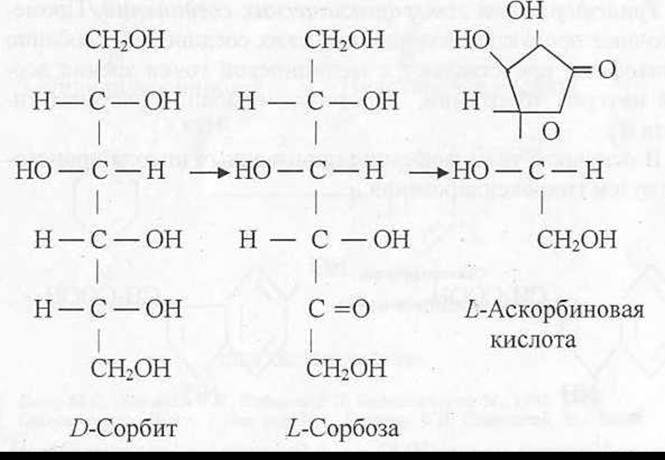
The submerged cultivation method is used in production. The inoculum—a suspension of Acetobacter suboxydans cells—is grown on a medium containing sorbitol, glucose, yeast extract, and CaCO3. Air is sparged through aeration systems into 15–20% D-sorbitol solutions containing the transforming culture and growth-essential vitamins. At a Temperature of 30 °C, L-sorbose is obtained in solution with a 93% yield after 24 hours.
At the end of the Fermentation process, the solution containing sorbose (culture broth) is decolorized with activated charcoal and filtered, including The Use of a filter press.
The filtrate is concentrated under vacuum to a syrup-like consistency, which crystallizes at 15 °C. The crystals are separated by centrifugation, washed with ice-cold water, and dried. A second crop of L-sorbose is recovered from the mother liquor and washed.
The ability to oxidize sorbitol to sorbose has been established not only in A. suboxydans, but also in other acetic acid bacteria: A. melanogenum, A. ketogenum, A. gluconicum, as well as in Bacterium orleanense, Bacterium xylinoides, and others.
Transformation of heterocyclic compounds. Intermediate products of heterocyclic compounds, especially those of Tryptophan, are of particular medical interest: tryptamine, serotonin, indole-3-acetic acid, and others.
Indole derivatives are primarily transformed via hydroxylation.
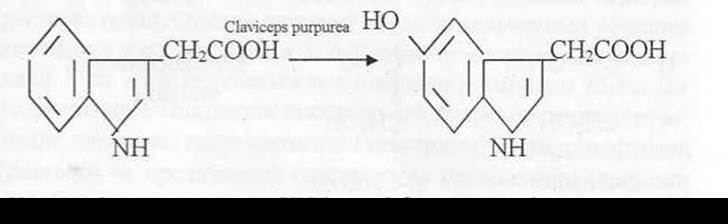
Under the influence of Aspergillus niger, tryptamine is converted into 5-hydroxy-IAA. This appears to be the mechanism by which microorganisms detoxify heteroauxin. The hydroxylase activity of many fungi is utilized to synthesize complex 5-hydroxyindoles. A. niger also performs the Oxidative Deamination of N-substituted tryptamine analogues.
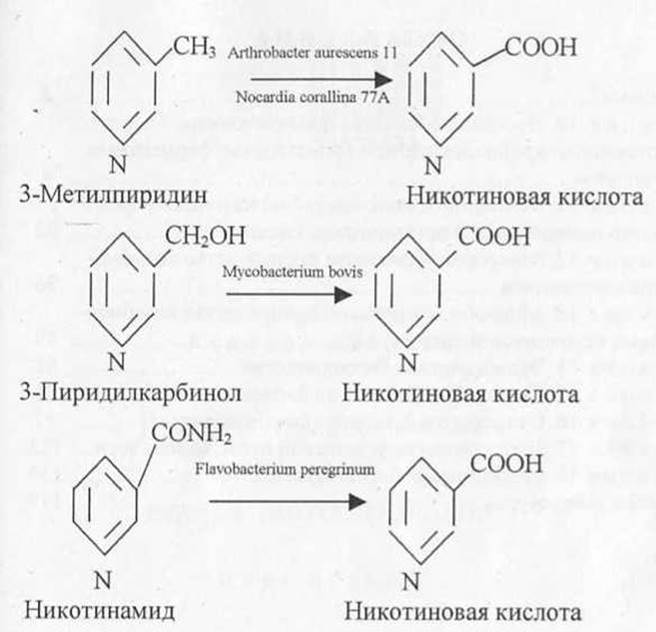
Transformation of pyridine derivatives. Nicotinic acid and its amide are typically produced by chemical synthesis. However, microbiological approaches for transforming the corresponding substrates have already been developed.
Last update: 06/08/2026
Editorial and Educational Adaptation: This material has been compiled based on the primary/original source text. The project team performed an editorial review, corrected technical inaccuracies, structured sections, and adapted the content for an educational format.
What was processed:
- elimination of formatting defects (OCR errors, structural breaks, corrupted characters);
- editorial organization of content;
- standardization of terminology in accordance with academic sources;
- verification of factual statements against the original source text.
All mentions of the author, publication year, and origin of the primary text have been preserved in accordance with the source.