Human Anatomy and Physiology - I. V. Gayvoronsky 2011
Internal Environments of the Body. Blood
Immunity
Immunity is a complex of protective mechanisms of the body aimed at preserving its biological integrity and individuality.
Humans are constantly exposed to millions of microorganisms and Viruses, many of which can cause infectious diseases upon entering the body's internal environment. It is known that one in every million Cell divisions results in a genomic defect. If such a cell continues to divide, it poses a risk of forming defective Tissues. At the same time, Cells that have outlived their functional lifespan constantly die off in the body and must be cleared away to make room for new cell development. Thus, The Immune System is designed to protect against external infections (Bacteria, viruses, Protozoa), as well as altered and dead cells.
The immune system integrates Organs and tissues where cells involved in immune responses are formed or function. The Organs of the immune system are divided into central and peripheral. The central organs include the Cytology/practical/86.html">Red Bone Marrow, Thymus, and the equivalent of the bursa of Fabricius. The Peripheral Organs of the Immune System are the spleen, Tonsils, Lymph Nodes, and lymphoid formations of the intestinal wall.
The red bone marrow, medulla ossium rubra, is the primary hematopoietic organ in humans. Located within the spongy Bone tissue, it consists of myeloid tissue where all types of formed Blood elements (erythrocytes, leukocytes, and thrombocytes) originate from hematopoietic stem cells. Among these formed elements, only leukocytes perform an immune function. While monocytes and and granulocytes enter the bloodstream upon maturation, lymphocytes undergo further differentiation in the thymus and the equivalent of the bursa of Fabricius.
The thymus, thymus, is a small organ located behind the Sternum. Within its cortical substance, lymphocytes undergo primary differentiation and develop into T-lymphocytes. Subsequently, they migrate to the peripheral organs of the immune system for further specialization.
Cells of the medullary substance synthesize the hormone thymosin, which regulates the differentiation process of T-lymphocytes.
The exact anatomical Location OF THE bursa of Fabricius equivalent in The Human Body has not been definitively established, though it is widely believed that the lymphoid tissue of the Appendix performs this function. The primary role of this organ is the primary differentiation of lymphocytes into B-lymphocytes. Upon maturation, these can transform into antibody-producing plasma cells.
The spleen, lien (Greek: splen), is a parenchymatous organ situated in the left hypochondrium. It features a diaphragmatic surface and a visceral surface (adjacent to Internal Organs) that contacts The Stomach, colon, and left Kidney. At the center of the visceral surface lies the splenic hilum, the entry point for blood Vessels and nerves that supply and innervate the organ. The spleen is externally covered by the Peritoneum, beneath which lies a Connective Tissue capsule that extends inward as trabeculae, dividing the splenic tissue into red and white pulp. The white pulp appears as spherical aggregates of lymphoid tissue where T- and B-lymphocytes undergo final differentiation. The red pulp surrounds these aggregates and performs several Functions: destroying aged erythrocytes, capturing iron released from their breakdown, and serving as a blood reservoir.
Lymph nodes, lymphoid structures of the gastrointestinal tract, and tonsils are described in detail in the respective sections. Here, It is worth noting that they serve as the primary sites for lymphocyte functioning. Within these organs, lymphocytes encounter microorganisms and viruses, destroy them, and acquire The ability to recognize and memorize their Antigens—in other words, they undergo final antigen-dependent differentiation.
Cellular and humoral immunity. The Russian scientist I. I. Mechnikov made a profound contribution to understanding the mechanisms of immunity. In 1863, he proposed The Theory of cellular immunity and phagocytosis. He discovered that leukocytes can penetrate blood vessel walls into tissues and migrate toward clusters of microorganisms. Upon approaching a bacterial cell, a leukocyte engulfs and absorbs it. A membrane-bound vacuole forms around the microbial cell, into which Lysosomes pour their contents, destroying The Cell wall and all structures of the bacterium. The process of capturing and digesting foreign agents is called phagocytosis, and the cells capable of performing it are known as phagocytes.
Lymphocytes also play an active role in destroying invading microorganisms. Upon transforming into plasma cells, B-lymphocytes produce Antibodies (IMMUNOGLOBULINS). Several classes of immunoglobulins are distinguished: A, D, E, G, and M. Each is responsible for specific functions and has a designated localization within the body. By binding to bacteria, antibodies render the microbial cell more vulnerable to macrophages.
T-lymphocytes are subdivided into several classes: T-killers destroy foreign agents; T-helpers activate B-lymphocytes, stimulating their transformation into plasma cells; T-suppressors downregulate the body's Immune Response to antigenic stimuli; and memory T-cells retain information about foreign agents that have previously invaded the body's internal environment (enabling a faster and more robust secondary response upon reinfection).
Specific and nonspecific immunity. The body's defense factors are categorized into specific and nonspecific. Nonspecific defenses prevent The entry of all pathogenic bacteria and viruses. A pathogen must first breach the barrier of the normal human microflora residing on the Skin and mucous membranes. While harmless to the host, this microflora acts antagonistically against pathogenic bacteria and viruses. The skin and mucous membranes serve as the next line of defense; as a rule, they are highly impermeable to most pathogens. The secretions they produce, the presence of Lysozyme, and the substantial thickness of the epithelium frequently present an insurmountable obstacle.
Complement is a complex protein system capable of lysing and destroying microbial cells. Additionally, the body produces a specialized substance capable of inhibiting viral Replication, known as interferon.
Should these barriers be breached, phagocytes and humoral immune factors are engaged to destroy the pathogens.
Specific defense factors are targeted at eliminating a specific strain of pathogen. Typically, specific immunity develops following contact (via infection or vaccination) with a microorganism. Specific antibodies are synthesized against the antigens of that particular bacterium or virus, which in turn trigger the destruction of the invading pathogens.
Inflammation. Once an infectious agent breaches the skin and mucous membrane barriers, it encounters tissue micro- and macrophages. Acting as the body’s "border guards," these cells destroy a small fraction of the invading bacteria and signal the immune system that foreign agents have crossed the body's boundaries.
Through evolution, the body developed a protective reaction to combat infection known as inflammation. During this process, blood flow slows down at the site of infection. Neutrophils (microphages) exit the bloodstream into the tissues, migrating toward the source of infection to eliminate the bulk of microorganisms. Subsequently, monocytes—macrophages—enter the tissue to phagocytize the remaining bacteria and dead neutrophils.
These exact mechanisms underlie inflammation. The tissues involved become dense and painful. If the inflammation occurs on the skin or visible mucous membranes, noticeable redness (hyperemia) develops. Typically, this process is characterized by either a local or systemic elevation in Temperature (hyperthermia) and impaired organ function.
Development of immunity. The human body is genetically programmed to defend against certain diseases and to eliminate altered and senescent cells. At the same time, the immune system is in a state of continuous refinement, acquiring the capacity to recognize and destroy novel infectious agents previously unencountered by the individual.
Various classes of T-lymphocytes can independently destroy Bacterial cells and retain memory of previously encountered bacteria or viruses. Upon re-exposure to the same agent, the immune system mounts an immediate destructive response, preventing the onset of disease.
Certain pathogenic viruses and bacteria possess related strains that share antigenic similarities but are incapable of causing disease. When introduced into the body, they provoke an immune response that culminates in the retention of information regarding the invaders' antigens. If pathogenic microorganisms bearing the same antigens subsequently enter the body, no disease develops because the immune system is already primed to recognize those antigens, leading to their rapid phagocytosis. For instance, in 1776, Edward Jenner observed that individuals working with livestock never contracted smallpox, a disease that was fatal in one out of ten cases. Jenner inoculated people with cowpox, which they contracted with virtually no symptoms, yet consequently acquired lifelong immunity against smallpox.
Vaccines are prophylactic preparations containing bacterial or viral antigens that prime the immune system to defend against pathogenic microbes. Vaccines may consist of live non-pathogenic microorganisms, killed or attenuated pathogenic microbes, or fragments thereof containing the necessary antigens. Thanks to vaccination, millions of lives have been saved from incurable diseases, the incidence of polio, measles, pertussis, diphtheria, anthrax, and plague has plummeted, and smallpox has been completely eradicated.
Serums are therapeutic agents containing antibodies directed against disease-causing antigens. They are derived from the blood of animals or humans who have recovered from an infectious disease or have been vaccinated. When administered, these pre-formed antibodies bind to invading antigens and stimulate the immune response. Serums are utilized for the emergency prophylaxis or Treatment of infectious diseases, helping to prevent or treat conditions such as Influenza, tetanus, pertussis, botulism, and diphtheria.
Immunity is classified into natural and artificial (Fig. 13.4). Natural immunity can be innate or acquired (following a past infection). Artificial immunity is subdivided into active (induced by vaccines) and passive (conferred by serums). Indeed, following vaccination, B-lymphocytes independently generate antibodies against a specific infectious agent, whereas serums introduce pre-formed antibodies.
Naturally acquired immunity does not develop against certain diseases, including Syphilis, tonsillitis, and others. In most cases, naturally acquired immunity is not lifelong.
There are diseases that target the human immune system, one of the most dangerous being Acquired Immunodeficiency Syndrome (AIDS). It is caused by the HUMAN IMMUNODEFICIENCY VIRUS (HIV). This virus attacks T-lymphocytes, suppressing their ability to fight off infectious agents. As a result, a person dies not from AIDS itself, but from opportunistic secondary infections (such as Pneumonia or Sepsis).
Considering the primary transmission routes (sexual contact, unsterile syringes among drug users, and unsterilized medical instruments), the Prevention of this infection requires the following measures:
1) avoiding casual sexual contact;
2) refraining from drug use;
3) using disposable needles and syringes, as well as sterile instruments, in medical facilities;
4) screening all blood Donors for HIV carriage prior to transfusion.
Class="center">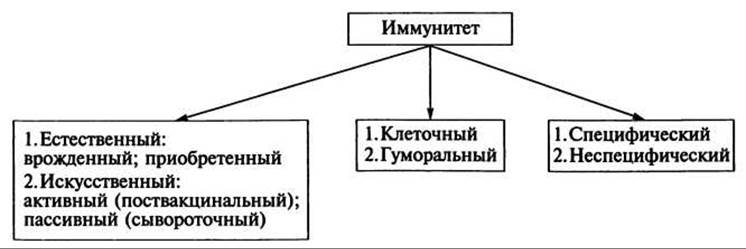
Fig. 13.4. Classification of immunity
Allergy is a condition characterized by hypersensitivity of the immune system to certain antigens, leading to damage to the body's own Cells and Tissues. Allergies can occur in response to contact with various biological substances (such as plant pollen or animal dander) or chemicals (including certain medications and foods). In an allergic reaction, the immune response to antigen exposure is disproportionately excessive relative to the stimulus. Consequently, antibodies and BIOLOGICALLY ACTIVE SUBSTANCES damage the body's own cells and tissues. Manifestations of allergies may include skin redness, itching, sneezing, a runny Nose, watery eyes, and asthma attacks.
1. List the body's internal environments.
2. What is Homeostasis?
3. Name the Functions and Composition of blood.
4. Describe the COMPOSITION AND PROPERTIES of Blood Plasma.
5. List the formed elements of blood.
6. What functions do erythrocytes perform?
7. What is anemia?
8. What types of anemia do you know?
9. What are the Different types of leukocytes?
10. List the functions of leukocytes.
11. WHAT IS A leukocyte differential (differential WHITE BLOOD CELL count)?
12. What is blood clotting (coagulation)?
13. Name the Blood Groups According to the ABO system and characterize them.
14. What is Rh incompatibility (Rh conflict)? In what cases does it occur?
15. What is immunity? Name its types.
16. What is the difference between vaccines and sera?
Last update: 08/08/2026
Editorial and Educational Adaptation: This material has been compiled based on the primary/original source text. The project team performed an editorial review, corrected technical inaccuracies, structured sections, and adapted the content for an educational format.
What was processed:
- elimination of formatting defects (OCR errors, structural breaks, corrupted characters);
- editorial organization of content;
- standardization of terminology in accordance with academic sources;
- verification of factual statements against the original source text.
All mentions of the author, publication year, and origin of the primary text have been preserved in accordance with the source.