LEHNINGER PRINCIPLES OF BIOCHEMISTRY - VOLUME 1. THE FOUNDATIONS OF BIOCHEMISTRY: STRUCTURE AND CATALYSIS - 2011
1. FOUNDATIONS OF BIOCHEMISTRY
1.5. Evolutionary Foundations
Class="center">Biological phenomena only make sense when viewed through the lens of evolution.
Theodosius Dobzhansky, biology educator, March 1973
The enormous progress in biochemistry and molecular biology over recent decades has only reinforced Dobzhansky's remarkable insight. The striking similarity of metabolic pathways and Gene sequences across a vast diversity of organisms provides rigorous evidence that all modern organisms share a common evolutionary ancestor, having diverged from it through a series of small changes (Mutations), each conferring a specific advantage in a particular ecological niche.
Changes in Hereditary Information Provide the Raw Material for Evolution
Despite the remarkably high fidelity of METABOLISM/36.html">DNA Replication, occasional errors do occur, resulting in alterations to the DNA nucleotide sequence—that is, genetic mutations (Fig. 1-32)—which alter the genetic instructions for a particular cellular component. Uncorrected damage to one of the DNA strands leads to a similar aberrant outcome. Heritable DNA mutations, occurring in reproductive Cells, may prove harmful or even lethal to the new Organism or Cell. For instance, a mutation might lead to the synthesis of an anomalous enzyme incapable of catalyzing a vital metabolic reaction. However, mutations occasionally arise that help organisms or cells survive under specific conditions. A mutant enzyme, for example, might possess a slightly altered Specificity, enabling it to utilize a substrate that The Cell previously could not metabolize. If a population of mutant cells finds itself in an environment where this substrate is the sole or predominant nutrient, it will gain a selective advantage over the remaining unmutated cells (wild-type cells). The mutant cell and its descendants will survive and thrive in these novel conditions, whereas the wild-type cells will starve and gradually die out. Darwin termed this phenomenon "the survival of the fittest in the Struggle for Existence"; fundamentally, it is The process of natural Selection.
Fig. 1-32. DNA Replication and mutation: a plausible pathway for The Emergence of novel enzymatic activity. This example illustrates a hypothetical random event in which the hexokinase gene is accidentally copied twice during DNA replication in a hypothetical organism. As a result, the organism carries two complete copies of the hexokinase gene, one of which is redundant. Over numerous cell divisions, the DNA of both hexokinase genes continues to replicate, with rare, random errors occasionally altering The sequence of one copy and the protein it encodes. In a very rare yet plausible event, the altered protein acquires The ability to bind a novel substrate (galactose in our hypothetical scenario). The cell carrying this mutant gene is now equipped to metabolize galactose, allowing it to survive in environments where glucose is absent but galactose is present. Had gene replication not preceded the mutation, the essential original function of the protein (glucose metabolism) would have been lost.

As a result of an error during chromosomal replication, a second complete copy of a gene may become integrated into the chromosome. Because this second copy is redundant, such mutations are generally well-tolerated. This is one of the primary mechanisms by which cells evolve: a new gene with novel Functions emerges while the original gene with its ancestral (standard) functions is preserved. Viewed in this light, the DNA molecules of modern organisms serve as historical documents, chronicling the long journey from the earliest cells to the species of today. To be sure, the historical "record" inscribed in DNA is incomplete, as many mutations must have been lost over the course of evolution. Nevertheless, DNA molecules remain the finest historical document of biology at our disposal. The error rate in DNA replication cannot be too high, as this would yield successive generations of nonviable cells; nor can it be too low, as this would preclude the genetic Variability required for surviving mutants to adapt to changing environments.
Billions of years of adaptive selection have taught cells to extract maximum benefit from the chemical and Physical Properties of the molecules available in their environment. Successful genetic changes in individual organisms within a population, combined with natural selection (the survival and reproduction of organisms best adapted to altered environmental conditions), have given rise to the immense diversity of modern life, with each species uniquely adapted to a specific ecological niche.
Biomolecules Arose through Chemical Evolution
Thus, we have traced the opening chapter of evolutionary history: the emergence of the first living cells. Organic compounds, including essential biomolecules such as Amino Acids and CARBOHYDRATES that make up living matter, are found in the Earth's crust, oceans, and atmosphere only in trace quantities. How, then, did the earliest living organisms acquire such characteristic organic building blocks?
According to one hypothesis, these compounds were synthesized through the action of intense atmospheric forces—such as ultraviolet radiation, lightning discharges, or volcanic eruptions—acting upon the gases of Earth's prebiotic atmosphere and the inorganic constituents of deep-sea hydrothermal vents.
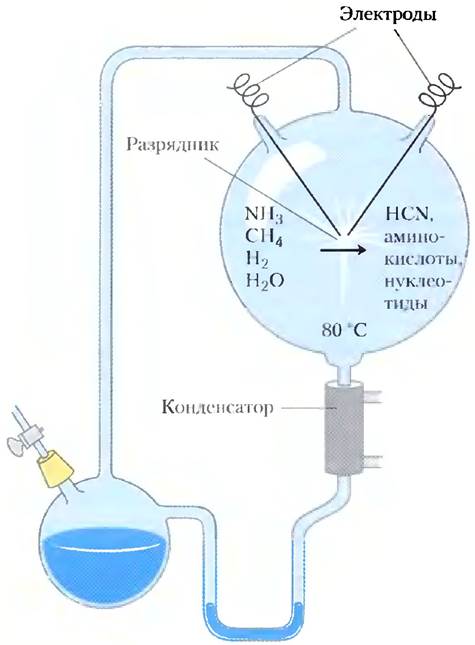
The classic experiment illustrating the abiotic (non-biological) origin of organic biomolecules was conducted in 1953 by Stanley Miller in the laboratory of Harold Urey. Miller circulated electrical discharges, simulating lightning, for a week or more through a gas mixture intended to mimic the primordial atmosphere—containing methane, ammonia, Water vapor, and hydrogen—enclosed within a system of Glass bulbs and electrodes (Fig. 1-33), and subsequently analyzed the products collected in the sealed reaction vessel. Carbon monoxide, carbon dioxide, and unreacted starting Materials were detected in the gas phase. The aqueous phase contained a rich assortment of organic compounds, including several amino acids, hydroxy acids, aldehydes, and hydrogen cyanide (HCN). This experiment demonstrated that biomolecules could be formed abiotically under relatively mild conditions in a comparatively short span of time.
Fig. 1-33. Abiotic synthesis of biomolecules. The spark-discharge apparatus used by Miller and Urey in their pioneering experiments to demonstrate the abiotic formation of organic compounds under simulated primitive atmospheric conditions. The gas mixture inside the apparatus was subjected to electrical discharges, after which the reaction products were condensed and analyzed. A variety of biomolecules, including amino acids, were identified among the products.
More sophisticated laboratory experiments have since provided evidence that many other chemical constituents of living cells, including Polypeptides and RNA-like molecules, can also be synthesized under these conditions. RNA polymers are capable of exhibiting catalytic activity in critical biological reactions (see Chapters 26 and 27). Furthermore, RNA likely played a pivotal role in prebiotic evolution both as a catalyst and as an informational molecule.
RNA and Related Precursors May Have Served as the First Genes and Catalysts
In modern organisms, Nucleic Acids encode the Genetic information that dictates the Structure of Enzymes, while enzymes catalyze the Replication and Repair of nucleic acids. The interdependence of these two classes of macromolecules poses a classic chicken-and-egg dilemma: which came first, DNA or protein?
It is possible, however, that they arose concomitantly, both having been preceded by RNA. The groundbreaking discovery that RNA molecules can catalyze their own synthesis points to a plausible role for RNA, or similar molecules, as the primordial genes and catalysts. According to this scenario (Fig. 1-34), at an early stage of biological evolution within the "primordial soup," an RNA molecule emerged that was capable of catalyzing the Synthesis of Other RNA molecules with an identical sequence—in other words, a self-replicating RNA molecule. The concentration of such RNA molecules would have grown exponentially, as one molecule gives rise to two, two to four, and so forth. The fidelity of self-replication was presumably imperfect, giving rise to diverse RNA variants, some of which proved even more proficient at self-replication. In the competitive struggle for available NUCLEOTIDES, the most efficient molecules prevailed, while less efficient variants faded from the population.
Fig. 1-34. A hypothetical scenario for the Evolution of the "RNA world."

According to the "RNA world" hypothesis, the division of labor between DNA (genetic storage) and protein (catalysis) occurred at a later stage. New variants of self-replicating RNAs arose that were also capable of catalyzing the Condensation of amino acid residues into polypeptide chains. At some point, the Peptides thus formed began to enhance the self-replicating efficiency of the RNA. Such an RNA/helper-peptide pair could undergo further evolutionary refinement, yielding increasingly sophisticated replication systems. The remarkable discovery that within the protein-synthesizing machinery of the modern cell (the ribosome), it is RNA rather than protein that catalyzes peptide bond formation stands as compelling testimony in favor of the RNA world hypothesis.
Sometime after the emergence of these primitive systems for Protein Synthesis, a major transition occurred: the DNA molecule took over the function of storing "genetic" information, its sequence being complementary to that of the self-replicating RNA. The RNA molecules, in turn, evolved to refine the catalysis of protein synthesis. (Later, in Chapter 8, we will examine why the DNA molecule is more stable than RNA and thus better suited for storing hereditary information.) Proteins proved to be versatile catalysts and subsequently assumed this function. Lipid-like components from the "primordial soup" formed relatively impermeable layers surrounding these self-replicating molecular associations. The high concentration of proteins and nucleic acids within these lipid envelopes promoted the molecular interactions essential for replication.
Biological evolution began more than three and a half billion years ago
Earth was formed approximately 4.6 billion years ago, and available evidence indicates that the first living organisms appeared over 3.5 billion years ago. In 1996, scientists working in Greenland discovered not fossilized remains, but chemical evidence of life ("fuel molecules") dating back more than 3.85 billion years. They found carbon-containing substances embedded in rock, likely of biological origin. During Earth's first billion years, simple organisms capable of replicating their own structure based on a template (RNA?)—which served as the earliest genetic material—began to appear in various locations. Because Earth's atmosphere at that time was virtually devoid of oxygen, and only a few microorganisms utilized the organic matter generated by abiotic processes, existing organic compounds were relatively stable. Given this stability of organic compounds and the vast timescales involved, one can understand how the improbable became inevitable: organic substances were incorporated into evolving cells, and the efficiency of self-replication mechanisms increased. Thus, biological evolution began.
The earliest cells were likely chemoheterotrophs
The very first cells arose in a reducing atmosphere (lacking oxygen) and probably derived their energy from inorganic substances such as iron(II) sulfide and iron(II) carbonate, which were abundant on early Earth. For example, the reaction
FeS + H2S —> FeS2 + Н2
releases sufficient energy to drive the synthesis of an ATP molecule or a similar substance. The organic compounds required by cells could have formed from components of Earth's early atmosphere (CO, СО2, N2, NH3, СН4, etc.) via non-biological processes such as lightning discharges and volcanic eruptions, or through hydrothermal mechanisms. Another hypothesis suggests that organic compounds were delivered to Earth from space. In 2006, the Stardust space probe returned to Earth with cosmic dust particles collected from a comet's tail; this dust contained a variety of organic compounds.
The earliest single-celled organisms, which emerged in a rich mixture of organic compounds (the "primordial soup"), were almost certainly chemoheterotrophs (Fig. 1–5). The organic molecules they required originally arose from the Components of the primitive atmosphere (CO, СО2, N2, СН4, etc.) through abiotic pathways driven by volcanic heat and lightning discharges. These early heterotrophs gradually acquired the ability to harvest energy from surrounding substances, using it to synthesize essential molecules and thereby becoming less dependent on external nutrient sources. A crucial milestone in evolution was the appearance of pigments capable of capturing solar energy, which allowed cells to reduce ("fix") СО2 into more complex organic compounds. The initial electron donor for this photosynthetic process was likely H2S, which was oxidized to elemental sulfur or sulfate ions (SO2-4). Later, cells began using water as an electron donor, resulting in the release of oxygen into the atmosphere. Modern cyanobacteria are the descendants of those first oxygen-producing photosynthetic organisms.
Because Earth's early atmosphere contained almost no oxygen, the first cells were anaerobes. Under these conditions, chemotrophs could oxidize organic compounds to СО2, transferring electrons not to oxygen, but to acceptors such as SО2-4, which produced H2S as a byproduct. With the advent of oxygen-producing photosynthetic Bacteria, the atmosphere became increasingly enriched with oxygen—a powerful oxidizing agent and a lethal poison to anaerobes. Faced with these challenging conditions, termed the "oxygen holocaust" by Lynn Margulis and Dorion Sagan, certain microbial lineages gave rise to aerobes, which obtained energy by transferring electrons from fuel molecules to oxygen. Because such reactions release substantial amounts of energy, aerobic organisms gained a bioenergetic advantage over their anaerobic counterparts in an oxygen-rich environment. Consequently, aerobic organisms came to dominate the oxygenated atmosphere.
Modern bacteria inhabit virtually every ecological niche in the biosphere, with organisms capable of utilizing almost any type of organic matter as a source of carbon and energy. Photosynthetic microbes in fresh and saltwater capture solar energy and use it to produce carbohydrates and other cellular components, which in turn serve as nutrients for other living things. The evolutionary process continues. We can witness this process in the laboratory using rapidly reproducing bacterial cells. One approach to generating a primitive cell ("protocell") in vitro is to determine the minimum gene Complement required for life by analyzing the genomes of the simplest bacteria. Among free-living bacteria, Mycroplasma genitalium has the smallest genome, consisting of 580,000 Base Pairs and containing 483 genes.
Eukaryotic cells arose in multiple stages from simpler precursors
Fossil evidence indicates that larger and more complex organisms began to emerge approximately 1.5 billion years ago, likely representing the first eukaryotic cells (Fig. 1–35). The details of the evolutionary transition from pre-nuclear to nuclear cells cannot be established solely from the fossil record; however, morphological and biochemical studies of modern organisms have allowed researchers to reconstruct a plausible sequence of events consistent with fossil data.
Figure 1–35. Stages in the evolution of life on Earth.

Three fundamental changes must have taken place. First, as cells acquired larger amounts of DNA, more sophisticated mechanisms were required to package the DNA compactly in complexes with specific proteins and to partition it accurately between daughter cells during division. This necessitated specialized proteins that stabilize coiled DNA and disassemble DNA–Protein Complexes (Chromosomes) during Cell Division. Second, as cell size increased, an internal membrane system began to develop, including The formation of a double membrane enclosing the DNA. This membrane separated DNA-templated RNA Synthesis in The Nucleus from Protein Synthesis on Ribosomes in the Cytoplasm. Finally, third, early eukaryotic cells that lacked the capacity for Photosynthesis or aerobic metabolism incorporated aerobic or photosynthetic bacteria, establishing endosymbiotic associations that eventually became permanent (Fig. 1–36). Some aerobic bacteria evolved into the Mitochondria of modern eukaryotes, while certain photosynthetic cyanobacteria became Plastids, such as the Chloroplasts found in green Algae—the likely precursors of modern plant cells.
Figure 1–36. The Role of endosymbiosis in eukaryotic evolution. The earliest eukaryotes were anaerobes. They engulfed purple bacteria (shown in yellow), which endowed them with the capacity for aerobic Catabolism and eventually evolved into mitochondria. Photosynthetic cyanobacteria (shown in green) subsequently became endosymbionts of certain aerobic eukaryotes, transforming these cells into the photosynthetic precursors of modern green algae and plants.

At later stages of evolution, single-celled organisms began to form clusters, enhancing their motility, metabolic efficiency, or reproductive success compared to free-living solitary cells. Further evolution of such clusters led to stable associations of individual cells and the gradual emergence of specialization within colonies—a process of cellular differentiation.
Capitalizing on the advantages of cellular specialization led to the emergence of even larger, highly differentiated organisms in which certain cells performed sensory functions, while others handled Digestion, photosynthesis, reproduction, and so forth. Present-day Multicellular Organisms contain hundreds of distinct cell types, each specialized for a specific function that serves the organism as a whole. The core mechanisms that arose at the dawn of evolution have been further developed and refined. The rhythmic beating of Paramecium cilia and Chlamydomonas flagella relies on the exact same key structures and mechanisms utilized, for instance, by highly specialized vertebrate sperm cells.
Molecular structure reveals evolutionary relationships
Today, biochemists possess a vast and continually expanding treasury of knowledge regarding the molecular architecture of cells, which can be used to analyze evolutionary relationships and refine evolutionary theory. Genome sequences (the complete genetic endowment of an organism) have been fully mapped for hundreds of bacteria, over 40 archaea, a steadily growing number of eukaryotic microorganisms (such as Saccharomyces cerevisiae and Plasmodium sp.), plants including Arabidopsis thaliana and rice, and Multicellular animals including Caenorhabditis elegans (roundworm), Drosophila melanogaster (fruit fly), mouse, rat, dog, chimpanzee, and Homo sapiens (Table 1–2). This list is constantly expanding. Having genome sequences allows for detailed comparisons among diverse species and provides deeper insight into the evolutionary process. To date, molecular phylogenetics based on gene sequences has generally agreed with classical Taxonomy based on macroscopic structures, while offering significantly greater precision. Although anatomical divergence has occurred continuously among organisms, the fundamental unity of life becomes glaringly evident at THE MOLECULAR LEVEL. Molecular structures and mechanisms share remarkable similarities between the simplest and most complex organisms. These similarities are most easily traced at the level of either DNA sequences encoding proteins or the proteins themselves.
Table 1–2. Some organisms with known nucleotide sequences
Organism |
Genome Size (millions of base pairs) |
Number of genes |
Biological features |
Mycoplasma genitaliim |
5.8 х 105 |
4.8 x 10² |
Causes Pneumonia |
Treponema pallidum |
1.1 х 106 |
1.0 x10³ |
Causes Syphilis |
Borrelia burgdorferi |
9.1 х 105 |
8.5 x 10² |
Causes Lyme disease |
Helicobacter pylori |
1.7 x 10⁶ |
1.6 x 10³ |
Causes gastric ulcers |
Methanococcus jannaschii |
1.7 x 10⁶ |
1.7 x 10³ |
Grows at 85 °C! |
Haemophilus influenzae |
1.8 x 10⁶ |
1.6 x 10³ |
Causes Influenza |
Archaeoglobus fulgidus |
2.2 x 10⁶ |
2.4 x 10³ |
Belongs to the domain Archaea, methanogen |
Synechocystis sp. |
3.6 x 10⁶ |
3.2 x 10³ |
Cyanobacterium |
Bacillus subtilis |
4.2 x 10⁶ |
4.1 x 10³ |
Common soil bacterium |
4.6 x 10⁶ |
4.4 x 10³ |
Certain strains cause toxic Shock |
|
Saccharomyces cerevisiae |
1.2 x 10⁷ |
5.9 x 10³ |
Single-celled eukaryotic organism |
Plasmodium falciparum |
2.3 x 10⁷ |
5.3 x 10³ |
Causes malaria in humans |
Caenorhabditis elegans |
1.0 x 10⁸ |
2.3 x 10⁴ |
Multicellular roundworm |
Anopheles gambiae |
2.3 x 10⁸ |
1.3 x 10⁴ |
Malaria vector |
Arabidopsis thaliana |
1.2 x 10⁸ |
3.2 x 10⁴ |
Weed plant |
Oryza sativa |
3.9 x 10⁸ |
3.8 x 10⁴ |
Cultivated rice |
Drosophila melanogaster |
1.2 x 10⁸ |
2.0 x 10⁴ |
Fruit fly |
Mus musculus domesticus |
2.6 x 1O9 |
2.7 x 10⁴ |
Laboratory mouse |
Pan troglodytes |
3.1 x 10⁹ |
4.9 x 10⁴ |
Chimpanzee |
Homo sapiens |
3.1 x 10⁹ |
2.9 x 10⁴ |
Human |
Source: RefSeq entry for each organism at www.ncbi.nlm.nih.gov/genomedata
When the sequences of two genes (DNA nucleotide sequences or the sequences of the proteins they encode) exhibit clear similarity, they are termed homologous, and the proteins they encode are called homologs. If two homologous genes are found within the same species, they are designated as paralogous, and their encoded protein products as paralogs. Paralogous genes are thought to have arisen via Gene Duplication followed by gradual sequence divergence of both copies. Typically, paralogous proteins share not only similar Amino acid sequences but also comparable three-dimensional structures, although they have evolved to perform distinct functions.
Two homologous genes (or proteins) from organisms of different species are called orthologous, and their protein products are called orthologs. Orthologs in both organisms typically perform the same function; therefore, when a newly sequenced gene in one organism is found to be orthologous to a gene in another, it can be inferred that they encode proteins with identical functions. Thus, the functions of protein products can be determined from genomic sequences without biochemical experimentation. An annotated genome, In addition to the DNA sequence itself, contains a Description of the predicted function of each gene's product, derived by comparing the given genomic sequence with sequences from other organisms in which Protein Functions are known. In principle, by determining the metabolic pathways (sets of enzymes) encoded by a given genome, one can deduce the metabolic characteristics of an organism from its genomic sequence alone.
Differences in the sequences of homologous genes can be viewed as a rough measure of the degree of divergence between two species during evolution—that is, these differences allow us to estimate how long ago a common ancestor gave rise to two evolutionary lineages. The greater the differences, the earlier the divergence occurred. One can construct a phylogenetic (family) tree in which the evolutionary distance between any two species is determined by the closeness of their placement (e.g., Fig. 1-4).
In the course of evolution, new structures, processes, and regulatory mechanisms emerge, reflecting Changes in the genomes of evolving organisms. The Genome of a simple eukaryotic organism such as Yeast must have acquired genes absent in bacteria and archaea that are responsible for the Formation of the nuclear membrane. The insect genome must contain genes for proteins—absent in yeast—that determine the specific segmented body structure of insects. The genomes of all vertebrates must contain genes carrying information for The Development of THE Vertebral Column, while mammalian genomes must possess unique genes responsible for the formation of the Placenta, which is unique to mammals, and so on. Comparing the complete genomes of various types of organisms leads to the identification of genes that are critically important for fundamental evolutionary changes in organismal structure and development.
Functional Genomics reveals the roles of genes in specific cellular processes
Once the complete nucleotide sequence of a genome has been determined and each gene has been annotated (i.e., assigned a specific function), a molecular geneticist can group genes according to the processes in which they participate (DNA or protein synthesis, ATP formation, etc.). This makes it possible to determine what fraction of the genome is responsible for a particular cellular activity. The functions of many genes (more than 40%) in the cells of E. coli, A. thaliana, and H. sapiens remain unknown to this day. In all three species, a significant portion of the genome consists of genes for transport proteins that mediate the movement of ions and small molecules across The Plasma Membrane (these are nevertheless more abundant in bacteria and plants than in mammals: 10% of ~4,400 genes in E. coli, ~8% of ~32,000 genes in A. thaliana, and ~4% of ~29,000 genes in H. sapiens). Genes encoding proteins and the RNA required for their synthesis account for 3–4% of the E. coli genome. In the more complex cells of A. thaliana, more genes are required for protein targeting to their primary intracellular destinations than for the Synthesis of the proteins themselves (6% and 2% of the genome, respectively). In general, the more complex the organism, the larger the fraction of its genome devoted to genes that regulate cellular processes, and the smaller the fraction responsible for fundamental housekeeping processes such as ATP formation and protein synthesis.
Comparative genomics plays an increasingly vital role in human biology and medicine
Human and chimpanzee genomes are 99.9% identical, yet the differences between the two species are vast. These subtle genomic differences must account for human speech capabilities, the extraordinary Muscle power of chimpanzees, and a myriad of other traits. Genome comparisons will allow researchers to identify genes that may be linked to divergences in the Developmental Programs of humans and other primates, as well as to the emergence of more complex human functions, including spoken language. This picture will only become clearer as Human Genome sequences are compared with those of a growing number of primates.
Similarly, genetic differences among humans are exceedingly minor compared to the differences between humans and chimpanzees; nevertheless, we are all profoundly diverse, particularly in terms of health and predisposition to chronic diseases. Much remains to be learned about variations in human genomic sequences, but it is certain that in the coming decades, the availability of genetic information will fundamentally transform medical Diagnostics and Treatment. We can anticipate that palliative care for certain genetic conditions will give way to actual cures, and diseases whose predispositions are linked to specific genetic markers will be preventable through enhanced prophylactic measures. Today’s medical "chart" may well be replaced by a medical "prognosis." ■
Summary of Section 1.5 The Evolutionary Foundations of Biochemistry
■ Heritable random mutations gave rise to organisms better adapted for survival in specific ecological niches, and such progeny triumphed through natural selection. This process of mutation and selection underpins Darwinian evolutionary theory, which points to the descent of All living organisms from a primordial cell and explains the fundamental unity of all life.
■ Life originated about 3.5 billion years ago, most likely with the emergence of a membrane-enclosed, self-replicating RNA molecule. The Building Blocks of the primordial cell may have formed near deep-sea hydrothermal vents or through the action of lightning or high Temperature on simple molecules such as CO2 and NH3.
■ The catalytic and genetic Functions of the RNA in early genomes were eventually transferred to proteins and DNA.
■ Through endosymbiosis with bacteria, eukaryotic cells acquired the capacity for photosynthesis and Oxidative Phosphorylation. Multicellular organisms arose, featuring cellular differentiation in which distinct cell types specialize in performing one or more functions vital to the organism as a whole.
■ Knowledge of the complete nucleotide sequences of organisms situated on different Branches of the Phylogenetic Tree enhances our understanding of the evolutionary process and unlocks vast opportunities for the advancement of medicine.
Last update: 06/08/2026
Editorial and Educational Adaptation: This material has been compiled based on the primary/original source text. The project team performed an editorial review, corrected technical inaccuracies, structured sections, and adapted the content for an educational format.
What was processed:
- elimination of formatting defects (OCR errors, structural breaks, corrupted characters);
- editorial organization of content;
- standardization of terminology in accordance with academic sources;
- verification of factual statements against the original source text.
All mentions of the author, publication year, and origin of the primary text have been preserved in accordance with the source.