LEHNINGER PRINCIPLES OF BIOCHEMISTRY - VOLUME 1. THE FOUNDATIONS OF BIOCHEMISTRY: STRUCTURE AND CATALYSIS - 2011
1. FOUNDATIONS OF BIOCHEMISTRY
Problems and Solutions
Below are several problems and exercises related to the material covered in this chapter. When solving them, you may consult the tables on the inside back cover. Each problem has a descriptive title to help you determine its subject matter. Whenever you solve numerical problems, remember to report your Answers with the correct number of significant figures. Brief answers are provided in Appendix B; more detailed solutions are published in a separate volume (David L. Nelson and Michael M. Cox, Lehninger Principles of Biochemistry Absolute Ultimate Guide (Study Guide & Solutions Manual, W. H. Freeman).
1. Dimensions of Cells and Their Components
a) If a Cell were magnified 10,000-fold (the typical magnification achieved with an Electron microscope), how large would it be? Assume you are examining a "typical" Introduction/5.html">Eukaryotic Cell with a diameter of 50 µm.
b) If you are examining a Muscle cell (myocyte), how many Actin molecules does it contain? (Assume The Cell is spherical and contains no other components; actin molecules are spherical with a diameter of 3.6 nm; the volume of a sphere is equal to (4/3) wr2.)
c) If you are examining a Liver cell (hepatocyte) of the same dimensions, how many Mitochondria might it contain? (Assume the cell is spherical and contains no other components; mitochondria are spherical with a diameter of 1.5 µm.)
d) Glucose serves as the primary energy source for most cells. Assuming an intracellular glucose concentration of 1 mM (i.e., 1 mmol/L), calculate the number of glucose molecules contained within our hypothetical eukaryotic cell (assumed to be spherical). (Avogadro's number, representing the number of molecules in 1 mole of a nonionizing substance, is 6.02 • 1023.)
e) Hexokinase is an essential enzyme in glucose METABOLISM. If the hexokinase concentration in our eukaryotic cell is 20 µM, how many glucose molecules are there per hexokinase molecule?
2. Components of an E. coli Cell
E. coli cells are cylindrical, with a height of 2 µm and a diameter of 0.8 µm. The volume of a cylinder is calculated using the formula wr2h, where h is the height of the cylinder.
a) What is the weight of a single E. coli cell if its density (due primarily to Water) averages 1.1 • 103 g/L?
b) The protective cell envelope of E. coli is 10 nm thick. What percentage of the bacterium's total volume does the cell envelope constitute?
c) E. coli grows and divides rapidly because its Cytoplasm contains approximately 15,000 spherical Ribosomes (each 18 nm in diameter) that carry out Protein Synthesis. What fraction of the total cell volume is accounted for by the ribosomes?
3. Genetic information in E. coli DNA
The genetic information contained in DNA is determined by the linear sequence of coding units called codons. Each codon consists of a specific sequence of three NUCLEOTIDES (three Base Pairs in double-stranded DNA) and corresponds to a single amino acid residue in a protein. E. coli DNA has a very large molar mass—about 3.1 • 109 g/mol. The average molar mass of a base pair is 660 g/mol, and each base pair contributes 0.34 nm to the length of the DNA molecule.
a) Using these data, calculate the length of the E. coli DNA molecule. Compare the length of the DNA molecule with the dimensions of the cell (Problem 2). How does the DNA fit inside the cell?
b) Calculate the maximum number of Proteins that could be encoded in the E. coli DNA molecule, assuming an average protein molecule consists of 400 Amino Acids.
4. High Metabolic Rate in Bacteria
Bacteria are characterized by a significantly higher metabolic rate than animal cells. Under ideal conditions, a bacterial cell typically doubles in size and divides every 20 min, whereas most animal cells require 24 h to do so. Because of their high metabolic rate, bacteria need a large surface-area-to-volume ratio.
a) Why must the maximum metabolic rate depend on The ratio of the cell's surface area to its volume?
b) Calculate the surface-area-to-volume ratio of the spherical bacterium Neisseria gonorrhoeae, which causes Gonorrhea (cell diameter 0.5 µm). Compare this value with the surface-area-to-volume ratio of a spherical amoeba, a large eukaryotic cell with a diameter of 150 µm. The surface area of a sphere is calculated using the formula wr2.
5. Rapid Axonal Transport
Neurons have long, thin extensions called axons. Axons transmit signals throughout The Nervous system. Some axons can reach lengths of up to 2 m, such as those originating in the Spinal Cord and terminating in the Muscles of the toes. Small membrane-bound particles carrying substances essential for axonal function move along the cytoskeletal microtubules from the cell center to the axon terminals. If the average movement speed of a particle is 1.5 µm/s, how long would it take such a particle (vesicle) to travel from the cell center in the spinal cord to the axon terminal in the toes?
6. Vitamin C: Is Synthetic Vitamin C Different from Natural?
Some purveyors of vitamin-fortified foods claim that Vitamins derived from natural sources are more beneficial to health than those synthesized artificially. For example, pure L-ascorbic acid (vitamin C) from rose hips is said to be superior to pure L-ascorbic acid synthesized chemically. Do vitamins from these two sources differ? Can the body distinguish between vitamins from different sources?
7. Identification of Functional Groups.
Figures 1-15 and 1-16 show some functional groups frequently found in Biomolecules. Because the properties and biological activity of biomolecules depend heavily on their functional groups, It is important to be able to identify them. Identify and name the functional groups in each of the compounds shown below.
Class="center">
8. Drug Activity and Stereochemistry.
In some cases, quantitative differences in the biological activity of two enantiomers of the same substance are quite pronounced. For example, the D-isomer of isoproterenol (used for mild asthma attacks) is 50 to 80 times more potent as a bronchodilator than the L-isomer. Identify the chiral center in the isoproterenol molecule. Why do the two enantiomers differ so significantly in their biological activity?

9. Separation of Biomolecules.
To study a specific class of biomolecules (protein, nucleic acid, carbohydrate, or lipid) in the laboratory, a researcher must first separate these molecules from others present in the sample—that is, purify them. Specific purification Methods are described later in the text. However, by looking at the structures of the monomeric subunits of biomolecules, you can already identify several characteristic features that allow them to be isolated from mixtures with other molecules. For example, how would you separate
a) amino acids from Fatty acids and b) nucleotides from glucose?
10. Is Silicon-Based Life Possible?
Silicon is in the same group of the periodic table as carbon and can form up to four single bonds. Many science fiction works have been based on the premise of silicon-based life. Is this possible? What properties of silicon make it less suitable than carbon as the central element of life? To answer this question, recall what you have read about carbon's ability to form diverse bonds, and consult an inorganic chemistry textbook to refresh your memory on silicon's bonding capabilities.
11. Drug Action and Molecular Shape.
Some years ago, two pharmaceutical companies marketed a drug under the trade names Dexedrine and Benzedrine. The structural formula of this substance is shown in the figure.

In terms of physical properties (C, H, and N content, melting point, solubility, etc.), both preparations are identical. Nevertheless, the recommended dose of Dexedrine (which is still marketed) was 5 mg/day, whereas the recommended dose of Benzedrine (now discontinued) was twice as high. Thus, much more Benzedrine than Dexedrine is required to achieve the same physiological effect. Explain this apparent contradiction.
12. Building Blocks of Complex Biomolecules.
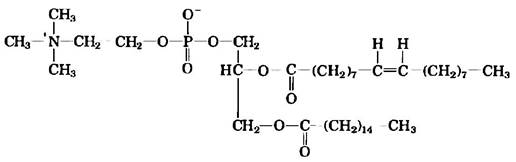
Figure 1-10 shows the structures of the most important components of complex biomolecules. Identify the building blocks that make up the three important biomolecules shown below (depicted in the ionic form corresponding to physiological pH).
a) Guanosine triphosphate (GTP) — an energy-rich molecule, a nucleotide that is a constituent of RNA:

b) Phosphatidylcholine — a component of many membranes:

c) Met-enkephalin (an enkephalin containing Methionine in the fifth position) — a natural Brain opiate:
13. Determination of the Structure of a biomolecule.
An unknown substance X was isolated from rabbit muscle. Its structure was determined based on the following observations and experiments. Qualitative analysis showed that the substance contains only carbon, hydrogen, and oxygen. A weighed sample of substance X was subjected to complete oxidation, after which the amounts of Н2O and СO2 produced were determined. Based on these analytical data, it was concluded that the mass fractions of C, H, and O in substance X are 40.0, 6.71, and 53.29%, respectively. The molecular mass of substance X, according to mass spectrometry data, was found to be 90.0 amu (see Supplement 1-1). Infrared Spectroscopy showed that molecule X contains one double bond. Substance X dissolves readily in water to form an acidic solution. Polarimetric analysis of this solution revealed that X exhibits optical activity.
a) Determine the empirical and molecular formulas of X.
b) Draw the possible structures of substance X that satisfy the molecular formula and contain one double bond. Consider only linear or branched structures, excluding cyclic structures. Note that oxygen atoms do not readily bond to each other.
c) What is The Significance of the optical activity of the substance for its molecular structure? Which of the structures proposed in part (b) are consistent with this observation?
d) What is the Significance of the fact that dissolving substance X yields an acidic solution for its molecular structure? Which of the structures proposed in part (b) are consistent with this observation?
e) What is The structure of substance X? Is the existence of multiple structures compatible with all the available data?
Analysis of Experimental Data
14. Sweet taste of a substance.
Humans perceive many substances as sweet. A sweet taste arises when a substance molecule binds to a sweet receptor—a single type of receptor On the surface of certain cells on the Tongue. The stronger the binding, the lower the concentration of the substance required to saturate the receptors, and the sweeter the taste provided by a given concentration of the substance. The change in Free energy ∆С° in the binding reaction between the sweet substance and the receptor can be measured in kilojoules or kilocalories per mole.
Quantitatively, sweet taste can be determined in relative units, taking the sweetness of sucrose as a reference point. For example, the sweetness of saccharin is 161 units, which means it is 161 times sweeter than sucrose. In practice, this value is determined by comparing the taste sweetness of solutions containing different concentrations of each sweet substance. Sucrose and saccharin solutions have the same sweetness when sucrose is used at a concentration 161 times higher than that of saccharin.
a) What is the relationship between the relative sweetness of a substance and the ∆С° of the binding reaction? In particular, does a more negative ∆С° value correspond to greater or lesser relative sweetness? Explain your answer.
Below are the structures of 10 substances, each of which tastes sweet to humans. For each substance, the relative sweetness and ∆С° values for the binding reaction with the sweet receptor are presented.
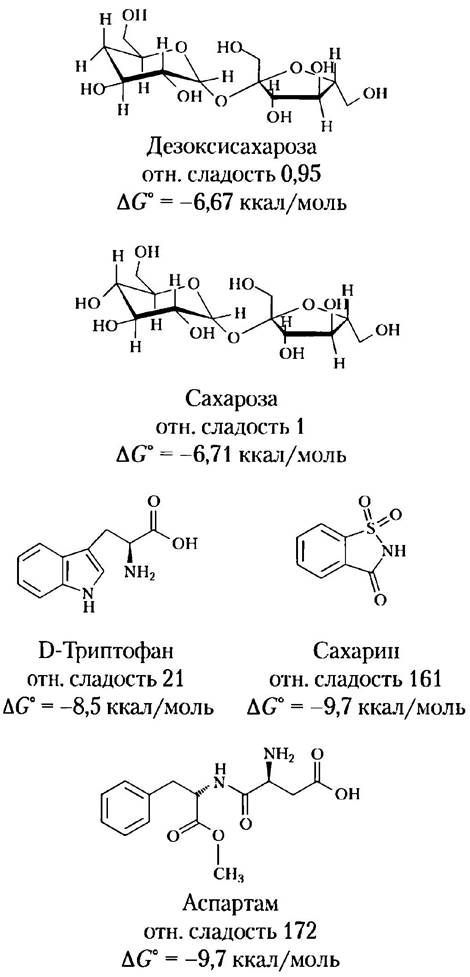

Morini, Bassoli, and Temussi (2005) used computational methods ("in silico" methods) to model the binding of sweet molecules to receptors.
b) What is the advantage of the computational METHOD FOR DETERMINING the sweetness of substances compared to the organoleptic method of sweetness determination by humans or animals?
In their early work, Shallenberger and Acree (1967) proposed that all sweet substances possess an AH-B structural unit, where A and B are electronegative atoms separated by a distance of at least 2.5 Å (0.25 nm) but no more than 4 Å (0.4 nm), and H is a hydrogen atom covalently bonded to one of the electronegative atoms (p. 481).
c) Given that the length of a "typical" single bond is 0.15 nm, identify the AH-B groups in each molecule shown above.
d) Based on your answer to question (c), raise two objections to the statement that "molecules possessing an AH-B structural group are sweet."
e) For two of the molecules shown above, the AH-B model helps explain the differences in relative sweetness and the ∆G° value. Which molecules are these, and how can they be used to support the validity of this model?
Many of the molecules shown above, despite having very similar structures, differ significantly in sweetness and ∆G° values. Give two Examples and use them to show why the AH-B model cannot explain the differences in sweetness and ∆С° values.
In their computational modeling method for predicting the ∆G° value of the binding reaction between a sweet substance and the sweet receptor, Morini and co-workers used the three-dimensional STRUCTURE OF THE sweet receptor and a special Molecular Dynamics simulation program (GRAMM). First, they "trained" their model, i.e., adjusted the model parameters so that the predicted ∆С° values matched the known ∆С° values for a specific set of substances. Then, they "tested" the model by attempting to predict the ∆С° values for a new set of molecules.
f) Why did Morini and co-workers test the model on a different set of substances rather than the one used to "train" the model?
g) The predicted ∆С° values for the test set of substances turned out to differ from the actual values by an average of 1.3 kcal/mol. Using the values provided for the molecules listed above, estimate the error in determining relative sweetness.
Last update: 06/08/2026
Editorial and Educational Adaptation: This material has been compiled based on the primary/original source text. The project team performed an editorial review, corrected technical inaccuracies, structured sections, and adapted the content for an educational format.
What was processed:
- elimination of formatting defects (OCR errors, structural breaks, corrupted characters);
- editorial organization of content;
- standardization of terminology in accordance with academic sources;
- verification of factual statements against the original source text.
All mentions of the author, publication year, and origin of the primary text have been preserved in accordance with the source.