Principles of Protein Structure - G. Schulz 1982
Protein Evolution
Phylogeny Based on Protein Structures
Phylogenetic Tree
Relationships between very distant taxa can be established by investigating protein specialization. The starting point for any evolutionary study based on Amino Acid Substitutions is a table of differences between Proteins belonging to different species [145]. These data are presented as an ordered matrix of differences; ordering is achieved by placing the smallest numbers reflecting differences near the diagonal. The MAIN STAGES OF transition from such a table to the establishment of phylogenetic relationships are described in Section 9.3 using short Peptide Hormones as an example. To establish the genealogy of proteins similar to the mitochondrial Cytochromes c discussed, isolated from more than 70 organisms [509], detailed schemes have been proposed, such as the "ancestral sequence method" [513] and the "matrix approach" [504].
The established genealogy of cytochrome c, corresponding to the phylogenetic tree of organisms containing cytochrome c, includes genetic distances (data in PAM units) without indications of evolutionary times. However, calibration can be performed by comparison with a phylogenetic tree based on macroscopic traits and fossil data. To date fossils, the Geological Time Scale established by the radioactive decay of long-lived isotopes is used. The calibration constant is The rate of evolution given in Table 9.1. For mitochondrial cytochromes c, this rate is approximately constant for all Branches of the tree, which leads to a linear appearance of calibration curves similar to those shown in Fig. 9.2. If we assume that the lines for the lowest fixation rates can be extrapolated to times preceding the epochs for which fossils are known, it is evident that using phylogeny based on protein specialization, one can not only compare such distant taxa as plants and animals, but also assign a date to the branching point. However, attempts at such generalizations are met with considerable skepticism. Indeed, if we assume that the environment imposed fewer constraints on early species, their rate of evolution could have been significantly higher [483, 509].
Cytochromes c are characterized by a low rate of evolution (Table 9.1), and therefore they cannot be used to clarify relationships within the branches of the phylogenetic tree, such as between the cow and other artiodactyls. For this purpose, it is necessary to use faster-evolving proteins, such as pancreatic Ribonuclease [145, 488] (Fig. 9.2).
Class="center">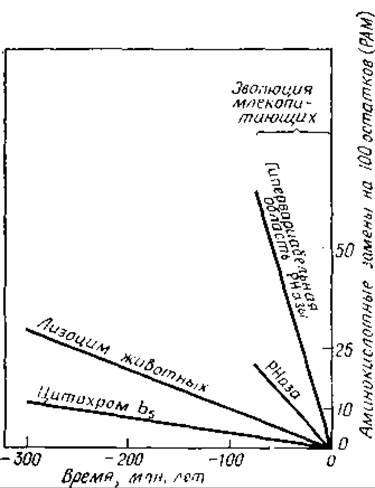
Fig. 9.2. Graphical representation of evolutionary rates (given in number of PAMs per 108 years) in specialized proteins.
300 Ma (million years) ago, a divergence of lineages occurred that led to reptiles and birds on the one hand, and mammals on the other. Going back 600 Ma, evolutionary events, as indicated by protein specialization, will correspond to the fossil record.
Last update: 06/08/2026
Editorial and Educational Adaptation: This material has been compiled based on the primary/original source text. The project team performed an editorial review, corrected technical inaccuracies, structured sections, and adapted the content for an educational format.
What was processed:
- elimination of formatting defects (OCR errors, structural breaks, corrupted characters);
- editorial organization of content;
- standardization of terminology in accordance with academic sources;
- verification of factual statements against the original source text.
All mentions of the author, publication year, and origin of the primary text have been preserved in accordance with the source.