Genetics - A. V. Sivolob 2008
Variability of Genetic Material
Molecular Mechanisms of Mutational Variability
Replication and Repair Errors
Nucleotide misincorporation during Replication is a major cause of point Mutations and chromosomal rearrangements. The formation of non-complementary nucleotide pairs (mismatches) during replication occurs at a frequency of 1 per 10,000 nucleotide pairs. The primary cause of erroneous nucleotide incorporation during replication is the Tautomerism of nitrogenous bases. Spontaneous rearrangements of the electronic systems of heterocycles cause each base to exist in two tautomeric forms: amino or imino forms for A and C; enol or keto forms for G and T (Fig. 4.6). The equilibrium is shifted toward the amino and keto forms, which are present within Double helices (see also Fig. 1.2) and for which the A-T and G-C complementarity rules apply. However, base pairing follows different rules for minor tautomeric forms: for example, the imino form of A and the amino form of C form two Hydrogen Bonds with each other (Fig. 4.6), which can occur during template recognition by the incoming nucleotide during replication. Similarly, the enol form of thymine is complementary to guanine. As a result of a rapid return to the major tautomeric form, a non-complementary nucleotide pair remains within the DNA. If the proofreading system during DNA Synthesis AND subsequently the Mismatch Repair system (see Chapter 1) fail to act, this non-complementary pair will be fixed as a mutation in one of the two daughter molecules during the next replication cycle.
Class="center">
Fig. 4.6. Tautomeric forms of nitrogenous bases; bottom: a complementary pair of the adenine imino form and cytosine amino form
At microsatellite tandem repeat sites (repeats of sequence elements 1-15 Base Pairs in length, Chapter 1 [or Chapter 6]), a specific error of the DNA polymerase complex is observed—DNA polymerase slippage. In some cases, microloops or microhairpins are formed on the template or newly synthesized DNA strands due to intrastrand complementary interactions. If a microloop appears on the DNA template strand, the daughter strand will be shorter by a few NUCLEOTIDES, and consequently, a deletion will be observed after the next round of replication (Fig. 4.7, a). If such a microloop forms in the daughter strand, the number of nucleotides in it will increase, leading to the insertion of one or more repeats (Fig. 4.7, b).
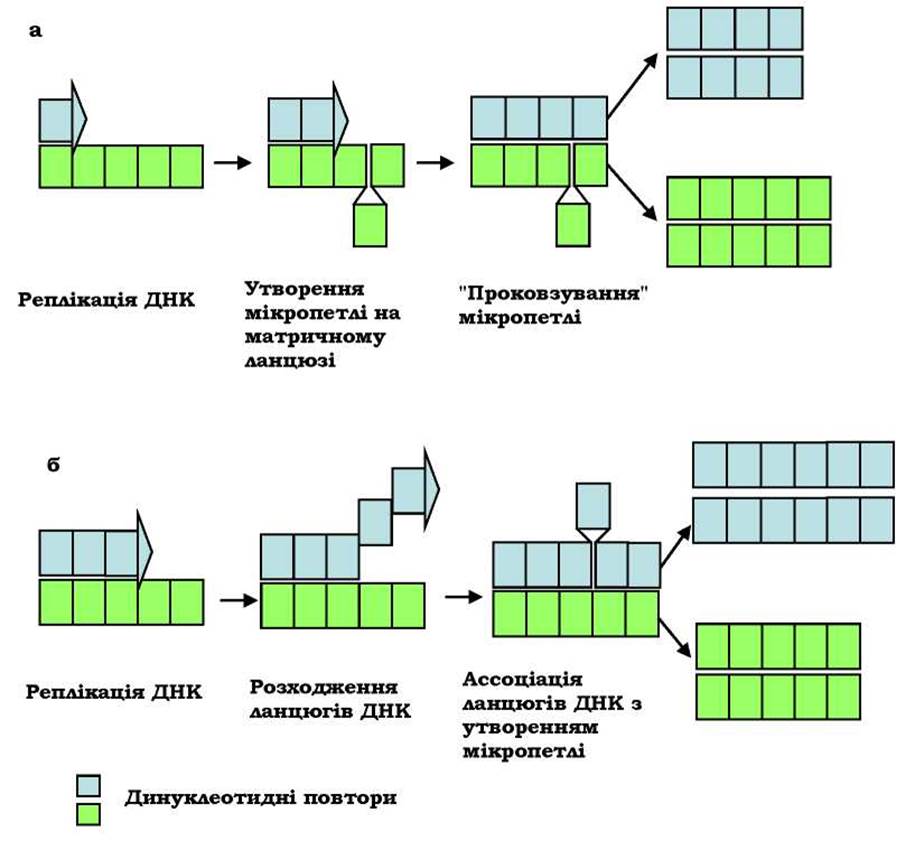
Fig. 4.7. Decrease (a) and increase (b) in the number of repeats due to microloop formation in DNA during replication.
Mutations arise not only as a result of inefficient repair—some DNA Repair processes are themselves mutagenic. First of all, this concerns error-prone repair systems: SOS repair, which causes Inaccurate DNA Synthesis in the presence of extensive damage, leading to an even greater increase in mutations, and the non-homologous end joining (NHEJ) system for double-strand break repair (see Chapter 1). NHEJ is considered the main cause of chromosomal rearrangements because it mediates the joining of the ends of virtually any DNA molecules.
Last update: 11/08/2026
Editorial and Educational Adaptation: This material has been compiled based on the primary/original source text. The project team performed an editorial review, corrected technical inaccuracies, structured sections, and adapted the content for an educational format.
What was processed:
- elimination of formatting defects (OCR errors, structural breaks, corrupted characters);
- editorial organization of content;
- standardization of terminology in accordance with academic sources;
- verification of factual statements against the original source text.
All mentions of the author, publication year, and origin of the primary text have been preserved in accordance with the source.