Fundamentals of Biochemistry - Filippovich, Y. B. 1999
General concepts of metabolism and energy exchange in the living organism
The CHARACTERISTICS OF THE Structure, properties, and functional activity of Enzymes, Coenzymes, Vitamins, and A number of other biologically active compounds, discussed in the previous chapters, were inevitably accompanied by an examination of the biochemical processes in which they participate. This inadvertently took the first step toward studying certain aspects of METABOLISM. In the subsequent chapters, this vital property of living matter will be explored in all its diverse manifestations. Here, however, it is appropriate to focus on general patterns and principles.
General Concepts of Metabolism. Metabolism and Energy Exchange constitute The Essence of the vital activity of any Organism. The phenomenon of life itself is characterized by a continuous exchange of matter with the surrounding external environment. Living matter remains alive as long as it is capable of building itself up from environmental substances; living matter maintains its own existence through the continuous and ongoing absorption—at varying rates—of chemical compounds from the external world, converting them into the constitutional elements of its own body or simpler compounds, and finally excreting the breakdown products of both its own body and transformed substances into the external environment. This continuous, self-sustaining, and self-regulating cycle of matter, which occurs during the existence of living matter and is accompanied by its constant self-renewal, is called metabolism.
In other words, metabolism is a regular, self-sustaining process of the transformation of matter within living bodies.
The transformation of chemical compounds, their interaction with one another, the destruction of some and the synthesis of others also occur in non-living matter. However, no non-living system of any type undergoes self-renewal; rather, it merely changes. Life and living matter arose when, among non-living systems with their characteristic processes of disordered material changes in nature, systems emerged that were capable of maintaining their own existence through the ordered transformation and utilization of environmental factors. Therefore, only that form of matter, those systems possessing metabolism, came to be designated as living matter.
The phenomenon of life is extraordinarily complex and multifaceted. "As a part of the planetary living matter of the Earth, we instinctively and unconsciously feel a vivid sense of the mystery of life—of our own existence and the existence of life," wrote Academician V. I. Vernadsky1.
1 Vernadsky, V. I. The Chemical Structure of the Earth's Biosphere and Its Environment. Moscow, 1987.
In connection with the significant advances in quantum biochemistry, molecular biology, cybernetics, Thermodynamics, and genetics, many attempts have recently been made to deepen and concretize our understanding of the essence of life. From the perspective of quantum biochemistry, life is defined as a form of dynamic realization of the quantum characteristics of atoms. Molecular biology arrives at the generalization that life is a macromolecular hierarchical Organization characterized by Replication, metabolic cyclicity, and finely tuned REGULATION OF ENERGY processes. In this context, a major role in the phenomena of life is assigned to Nucleic Acids. Cybernetics pays special attention to the processes of generation and transmission of information, characterizing Life as a highly stable state of matter that utilizes information encoded by the states of individual molecules to produce preservation reactions. From a thermodynamic standpoint, the most essential property of living organisms is stable thermodynamic nonequilibrium and The ability to maintain it at a certain level. While a non-living system tends to reach equilibrium with its environment, a living system, conversely, strives to move away from this equilibrium, purposefully maintaining its nonequilibrium state relative to the environment. Based on this, life is defined as a mode of existence of a dynamically self-preserving form of matter—living nature—the essence of which boils down to the grand process of the cyclic transformation of organic matter, based on the interaction of the Synthesis and Breakdown of living protoplasm, i.e., the biotic cycle. In this same aspect, life is defined as a potentially self-replicating open system of coupled organic reactions catalyzed sequentially and almost isothermally by complex and specific organic catalysts that are themselves produced by this system.
To the modern geneticist, life on Earth appears as the integral existence of DNA, RNA, and Proteins in the form of individualized, personal and species-specific, holistic, structural-biochemical, self-regulating open systems with The properties of reproducing historically developing forms of Genetic information. When evaluating the essence of life from the standpoint of evolutionary theory, the origin, organization, and interaction of certain supramolecular and cellular structures, as well as the patterns of their emergence as an independent biological unit, come to the forefront. According to physical chemists, life is the dynamic equilibrium of multiphase systems. All of the enumerated approaches to a deeper understanding of the essence of life certainly deserve attention, and each of them reveals new facets of this highly complex phenomenon, yet each of them taken individually is one-sided.
As we continue to study life, our concepts regarding The Role of individual, specific chemical compounds, as well as The Significance of various processes in its execution, will inevitably change. Furthermore, humanity's ventures into space make it likely that we will encounter extraterrestrial forms of life, whose material and functional characteristics may prove unique in each instance. Therefore, the DEFINITION OF LIFE as a special, qualitatively distinct biological form of the motion of matter, arising at a certain stage of its development, is apparently the most fundamental and successful one.
The biological form of the motion of matter is characterized by the existence of self-regulating and self-reproducing systems that exchange matter and energy with the environment. Since the orderly Transformation of substances underlies both The process of self-regulation and self-reproduction, and the condition for their execution is the continuous influx of certain substances into the system and The excretion of others from it, metabolism is the most essential element of life.
That part of the overall metabolic process which is expressed in the absorption, accumulation, and assimilation of environmental substances by the organism, and the creation and synthesis of its own structural units at their expense, is called anabolism or assimilation. That part of the overall metabolic process which consists of the destruction of substances constituting the organism, The breakdown of living body elements, and the excretion of these breakdown products from the organism is called Catabolism or dissimilation. Consequently, metabolism is the dialectical unity of the opposing processes of Nutrition and excretion, assimilation and destruction, synthesis and breakdown—in other words, the dialectical unity of assimilation and dissimilation.
Metabolism represents a combination of many diverse and opposing processes. Some of these are physiological processes (nutrition, excretion, etc.), others are physical (sorption, transport, etc.), and still others are chemical (breakdown, synthesis, etc.). That part of the metabolic processes in the organism which consists in carrying out Chemical Reactions leading to the transformation of individual chemical compounds during their breakdown and synthesis in the course of the organism's vital activity is called Intermediary Metabolism or simply metabolism. It is precisely intermediary metabolism that dynamic biochemistry studies.
The scale of metabolism in living nature is colossal. The Earth's biomass, which scientists estimate to be from 1.8 ∙ 1012 to 2.4 ∙ 1012 t (calculated on a dry weight basis), continuously renews its composition by absorbing and releasing immense quantities of chemical substances. According to A. A. Nichiporovich's calculations, the Earth's plants assimilate about 650 billion t of CO2 from the atmosphere annually and release about 350 billion t of O2 into the atmosphere. Over the same period, plants extract about 5 billion t of N, about 1 billion t of P, and 10–15 billion t of other mineral elements from the soil, forming about 380 billion t of biomass (calculated on a dry weight basis). Free-living nitrogen-fixing microorganisms and nodule Bacteria alone bind about 100 million t of molecular N from the air annually. In 2,000 years, all the O2 in the Earth's atmosphere passes through living matter. The release of oxygen resulting from Photosynthesis occurring in plants, Algae, and photosynthetic bacteria ranges from 2 thousand to 5 thousand t per second. Daily on Earth, up to 1 billion t of Organic compounds are degraded to CO2 and H2O. According to V. A. Kovda, the complete renewal of land biomass occurs over 200 years. In the opinion of V. I. Vernadsky, all the matter of the biosphere can pass through living organisms within a period that is brief on a geological scale. Thus, "...life—living matter—is truly one of the most powerful geochemical forces of our planet, and the biogenic migration of atoms caused by it represents a form of organization of paramount importance in The structure of the biosphere"1.
1 Vernadsky, V. I. The Chemical STRUCTURE OF THE Earth's Biosphere and Its Environment. Moscow, 1987.
Moving from the consideration of metabolism on the scale of living matter across the entire planet to an evaluation of its role in the smallest unit of life—The Cell—the significance of metabolic processes in the phenomena of life becomes even more striking. The cell, which according to modern concepts (see Fig. 3) possesses a highly complex internal organization, is the focal point of several thousand different substances. A simple bacterial cell (see Table 1) contains about 300 million molecules of organic compounds of approximately 5,000 types, along with a vast number of Water molecules and inorganic salts. They are not only arranged in an orderly fashion within the cellular volume but are also in constant Physical and Chemical motion. The former is accomplished through the presence in the cell of A large number of pathways connecting its various parts to one another. The latter consists in the continuous transformation of chemical substances via numerous breakdown and synthesis reactions of proteins, nucleic acids, CARBOHYDRATES, Lipids, etc. All these reactions are accelerated by hundreds of enzymes and are carried out in a coordinated manner in time and space, and most importantly—they occur at tremendous speeds and are self-regulated.
Metabolism is carried out under the condition and As a result of the constant interaction between living and non-living matter, between the organism and the environment. It is therefore natural that the course of metabolism in an organism, and frequently the very nature of this metabolism, are closely dependent upon and in unity with environmental conditions. The molecular mechanisms inherent in organisms for modifying, transforming, reproducing, and destroying specific organic compounds (nucleic acids, proteins, lipids, carbohydrates, etc.) operate only within specific, limited intervals of Temperature, pressure, and radiation. They are realized only under the condition of a constant influx of substances suitable for transformation and the outflow of substances that can no longer serve as Starting Material for building the body of the given organism.
Moreover, maintaining the specific activity of the molecular mechanisms that transform cell substances at a certain level depends on the continuous reproduction of the constituent parts of these very mechanisms within a unified metabolic process. In this sense, any organism is inevitably a self-tuning, self-regulating system that regularly (and adequately) changes when the environmental conditions with which the organism interacts change. Thus, the type of metabolism takes shape in the course of the organism's vital activity as The Unity of internal (conservative) and external (variable) factors. This constitutes the dialectical unity of the organism and the environment.
Patterns of Energy Exchange. Metabolism is impossible without the energy exchange that accompanies it. Every organic compound making up living matter possesses a certain reserve of potential energy, at the expense of which work can be performed. This energy is conventionally called Free energy. The levels of Free energy of individual starting substances and reaction products are, as a rule, different; consequently, during the transformation of substances, a redistribution of free energy occurs among the Components of the reaction mixture, i.e., energy exchange takes place between the substances.
THE CONCEPT OF High-Energy Compounds. The main material carriers of free energy in organic substances are the chemical bonds between atoms; therefore, when chemical bonds in a molecule are transformed, the level of free energy of the compound changes. If The change in the free energy level of a compound during the formation or breakdown of a chemical bond is about 12.5 kJ/mol of the transformed substance, such a bond is considered normal in terms of its energy level. This is precisely the dimension of the free energy change during the transformation of most bonds in organic compounds. However, during the formation and breakdown of certain bonds, the free energy level in the molecules of a number of organic compounds changes to a much greater extent, amounting to 25–50 kJ/mol or more. Such compounds are called high-energy compounds, and the bonds whose transformation results in such large Changes in the substance's Energy balance are called high-energy bonds. The latter, in contrast to ordinary bonds, are designated by the symbol ~. Below are some organic substances of the first (with normal bonds) and second (with high-energy bonds) types. In each case, the figures in parentheses indicate the magnitude of the decrease in free energy (marked with a minus sign before the numbers in parentheses) in the starting substances compared to those in their Hydrolysis products (at pH 7, t = 25 °C, kJ/mol):
Class="center">
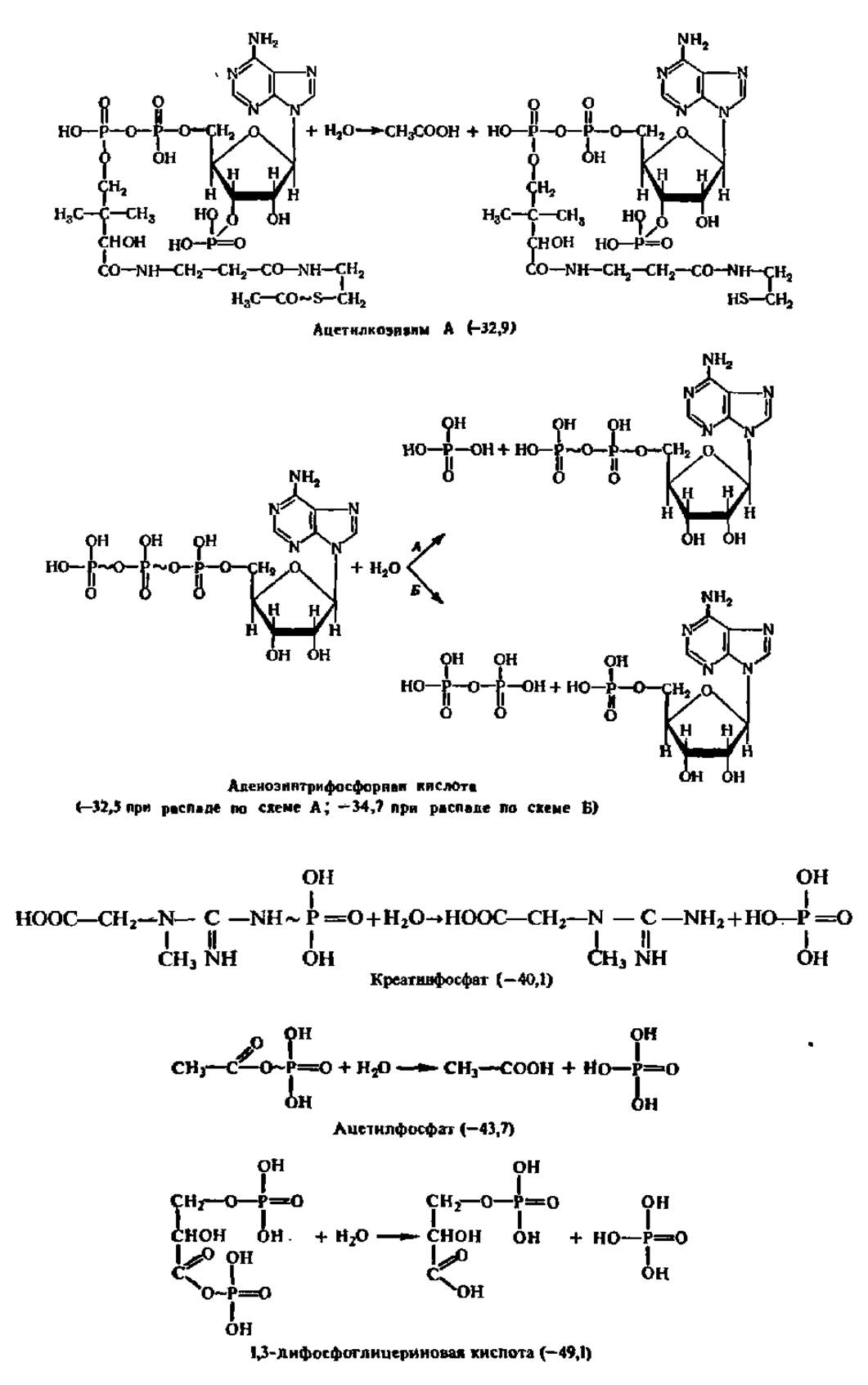
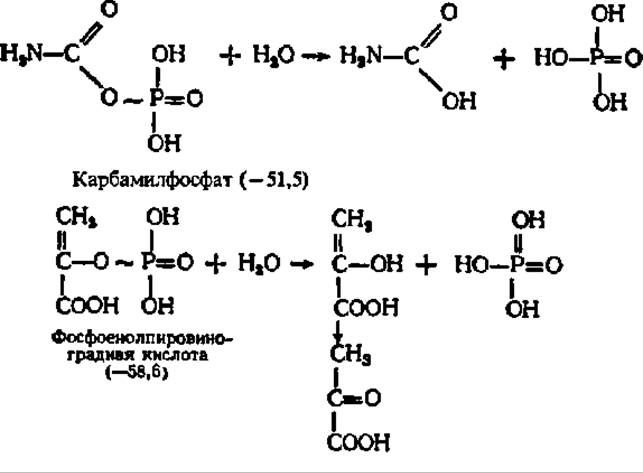
It is easy to see that high-energy bonds are predominantly ester bonds (including thioester bonds), anhydride bonds, and phosphoamide bonds. However, what is most interesting is that almost all known compounds with high-energy bonds contain P and S atoms, at the sites of which in the molecule these bonds are localized. The special role of S and P atoms in The formation of high-energy bonds is explained by the following reasons: 1) chemical bonds characteristic of Period III elements are weaker than bonds characteristic of Period II elements; 2) S and P form more than four covalent bonds; 3) only S and P in Period III retain the ability to form multiple bonds.
It is precisely The energy released during the Cleavage of high-energy bonds that is absorbed during the synthesis of organic compounds with a higher free energy level than the starting Materials. At the same time, the reserves of high-energy substances in the organism are constantly replenished by accumulating the energy released during the decrease in the energy level of degrading compounds.
Thus, high-energy substances perform the function of both Donors and acceptors of energy in metabolism; they serve as both accumulators and conductors of energy in biochemical processes. In addition, they are characterized by the role of energy transformers, as they are capable of converting the stationary form of chemical bond energy into a mobile form, i.e., into the energy of an excited state of the molecule.
The latter type of energy serves as a direct source of the molecules' reactivity; converting back into the stationary form of chemical bond energy, it provides the energetic driving force for the modification and transformation of substances, i.e., their metabolism within the organism.
All of the above once again emphasizes the close interdependence of metabolism and energy transformation.
The Nature of high-energy bonds. What structural regularities in the molecules of high-energy compounds ensure their pivotal role in metabolism and energy exchange? To answer this question, let us examine the structure of the adenosine triphosphate (ATP) molecule, the most important high-energy compound in the organism. F. Lipmann (1939–1941) was the first to draw attention to its role in the energetic supply of chemical processes, while V. A. Engelhardt and M. N. Lyubimova (1939) investigated The Mechanism of its breakdown under the action of Myosin and The conversion of high-energy bond chemical energy into the mechanical energy of Muscle contraction.
The chemical bond energy between the two terminal phosphate groups in a high-energy compound molecule (ATP) is approximately equal to the bond energy between the phosphoric acid residue and glucose in a low-energy compound molecule (glucose-6-phosphate). In both cases, the same amount of work must be expended to cleave the phosphate residue from either compound. However, when studying the hydrolysis reactions of ATP and glucose-6-phosphate, a significant difference in the Energy balance of these similar reactions is revealed: in the case of ATP, the change in free energy is 32.5–34.7 kJ/mol, whereas for glucose-6-phosphate, it is only 13.1 kJ/mol.
It follows that The concepts of "bond energy" and "high-energy bond" are entirely different. The former refers to the energy level of a chemical bond from the perspective of physical chemistry, i.e., The amount of energy required to break the bond between atoms. The latter accounts for the energetic effect resulting from the Transformation of a bond via a chemical reaction.
This is precisely where the characteristic difference between a standard chemical bond and a high-energy bond becomes apparent; the latter cannot be viewed merely as a chemical bond possessing an elevated energy reserve compared to a normal bond, nor as an unstable bond that is simply "waiting" for an opportunity to disintegrate explosively with the release of energy. Its primary characteristic is that much more energy is released upon the hydrolysis or alternative transformation of such a bond than during the hydrolysis or transformation of a conventional bond.
An investigation of the structure of the ATP molecular region where high-energy bonds are concentrated has shown that its architecture is distinct. Specifically, the charge distribution among the P and O atoms within the triphosphate group of ATP is as follows:
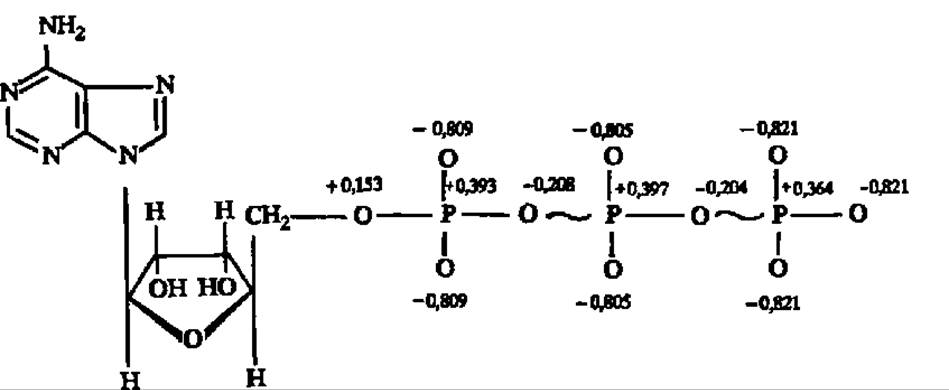
As can be seen from the aforementioned formula of adenosine triphosphate, the oxygen-phosphorus backbone of the triphosphate group is composed of positively charged O and P atoms. The electrostatic repulsion of positive charges within the backbone of the triphosphate moiety of ATP apparently plays a crucial role in releasing an increased amount of energy upon the hydrolytic cleavage of phosphate groups. Similarly, from the standpoint of quantum-mechanical concepts, other high-energy compounds are structured in this manner: they are characterized by the accumulation of positive charges on atoms directly bonded by a high-energy bond, and negative charges on the atoms surrounding these bonds:

It is also significant that the π-electrons of the O, N, and S atoms linking atomic groupings in high-energy compounds are unable to satisfy the electron demands of these groupings.
As an illustration, let us consider the structure of acetyl phosphate:

As a consequence of this, the unstable electron conjugation system in high-energy compounds is easily and irreversibly disrupted during hydrolysis and other transformations.
The role of high-energy compounds in energy transformation. Let us now examine how the conversion of stable chemical bond energy into the mobile excitation energy of a molecule, and the reverse process—the conversion of mobile excitation energy into stationary chemical bond energy—can be conceptualized. This constitutes one of the most essential Functions of high-energy compounds. The ATP molecule performs this energy transformation while bound to a specific protein. The fixation of ATP onto the protein molecule is accompanied by the approximation of its triphosphate moiety to its purine moiety. The energy released during the breakdown of the high-energy bond between the phosphoric acid residues is transferred to the purine part of the molecule. Here, it is transformed into the mobile excitation energy of the electrons in the conjugated double bond System of the purine ring, from which it subsequently proceeds to the site of the chemical reaction, driving the electrons of the organic compound undergoing transformation into an excited state. This provides the latter with enhanced reactivity, creating, in particular, the potential for the reverse conversion of mobile excitation energy into the stationary energy of new chemical bonds (Fig. 63).
The energy released during the breakdown of high-energy compounds, which can be utilized to perform Various Forms of work, is employed not only for chemical synthesis. In the organism, it can serve for heat production, Bioluminescence, the storage of electricity, the performance of mechanical work, and so on. In this process, chemical energy is converted into thermal, radiant, electrical, mechanical, and Other types of energy. It is fundamentally important that the transformation of chemical energy into its other forms proceeds within the organism with the obligatory participation of compounds containing high-energy bonds, particularly ATP. As shown above, in the ATP molecule, the stable energy of high-energy interphosphate chemical bonds is transformed into the mobile excitation energy of the electrons in the purine portion of the molecule; this is presumably the primary stage of energy conversion in the organism. For this reason, ATP occupies a central position in the Energy Metabolism of living matter.

Fig. 63. Energy transformation in the ATP molecule (explanations in the text)
Examining the mechanism of energy transformation and transfer during the breakdown of ATP and analogous high-energy compounds allows us to understand one of the elementary Fundamental properties of living matter. This property consists in the fact that within systems possessing living characteristics, the energy required to carry out a chemical reaction, once released at one point, can be transferred to another point where it is directly utilized. This means that in living nature, there is no need for direct contact via collision (which is a characteristic feature of reactions in inanimate nature) between the energy-supplying molecule and the energy-requiring molecule. This fundamentally distinguishes the course of chemical processes in living objects from those in non-living ones.
In living nature, There is a continuous process of energy storage in the form of the chemical bond energy of organic substances. This consists primarily of the conversion of radiant energy into chemical energy (photosynthesis in green plants) and, to a small extent, the transition of chemical energy from Inorganic Compounds into organic ones (Chemosynthesis in microorganisms).
As can be seen from Fig. 64, ATP plays a prominent role in both energy storage and Energy Expenditure, making it a key substance in the organism's energy metabolism. Many reactions are known through which ATP is generated from other high-energy compounds, and conversely, There are many processes leading to the synthesis of high-energy compounds involving ATP. For example, such high-energy compounds as creatine phosphate, phosphoenolpyruvate, and 1,3-diphosphoglycerate interact with ADP to form ATP, yielding creatine, pyruvic acid, and 3-phosphoglyceric acid. These and similar compounds are conventionally designated as ATP-generating substances. The listed reactions are reversible, and under certain conditions, the equilibrium can be shifted toward ATP breakdown.

Fig. 64. Energy transformations in living nature (explanation in the text)
General regularities of energy transformation in living systems. Energy metabolism during vital activity is not limited to the conversion of chemical energy into other forms and vice versa (Fig. 64); it is of a broader character. For instance, in the rods and cones of the retinal layer of the eye, light energy is converted into electrical energy; in the specific structures of the Inner ear, acoustic and hydrodynamic energy transitions into electrical energy, and so forth.
The transformation of one type of energy into another is accomplished in organisms within morphologically diverse elements—Chloroplasts, Muscles (Russian cardiologists recently identified new pathways for energy transfer from its site of production in Mitochondria to the site of consumption in Heart muscle myofibrils for the first time), receptor apparatuses of Tissues and Organs, the retina of the eye, luminescent organs, and the like.
However, all these diverse elements share certain structural commonalities. They are characterized by the presence of bilayer membranes with a high lipoprotein content and a structural protein that organizes relatively uniform elementary particles into ordered structures. These particles contain specific molecules that directly drive the energy transformation process. In this process, energy of one type is absorbed by the transducing molecule and converted into energy of another type. A simple example of intramolecular energy conversion by a transducer molecule is the transition of the stationary chemical bond energy of the triphosphate group in an ATP molecule into the mobile excitation energy of the electrons in its purine moiety (see Fig. 63). A more complex example involves Conformational Changes in protein molecules during the conversion of one form of energy into another (such as muscle contraction).
The metabolism of matter and energy constitutes a unified, inseparable process, in which any modification of matter is invariably accompanied by the release or absorption of free energy. The energy released or absorbed in varying amounts drives the cleavage or synthesis of chemical bonds—effectively transforming the substances themselves. Thus, the laws governing metabolism and energy exchange in living nature represent a specific manifestation of the general law of conservation of matter and energy.
Last update: 06/08/2026
Editorial and Educational Adaptation: This material has been compiled based on the primary/original source text. The project team performed an editorial review, corrected technical inaccuracies, structured sections, and adapted the content for an educational format.
What was processed:
- elimination of formatting defects (OCR errors, structural breaks, corrupted characters);
- editorial organization of content;
- standardization of terminology in accordance with academic sources;
- verification of factual statements against the original source text.
All mentions of the author, publication year, and origin of the primary text have been preserved in accordance with the source.