BIOCHEMISTRY in Questions and Answers - Alimov A.M. - 2016
SECTION 1. PROTEINS AND AMINO ACIDS
Question 1. Define Proteins.
Answer: Proteins are high-molecular-weight nitrogen-containing organic substances composed of α-Amino Acids linked together by peptide bonds.
Question 2. What is an α-amino acid?
Answer: α-Amino acids are carboxylic acid derivatives in which a hydrogen atom at the α-carbon is replaced by an amino group (-NH2). They contain both an amino group and a carboxyl (-COOH) group.
Question 3. How do Amino acids differ from one another?
Answer: Amino acids differ from one another by the Chemical Nature of their side chain (R group), which is a group of atoms in The amino acid molecule attached to the α-carbon atom and not involved in peptide bond formation during METABOLISM/35.html">Protein Biosynthesis.
Question 4. Which amino acids are proteinogenic?
Answer: The α-amino acids that make up proteins.
Question 5. What is the general formula of amino acids?
Answer:
Class="center">
Question 6. Write the formula of an amino acid in its ionized state (protonated form).
Answer.
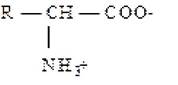
Question 7. What causes the optical activity of amino acids?
Answer. When all four valences of the α-carbon atom are occupied by different functional groups, the carbon atom is called asymmetric (chiral), and the amino acid is optically active.
Question 8. Which amino acids are optically active?
Answer: All naturally occurring protein amino acids except Glycine.
Question 9. How do D- and L-isomers of amino acids differ from each other?
Answer: These isomers differ in the spatial arrangement of the NH2 groups around the α-carbon atom.
Question 10. To which series do natural protein amino acids belong?
Answer: All natural Proteinogenic Amino Acids belong to the L-series.
Question 11. What determines the net charge of an amino acid?
Answer: The charge of an amino acid depends on the pH of the medium. In an acidic environment, an amino acid accepts a proton and acquires a positive charge. In an alkaline environment, it acts as an acid and carries a negative charge.
Question 12. What is meant by the isoelectric point (pI) of an amino acid?
Answer: The pI is the state at which the sum of positive charges equals the sum of negative charges, and the amino acid does not migrate toward either the anode or the cathode in an electric field.
Question 13. Which amino acids contain aromatic rings?
Answer. Phenylalanine, Tyrosine, Tryptophan
Question 14. Which amino acids carry a negative charge at pH 7.0 ("acidic amino acids")?
Answer. Glutamic acid, Aspartic acid
Question 15. Which amino acids carry a positive charge at pH 7.0 ("basic amino acids")?
Question 16. Which amino acids are hydroxyl-containing?
Answer: Serine, Threonine, Tyrosine
Question 17. Which amino acids are nonpolar?
Answer: Alanine, Valine, Isoleucine, Leucine, Methionine, Proline, Tryptophan, Phenylalanine.
Question 18. Which amino acids are classified as monoaminomonocarboxylic, and why? Answer: Monoaminomonocarboxylic amino acids include glycine, alanine, serine, Cysteine, methionine, threonine, valine, leucine, and isoleucine, because they each contain one amino group and one carboxyl group.
Question 19. Name the monoaminodicarboxylic amino acids.
Answer: These include aspartic and glutamic acids, which contain one amino group and two carboxyl groups each.
Question 20. Which amino acids are classified as diaminomonocarboxylic?
Answer: These include arginine, citrulline, and lysine.
Question 21. Name the heterocyclic amino acids.
Answer: This group includes tryptophan, which contains a heterocyclic pyrrole ring; Histidine, containing an imidazole ring with two nitrogen atoms; proline; and oxoproline.
Question 22. What reactions are used to identify amino acids in proteins?
Answer: 1. The xanthoproteic reaction for aromatic amino acids containing a benzene ring
2. Millon's reaction for tyrosine
3. Fohl's reaction for cysteine
4. Sakaguchi's reaction for arginine
Question 23. What are the sources of amino acids in the body?
Answer. 1. Breakdown of tissue proteins
2. Diet (feed)
3. Intracellular synthesis of amino acids
Question 24. Which Chemical Reactions can be used to detect proteins?
Answer: Biuret test, Ninhydrin test
Question 25. What does the biuret reaction detect?
Answer: The peptide bond
Question 26. What are complete (nutritionally balanced) proteins?
Answer: These are proteins that:
1. Contain all Essential Amino Acids
2. Contain all amino acids in optimal ratios
3. Are readily digested in the gastrointestinal tract
Question 27. What does "essential" amino acids mean?
Answer. These are amino acids that cannot be synthesized by the body and must be obtained from the diet
Question 25. Which amino acids are classified as essential?
Answer: Isoleucine, Leucine, Tryptophan, Threonine, Phenylalanine, Valine, Methionine, Lysine.
Question 29. Which amino acids are semi-essential (partially essential)?
Answer: Amino acids that can be partially synthesized in the body. These are arginine and histidine
Question 30. What are conditionally essential amino acids?
Answer: Amino acids that can be synthesized from essential amino acids: cysteine from methionine and tyrosine from phenylalanine.
Question 31. What is the nitrogen content in proteins?
Answer: Approximately 16 %
Question 32. What does the Tertiary Structure of a protein refer to?
Answer: The three-dimensional arrangement of a single polypeptide chain, stabilized by bonds between the side chains of amino acid residues located far apart from one another
Question 33. What does The quaternary structure of a protein mean?
Answer: The association of several polypeptide chains, each with a tertiary structure, into a single functional molecule
Question 34. Which proteins have a quaternary structure?
Answer: Hemoglobin, Lactate dehydrogenase, Creatine kinase
Question 35. WHAT IS A domain?
Answer. A domain is a distinct region of a protein molecule that possesses Structural and functional autonomy
Question 36. What is The basis of Electrophoresis?
Answer. The movement of charged molecules in an electric field
Question 37. What is the isoelectric point (pI) of a protein?
Answer: The pH value of the medium at which a protein molecule carries no net charge and therefore does not move toward either the anode or the cathode
Question 38. Why do proteins act as buffers?
Answer: Depending on the pH of the medium, proteins acquire The properties of anions or cations and thus exhibit buffering capacities
Question 39. What is protein coagulation?
Answer: The precipitation of proteins from colloidal solutions under The Influence of various factors
Question 40. What forms of coagulation do you know?
Answer: Reversible, where only the solvation shell of the colloidal particle is disrupted, and irreversible, where profound structural damage to the protein molecule occurs
Question 41. What is Protein Denaturation?
Answer: Irreversible denaturation refers to the loss of physicochemical properties and biological activity of a protein due to the disruption of higher Levels of Organization
Question 42. How can denaturation be induced?
Answer: By heating, adding acids and alkalis, adding heavy metal salts, or by the action of ionizing radiation and ultrasound
Question 43. What are simple proteins?
Answer. These are proteins that yield only amino acids upon Hydrolysis
Question 44. Which proteins are classified as fibrous?
Answer: Silk Fibroin, Collagen proteins
Question 45. Which proteins are called globular?
Answer: Proteins that have a globular (spherical) shape.
Question 46. What are the Features of the Amino Acid Composition of type I collagen?
Answer: Collagen contains about 33% glycine, 25% proline and hydroxyproline, and 1% hydroxylysine. Amino acid hydroxylation serves as a marker for collagen, as it is not found in other proteins
Question 47. Which amino acid is abundant in keratin proteins?
Answer: Cysteine, which accounts for about 12%
Question 48. What are chaperones?
Answer: A family of proteins involved in the folding and Formation of the three-dimensional conformation of a polypeptide chain synthesized on the ribosome
Question 49. What are conjugated (complex) proteins?
Answer: Conjugated Proteins are those that upon hydrolysis break down into Amino Acids and a non-protein component (prosthetic group)
Question 50. What is an apoprotein?
Answer: The protein moiety of a conjugated protein
Question 51. What is a prosthetic group?
Answer: The non-protein moiety of a conjugated protein
Question 52. Which proteins are Hemoproteins?
Answer: Hemoglobin, Myoglobin, Cytochromes, catalase, peroxidase
Question 53. What are Nucleoproteins?
Answer: These are conjugated proteins whose prosthetic group is represented by Nucleic Acids
Question 54. What are deoxyribonucleoproteins?
Answer: These are proteins whose prosthetic group is represented by ДНК
Question 55. Which proteins are components of deoxyribonucleoproteins?
Answer: Histones and acidic non-histone proteins
Question 56. Which amino acids are present in large amounts in histones?
Answer: Arginine, Lysine, Histidine
Question 57. Into what fractions are histones separated?
Answer: H1, Н2А, Н2В, Н3, Н4
Question 58. What types of bonds are involved in The formation of the Primary Cell/13.html">Protein Structure?
Answer: The bonds between the α-amino and α-carboxyl groups of amino acids, known as peptide bonds (-CO-NH-), along with partial Disulfide Bonds.
Question 59. What bonds are involved in the formation of the Secondary Protein Structure?
Answer: Hydrogen Bonds between peptide groups: =C=O...HN=, O...H, K...H.
Question 60. What bonds ensure the formation of the Tertiary Protein Structure?
Answer: Hydrogen bonds, Van der Waals forces, hydrophobic interactions, as well as peptide and disulfide bonds.
Question 61. Which proteins are classified as simple proteins?
Answer. Histones, protamines, glutelins, proteinoids, Collagen and Elastin, albumins, and globulins.
Question 62. What are the compositional features of histones?
Answer: Histones contain a high proportion (10–30%) of diamino monocarboxylic amino acids (lysine, arginine, histidine), exhibit pronounced basic properties, and are components of Nuclear Proteins.
Question 63. Provide a description of protamines.
Answer: Protamines are basic proteins characterized by a high arginine content (up to 60–65%) and are part of deoxyribonucleoprotein (DNP).
Question 64. What is the solubility of prolamins and glutelins?
Answer. They are insoluble in Water and are found in plant seeds.
Question 65. How do albumins and globulins differ?
Answer: Albumins are readily soluble in water and precipitate with ammonium sulfate and other neutral salts at 80–100% saturation; they perform
plastic (structural/nutritive) Functions and help maintain Blood oncotic pressure. Globulins are insoluble in distilled water but soluble in salt solutions.
Question 66. What are the main Functions of Proteins in the body?
Answer: Catalytic (Enzymes), nutritive (reserve), transport, protective (IMMUNOGLOBULINS, interferon), contractile, structural, hormonal, and others.
Question 67. What factors can regulate the biological activity of proteins?
Answer: Interaction with ligands (substrates, effectors, Cofactors).
Question 68. What happens during protein denaturation?
Answer: A disruption of numerous inter-radical bonds and A change in covalent bonds occur, leading to the loss of the protein's biological activity.
Question 69. Name the main conjugated (complex) proteins and provide a brief description of each.
Answer: Conjugated proteins include Chromoproteins, nucleoproteins, Lipoproteins, Glycoproteins, and Metalloproteins. Chromoproteins consist of a simple protein bound to a colored non-protein component. Nucleoproteins consist of proteins and nucleic acids. Lipoproteins consist of a protein and a lipid. Phosphoproteins contain a phosphoric acid residue as their prosthetic group. In glycoproteins, the prosthetic group is represented by CARBOHYDRATES and their derivatives. Metalloproteins contain Metal Ions In addition to the protein part.
Last update: 06/08/2026
Editorial and Educational Adaptation: This material has been compiled based on the primary/original source text. The project team performed an editorial review, corrected technical inaccuracies, structured sections, and adapted the content for an educational format.
What was processed:
- elimination of formatting defects (OCR errors, structural breaks, corrupted characters);
- editorial organization of content;
- standardization of terminology in accordance with academic sources;
- verification of factual statements against the original source text.
All mentions of the author, publication year, and origin of the primary text have been preserved in accordance with the source.