Protein Chemistry - Part 2 - Selected Topics in Special Protein Chemistry - Ashmarin I. P. 1968
Scleroproteins
Fibroin
Regular silk, produced by the silkworm Bombyx mori, consists of cocoon fibers made up primarily (more than 2/3) of fibroin.* Fibroin is an insoluble fibrous protein that forms the core of regular silk and is the simplest of the Scleroproteins. Its simplicity is evident in its Amino Acid Composition, Secondary Structure, and limited range of Functions.
Amino acid composition and interaction with Water. About 90% of all amino acid residues in fibroin are represented by just four Amino Acids (see Table 1). Nearly half of these are Glycine, which accounts for the relatively small number of side chains in fibroin polypeptide chains. Fibroin is particularly poor in amino acids with easily ionizable side groups. This explains fibroin's Hydrophobicity, its inertness to many agents, and its exceptionally high resistance to dissolution compared to other scleroproteins. Only specific agents, such as an aqueous solution of dichloroacetic acid and copper-ethylenediamine complexes, prove to be effective Solvents for fibroin. Solubility also occurs after Treatment with solutions of lithium bromide, iodide, or thiocyanate. The fibroin molecules or molecular fragments that pass into solution have a Molecular Weight of about 33,000 or more, depending on the dissolution method used.
* The remainder of the fiber consists almost exclusively of sericin, a protein that is easily removed due to its solubility in hot water.
Elements of Primary Structure. The predominance of glycine, Alanine, and Serine residues, along with a negligible content of basic amino acids, results in fibroin being only partially hydrolyzed and solubilized by Trypsin. A significant portion of it remains in the precipitate due to the presence of a peptide containing glycine, alanine, and serine. The soluble residue, however, contains all the Other Amino Acids present in fibroin, namely: Tyrosine, valine, leucine, Arginine, phenylalanine, aspartic acid, glutamic acid, and Proline. The presence of peptide fragments with a periodically repeating sequence of the Ala—Gly—Ala—Gly—X—Gly type (where X most often corresponds to serine) and peptide fragments lacking such periodicity has led to the concept that fibroin contains either two components or two phases in its molecule—crystalline and amorphous.
Secondary structure. X-Ray Diffraction patterns of Silk fibroin have revealed an elementary Cell in its structure, calculated to contain four amino acid residues; it was found that this cell cannot accommodate ("pack") amino acids with relatively large side chains. Apparently, such side chains form the amorphous phase of the molecule, which is not reflected in the X-ray diffraction pattern—a key feature of fibroin's secondary structure.
X-Ray Structural Analysis further showed that fibroin consists of polypeptide chains (possibly a single chain) that closely approach a fully extended ß-conformation.
Class="center">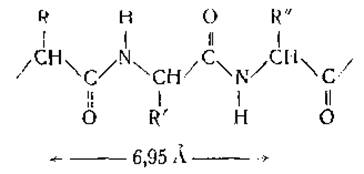
Meridional reflections indicate a repeat period along the axis of 6.95 Å, which is only slightly less than the 7.27 Å predicted by theory for an ideal ß-Structure. An analysis of Infrared Spectra confirms the validity of this view on fibroin's secondary structure, demonstrating that the C=O and X—H bonds are perpendicular to the chain axis. This structure is stabilized by interchain Hydrogen Bonds.
Mechanical properties. Fibroin is responsible for silk's exceptional tensile strength (about 35 kg/mm2) and its relatively low Swelling in water. However, the extensibility of silk fiber cannot be attributed to any Changes in the Introduction/11.html">Secondary structure of its polypeptide chains, unlike what has been demonstrated for keratin. The X-ray patterns of fibroin do not change upon stretching. Its extensibility and elasticity are instead associated with the presence of an admixture of some other protein substance.
It is interesting to note that one of the main structural principles of fibroin—the presence in the peptide chains of significant regions free of any side chains—forms The basis of The structure of synthetic silk substitutes such as nylon, a polymerization product of adipic acid and hexamethylenediamine:

Last update: 06/08/2026
Editorial and Educational Adaptation: This material has been compiled based on the primary/original source text. The project team performed an editorial review, corrected technical inaccuracies, structured sections, and adapted the content for an educational format.
What was processed:
- elimination of formatting defects (OCR errors, structural breaks, corrupted characters);
- editorial organization of content;
- standardization of terminology in accordance with academic sources;
- verification of factual statements against the original source text.
All mentions of the author, publication year, and origin of the primary text have been preserved in accordance with the source.