Protein Chemistry - Part 2 - Selected Topics in Special Protein Chemistry - Ashmarin I. P. 1968
Scleroproteins
General characteristics of scleroproteins
Structural Proteins, specifically Scleroproteins, were once considered a fairly broad and essentially heterogeneous Class of proteins that are insoluble in media commonly used for such purposes (Water, salt solutions, aqueous-ethanolic mixtures, etc.). In addition to their insolubility, these proteins shared another common feature: all of them possessed a fibrous, fibrillar Structure. Over time, conditions for dissolving some of them were discovered, making the criterion of insolubility less strict; their Functions and several other specific differences among individual representatives of this protein class were studied in greater detail. As a result, the term scleroproteins is currently best reserved exclusively for proteins that simultaneously exhibit the following characteristics:
1) insolubility or very limited solubility in water, aqueous solutions of neutral salts, ethanol, and ethanol-water mixtures;
2) relatively high resistance to chemical Reagents and enzymatic action;
3) fibrillar particle structure;
4) primarily structural-mechanical or mechanoprotective functions.
These features are characteristic of Fibroin, Keratins, collagens, and several other related proteins. Despite the difficulties caused by their poor solubility, these proteins have been studied with particular intensity. The reason for this lies in the industrial importance of the products derived from them, namely silk, wool, and leather. Furthermore, they proved to be advantageous research objects due to the relative regularity of their structure, which facilitated, among other things, their X-Ray Diffraction Analysis.
Finally, many representatives of this protein group, in accordance with the relative simplicity of their functions, turned out to have a relatively simple Amino Acid Composition (see, for example, fibroin and keratin in Table 1).
Table 1 Content of Certain Amino Acids in fibroin, keratin, and Collagen (mol %)
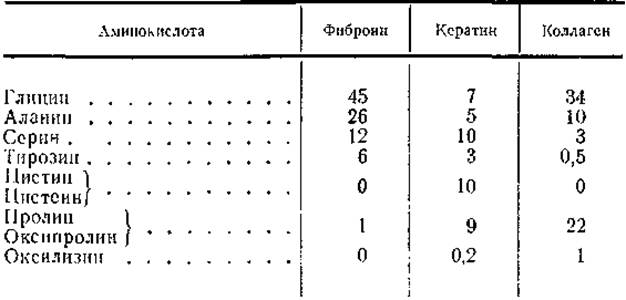
The simplicity of their amino acid composition provided the basis for attempts to isolate them into a special class of so-called proteinoids—compounds that only approach proteins in compositional complexity, yet are too simple to be considered true proteins. However, in accordance with METABOLISM/2.html">THE CONCEPT OF proteins presented in Part I of this manual, such a critical approach to scleroproteins appears unjustified.
Last update: 06/08/2026
Editorial and Educational Adaptation: This material has been compiled based on the primary/original source text. The project team performed an editorial review, corrected technical inaccuracies, structured sections, and adapted the content for an educational format.
What was processed:
- elimination of formatting defects (OCR errors, structural breaks, corrupted characters);
- editorial organization of content;
- standardization of terminology in accordance with academic sources;
- verification of factual statements against the original source text.
All mentions of the author, publication year, and origin of the primary text have been preserved in accordance with the source.