Principles of Biochemistry Volume 1 - A. Lehninger 1985
Biomolecules
Water
Amino acids differ in their acid-base properties
We have analyzed The titration curve of Alanine shown in Fig. 5-10 in considerable detail. But how do the other 19 Amino Acids behave? Fortunately, it is possible to make some simplifying generalizations regarding the acid-base properties of various classes of amino acids.
All amino acids containing one a-amino group, one carboxyl group, and one nonionizable R-group yield titration curves similar to that of alanine. This entire group of amino acids (see Table 5-3) is characterized by very close, though not identical, values of pK'1, ranging from 2.0 to 3.0, and pK'2, ranging from 9.0 to 10.0, as evidenced by the figures given for some of these amino acids in Table 5-4. Thus, all amino acids in this group behave like alanine and produce titration curves of the same type as shown in Fig. 5-10.
Class="center">Table 5-4. Values of pK' for ionizable groups of Certain amino acids at 25°C
|
Amino acid |
рK'1 |
pK'2 |
рК’ |
|
—СОС—NH+3 |
R-group |
||
|
2,34 |
9,6 |
||
|
Alanine |
2,34 |
9,69 |
|
|
Leucine |
2,36 |
9,60 |
|
|
2,21 |
9,15 |
||
|
2,63 |
10,43 |
||
|
Glutamine |
2,17 |
9,13 |
|
|
Aspartic acid |
2,09 |
9,82 |
3,86 |
|
Glutamic acid |
2,19 |
9,67 |
4,25 |
|
1,82 |
9,17 |
6,0 |
|
|
1,71 |
10,78 |
8,33 |
|
|
2,20 |
9,11 |
10,07 |
|
|
2,18 |
8,95 |
10,53 |
|
|
2,17 |
9,04 |
12,48 |
Amino acids with an ionizable R group (see Table 5-3) exhibit more complex titration curves consisting of three segments corresponding to three possible ionization stages; consequently, they have three pK' values. The stage corresponding to the titration of the ionizable R group overlaps to some extent with the other two. Figure 5-12 illustrates the titration curves for two representatives of this group, glutamic acid and histidine. The isoelectric points of this class of Amino acids are determined by the type of ionizable R group present. For example, glutamic acid, which contains two carboxyl groups and one amino group, has an isoelectric point of 3.22 (the average of the two pK' values for the two carboxyl groups)—much lower than that of alanine. Similarly, the isoelectric point of lysine, which contains two amino groups, is 9.74, which is significantly higher than that of alanine.
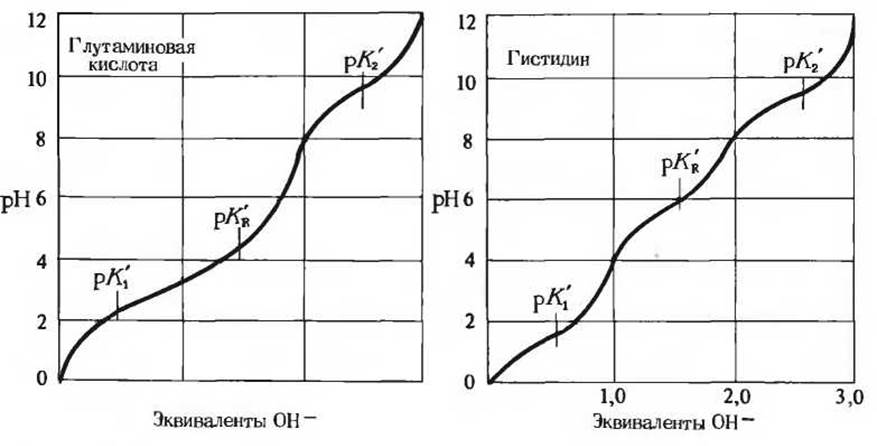
Fig. 5-12. Titration curves of glutamic acid and histidine. The pK' value of the R group is designated as pKR'.
Another important generalization concerning the acid-base Properties of the 20 standard amino acids is that virtually only one amino acid, histidine, possesses significant buffering capacity at pH values close to the pH of extracellular fluid and Blood. As can be seen from Table 5-4 and Figure 5-12, the R group of histidine has a pK' of 6.0, giving it substantial buffering capacity at pH 7. All Other Amino Acids have pK' values far too distant from pH 7 for their solutions to serve as effective buffers at this pH. Hemoglobin, the oxygen-carrying protein contained in erythrocytes, is characterized by a very high content of histidine residues. This imparts a significant buffering capacity at around pH 7, which is crucial for The Physiological Role of erythrocytes in The transport of oxygen and carbon dioxide by the blood (Chapter 25).
Last update: 06/08/2026
Editorial and Educational Adaptation: This material has been compiled based on the primary/original source text. The project team performed an editorial review, corrected technical inaccuracies, structured sections, and adapted the content for an educational format.
What was processed:
- elimination of formatting defects (OCR errors, structural breaks, corrupted characters);
- editorial organization of content;
- standardization of terminology in accordance with academic sources;
- verification of factual statements against the original source text.
All mentions of the author, publication year, and origin of the primary text have been preserved in accordance with the source.