Fundamentals of Biochemistry - A. A. Anisimov 1986
Protein and Amino Acid Metabolism
Amino Acid Biosynthesis
5.2.1. Sources of Nitrogen and Carbon for Amino acid Biosynthesis
The BIOSYNTHESIS OF AMINO Acids from simple precursors is a process no less vital to the biosphere than carbohydrate formation during Photosynthesis, although it is quantitatively inferior to the latter. This process is absolutely essential for all forms of life, as Amino Acids serve as the Building Blocks of Proteins and precursors for numerous Biomolecules that perform diverse specialized Functions. However, organisms from different taxonomic groups vary significantly both in their ability to synthesize specific Amino Acids and in their requirements for particular forms of nitrogen to achieve this.
Humans and animals are capable of synthesizing only 10 out of the 20 amino acids required for Protein Synthesis. The remaining ones, known as essential or indispensable amino acids, must be obtained from diet (see Section 5.6.1). For the synthesis of non-Essential Amino Acids, humans and animals require only ammonium nitrogen compounds, rather than nitrites, nitrates, or N2. Ruminants can utilize nitrites and nitrates for this purpose, provided they are first reduced to ammonia by Bacteria living in the rumen, one of the compartments of The Stomach.
A characteristic feature of higher plants, distinguishing them from animals, is their ability to synthesize all amino acids using ammonia, nitrates, and nitrites as nitrogen sources. Meanwhile, CO2 serves as the carbon source in green plants. Thus, they synthesize amino acids, and consequently proteins, entirely from Inorganic Compounds. Photosynthetic and chemosynthetic bacteria possess this same capability. All other chlorophyll-free microorganisms and heterotrophic Tissues of higher plants require pre-existing carbon-containing organic substances (CARBOHYDRATES, organic acids) In addition to a nitrogen source for Amino acid synthesis. Higher plants capable of Symbiosis with ROOT-nodule bacteria also fix atmospheric molecular nitrogen, converting it into NH3 and subsequently using it for amino acid synthesis.
Among bacteria, some can synthesize all the amino acids they need (e.g., E. coli), whereas others fail to grow if the medium lacks specific amino acids required for their growth. For instance, Staphylococcus aureus (which causes purulent wounds) strictly requires the presence of Two amino acids in the growth medium—Thr and Cys; the lactic acid bacterium Lactobacillus casei requires 16 amino acids, and the hemolytic Streptococcus requires 17.
When feeding on organic nitrogen compounds, bacteria and Fungi typically break them down, converting the contained nitrogen into ammonia and subsequently utilizing it for amino acid biosynthesis. Most microorganisms utilize nitrogen in its reduced, i.e., ammonium form, but certain bacteria and fungi are capable of utilizing nitrites and nitrates.
Free NH3 is toxic to living organisms; therefore, when feeding on ammonium salts, plants and microorganisms do not accumulate it, but immediately use it for the synthesis of amino acids and other nitrogen-containing Organic compounds. Nitrates, however, may accumulate in plant tissues, sometimes in quite large quantities (buckwheat, tobacco). When nitrates are used as a nitrogen source for amino acid synthesis in plants and microorganisms, they are reduced to NH3. This process occurs in two stages: NО-3 → NО-2 →...—NH+4.
The First stage is catalyzed by nitrate reductase, involving a two-electron reduction of nitrates to nitrites. In plants and bacteria, the electron donor for this process is NADH, whereas in fungi it is NADPH: NO-3 + NADH + H+ → NAD+ + NО-2 + H2O. Nitrate reductases are metalloflavoproteins containing Mo. The synthesis of nitrate reductase is induced by nitrates and repressed by NH+4.
In the second stage, mediated by nitrite reductase, a six-electron reduction of nitrites to ammonia takes place: NО3 + 8H+ + 6е-→NH4+ + 2H2O. The prosthetic groups of nitrite reductase include FMN, FAD, Fe2S2, and siroheme (an iron tetrahydroporphyrin). The latter functions as the direct reductant of nitrites. In Higher Plants and Algae, ferredoxin serves as the reducing agent in the reaction catalyzed by nitrite reductase.
In addition to de novo primary amino acid synthesis, plants can also assimilate preformed amino acids. This is particularly typical of carnivorous and parasitic plants. Studies on plants grown under sterile culture conditions, which preclude The Development of microorganisms, have established that, in principle, all higher plants can take up amino acids and certain other organic nitrogen compounds through their root system. The technique of sterile cultures was perfected by D. N. Pryanishnikov and his coworker G. G. Petrov. Despite this capacity for organic nitrogen assimilation, higher green plants develop normally only when exposed to light and actively producing organic matter via photosynthesis.
5.2.2. Primary Assimilation of Ammonia. The primary uptake of NH3 in All living organisms occurs via three main reactions leading to The formation of: 1) glutamic acid, 2) glutamine, and 3) carbamoyl phosphate. However, while the nitrogen of carbamoyl phosphate is utilized solely for the synthesis of Pyrimidines and Arginine, the amino group of glutamate or the amide group of glutamine serves, directly or indirectly, as the source of virtually all nitrogen atoms incorporated into amino acids and other nitrogen-containing compounds (only in rare instances is ammonia used in place of glutamine).
The incorporation of NH3 into glutamate proceeds via reductive amination.
α-Ketoglutarate + NН+4 + [NADH or NADPH] ⇄ Glutamate + [NAD+ or NADP+] + H2O. This reaction is catalyzed by glutamate dehydrogenases, which differ significantly across various organisms in the number of subunits comprising the enzyme molecule and in their Specificity for NAD+ or NADP+. This reaction is of paramount importance in The biosynthesis of all amino acids across all organisms, since the Transamination of α-keto acids using glutamic acid as the amino group donor is the primary pathway for introducing the α-amino group during the biosynthesis of Other Amino Acids.
In some plants, bacteria, and Yeasts, a similar pathway involves the direct reductive amination of Pyruvate and oxaloacetate, yielding Alanine and aspartate, respectively.
The resulting glutamate can be utilized for the fixation of a second molecule of NH3 via the reaction
Class="center">
The enzyme Glutamine Synthetase, which catalyzes this reaction, is a regulatory enzyme with a quaternary Structure.
Under conditions where The amount of NH3 is limited, its assimilation can proceed by coupling the preceding reaction with the following one:

A similar glutamate synthesis reaction occurs in bacteria as well as in higher plants.
The formation of carbamoyl phosphate, catalyzed by carbamoyl phosphate synthetase, represents the third pathway of ammonia assimilation:

Glutamine can also be used for the formation of carbamoyl phosphate. This occurs during pyrimidine biosynthesis:

Finally, mention should be made of yet another pathway of NH3 assimilation: aspartate ammonia-lyase, an enzyme isolated from certain bacteria, which catalyzes the synthesis of aspartate through the direct addition of NH3 to fumaric acid:

5.2.3. Major PATHWAYS OF AMINO Acid Biosynthesis. As seen from the reactions discussed in the previous section, direct amination produces a relatively small number of amino acids and compounds containing fixed ammonia. All other Amino acids are synthesized via processes of varying complexity, ranging from single-step to multi-step reactions. In general, there are three primary pathways for amino acid biosynthesis: 1) direct amination of $\alpha$-keto acids or unsaturated organic acids; 2) Transamination reactions between amino acids and $\alpha$-keto acids; 3) enzymatic interconversions of individual amino acids.
The first pathway was examined in the previous section. A major route for the Biosynthesis of Non-essential amino acids is transamination—The transfer of amino groups (primarily from glutamate) to other carbon chains, most commonly the corresponding keto analogs of amino acids. The Enzymes catalyzing this process are called aminotransferases, and their full names include the specific amino acids participating in the reaction:
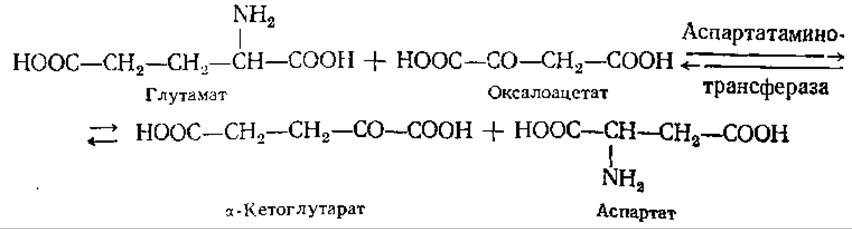
Transamination reactions, which play a paramount role in the Nitrogen METABOLISM of any living Organism, were discovered in 1937 by the Soviet biochemists A. E. Braunstein and M. G. Kritzmann. It has been established that asparagine and glutamine can also serve as amino group Donors in transamination reactions. Aminotransferases catalyzing these reactions have been found in microorganisms, plants, and animals.
Academician A. E. Braunstein demonstrated that the pathways of direct keto acid amination and transamination are closely linked. Very frequently, the synthesis of any amino acid begins with the direct reductive amination of $\alpha$-ketoglutarate, resulting in the formation of glutamic acid. This acid subsequently enters transamination reactions with other keto acids to yield new amino acids.
AMINO ACID DEAMINATION also frequently proceeds via glutamic acid. First, any amino acid undergoes transamination with $\alpha$-ketoglutarate to form glutamate, which then either transfers its ammonia into the Ornithine urea-cycle via transamination with oxaloacetate or undergoes deamination.
New Amino acids can be formed through enzymatic interconversions: arginine $\rightarrow$ ornithine; glutamate $\rightarrow$ Proline; Serine $\rightarrow$ Glycine; phenylalanine $\rightarrow$ Tyrosine.
There are distinct differences between the biosynthetic pathways of essential and non-essential amino acids: the biosynthesis of essential amino acids involves A large number of steps (from 5 to 15), whereas non-essential ones require fewer than five steps. Essential amino acids are also more complex in that their intermediates serve as precursors for many Other types of biomolecules.
5.2.4. Biosynthesis of Non-Essential Amino Acids. The synthesis of glutamic acid—the precursor of many other amino acids—was discussed in the previous section. Its transamination with pyruvate and oxaloacetate yields alanine and aspartate. In plants and bacteria, the latter can also be synthesized via reductive amination of keto acids.
Proline is formed through the sequential reduction of phosphorylated glutamate, its cyclization, and a subsequent reduction step. The reduction of glutamate is feedback-inhibited by proline itself.
Ornithine can be readily synthesized from arginine. In turn, ornithine can be converted into proline by ornithine cyclase through Reactions Involving the Oxidative Deamination, cyclization, and reduction of ornithine.
Tyrosine is formed from the essential amino acid phenylalanine via its hydroxylation by an oxygenase (phenylalanine 4-hydroxylase) through the direct incorporation of oxygen:


Fig. 5.2. Pathways of phenylalanine, Tryptophan, and tyrosine biosynthesis
Its synthesis from prephenic acid is also possible (Fig. 5.2).
In mammals, Cysteine is synthesized from Methionine (the sulfur donor) and serine (the carbon chain and amino group). A series of reactions replaces the OH group of serine with the sulfhydryl group of homocysteine, which is derived from methionine. ATP and A number of enzymes take part in these reactions, two of which are Pyridoxal phosphate-dependent.
In microorganisms and plants, cysteine is synthesized from serine using H2S as the sulfur source.
In animals, serine is synthesized primarily from 3-phosphoglyceric acid (3-PGA), an intermediate of Glycolysis. In plants, serine is produced during photosynthesis (see Section 6.5.1):
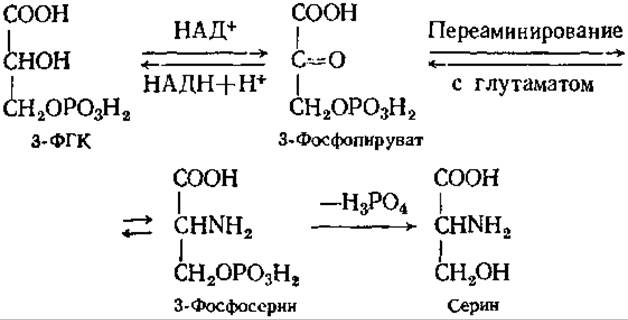
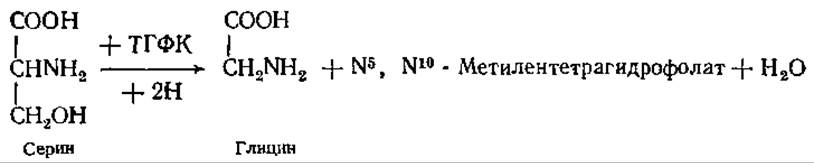
Glycine is synthesized by removing the $\beta$-carbon of serine. This process yields not only glycine but also active single-carbon units (at the oxidation levels of CH3OH, HCHO, or HCOOH). The reaction involves a coenzyme, tetrahydrofolic acid (THFA), a derivative of Folic acid (see Section 10.3), which transfers the single-carbon fragment by attaching it as a methylene residue to N-5 and N-10 via hydrogen substitution:
5.2.5. Biosynthesis of Essential Amino Acids. The inability of animals to synthesize Certain amino acids (essential amino acids) is due to the fact that their bodies do not produce the keto acids whose amination leads to the Formation of the corresponding essential amino acids. Most bacteria and higher plants actively synthesize these amino acids, and their biosynthetic pathways are identical or closely related.
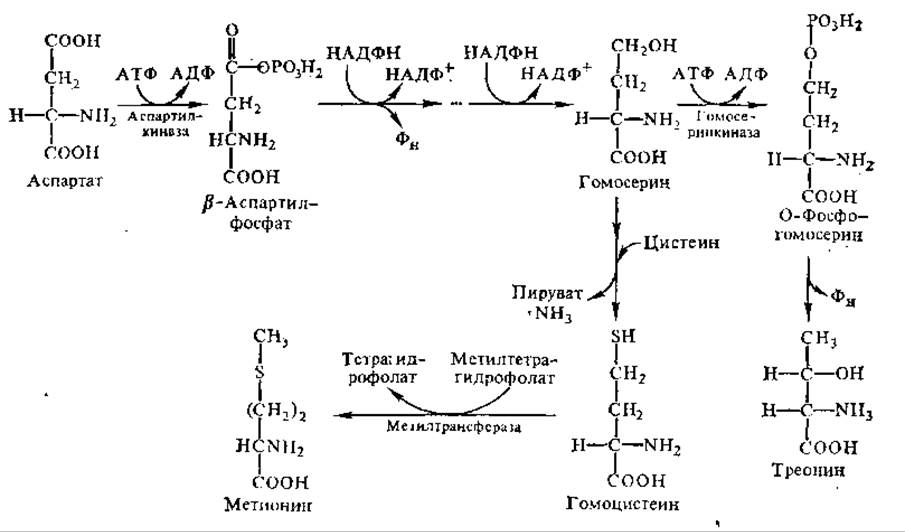
Methionine and Threonine are synthesized from aspartic acid with the participation of ATP, NADH+, and a number of enzymes—some of which are pyridoxal phosphate-dependent, while others contain a reduced cobalamin derivative (vitamin B12) as a prosthetic group. The methyl group in methionine biosynthesis is provided by N5-methyltetrahydrofolate. The Initial Stages of the biosynthesis of these amino acids, up to the formation of homoserine, proceed identically, after which the pathways diverge:
In bacteria and higher plants, Lysine is synthesized via the Condensation of aspartate with pyruvate through diaminopimelic acid:
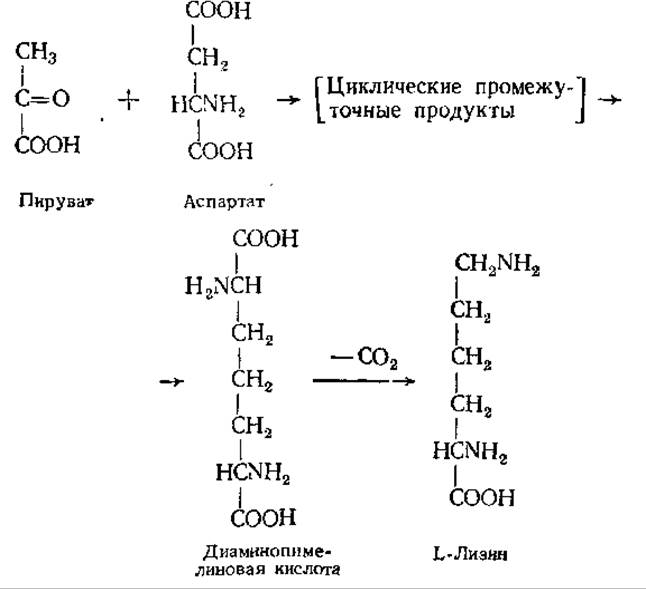
In Molds, lysine is formed from a-ketoglutarate and acetyl-CoA via a-aminoadipic acid.
Valine, leucine, and isoleucine share a common structural feature: a branched aliphatic side chain. The synthesis of all Three amino acids begins with pyruvate, which yields an active acetaldehyde group that condenses with a second molecule of an a-keto acid (pyruvate, a-ketoisovalerate, or a-ketobutyrate). Through a series of extensive transformations, this produces an a-keto acid that serves as an analogue of the respective amino acid, followed by a final transamination step with glutamate.
Additionally, isoleucine is readily synthesized from threonine.
Arginine can be synthesized by mammals from ornithine within The Urea Cycle (see Section 5.6.4), though only in very small quantities. This is because, first, it is rapidly hydrolyzed by the enzyme arginase to yield urea, and second, ornithine is present in limited, catalytic amounts only. In bacteria and plants, the guanidino group of arginine incorporates one nitrogen atom from carbamoyl phosphate and ultimately two from glutamate (via aspartate and ornithine).
Histidine is synthesized via a complex pathway involving nine reactions. The starting Materials are ATP, 5-phosphoribosyl-1-pyrophosphate, and glutamine. The pathway proceeds with the opening of the purine ring of AMP, and the nitrogen atom in the final step is contributed by the amide group of glutamine. This reaction sequence features several Metabolic control points; notably, the first reaction—catalyzed by ATP phosphoribosyltransferase—is specifically inhibited by histidine.
Phenylalanine and tryptophan are products derived from the metabolism of cyclic organic acids. The biosynthetic pathways of phenylalanine and tryptophan were elucidated through experiments using E. coli mutants auxotrophic for these amino acids (i.e., incapable of synthesizing them). It was discovered that shikimic acid, which is widespread in plants, Supports the growth of such mutants, leading to the Conclusion that this acid is a precursor to phenylalanine and tryptophan. In turn, the carbon atoms of the aromatic ring and side chain of shikimate are supplied by erythrose-4-phosphate and phosphoenolpyruvate. Further transformation of shikimic acid leads to the formation of Chorismic acid, at which point the biosynthetic Pathways of the aromatic acids diverge. The formation of anthranilate leads to tryptophan biosynthesis, whereas prephenate serves as the precursor for Phenylalanine and Tyrosine (see Fig. 5.2).
5.2.6. Regulation of Amino Acid Biosynthesis. Because bioavailable forms of nitrogen are relatively scarce in the abiotic environment, most living organisms have evolved to use reduced forms of nitrogen efficiently for metabolic needs. Amino acid biosynthesis is continuously regulated via feedback inhibition (retroinhibition) mediated by regulatory enzymes. In this mechanism, the synthesized amino acid acts as an inhibitor of one of the initial steps in its own long biosynthetic pathway. Furthermore, the Synthesis of the enzymes catalyzing amino acid formation is regulated through the repression and derepression of the corresponding DNA cistrons (see Section 5.4).
The first mechanism provides "fine-tuning," as it can rapidly adjust The rate of biosynthesis of any amino acid according to its current steady-state concentration. The second regulatory mechanism acts as "coarse-tuning" and is utilized when The Cell is abundantly supplied with amino acids from exogenous sources. Both regulatory forms reflect the inherent economy governing the synthesis and utilization of amino acids in biological systems. Under normal conditions, none of the amino acids are produced in excess. Over the course of evolution, a sophisticated mechanism has been established that maintains a balanced intracellular concentration of each of the twenty amino acids.
Last update: 06/08/2026
Editorial and Educational Adaptation: This material has been compiled based on the primary/original source text. The project team performed an editorial review, corrected technical inaccuracies, structured sections, and adapted the content for an educational format.
What was processed:
- elimination of formatting defects (OCR errors, structural breaks, corrupted characters);
- editorial organization of content;
- standardization of terminology in accordance with academic sources;
- verification of factual statements against the original source text.
All mentions of the author, publication year, and origin of the primary text have been preserved in accordance with the source.