GENERAL MICROBIOLOGY - T.P. Pyrog - 2004
13. BIOSYNTHETIC PROCESSES IN MICROORGANISMS
13.2. AMINO ACID BIOSYNTHESIS
Most microorganisms are capable of de novo synthesis of all 20 Amino Acids that make up Proteins. The carbon skeletons of Amino acids are built from metabolic intermediates, and Amino groups are introduced via direct amination or Transamination. The conversion of inorganic nitrogen into Organic compounds always proceeds via ammonia. Nitrates, nitrites, and molecular nitrogen (sources of nitrogen in growth media) are preliminarily reduced to ammonia (assimilatory nitrate reduction) and only then incorporated into organic compounds (Fig. 13.1, a, b, c).
Only a few amino acids are formed via direct amination by free ammonium ions. L-Glutamate dehydrogenase and L-Alanine Dehydrogenase participate in the primary assimilation of ammonia, mediating the reductive amination of 2-oxo acids (Pyruvate and 2-oxoglutarate) (Fig. 13.1, d, e). ATP is not consumed in this process. The formation of glutamine from glutamate is catalyzed by Glutamine Synthetase and requires ATP expenditure (Fig. 13.1, f). Via glutamate synthase, the amino group of glutamine can be transferred to 2-oxoglutarate to yield glutamate (Fig. 13.1, g).
Class="center">
Fig. 13.1. Main Pathways of nitrogen assimilation:
ammonium ions present in the nutrient medium are directly taken up by Cells (a). Nitrate ions during assimilatory nitrate reduction (b), and molecular nitrogen during Nitrogen Fixation (c) are reduced to ammonium ions. Ammonium nitrogen is converted into organic compounds either with ATP consumption via glutamine formation or without ATP expenditure via direct reductive amination of 2-oxoglutarate or pyruvate
The remaining amino acids acquire their amino groups from primary amino acids through transamination. Among free amino acids in the Cytoplasm, glutamic acid is quantitatively dominant (accounting for more than half of the total amino acid pool).
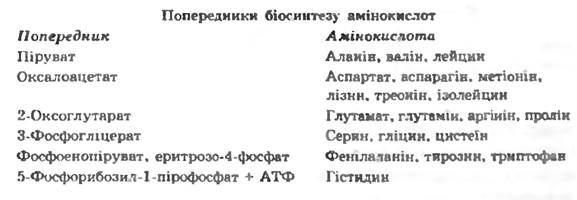
All 20 amino acids required for Protein Synthesis are generated from specific metabolic precursors (Fig. 13.2).

Fig. 13.2. Pathways of Amino acid Biosynthesis:
amino acid families: 1 — aromatic Amino Acids and Histidine; 2 — pyruvate family; 3 — aspartate family; 4 — glutamate family.
Lysine biosynthesis pathways: A — diaminopimelate pathway; B — aminoadipate pathway
As seen from the presented data, the substrates for Amino acid synthesis include several compounds: pyruvate, oxaloacetate, 2-oxo-3-phosphoglycerate, phosphoenolpyruvate, erythrose-4-phosphate, and 5-phosphoribosyl pyrophosphate. Oxaloacetate serves as the starting point for the synthesis of six amino acids, 2-oxoglutarate is the precursor for four, and pyruvate for Three amino acids. Figure 13.2 illustrates two possible pathways for lysine synthesis: A — the diaminopimelate pathway and B — the aminoadipate pathway.
Microalgae, Fungi, and Yeasts synthesize lysine via the aminoadipate pathway, whereas Bacteria utilize the diaminopimelate pathway.
Alanine and aspartate are synthesized from pyruvate and oxaloacetate via transamination using glutamate as the amino group donor. Asparagine is formed in a reaction analogous to that catalyzed by glutamine synthetase. The reduction of aspartate yields aspartate semialdehyde, a precursor for lysine, Threonine, and Methionine. Deamination of threonine leads to the formation of 2-oxobutyrate, which is subsequently converted into isoleucine through the sequential action of four Enzymes. Pyruvate is converted into valine by four enzymes; an intermediate in valine synthesis serves as a precursor for leucine formation. Serine, Glycine, and Cysteine are synthesized from 3-phosphoglycerate, while Proline and Arginine originate from glutamate.
The synthesis of aromatic amino acids is more complex (Fig. 13.3). Erythrose-4-phosphate and phosphoenolpyruvate condense to form a C7 compound, which undergoes cyclization. Chorismate serves as the common intermediate in the synthesis of aromatic amino acids. At this junction, the biosynthetic pathway branches into two: 1) the formation of Tryptophan via anthranilate; 2) the formation of Tyrosine and phenylalanine via prephenate (Fig. 13.3).
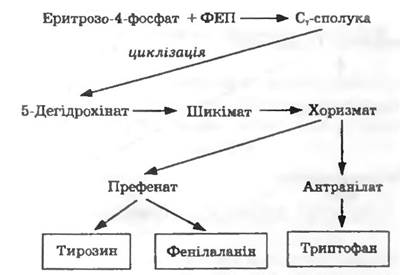
Fig. 13.3. Biosynthesis of aromatic amino acids
Last update: 12/08/2026
Editorial and Educational Adaptation: This material has been compiled based on the primary/original source text. The project team performed an editorial review, corrected technical inaccuracies, structured sections, and adapted the content for an educational format.
What was processed:
- elimination of formatting defects (OCR errors, structural breaks, corrupted characters);
- editorial organization of content;
- standardization of terminology in accordance with academic sources;
- verification of factual statements against the original source text.
All mentions of the author, publication year, and origin of the primary text have been preserved in accordance with the source.