BIOCHEMISTRY - L. Stryer - 1984
VOLUME 2
PART III. BIOSYNTHESIS OF MACROMOLECULAR PRECURSORS
CHAPTER 21. BIOSYNTHESIS OF AMINO ACIDS AND HEME
21.10. Histidine is synthesized from ATP, PRPP, and glutamine
The pathway for Histidine Biosynthesis in E. coli and Salmonella has many complex and novel features. The reaction sequence begins with the Condensation of ATP and PRPP, in which the N-1 of the purine ring is linked to the C-1 of the ribose group of PRPP. In the final molecule, the five carbon atoms of histidine are derived from PRPP. The adenine residue of ATP contributes a nitrogen and a carbon atom to the imidazole ring of histidine. The second nitrogen atom of the imidazole ring comes from the side chain of glutamine. An important feature of this pathway is that 5-aminoimidazole-4-carboxamide ribonucleotide, which is formed during the Cleavage reaction that yields the imidazole ring, is an intermediate in Purine Biosynthesis (Section 22.4). Thus, the pathways for histidine and purine biosynthesis are interconnected.
21.11. Amino acid biosynthesis is regulated by feedback inhibition
The rate of Amino acid synthesis depends mainly on The amount of biosynthetic Enzymes and their catalytic activity. We now turn to the REGULATION OF ENZYMATIC Activity. The Introduction/15.html">Regulation of enzyme synthesis will be discussed in Chapter 28.
The first irreversible reaction in a biosynthetic pathway, called the committed step, is usually an important site of regulation. The end product of the pathway (Z) often inhibits The enzyme catalyzing the first committed step (A → B).
Class="center">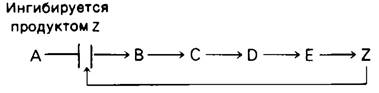
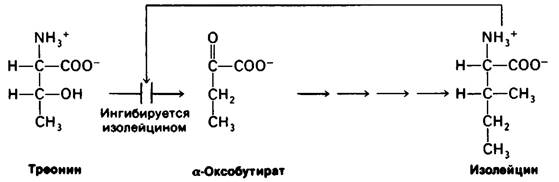
This type of regulation is essential for conserving building blocks and metabolic energy. The first example of this important principle of Metabolic Regulation was discovered in studies of isoleucine biosynthesis in E. coli. The dehydration and deamination of Threonine to form α-ketobutyrate is the committed step in isoleucine synthesis. Threonine deaminase, the pyridoxal enzyme catalyzing this reaction, is allosterically inhibited by isoleucine.
Similarly, Tryptophan inhibits the enzyme complex that catalyzes the first two steps in The conversion of chorismate into tryptophan.
Consider a branched biosynthetic pathway whose end products are Y and Z.
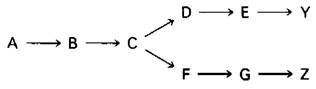
Suppose that a high concentration of Y or Z completely inhibits the first common step (A → B). Then, a high concentration of Y would block the synthesis of Z, even if its level is below what is needed. Obviously, such a regulatory scheme is not optimal. In fact, several sophisticated regulatory mechanisms have been discovered in branched biosynthetic pathways.
1. Sequential feedback inhibition. The first common reaction (A → B) is not directly inhibited by the products Y or Z. Instead, the end products inhibit the initial reactions of each branch: Y inhibits the reaction C → D, and Z inhibits the reaction C → F. A high concentration of C, in turn, inhibits the reaction A → B. Thus, the first common reaction is blocked only when both end products are present in excess.
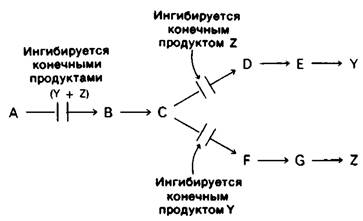
Sequential feedback inhibition operates in the synthesis of aromatic Amino Acids in Bacillus subtilis. The first reactions after the branch point of the common biosynthetic pathway for phenylalanine, Tyrosine, and tryptophan are inhibited by their respective end products.
If all three products are present in excess, chorismate and prephenate accumulate. These intermediates, synthesized in reactions preceding the branch point, in turn inhibit the first common reaction of the entire biosynthetic pathway—the condensation of phosphoenolpyruvate and erythrose 4-phosphate.
2. Enzyme multiplicity. The distinctive feature of this mechanism is that the first common reaction (A → B) is catalyzed by two different enzymes. One is inhibited by product Y, and the other by product Z. Thus, to completely prevent the conversion of A into B, the concentrations of both Y and Z must be high. In addition, in this regulatory scheme, as in sequential feedback inhibition, Y inhibits the reaction C → D, and Z inhibits the reaction C → F.
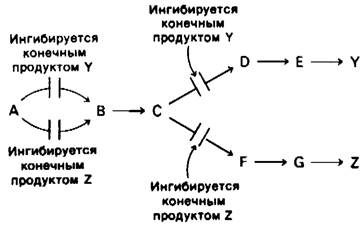
Differential inhibition of multiple enzymes is used to regulate numerous Metabolic Pathways in microorganisms. In E. coli, the condensation of phosphoenolpyruvate and erythrose 4-phosphate is catalyzed by three distinct enzymes. One is inhibited by phenylalanine, another by tyrosine, and the third by tryptophan. In addition, There are two different Mutases that convert chorismate into prephenate. One is inhibited by phenylalanine, and the other by tyrosine.
3. Concerted feedback inhibition. The first common reaction (A → B) is inhibited only when both Y and Z are simultaneously present in high concentrations. A high concentration of only one of these products does not inhibit the reaction A → B. As in the first two regulatory schemes, Y inhibits the reaction C → D, and Z inhibits the reaction C → F.
An example of concerted feedback inhibition is the inhibition of aspartokinase by the end products threonine and Lysine.
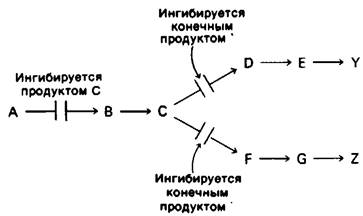
4. Cumulative feedback regulation. The first common step (A → B) is partially inhibited by each of the end products. Each end product acts independently of the others. Suppose that at a high concentration of Y, the rate of reaction A → B decreases from 100 to 60 s-1, and Z decreases the rate from 100 to 40 s-1. Then the rate of reaction A → B in the presence of high concentrations of Y and Z will be 24 s-1 (0.6 • 0.4 • 102 s-1).
21.12. Glutamine Synthetase Activity Is Regulated by Adenylylation
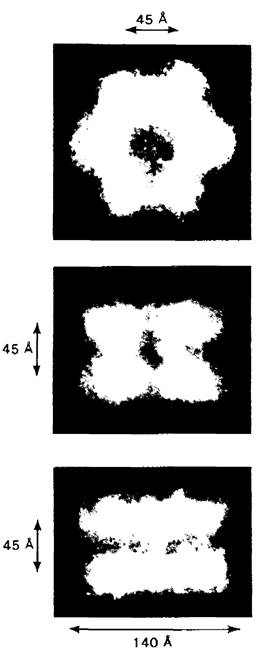
The regulation of E. coli Glutamine Synthetase is a striking example of cumulative feedback inhibition. Recall that glutamine is synthesized from glutamate, NH4+, and ATP (Section 21.2). Glutamine synthetase consists of 12 subunits of 50 kDa each, arranged in two parallel hexagonal rings (Fig. 21.15). This enzyme is a key regulatory element of METABOLISM because, as Earl Stadtman and his colleagues showed, it regulates the flow of nitrogen. The amide group of glutamine is the nitrogen source in The biosynthesis of several compounds, such as tryptophan, histidine, carbamoyl phosphate, glucosamine 6-phosphate, CTP, and AMP. Glutamine synthetase is cumulatively inhibited by each of these End products of glutamine metabolism, as well as by Alanine and Glycine. Apparently, the enzyme molecule has binding sites for each of these inhibitors. The enzymatic activity of glutamine synthetase is almost completely shut down when all eight end products are bound.
Fig. 21.15. Three-dimensional views of E. coli glutamine synthetase. The images were obtained by superimposing A large number of electron micrographs. The twelve subunits are arranged in two hexagonal rings located in parallel planes
Another important property of glutamine synthetase is reversible covalent modification, which alters its activity (Fig. 21.16). We have already encountered this regulatory mechanism in the Synthesis and Breakdown of Glycogen (Section 16.11). Phosphorylation activates Glycogen phosphorylase and inactivates glycogen synthase. The activity of glutamine synthetase is regulated to some extent by the covalent attachment of an AMP residue to the hydroxyl group of a specific tyrosine residue in each subunit. This adenylylated enzyme is more sensitive to cumulative feedback inhibition than the unadenylylated enzyme. The AMP residue covalently attached to the enzyme can be removed by phosphorolysis. A curious feature of these reactions is that they are catalyzed by the same enzyme, adenylyltransferase. What determines whether this enzyme attaches or removes the AMP residue? It turns out that the Specificity of adenylyltransferase is controlled by a regulatory protein (designated as P) that can exist in two forms: РA and РD. The РA–adenylyltransferase complex attaches AMP to glutamine synthetase, thereby reducing its activity, whereas the PD–adenylyltransferase complex removes AMP. Thus, we encounter another level of reversible covalent modification. РA is converted to PD by the attachment of uridine monophosphate (UMP) (Fig. 21.17). This reaction, catalyzed by uridylyltransferase, is stimulated by ATP and α-ketoglutarate and inhibited by glutamine. The UMP residue attached to PD can, in turn, be removed by Enzymatic Hydrolysis.
Fig. 21.16. Regulation of glutamine synthetase activity by reversible covalent modification. Adenylylation is catalyzed by a complex of adenylyltransferase (AT) and one form of the regulatory protein (РА). The same enzyme in complex with another form of the regulatory protein (РD) catalyzes deadenylylation
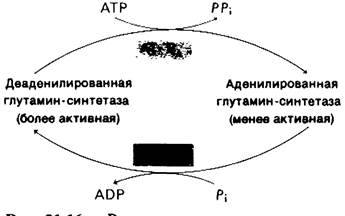
Fig. 21.17. A higher level of cascade regulation of glutamine synthetase. The regulatory Proteins РА and РD, which determine the specificity of glutamine synthetase, are interconvertible. РА is converted to РD by uridylylation (attachment of a UMP residue). The reverse reaction occurs by hydrolysis. The enzymes catalyzing these reactions "sense" the concentrations of metabolic intermediates
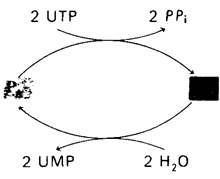
As a result of this regulatory cascade, when the supply of active nitrogen is limited, adenylylation is inhibited and deadenylylation is stimulated. Glutamine synthetase becomes less sensitive to cumulative feedback inhibition, and The production of glutamine increases accordingly. Why is a cascade mechanism used to regulate this enzyme? One advantage of this mechanism is that it amplifies signals, as seen, for example, in Blood clotting (Section 8.17) or in the Regulation of Glycogen metabolism (Section 16.17). Another reason is likely that the potential for allosteric control is greatly increased, since each enzyme in the cascade becomes an independent target for regulation. To integrate Nitrogen metabolism, The Cell must perceive and process a large number of signals. The capacity of a single protein in this regard is limited, even for a molecule as sophisticated as glutamine synthetase! The evolution of cascade regulation has provided many additional regulatory sites, allowing for the fine-tuning of nitrogen flow within the cell.
Last update: 06/08/2026
Editorial and Educational Adaptation: This material has been compiled based on the primary/original source text. The project team performed an editorial review, corrected technical inaccuracies, structured sections, and adapted the content for an educational format.
What was processed:
- elimination of formatting defects (OCR errors, structural breaks, corrupted characters);
- editorial organization of content;
- standardization of terminology in accordance with academic sources;
- verification of factual statements against the original source text.
All mentions of the author, publication year, and origin of the primary text have been preserved in accordance with the source.