BIOLOGY Volume 1 - A Guide to General Biology - 2004
8. HETEROTROPHIC NUTRITION
8.1. Types of Heterotrophic Nutrition
8.1.3. Symbiosis: Mutualism, Parasitism, and Commensalism
The term symbiosis literally means "living together." It was introduced in 1879 by the German scientist de Bary, who described the phenomenon as "the co-existence of unlike organisms." In other words, symbiosis is an association between two or more organisms of different species. Since de Bary's time, many biologists have narrowed the definition of "symbiosis" to imply close relationships between two or more organisms of different species that benefit all partners involved.
Since the 1970s, symbiosis as a branch of biology has gained increasing importance. Today, for example, it is known that the majority of plants obtain essential nutrients with the help of Fungi, and nitrogen is fixed primarily by symbiotic Bacteria. The discovery that Fermentation in the rumen of ruminants occurs through the assistance of symbiotic organisms is of major importance for improving cattle productivity. At the same time, biologists have come to realize that the degree of closeness in relationships, benefits, or harm in such cases can vary widely. Consequently, most modern biologists use a definition of symbiosis similar to that given by de Bary and approved by the Society for Experimental Biology in 1975.1
This book will use the Structure/97.html">Definitions provided below, with an emphasis on how mutually beneficial the relationships are for both participants.
Symbiosis is the close, interactive co-habitation of two or more organisms of different species. Many such associations consist of three or more "partners" sharing a nutritional relationship. There are three MAIN TYPES OF symbiotic relationships:
1) mutualism, or mutually beneficial relations between both "partners";
2) parasitism, in which one "partner" benefits while causing harm to the other;
3) commensalism, in which the relationship is advantageous to one "partner" while being neither beneficial nor harmful to the other.
Mutualism
Mutualism is a close relationship between two living organisms of different species that is mutually beneficial to both partners. For example, the sea anemone Calliactis attaches itself to the shell inhabited by a hermit crab (Fig. 8.3). The anemone feeds on the hermit crab's food scraps and "travels" along with it. At the same time, the anemone camouflages the crab's home and provides protection using stinging Cells ( nematocysts) located in its tentacles. Apparently, the anemone cannot survive without attaching to a hermit crab shell, while the crab, should the anemone leave, will actively seek out another and transfer it to its own shell.
Class="center">
Fig. 8.3. Sea anemones attached to the gastropod mollusc shell inhabited by a hermit crab.
Herbivorous ruminants harbor a vast array of bacteria and ciliated Protozoa in their digestive tracts that digest Cellulose (sec. 8.6.2). These microscopic organisms can survive only in the anaerobic conditions of the ruminant digestive tract. Here, the bacteria and protozoa feed on the abundant cellulose found in the host's diet, breaking it down into simpler compounds that the ruminant can further digest and assimilate.
An important example of mutualism is The formation of ROOT nodules by Rhizobium bacteria (sec. 7.10.2). Other Examples include mycorrhiza (sec. 7.10.2) and endosymbiosis (sec. 8.1.3).
Parasitism
(pará — beside; sitos — food)
Parasitism is a close interaction between two living organisms of different species that benefits one of them (the parasite) while harming the other (the host). The parasite obtains not only food but also shelter from the host. A successful parasite is capable of living with its host without causing severe damage. Sometimes it can be difficult to establish the exact degree of benefit or harm.
Parasites living on the external surface of the host are called ectoparasites (e.g., ticks, fleas, leeches). They do not always lead an exclusively parasitic lifestyle. Parasites inhabiting the interior of the host are termed endoparasites, such as Plasmodium (the protozoan causing malaria; Ch. 15), the pork tapeworm Taenia, and the Liver fluke Fasciola. If an Organism leads a permanent parasitic lifestyle, it is referred to as an obligate parasite, such as Phytophthora, which causes potato late blight (sec. 2.6.2). Facultative parasites include fungi that, In addition to a parasitic mode of Nutrition, can also utilize a saprotrophic one. Examples of such organisms include the fungus Candida, which causes thrush in humans (sec. 2.5.3), and Pythium, which causes seedling damping-off (sec. 2.5.3). In some cases, facultative parasites (e.g., Pythium) kill their hosts and then live saprotrophically on the dead remains.
Parasites are highly specialized organisms endowed with numerous adaptations, many of which are intimately linked to their hosts and lifestyles. This is particularly evident in the pork tapeworm Taenia, which is adapted to Life in the intestine, as well as the liver fluke Fasciola, which inhabits the Bile ducts. The life cycle of the liver fluke is described in sec. 2.8.3 and Fig. 2.5.1.
Like the liver fluke, the pork tapeworm Taenia belongs to the phylum Platyhelminthes (Flatworms). In contrast to free-living planarians, these animals possess numerous adaptations for their parasitic lifestyle (sec. 2.8.3). Some of these adaptations are shown in Fig. 8.4, and their nutritional features are discussed below.
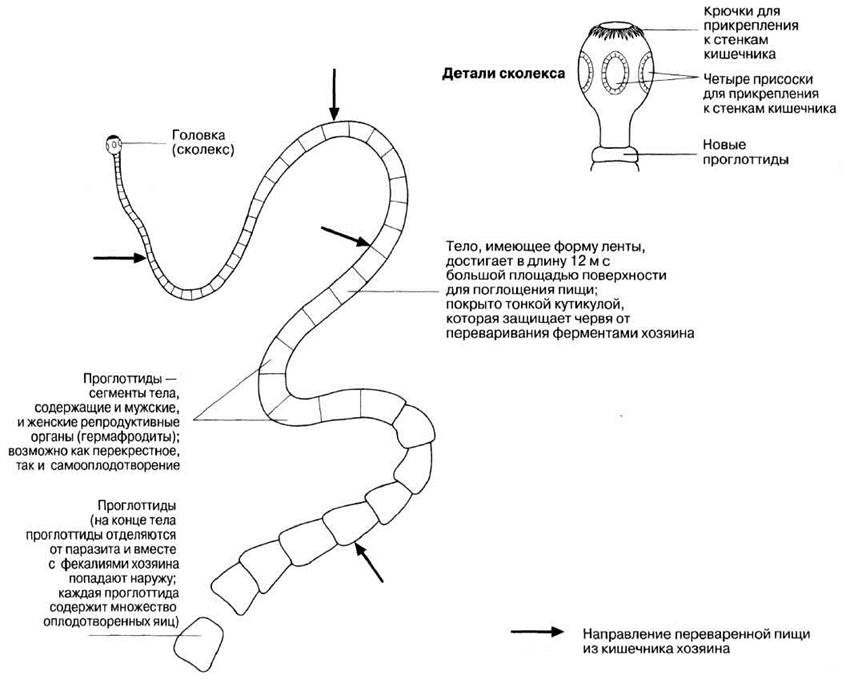
Fig. 8.4. Structure of an adult pork tapeworm (Taenia).
Unlike free-living flatworms, tapeworms lack their own gut or any other digestive structures, as they absorb pre-digested food directly through their cuticle. (The high surface area-to-volume ratio in flatworms eliminates The Need for a specialized internal transport system, such as a Circulatory system, since nutrients can be rapidly distributed to all PARTS OF THE body.) Tapeworms do not require specialized Sense Organs, such as eyes, because they live in darkness within a constant environment and do not need to move about in search of food, hence they lack locomotor organs. (Free-living flatworms possess simple eyes and are capable of movement, gliding by means of cilia beating.) These differences account for the relatively poor development of The Nervous system in tapeworms compared to that of free-living flatworms. In addition, tapeworms can tolerate low oxygen concentrations in the intestine and respire anaerobically.
Table 8.1 summarizes some of the structural, physiological, and reproductive features found in various parasites. Microorganisms that cause various diseases can also be regarded as parasites (sec. 8.1.3).
Table 8.1. Some structural, physiological and reproductive features of parasites
Type of modification |
Examples |
|
Structural features |
Complete absence or partial degeneration of the alimentary canal and locomotor organs — features characteristic of intestinal parasites Highly specialized mouthparts, as in fluid-feeding animals Development of haustoria in certain parasites of green plants Adaptations for penetrating the host's body wall Attachment organs, such as hooks and suckers Integument resistant to host Enzymes Reduction of sense organs associated with the constancy of the parasite's external environment |
Fasciola (liver fluke), Taenia (pork tapeworm) Pulex (flea), Aphis (aphid) Cuscuta (dodder) (a flowering plant belonging to the bindweed family, lacking chlorophyll and parasitizing various green plants) Parasitic nematodes Taenia, Hirudo (leeches), Fasciola Taenia, Fasciola Taenia |
Parasite secretes extracellular enzymes to digest host Tissues Synthesis of anticoagulants by Blood-feeding parasites Sensitivity to chemical cues, enabling the parasite to locate optimal conditions within the host's body Synthesis of digestive enzymes facilitating parasite penetration into the host's body |
Fungi, Plasmodium (a protozoan infecting mammals and birds, and causing malaria in humans) Pulex, Hirudo Plasmodium |
|
Physiological |
||
features |
||
Cuscuta |
||
Ability to respire under anaerobic conditions |
Intestinal parasites |
|
Reproductive features |
Hermaphroditism, allowing self-Fertilization when necessary Production of vast numbers of eggs, cysts, and spores Resistance of eggs, cysts, and spores in the external environment |
Taenia, Fasciola Taenia, Fasciola Phytophthora (CAUSATIVE AGENT OF potato late blight) |
Presence of specialized stages in the life cycle |
Fasciola |
|
Presence of intermediate hosts acting as vectors |
Taenia, Fasciola, Plasmodium |
8.2. List the structural, physiological, and reproductive features that contribute to the parasitic success of the liver fluke (Fasciola).
Commensalism
(com — together; mensa — table)
Commensalism is a close association between two living organisms of different species that is beneficial to one of them (the commensal) and neutral to the other (the host). In other words, the term commensalism means "eating at the same table" and is used to describe symbiotic relationships that do not fit the categories of mutualism or parasitism. An example is the colonial polyp Hydractinia, which attaches to gastropod shells inhabited by hermit crabs. The polyp feeds on the leftovers of the hermit crab's meals. In this case, the crab is completely unaffected by such coexistence. Other examples include orchids and Lichens (commensals) growing on trees (the host).
1 Literature: SEB symposia XXIX, Symbiosis, CUP (1975) D. H. Jennings, D. L. Lee (eds.); G. H. Harper (1985) "Teaching symbiosis" J. Biol. Ed. 19 (3), 219—23; D. C. Smith, A. E. Douglas (1987) The Biology of Symbiosis, Arnold.
Last update: 06/08/2026
Editorial and Educational Adaptation: This material has been compiled based on the primary/original source text. The project team performed an editorial review, corrected technical inaccuracies, structured sections, and adapted the content for an educational format.
What was processed:
- elimination of formatting defects (OCR errors, structural breaks, corrupted characters);
- editorial organization of content;
- standardization of terminology in accordance with academic sources;
- verification of factual statements against the original source text.
All mentions of the author, publication year, and origin of the primary text have been preserved in accordance with the source.