PLANT BIOTECHNOLOGY AND BIOSAFETY - A. P. Ermishin - 2015
CHAPTER 2. METHODOLOGICAL FOUNDATIONS OF IN VITRO PLANT ORGAN, TISSUE, CELL, AND PROTOPLAST CULTURE
To establish an in vitro Cell culture, a small fragment of plant tissue (an explant) is placed in a culture vessel (such as a test tube or Erlenmeyer flask) containing an artificial nutrient medium, where the explant Cells begin to divide and form callus tissue. Callus culture is the most common and widely used type of in vitro PLANT CELL CULTURE. It is initiated from explants cultivated On the surface of semi-solid (most frequently Agar-solidified) nutrient media. When cells are cultured in a liquid nutrient medium under submerged conditions, plant cell Suspensions (suspension cultures) are obtained. The Use of enzyme solutions capable of digesting cell walls makes it possible to isolate protoplasts—plant cells lacking a cellulosic Cell wall. Protoplasts can be cultured in liquid media or plated as a suspension onto The surface of an agar-solidified medium. Over time, protoplasts regenerate their cell wall and resume division, ultimately forming callus tissue. Under specific conditions, callus cultures and cell suspensions are capable of morphogenesis and/or somatic Embryogenesis, enabling the regeneration of whole plants. Plant-regenerant plants can also be obtained directly from explants. They can be maintained over long periods and propagated via in vitro culture (test-tube plant culture).
The Procedures for establishing and maintaining all or specific types of plant organ, tissue, cell, and protoplast cultures (hereinafter referred to as plant cell cultures) require specialized facilities, equipment, and tools, as well as the use of complex nutrient media. Rooms, instruments, glassware, and nutrient media are subjected to sterilization using various Methods. Many procedures must be carried out under strict aseptic conditions.
2.1. Facilities, Equipment, and Tools for Plant Cell Culture Work
Working with plant cell cultures requires dedicated laboratory rooms for: washing and sterilizing glassware and instruments; preparing and sterilizing nutrient media; performing cytological studies; isolating, subculturing, and otherwise manipulating cell cultures; cultivating plant cells; and a growth chamber or greenhouse with artificial lighting.
The glassware washing room is typically equipped with a Water distiller (or bi-distiller). Distilled water is essential for preparing nutrient media, rinsing washed glassware, and washing explants after sterilizing agent treatments. Washed glassware is dried in a hot-air oven at 80–100 °C. High temperatures also ensure its sterilization.
Plant cell culture work utilizes various types and volumes of chemical glassware for preparing nutrient media, storing stock solutions, and obtaining and manipulating cultures (such as isolating and sterilizing explants, subculturing, micropropagating test-tube plants, etc.). Cultivation glassware includes flasks, beakers, Petri dishes, test tubes, graduates, and volumetric cylinders and pipettes. Recently, A wide variety of single-use plasticware for plant cell culture has gained widespread adoption. However, in many cases, glassware remains more convenient and cost-effective.
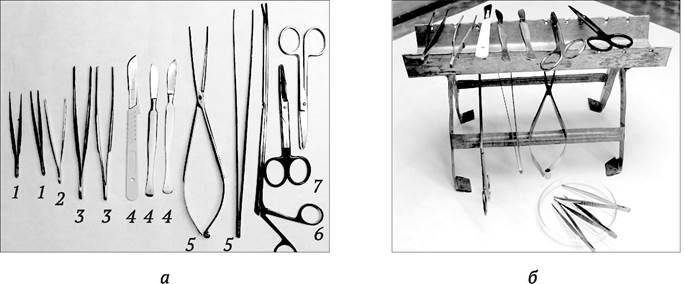
Autoclaves, which are required for sterilizing nutrient media and glassware, are frequently located in the washing room, along with a dedicated hot-air oven for instrument sterilization. Instruments are sterilized at 160 °C for 4 hours inside metal instrument boxes. The minimum set of tools includes: forceps of various lengths with blunt and sharp tips, scalpels, scissors, and medical clamps (Fig. 2.1, a). During operation, instruments are kept on a special rack or in sterilized Petri dishes; after each Procedure, they are dipped in 96% alcohol, flamed over a spirit lamp, and allowed to cool (Fig. 2.1, b).
Class="center">Fig. 2.1. Tool kit for plant cell culture work: a - set of instruments: 1 - fine ophthalmic forceps (5-7 cm) with sharp tips; 2 - short forceps (5-7 cm) with blunt tips; 3 - forceps (10-14 cm); 4 - surgical scalpels; 5 - long forceps; 6 - urethral forceps; 7 - scissors; b - instruments on a rack and Glass Petri dish during operation inside a laminar flow hood
The media preparation room should be equipped with various balances, a laboratory pH meter, an electric hotplate, a water bath for preparing agar-solidified media (a microwave oven can be used for small volumes), a refrigerator, a freezer, a magnetic stirrer, and a fume hood. Microscopes (standard and/or inverted), binocular loupes, cell counters, and other equipment and instruments required for cytological studies and protoplast manipulations may also be housed in this room or in a separate adjacent space.
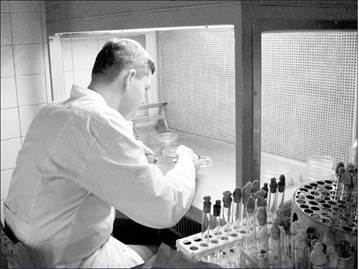
All procedures directly involving plant cell cultures (explant isolation and sterilization, subculturing, micropropagation of in vitro plants, etc.) are performed in laminar flow hoods located in a dedicated room or within the media preparation and cytological laboratory (Fig. 2.2). A laminar flow hood (clean bench) consists of a stainless-steel workbench enclosed at the top, back, left, and right. Sterile air is delivered under pressure into the working zone (above the workbench) to maintain the aseptic conditions necessary for plant cell culture work. Air is drawn into the hood from the room via a specialized pump and passed through coarse and fine particulate air filters that trap not only dust particles but also microorganisms. Laminar flow hoods are categorized as horizontal or vertical (depending on the direction of sterile airflow across the work surface), both of which are equally effective. Prior to work, the interior workbench surface is sterilized using a built-in germicidal UV lamp positioned above the deck (for 30–60 minutes), after which the surface is wiped down with a 70% ethanol solution.
Fig. 2.2. Plant cell culture work inside a laminar flow hood
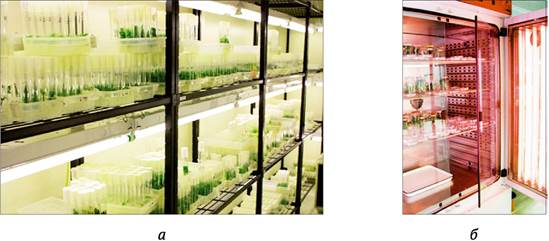
A climate-controlled, isolated room is typically used as the culture room. It houses incubators (for cultivating plant cells in the dark). However, illumination is required for cultivating many types of plant cells. In the simplest setup, this is achieved by placing shelving units equipped with fluorescent lamps in the culture room (Fig. 2.3, a). Lamps may be positioned above the shelves or centrally between two shelves (in which case cultures receive primarily lateral illumination). The lamps are turned on and off automatically on a scheduled timer. Various growth chambers with regulated lighting, Temperature, and humidity regimes can also be used for plant cell cultivation (Fig. 2.3, b).
Fig. 2.3. Setup for light cultivation of plant cells: a - shelving unit with top illumination of in vitro cultures using fluorescent lamps; b - growing in vitro cultures inside a growth chamber with lateral illumination from specialized spectral fluorescent lamps
Plant cell culture work requires a box greenhouse or soil greenhouse with artificial lighting. First, it can be used to grow stock plants from which explants are harvested. Explants taken from such plants are generally less contaminated than those from field-grown specimens. Furthermore, the success of plant cell cultivation and Plant Regeneration in certain cases largely depends on the growing conditions (temperature, photoperiod, and lighting method) of the explant donor plants (e.g., when producing haploids via anther culture). Second, a greenhouse is essential for transplanting the resulting plant-regenerants into soil, as transferring them ex vitro directly from test tubes requires a specialized acclimatization period.
2.2. Nutrient Media
As plant cell culture techniques evolved, nutrient media underwent continuous refinement. Today, a wide variety of nutrient media exist to suit different cultivation objectives, plant species, and explant types. Drawing on published literature, an appropriate protocol can be selected for virtually any type of work. In some instances, optimization of the nutrient medium is required. Special approaches have been developed for this purpose, including those based on mathematical design of experiments. By varying the concentrations of individual medium components (primarily growth regulators) according to a specific experimental matrix, the optimal formulation is determined.
There are several basal nutrient media that serve as a starting point and are subsequently optimized if necessary. The Murashige and Skoog (MS) medium (1962) is the most frequently employed. It is well-balanced in its constituent components and yields excellent results in cultivating cells from numerous plant species (see table). Gamborg's B-5 medium (1968) is better suited for cereal crops, whereas Nitsch's medium (1969) is designed for anther cultures of dicotyledonous plants. Nevertheless, various plant cell culture media share many common features. They must contain all essential mineral and organic elements at concentrations as close as possible to those absorbed by intact plants for normal GROWTH AND DEVELOPMENT under in vivo conditions.
Composition of selected nutrient media for in vitro plant cell culture
Components |
Nutrient media (component concentration, mg/L) |
|||
MS* |
ER* |
B-5* |
Nitcsh* |
|
NH4 NO3 |
1650 |
1200 |
- |
720 |
KNO3 |
1900 |
1900 |
2500 |
950 |
CaCl2 • 2H2O |
440 |
440 |
150 |
- |
CaCl2 |
- |
- |
- |
166 |
MgSO4 • 7H2O |
370 |
370 |
250 |
185 |
kH2PO4 |
170 |
340 |
- |
68 |
(NH4)2SO4 |
- |
- |
134 |
- |
NaH2PO4 • H2O |
- |
- |
150 |
- |
Micronutrients |
||||
KI |
0,83 |
- |
0,75 |
- |
H3BO3 |
6,20 |
0,63 |
3,00 |
10 |
MnSO4 • 4H2O |
22,30 |
2,23 |
- |
25 |
MnSO4 • H2O |
- |
- |
10,00 |
- |
ZnSO4 • 4H2O |
6,80 |
- |
- |
- |
ZnSO4 • 7H2O |
- |
- |
2,00 |
10 |
ZnNa2 EDTA |
- |
15,0 |
- |
- |
Na2MoO4 • 2H2O |
0,25 |
0,025 |
0,25 |
0,25 |
CuSO4•5H2O |
0,025 |
0,0025 |
0,025 |
0,025 |
CoCl2 • 6H2O |
0,025 |
0,0025 |
0,025 |
- |
Na2 EDTA • 2H2O |
37,30 |
37,30 |
37,30 |
37,30 |
FeSO4 • 7H2O |
27,80 |
27,80 |
27,80 |
27,80 |
Vitamin and hormonal supplements** |
||||
Myo-Inositol |
100 |
- |
100 |
100 |
Nicotinic acid |
0,5 |
0,5 |
1,0 |
5,0 |
Pyridoxine HCl |
0,5 |
0,5 |
1,0 |
0,5 |
Thiamine HCl |
0,1 |
0,5 |
10,0 |
0,5 |
Folic acid |
0,5 |
|||
Biotin |
0,05 |
|||
2,0 |
2,0 |
- |
2,0 |
|
β-Indoleacetic acid (IAA) |
1,0-30,0 |
- |
- |
0,1 |
α-Naphthylacetic acid (NAA) |
- |
1,0 |
- |
- |
2,4-Dichlorophenoxyacetic acid (2,4-D) |
- |
- |
0,1-1,0 |
- |
Kinetin |
0,04-10,0 |
0,02 |
0,1 |
- |
Sucrose |
30 000 |
40 000 |
20 000 |
20 000 |
Medium pH |
5,7 |
5,8 |
5,5 |
5,5 |
Agar-Agar |
7000*** |
7000*** |
7000*** |
8000*** |
* MS: T. Murashige, F. Skoog. A revised medium for rapid growth and bioassays with tobacco tissue cultures // Physiol. Plant. 1962. Vol. 15. P. 473-497.
ER: T. Eriksson. Studies on the growth requirements and growth measurements of cell culture of Haplopappus gracilis. Physiol. Plant. 1965. Vol. 18. P. 976-983.
B-5: O. L. Gamborg, R. A. Miller, K. Ojima. Nutrient requirements of suspension cultures of soybean ROOT cells // Exp. Cell Res. 1968. Vol. 50. P. 151-158.
Nitsch: J. P. Nitsch, C. Nitsch. Haploid plants from pollen grains // Science. 1969. Vol. 163. P.85-87.
** The composition and quantities of vitamin and hormone supplements may vary depending on the experimental objectives, explant type, plant species, etc. (the given composition is presented in accordance with the authors' original formulations).
*** To obtain a medium of standard consistency, 6000 mg/L of agar-agar is sufficient.
Mineral elements. To ensure normal cellular METABOLISM in in vitro culture, nutrient media must contain a range of inorganic macro- and microelements. According to the recommendations of the International Association for Plant Physiology, plant Mineral Nutrition elements required at concentrations exceeding 0.5 mM are classified as macronutrients, whereas those needed in lower concentrations are termed micronutrients. The principal macronutrients in nutrient media for plant cell culture include nitrogen, potassium, phosphorus, calcium, magnesium, and sulfur. They are supplied in nutrient media as corresponding salts that are readily assimilated by plant cells. It is important to note that nitrogen is present in nutrient media in both nitrate and ammonium forms, and their ratio is often of great significance. Amino Acids (such as Alanine, glutamic acid, glycine, Arginine, aspartic acid, Proline, etc.) are occasionally added to the media as an additional nitrogen source. Sometimes, The amino acid mixture is replaced with casein hydrolysate.
The principal micronutrients of nutrient media are iron (ferrous), manganese, boron, copper, zinc, iodine, molybdenum, and cobalt. Iron and copper are among the most critical micronutrients because they participate in regulatory processes and redox reactions, and form part of Coenzymes. Iron is supplied in the form of chelates [FeSO4 + EDTA (ethylenediaminetetraacetic acid or its disodium salt Na2EDTA, Trilon B)].
CARBOHYDRATES are an essential component of nutrient media for plant cell culture, as cells are incapable of autotrophic nutrition in most cases. When explants are isolated from chlorophyll-bearing Tissues and placed on a nutrient medium, they typically lose their chlorophyll. When cultured in the light, some cultures remain devoid of chlorophyll, whereas others turn green but are unable to fully sustain themselves with carbohydrates via Photosynthesis. In addition, carbohydrates in the nutrient medium perform osmotic Functions, particularly in protoplast cultures.
Most commonly, the carbohydrate component in plant cell culture media is sucrose at a concentration of 2-3%. Higher concentrations of 6-10% are used for anther culture. In addition to sucrose, glucose, fructose, galactose, maltose, and others are employed as carbon sources. Mannitol (13%) is the primary osmotic agent for protoplast culture; sorbitol, glucose, sucrose, and combinations of various sugars are also used for this purpose.
Vitamins are substances that play a vital role in plant cell culture. Most vitamins are constituents of Enzymes that catalyze metabolically important reactions. Nutrient media most frequently include Water-Soluble Vitamins: thiamine, pyridoxine, nicotinic acid, as well as riboflavin, biotin, pantothenic acid, and ascorbic acid. Myo-inositol (meso-inositol), which is involved in auxin metabolism in plants, is present in many plant cell culture media. In cell culture, meso-inositol plays an important role in The Biosynthesis of pectin and hemicellulose, and participates in ion utilization.
The Effect of vitamins on cell culture growth depends on the cells' ability to synthesize them in optimal or suboptimal amounts and on the composition of other medium components, with which vitamins may interact synergistically (e.g., with Cytokinins) or antagonistically. When a complete vitamin mixture is applied, the stimulating effect may be determined by synergy among individual vitamins.
Phytohormones and Plant Growth and Development regulators. Phytohormones are plant-synthesized Organic compounds that influence growth and development. Alongside natural phytohormones extracted from plants, There is a considerable number of artificial compounds with analogous effects, termed plant growth and development regulators (hereinafter referred to as growth regulators). Nutrient media are predominantly supplemented with growth regulators because they are less expensive, more stable, and in many cases exhibit higher activity than natural phytohormones.
Various Auxins and cytokinins are most commonly present in nutrient media. Gibberellins, abscisins, Ethylene, and retardants are also used for specific purposes.
Natural auxin occurs in plants primarily as indole-3-acetic acid (heteroauxin) (IAA). Phenylacetic acid (PAA) is a second representative of this class of phytohormones, although its activity is considerably lower than that of IAA. Auxins are Amino Acid Derivatives: IAA is derived from Tryptophan, and PAA from phenylalanine. In plants, auxins play a key role in stem and internode elongation, Tropisms, apical dominance, adventitious and lateral root formation, bulb development, and the initiation of vegetative buds, among other processes. In cell culture, auxins are obligatory components required to initiate morphogenetic processes, influencing Cell Division, expansion, and differentiation.
Excess auxin in plants is degraded by IAA oxidase. For agricultural Applications and plant cell culture, synthetic auxins are frequently used instead of IAA because they are resistant to IAA oxidase degradation. Synthetic auxin molecules vary in Structure but typically contain an aromatic or heterocyclic ring with an aliphatic acid residue as a side chain. 2,4-Dichlorophenoxyacetic acid (2,4-D) is most frequently used as an auxin in nutrient media. Indole-3-butyric acid (IBA), α-naphthaleneacetic acid (NAA), phenylacetic acid (PAA),
2,4,5-trichlorophenoxyacetic acid (2,4,5-T), p-chlorophenoxyacetic acid (CPA), picloram (4-amino-3,5,6-trichloropicolinic acid), and similar compounds are also employed. Regarding their effect on tobacco stem cultures, The activity of 2,4-D is 8–12 times higher, and that of 2,4,5-T, CPA, and picloram is 2–4 times higher than that of IAA.
Cytokinins in plants perform functions related to the induction of cell division, modification of apical dominance, and stem differentiation. They promote branching, bud formation, accelerate seed germination, and break the dormancy of resting buds, seeds, and tubers. They are a critical factor in inducing mitotic activity in plant cell cultures, as well as initiating cellular differentiation and morphogenesis through interactions with other phytohormones.
Cytokinins are N-substituted adenine derivatives synthesized in the plant from two main precursors: mevalonic acid and 5'-AMP. Cytokinin synthesis is also possible from the breakdown products of certain tRNAs containing modified adenosine. High cytokinin activity has additionally been demonstrated in diphenylurea and A number of its derivatives. The first cytokinin used in plant cell culture media was kinetin (N6-furfurylaminopurine), isolated from herring sperm DNA by C. Miller and F. Skoog in 1955. As noted in Chapter 1, the discovery of kinetin was revolutionary because it enabled the control of plant regeneration from callus and suspension cultures. Later, natural phytohormones with cytokinin activity were isolated, namely zeatin (6-(4-hydroxy-3-methyl-trans-2-butenylamino)purine) and 6-isopentenylaminopurine (2iP, i6A). Currently, the synthetic growth regulator 6-benzylaminopurine (6-benzyladenine, 6-BAP) serves as the primary cytokinin used in cell culture media. However, in certain instances, the considerably more expensive zeatin (or zeatin riboside) and 2iP remain indispensable.
From a chemical standpoint, gibberellins are tetracyclic carboxylic acids. In plants, they are formed from mevalonic acid synthesized via acetyl-CoA. Several gibberellins occur simultaneously in plant tissues, and their set and ratio change during ontogenesis. Like auxins, gibberellins exert multiple effects: they stimulate growth during The Cell expansion and division phases (e.g., in the cambium) and promote fruit growth. Expansion growth is stimulated by the combined action of gibberellins and auxins. In other contexts, gibberellins may act as auxin antagonists, for instance, by inhibiting adventitious root growth. They are used to break seed, bulb, and tuber dormancy and to enhance plant growth. Like auxins, they can induce parthenocarpy (thus, they are recommended for treating vineyards to increase cluster size). Approximately 70 gibberellins are known; however, gibberellic acid (GA3), obtained via microbiological synthesis, is most frequently used in practice. In plant cell culture media, gibberellins are used to enhance the growth of apical Meristems or underdeveloped zygotic embryos when recovering plantlets, to stimulate suspension culture growth at low cell densities, and for other purposes.
Abscisic acid (ABA) exhibits diverse physiological effects. ABA is well known as a plant growth inhibitor that promotes the transition of plants into a dormant state. In many cases, ABA acts as an antagonist to auxins, cytokinins, and gibberellins. In plant cell culture media, ABA is occasionally used in combination with other phytohormones to ensure the normal growth and development of somatic embryos.
Ethylene. All plant parts produce ethylene, a process that is markedly intensified under stress conditions. In plant cell culture, ethylene can exert either a stimulating or an inhibitory effect (depending on the system) on morphogenetic processes. To generate ethylene for influencing plants or plant cell cultures, chemical substances that release this gas upon degradation are typically employed, such as 2-chloroethylphosphonic acid (commercial preparations known as Ethephon, Ethrel, or Camposan).
Retardants are growth regulators of various chemical structures that suppress plant growth. They are used in crop production to reduce the height of agricultural plants and increase stem thickness, thereby minimizing lodging. In biotechnology, the use of retardants (chlormequat chloride, daminozide/Alar, etc.) can be beneficial for shortening the internode length of in vitro propagated plants. This extends the interval between subcultures onto fresh nutrient medium and ensures better plant survival upon transplanting into soil.
Organic supplements of undefined composition. Plant cells are more sensitive than microorganisms to the presence of foreign ingredients and therefore require chemically pure medium components. Nevertheless, some nutrient media contain natural biological biological supplements: liquid coconut endosperm (coconut milk), chestnut endosperm extract, casein hydrolysate, malt extract, tomato juice, Yeast extract, potato decoction, etc. The practice of using such supplements was widespread in the 1930s–1960s, when cell culture and plant regeneration technologies had not yet been developed for most plant species. The use of coconut milk was particularly popular, its effect later being attributed to the presence of the phytohormone zeatin. Recently, however, researchers have preferred using defined nutrient medium components of high purity, which ensures reproducibility of results. Nonetheless, higher morphogenetic efficiency in cell culture can sometimes be achieved using natural biological supplements, such as potato decoction to increase the yield of green haploid plantlets in wheat anther culture.
Adsorbents. Certain explants release substances into the nutrient medium that can inhibit callus formation and lead to growth arrest and culture death. Activated charcoal or other adsorbents, such as polyvinylpyrrolidone, are added to nutrient media to adsorb these substances.
Gelling agents. Callus cultures and in vitro plantlets are grown on semi-solid (gel-like) nutrient media, which ensure good access of medium components to cells or plants and eliminate The Need for constant culture agitation for aeration, which is mandatory when using liquid media. To obtain gel-like nutrient media, gelling substances are added that must meet specific requirements: they must not exert adverse effects on the cultured plant cells, and The properties of the nutrient medium containing the gelling agent must not change significantly during autoclaving or cell cultivation. The nutrient medium must be liquid when hot and possess a semi-solid (gel-like) consistency at room (cultivation) temperature.
Agar-agar (agar), derived from red Algae such as Gelidium amansii, is most commonly used as a gelling agent. Agar is a mixture of galactose-derived Polysaccharides: a neutral polymer fraction, agarose, which provides gel strength, and charged anionic polysaccharides, agaropectins, which affect its viscosity. The quality of agar depends on the degree of purification and may vary among manufacturers; therefore, using highly purified agar is recommended. The concentration of agar in the nutrient medium typically ranges from 0.6% to 1.0%. In addition to agar, other agents with more easily controllable compositions are also used, such as agarose (for single-cell and protoplast cultures), Gelrite (a polysaccharide produced via microbial synthesis from Pseudomonas elodea), and Phytagel.
The pH of the nutrient medium is of great importance. The optimal pH largely depends on the plant species—more specifically, on the type of soil in which certain plant species naturally prefer to grow: acidic, neutral, or alkaline. For most plant species, the pH of the nutrient medium for in vitro cell cultures ranges from 5.5 to 5.8. However, these values may be lower for plants naturally growing in acidic soils and higher for those inhabiting alkaline soils.
2.3. Preparation of Nutrient Media
Nutrient media for plant cell cultures are prepared according to formulations using the required chemical components. It is recommended to use chemically pure (CP) or extra pure grade Reagents. Whenever possible, reagents labeled "Plant Cell Culture Tested" should be used. Distilled or double-distilled water is required for the Preparation of Solutions.
Several leading chemical manufacturers, such as SIGMA, MERCK, SERVA, FLUKA, and others, supply ready-to-use nutrient media for plant cell cultures as well as individual components (macro- and microelements, vitamins, etc.). The use of ready-made mixtures significantly simplifies the preparation process and improves the quality of the media.
In medium formulations, the concentrations of mineral and organic components are typically expressed in mass-per-volume units (mg/L), sometimes abbreviated in English-language literature as "ppm" (parts per million). The International Association for Plant Physiology recommends using molar concentrations for this purpose: the molecular mass of a substance expressed in grams (1 mol - 1M), in milligrams (1 mM), or in micromilligrams (1 μM) per liter of solution. It is suggested to express the concentrations of macronutrients and organic additives in mM, and those of micronutrients, vitamins, and growth regulators in μM. Thus, if a medium formulation states that it contains 1 μM 2,4-D, this means the medium contains 221 μg/L of this growth regulator. To convert a medium component concentration expressed in mg/L to one expressed in mM, the following formula is used: amount in mM = amount of substance in mg / molecular mass of the substance.
When preparing nutrient media—especially from individual components rather than ready-made mixtures—it is convenient to use concentrated stock solutions. This not only simplifies the workflow but also improves the dosing accuracy of the medium components. Typically, the following stock solutions are prepared: micronutrients (with potassium iodide solution prepared separately), calcium chloride, vitamins, iron chelate, and growth regulators.
The preparation of certain stock solutions has specific features. For example, to prepare 100 mL of a micronutrient stock solution, 50–60 mL of distilled water is poured into a volumetric flask, into which salts (previously dissolved in a small amount of water in a separate container) are successively added in the amounts (mg) specified in the formulation. It is important to follow the order of addition given in the formulation and to mix the components thoroughly. After adding the final micronutrient, the solution volume is brought up with distilled water.
To prepare 100 mL of iron chelate stock solution, weigh out 557 mg of iron(II) sulfate heptahydrate and 745 mg of Na2EDTA. Dissolve each portion in 25–30 mL of hot distilled water using a water bath. Once the components are completely dissolved, mix the solutions in a volumetric flask and adjust the volume with distilled water. The solution should have a fairly bright yellow color with a slight opalescence. Typically, 5 mL of this stock solution is added per 1 liter of nutrient medium.
When preparing stock solutions of growth regulators, keep in mind that phytohormones belonging to the auxin group (2,4-D, IAA, NAA, IBA, etc.) as well as gibberellin are weak organic acids and must therefore be dissolved in alkalis; 96% ethanol is also suitable for dissolving them. Conversely, cytokinin phytohormones (6-BAF, zeatin, kinetin, etc.) are dissolved in acids, with 1N Hydrochloric acid being suitable for this purpose. It is practical to prepare stock solutions of 6-BAF, zeatin, and gibberellin at a concentration of 1 mg/1 mL. Because concentrated solutions of certain auxins tend to crystallize during refrigerated storage, preparing them at a more dilute concentration—specifically 0.1 mg/1 mL—is recommended (meaning ten times more of the stock solution is added to the nutrient medium accordingly).
All stock solutions should be stored in a refrigerator at 4–5 °C in glassware (bottles or flat-bottomed flasks) with tightly fitted lids. The potassium iodide solution must be kept in a dark glass bottle. All bottles must be labeled with the contents, concentration (e.g., 1 mg/1 mL), and preparation date. Solutions can be stored in the refrigerator without loss of quality for up to 6 months. If stored longer or if microbial contamination appears, preparing a fresh solution is advisable. Zeatin and gibberellin solutions are used relatively rarely and should be stored at -20 °C. Therefore, it is practical to aliquot these solutions into newly autoclaved 1.5–2 mL Eppendorf tubes, place them in a dedicated container, and store them in a freezer. Under these conditions, zeatin and gibberellin solutions can retain their activity for more than two years.
Nutrient media are conveniently prepared in a large beaker or a flask of appropriate volume. First, fill the beaker (flask) with distilled (double-distilled) water to half of the required volume. Add the powdered mineral Components of the medium (or ready-to-use macro- and microelement mixtures) according to the formulation, followed by the stock solutions (if using ready-made macro- and microelement mixtures, add any missing elements specified in the formulation). Each powdered component must be completely dissolved before adding the next; a magnetic stirrer can be used for this purpose.
The carbohydrate component is added last. Bring the solution volume up to the final mark with distilled water in a volumetric flask. Afterward, pour the solution into a beaker and adjust the pH of the nutrient medium to the required value using 1N NaOH. Add the alkali solutions dropwise to the medium while the pH meter electrodes are immersed in it. A magnetic stirrer can be used to agitate the solution. If the solution is over-titrated, acidify it similarly using 1N hydrochloric acid.
If a semi-solid medium is required, add the weighed amount of agar (or another gelling agent) and mix thoroughly. Dissolve the agar by heating the solution in a water bath or during autoclave sterilization. A microwave oven can be used to dissolve agar in small volumes of medium.
As evident from the description above, nutrient media have a very complex composition. Using ready-made component mixtures and stock solutions simplifies the preparation process; nevertheless, it requires a high level of concentration from laboratory personnel. Keep in mind that formulations usually specify component concentrations per 1 liter of the final volume of the nutrient medium. In practice, other volumes frequently need to be prepared. Therefore, using a checklist during medium preparation is recommended. This checklist lists the medium components and stock solutions in the order of their addition to the mixture, along with their respective quantities. As each component or stock solution is added during preparation, check it off the list. For each specific case (depending on the medium type and volume required), preparing a custom checklist in advance is advisable.
Dispensing into culture vessels and sterilizing nutrient media may vary depending on the culture type and experimental goals. In most cases, glass culture tubes plugged with cotton wool wrapped in gauze are used for cell cultures. Media are dispensed into tubes or containers after the agar dissolves, plugged, and then autoclaved at 0.8–0.9 atm for 20–30 min.
Recently, plastic tubes with snap-caps or disposable containers have become widely used for plant cell cultures. Consequently, the nutrient medium is dispensed into them under aseptic conditions (in a laminar flow hood) after autoclaving. Petri dishes (glass or disposable plastic) are also frequently used for cell cultures, with the nutrient medium poured into them post-autoclaving. Finally, some nutrient media contain thermolabile components (such as zeatin, gibberellin, and ascorbic acid) that degrade or lose activity during autoclaving. These components are measured in the required quantities (calculated for the total volume of the medium being prepared), dissolved in a small amount of distilled water or medium taken from the prepared batch prior to adding the gelling agent, and sterilized under aseptic conditions by passage through bactericidal filters (microporous nylon membranes). They are then added to the autoclaved nutrient medium once it has cooled to 50–60 °C. Stock solutions of growth regulators used at low concentrations in the medium can be filter-sterilized beforehand as concentrated solutions and added to the autoclaved medium according to the formulation using automatic pipettes fitted with sterile tips.
2.4. Ensuring Asepsis in Plant Cell Culture Work
As noted above, plant cell cultures can only be established and successfully maintained under strict aseptic conditions. This is achieved through various sterilization methods for facilities, glassware, instruments, and nutrient media. The surfaces of explants intended for cell culture initiation require particularly meticulous sterilization. All procedures involving the opening of culture vessels—such as dispensing sterile medium into tubes, Petri dishes, and flasks, isolating and transferring explants onto the medium, and subculturing plant material onto fresh medium—must be performed under sterile conditions within the working area of a laminar flow hood in compliance with aseptic protocols.
All glassware (except disposable plasticware) must be sterilized before use by autoclaving, followed by drying in a drying oven or via vacuum drying if the autoclave is equipped with it. Prior to autoclaving, wrap the glassware in kraft paper or place it in sterilization drums (bixes) to prevent recontamination during transport. Autoclaving parameters: pressure of 1.5 atm, sterilization time of 40–60 min. Drying in an oven is conducted at approximately 100 °C for 30–40 min.
Instruments cannot be autoclaved as this damages them. Instead, they are placed in a tightly sealed metal case for transport between rooms and sterilized by dry heat in an oven at 160 °C for 2–4 hours. When working in a laminar flow hood, to prevent instruments from contacting working surfaces, place them on a special heat-resistant and fireproof (metal) rack (Fig. 2.1, b). During work, sterilize instruments after each use by dipping them in 96% ethanol and flaming them with a spirit burner (or gas burner, if the hood is equipped with one). Because hot instruments can damage plant tissues, have at least a double set of instruments for a single operation (one set in use while the other cools). Some laboratories use specialized heaters, such as infrared sterilizers, for instrument sterilization during work.
Before work, sterilize the laminar flow hood using its built-in germicidal lamps for 40–60 min. Ten to fifteen minutes before the UV Treatment cycle ends, turn on the active sterile air purge. To do this, set the hood purge to 80–100% blower capacity. After sterilization is complete, turn off the germicidal lamps and reduce the airflow to 40–60% capacity. Directly before starting work, wipe the internal surfaces of the hood with 96% ethanol. The operator working in the hood must sanitize their hands with ethanol at the beginning of the procedure and periodically throughout the work.
Surface sterilization of plant tissues prior to explant isolation and placement on the nutrient medium is one of the most critical steps in establishing a plant cell culture, as achieving complete sterility is often very difficult. The success of sterilization depends on a variety of factors. As a rule, explants from greenhouse-grown plants are much cleaner than those from field-grown plants. Plant material from subterranean Organs (tubers, bulbs, etc.) is heavily contaminated and must be thoroughly washed in soapy water and rinsed with distilled water before sterilization. Tissues with dense pubescence (hairs) are difficult to sterilize because trapped air bubbles hinder contact between the sterilizing agents and the plant surface; special techniques described below are applied in such cases. Finally, the choice of sterilizing agents can be decisive. For surface sterilization, solutions of calcium or sodium hypochlorite (5–10%), hydrogen peroxide (10–12%), bromine water (1–2%), silver nitrate (1%), mercuric chloride (sublimate, 0.1%), and other agents found in cell culture reagent catalogs are used. In particularly difficult cases, Antibiotics are added to the nutrient medium.
High sterilization efficiency for explants was achieved in our work using 70% ethanol and diacid. Diacid is a 0.1% aqueous solution of ethylmercuric chloride (C2H5ClHg) and cetylpyridinium chloride (C21H38Cl • H2O). It can be reused; when stored properly, it retains its efficacy for one year or more. The plant material to be sterilized is immersed first in alcohol (30–40 s) and then in the diacid solution (7–10 min), after which it is thoroughly rinsed through 4 to 5 changes of autoclaved distilled water.
To improve the wetting of pubescent explant surfaces during sterilization, so-called vacuum sterilization is employed. For this procedure, place the plant material into a Büchner flask along with the sterilizing solution. Seal the flask tightly with a well-fitting rubber stopper, connect the side arm to a vacuum pump, and evacuate the air from the flask (Fig. 2.4).
Fig. 2.4. Sterilization of plant material using a Kamovsky vacuum pump: a - treatment of a SHOOT cutting (a generative potato shoot with buds intended for anther dissection) with BF-6 glue to prevent the sterilizing agent from penetrating the cut under vacuum; b - packaging of shoots in a gauze pouch that allows the sterilizing agent to freely reach the material while enabling rapid retrieval from the flask after sterilization; c - the pouch containing the packaged plant material; d - the pouch with plant material placed in a Bunsen flask connected to a vacuum pump via a side arm (the researcher pours the sterilizing agent into the flask with one hand while holding the stopper with the other)
(photo by T. V. Nikonovich)
Explants are isolated and transferred into culture vessels on nutrient medium immediately after sterilizing the plant material. This procedure is performed inside a laminar flow cabinet, strictly adhering to aseptic techniques. In the simplest case, the sterilized plant material is placed in pre-autoclaved open Petri dishes, and fragments of the required size are excised using sterile instruments (a scalpel or scissors). Test tubes are opened over a spirit lamp flame, and the explant is transferred onto the surface of the nutrient medium using sterile long forceps or urethral tweezers. For each successive operation, fresh autoclaved Petri dishes and tools that have been sterilized (by immersion in 96 % ethanol followed by flaming over a spirit lamp) and cooled are used.
In some cases, explants are extremely small and must be freed from surrounding covering tissues (for example, anthers extracted from sterilized flower buds or spikelets). For such instances, it is convenient to use a pre-autoclaved support made of double sheets of cellophane interleaved with kraft paper. Plant material, such as flower buds, is placed near the edge between the two cellophane sheets and, holding them down from above with a finger (through the cellophane), anthers are extracted with sterile instruments without fear of contamination. A single pair of 15x15 cm cellophane sheets is sufficient to extract anthers from 8-12 buds (2-3 from each side of the cellophane sheet).
2.5. Cultivation Conditions. Transfer of Cultures to Fresh Nutrient Medium
Depending on the type of explant and the objectives of the experiment, various culture vessels (glass or plastic tubes, Petri dishes of various sizes, flasks, and containers) and cultivation conditions are used for cell cultures. Cultivation is carried out in air-conditioned culture rooms. Many cultures are grown in the dark in incubators. The optimum temperature is 24-26 °С; however, depending on the plant species, it may be slightly higher or lower.
If illumination of cultures is required (to maintain in vitro cultures of test-tube plants, for clonal micropropagation, etc.), the simplest setup involves placing shelves with fluorescent lighting in the culture room. The lamps turn on and off automatically at set times. Typically, the photoperiod is 14-18 hours, and the dark period is 6-10 hours. The temperature during the light period can be 22-26 °С, and slightly lower during the dark period, at 18-20 °С. Light intensity for cultures varies within a fairly wide range (from 1 to 10 thousand lux). Fluorescent lamps are most commonly used for illumination, though Other types of lamps, including those with specific spectral characteristics, may also be employed.
The temperature and light regimes of cultivation, as well as the spectral CHARACTERISTICS OF THE light, can significantly influence the induction of morphogenesis processes in plant cell cultures. Therefore, climatic chambers are best utilized to establish precise and varied cultivation regimes.
For cultivating cell suspensions, shakers, rotary units, or more complex devices for mixing and aerating cultures (bioreactors) are installed in the culture room.
During cultivation, callus cells age (callus Cell Differentiation), lose their ability to divide, and gradually die off. Nutrient depletion also occurs, and cellular metabolites may be released into the medium, adversely affecting culture growth. The culture itself can increase significantly in volume, rendering the culture vessel insufficiently large. Consequently, at regular intervals, a small callus fragment or a volume of suspension (the inoculum) is transferred under sterile conditions into prepared vessels with fresh nutrient medium (passaging, subculturing). With regular passaging, the division capacity of callus or suspension cells can be maintained for decades. When subculturing test-tube plants, microcuttings are made onto fresh nutrient medium by transferring a small plant fragment—such as a stem piece with 1-2 axillary buds—from which a new test-tube plant regenerates.
Transferring cultures from one medium to another is also used to induce morphogenesis, primarily to obtain regenerated plants. This is because nutrient media for cell culture proliferation and morphogenesis generally differ significantly. Passaging is frequently accompanied by changes in cultivation conditions (light and temperature regimes).
The work of establishing and maintaining plant cell cultures requires specialized facilities, equipment, and instruments, as well as the use of complex nutrient media.
A wide variety of nutrient media exist for different cultivation tasks, plant species, and explant types. The Murashige and Skoog medium is the most frequently used. It is well-balanced in its constituent components and yields excellent results in cultivating cells from numerous plant species. Nutrient media for plant cell cultures must include all essential mineral and organic elements at concentrations closely approximating those received by intact plants for normal growth and development in vivo: macro- and microelements, vitamins, and carbohydrates. The addition of plant growth regulators to the nutrient medium stimulates cell culture proliferation or induces morphogenesis.
Plant cell cultures can only be established and successfully maintained if aseptic conditions are strictly observed. This is achieved through various sterilization methods for rooms, Laboratory glassware, instruments, and nutrient media. The surface of explants intended for cell culture initiation is sterilized with particular care. All procedures involving the opening of culture vessels (dispensing sterile nutrient medium into tubes, Petri dishes, or flasks; isolating explants and transferring them to nutrient medium; transferring a portion of the culture to fresh medium, etc.) must be performed under sterile conditions within the laminar flow hood while strictly following aseptic rules.
Depending on the type of explant and the goals of the experiment, various culture vessels and cultivation conditions are used for cell cultures. Cultivation is carried out in air-conditioned culture rooms, either in the dark (in incubators) or under illumination (on specialized lighted shelves or in climatic chambers). The temperature and light regimes, along with the spectral characteristics of the light, can profoundly affect cell proliferation and the induction of morphogenesis in plant cell cultures.
At regular intervals, cultures are transferred to fresh nutrient medium (passaging, subculturing) in order
to prevent nutrient depletion, avoid the Adverse effects of metabolites released into the medium during cultivation, and overcome the volume limitations of culture vessels for overgrown cultures.
1. Name the Main Components of synthetic nutrient media for plant cell cultures.
2. For what purposes are stock solutions of nutrient medium components used?
3. How are aseptic conditions ensured when initiating plant cell cultures?
4. Why is it necessary to perform subculturing of cell cultures?
Last update: 11/08/2026
Editorial and Educational Adaptation: This material has been compiled based on the primary/original source text. The project team performed an editorial review, corrected technical inaccuracies, structured sections, and adapted the content for an educational format.
What was processed:
- elimination of formatting defects (OCR errors, structural breaks, corrupted characters);
- editorial organization of content;
- standardization of terminology in accordance with academic sources;
- verification of factual statements against the original source text.
All mentions of the author, publication year, and origin of the primary text have been preserved in accordance with the source.