Plant Physiology - Musienko M. M. 2001
Plant Root Nutrition
Mineral nutrition elements as a potential source of environmental pollution
It is well known that obtaining high and stable crop yields involves the application of elevated doses of mineral fertilizers. Fertilizers, including nitrogenous ones, exert a powerful influence not only on plant productivity, but also on their Chemical Composition and the surrounding environment. Consequently, as the rates of nitrogen and phosphorus increase, the uptake of other elements also rises, leading to one of the most pressing modern problems: environmental pollution by excessive amounts of chemical elements.
With the increase in fertilizer application rates, their percentage uptake by plants naturally decreases, and the growth in The amount of applied fertilizers significantly outpaces the growth in crop yields. Widely used mineral fertilizers are considered one of the most drastic forms of human intervention in the natural nutrient cycle. Human economic activity is associated with the "intentional" dispersal of A number of elements contained in fertilizers throughout the natural environment, which, under intensive farming conditions, causes ecological problems. Let us examine this problem in more detail, highlighting the potential causes of environmental disruption and measures that promote the more efficient use of nutrients.
One of the consequences of applying high rates of mineral fertilizers is soil contamination. This is caused by various impurities found in fertilizers. Among these impurities, significant quantities of heavy metals are detected: uranium, thorium, and their radioactive decay progeny. Simple superphosphate is particularly rich in uranium, thorium, strontium, and other rare-earth elements. Considering that global phosphate production and the volume of phosphorus fertilizers increase every year, the uncontrolled flow of radioactive elements into the soil solution and agricultural produce grows annually.
When scaling up The production of phosphorus fertilizers, attention is usually focused on only one component—phosphorus—even though phosphate ores contain fluorine. The elemental ratio of phosphorus to fluorine in the beneficiated concentrate is 5.8. This demonstrates the scale of fluorine influx originating from phosphate raw Materials. During phosphate Processing, fluorine is converted into a readily soluble form, meaning it is chemically activated. Thus, while nature established a more or less effective barrier protecting living organisms from the effects of fluorine, human agricultural activity destroys this barrier. For example, one tonne of elemental phosphorus in double superphosphate is accompanied by 80 kg of fluorine, in simple superphosphate by 122 kg, and in ammophos by 165 kg. When studying the effects of fluorides on certain Links of the ecological chain, a beneficial physiological role for fluorine in plant life has not been clearly established. However, researchers are unanimous regarding its harmfulness to living organisms. Consequently, There is a pressing need for strict accounting of phosphorus fertilizers as a source of radiation.
Human economic activity significantly impacts The Nitrogen Cycle. Industrial Nitrogen Fixation is considered one of the most potent forms of human Interference in the natural cycle. The systematic use of nitrogen fertilizers leads to elevated levels of nitrogen compounds not only in soils, but also in surface and groundwaters. It is well known that the nitrate form of nitrogen is quite mobile and easily leached from the soil. Approximately 20% of nitrates enter natural waters from fertilizers. The contamination of river and lake waters by mineral fertilizers must be considered undeniable when fertilizers are washed off the soil surface by Water or carried away along with soil particles due to erosion processes.
The Use of mineral fertilizers reduces the Biological value of plant products due to shifts in The ratio of ash elements and Changes in the composition of organic components. Applying large doses of nitrogen fertilizers increases the nitrate content in plants, which subsequently convert into harmful nitrites within food products. The negative role of unbalanced nitrogen Nutrition with respect to Plant resistance to various diseases is particularly pronounced.
The previously mentioned negative aspects of fertilizer application do not diminish their immense positive significance for countries worldwide. The issue should not be about abandoning the use of mineral fertilizers, but rather about improving their production and application technology to completely eliminate any undesirable consequences. Modern advances in science and technology allow for the Organization of fertilizer use in such a way that they do not harm the environment, but instead play a role in its restoration. The most realistic directions for protecting the environment from fertilizer pollution include the following:
· mineral fertilizers should be applied to the soil in agronomically substantiated doses, balanced for individual nutrients;
· reducing application rates of water-soluble fertilizers in high-precipitation zones;
· using granulated and slow-release fertilizers to reduce nitrogen losses from fertilizers;
· utilizing nitrification inhibitors;
· liming acidic soils following long-term mineral fertilizer use (liming acts as a preventive measure against the Toxic effects of heavy metals);
· increasing fertilizer concentration and gradually raising the proportion of chlorine-free potassium fertilizers.
The aforementioned measures are currently not only viable but also necessary in modern agriculture for both economic and hygienic reasons.
Hydroponics. Recently, protected cultivation Methods involving growing plants in aqueous nutrient solutions using gravel, expanded clay, perlite, or similar substrates have become widely used. The cultivation of plants in the absence of soil, using nutrient solutions, is called hydroponics.
There are certain requirements for the environment used to grow plants under artificial conditions: it must have a low absorption capacity, continuously supply water with dissolved nutrients to the plants, provide adequate oxygen access for ROOT Respiration, and serve as a solid support to keep plants upright. The nutrient level is generally maintained 3–4 cm below the substrate surface. The nutrient solution forms a water film around the substrate particles, in which mineral elements are dissolved. A sufficient supply of oxygen and nutrients in the root zone ensures their rapid uptake and assimilation by plants. In general, the frequency of fertigation depends on the particle size of the inert substrate, the season, and the plant development phase. To prevent substrate salinization, it is rinsed with clean water before applying a fresh solution. Numerous recipes have been developed for preparing working nutrient solutions for growing various plant species. The composition of one such solution is presented in Table 18.
Table 18. Nutrient mixtures for hydroponics (per 1000 L of water, g)
|
Fertilizers |
GROWTH AND DEVELOPMENT phases of tomatoes |
||||
|
at planting |
during intensive growth |
during mass flowering and fruit Setting |
during fruiting |
at the end of fruiting |
|
|
Winter-spring crop |
|||||
|
Ammonium nitrate |
180 |
224 |
224 |
224 |
224 |
|
Potassium nitrate |
500 |
720 |
720 |
90 |
576 |
|
Superphosphate |
272 |
432 |
592 |
752 |
800 |
|
Potassium chloride |
- |
- |
37 |
84 |
- |
|
Magnesium sulfate |
500 |
500 |
500 |
500 |
500 |
|
Phosphoric acid |
170 |
170 |
170 |
170 |
- |
|
Autumn-winter crop |
|||||
|
Ammonium nitrate |
180 |
240 |
224 |
160 |
- |
|
Potassium nitrate |
576 |
576 |
576 |
720 |
840 |
|
Superphosphate |
150 |
400 |
500 |
640 |
1220 |
|
Potassium chloride |
- |
- |
140 |
280 |
140 |
|
Magnesium sulfate |
260 |
400 |
500 |
620 |
400 |
|
Phosphoric acid |
170 |
170 |
170 |
170 |
- |
Currently, advanced technologies are being developed and widely implemented that not only increase crop productivity but also preserve the ecological balance of the biosphere. For instance, on an industrial scale, an increasing number of vegetable crops are grown in specialized greenhouse complexes equipped with systems for monitoring and regulating most environmental parameters. In the near future, such complexes will operate around many industrial centers in Ukraine, primarily utilizing artificial lighting during off-peak electricity hours.
This is a 21st-century technology that will operate on a closed-loop basis and ensure a sufficient yield of various crop products. It is economically advantageous, requires no soil, and eliminates The Need for excessive water supplies, mineral fertilizers, plant protection products, and the like.
As known, any plant Organism is an open living system whose environmental requirements change depending on its ontogenetic stage. Therefore, continuous information regarding the state of the plant organism and the intensity of physiological processes crucial for maximizing yields is necessary to maintain appropriate growing conditions. Thus, an automated physiological process optimization system effectively combines both an information system and a control system (Fig. 138).
Using the automatic optimization system, plants themselves select the most optimal environmental parameters (lighting, humidity, mineral nutrient supply) and adjust them according to their own needs throughout the entire growing season.
In the near future, such automated systems will be widely employed to manage plant cultivation in closed-ground systems.
The Study of plant nutrition conditions has led to the creation of a fundamentally new cultivation technology—aeroponics. In aeroponics, The Root System of plants develops not in soil or nutrient solution, but in the air on special racks. A nutrient solution is sprayed into the root zone by specialized atomizers. The delivery of nutrients and moisture is regulated automatically according to plant requirements. It is anticipated that the aeroponic cultivation method will find application in spacecraft. Soil substitutes have been developed for space vehicles. In appearance, the artificial soil consists of small polymer-based granules. Inside the granules, essential ions required for normal plant growth are held in a bound state. They are not leached by water and cannot be mechanically removed. The plant organism can assimilate them through exchange with ions formed during root respiration.
Class="center">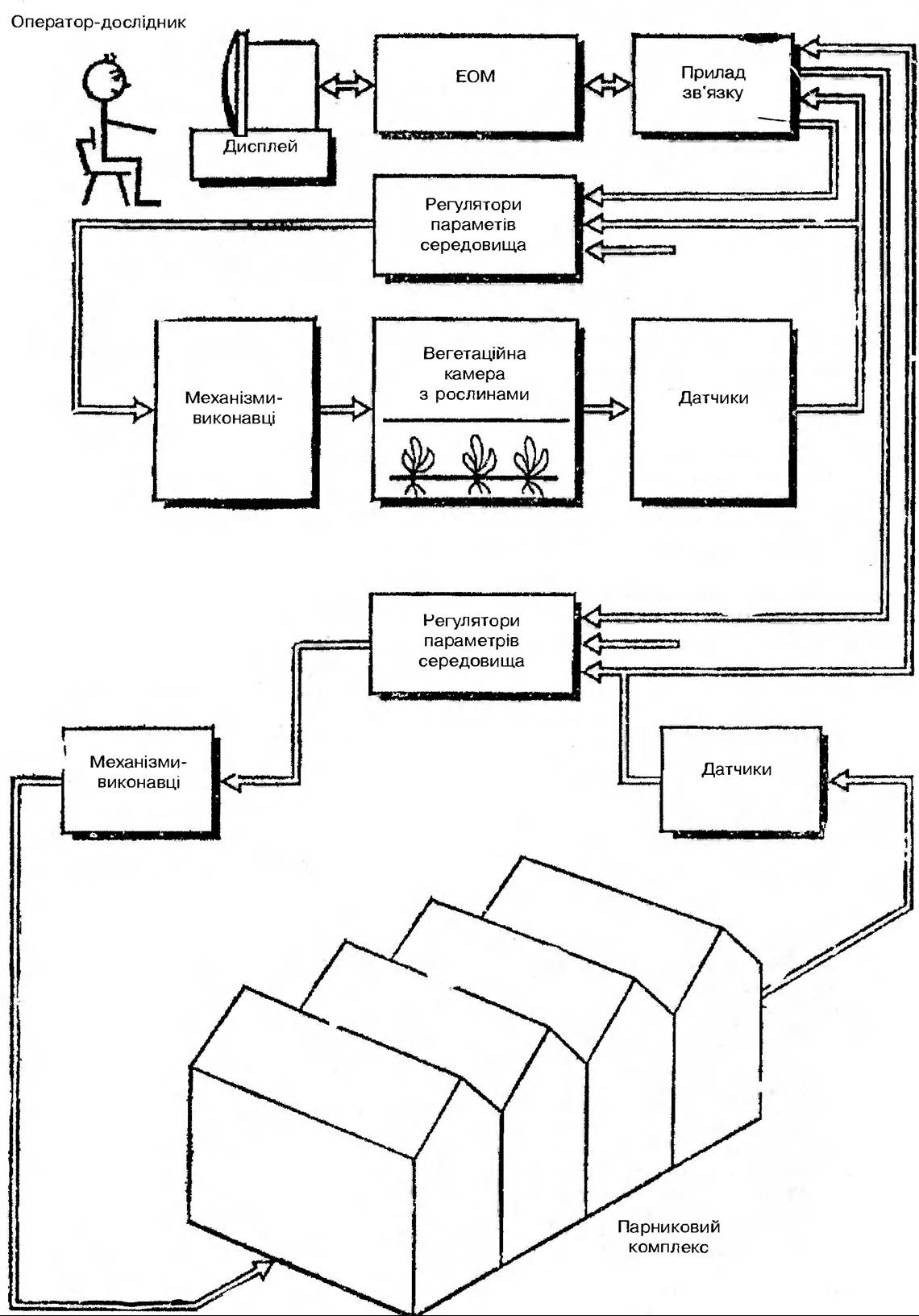
Fig. 138. Structure OF THE automatic environmental optimization system for growing plants in enclosed soil.
As is known, respiration releases carbon dioxide. Dissolving in water, it forms carbonic acid:

This acid dissociates into H+ and HCO3- ions. The latter reach the outer surface of root hairs, which are in contact with artificial soil particles containing plant-beneficial ions: K+, NO3 , Ca2+, Mg2+, SO42-, PO43-, NH4+, and others. Thus, an exchange of hydrogen for K+, Ca2+, Mg2+, NH4+ ions takes place, while HCO3- ions are replaced by NO3-, SO42-, PO43- ions. Currently, attempts are being made to introduce plant-essential ions into other materials as well, for instance, into special fabrics On the surface of which plant cultivation in space is envisaged.
Last update: 07/08/2026
Editorial and Educational Adaptation: This material has been compiled based on the primary/original source text. The project team performed an editorial review, corrected technical inaccuracies, structured sections, and adapted the content for an educational format.
What was processed:
- elimination of formatting defects (OCR errors, structural breaks, corrupted characters);
- editorial organization of content;
- standardization of terminology in accordance with academic sources;
- verification of factual statements against the original source text.
All mentions of the author, publication year, and origin of the primary text have been preserved in accordance with the source.