BIOCHEMISTRY - Textbook - Ostapchenko L. I. - 2012
Chapter 6. AMINO ACID METABOLISM AND FUNCTIONS. PROTEIN BIOSYNTHESIS
6.8. Metabolism of Individual Amino Acids
6.8.2. Metabolism of Methionine and Cysteine
Human Proteins contain two Sulfur-Containing Amino Acids: Methionine and Cysteine. They are metabolically closely interrelated.
Methionine is an essential amino acid. It is required for the synthesis of body proteins, participates in deamination reactions, and serves as a sulfur atom source for cysteine synthesis. Methionyl-tRNA is involved in the initiation of Translation.
The methyl group of methionine is a mobile one-carbon fragment used for the synthesis of various compounds. The transfer of this group to a specific acceptor is called a Transmethylation reaction, which holds significant metabolic importance.
The methyl group in the methionine molecule is tightly bound to the sulfur atom; therefore, the active form of The amino acid serves as the direct donor of this one-carbon fragment.
The active form of methionine is S-adenosylmethionine (SAM), a sulfonium form of the amino acid formed by joining methionine to an adenosine molecule, which is produced during ATP Hydrolysis:
Class="center">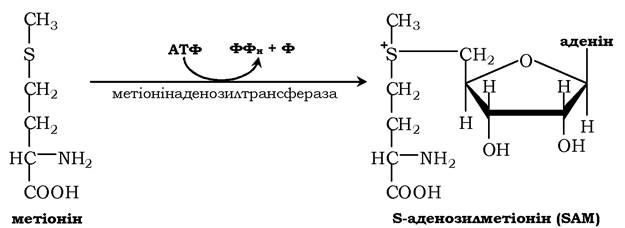
This reaction is catalyzed by methionine adenosyltransferase, an enzyme present in all Cell types. The (-S+ -CH3) Structure in SAM is an unstable group that determines the high reactivity of the methyl group (hence the term "active methionine"). This reaction is unique to biological systems, as it is likely the only known reaction in which all three phosphate residues of ATP are released.
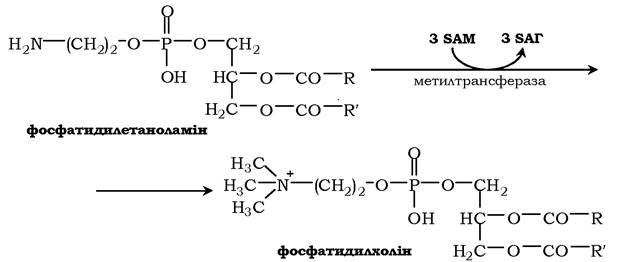
The Cleavage of the methyl group from SAM and its transfer to an acceptor compound are catalyzed by methyltransferase Enzymes. As a result of this reaction, SAM is converted into S-adenosylhomocysteine (SAH).
Synthesis of phosphatidylcholine from phosphatidylethanolamine. Phosphatidylcholines (lecithins) are the most common group of Glycerophospholipids involved in The formation of cell membranes and Lipoproteins, which mediate lipid transport:
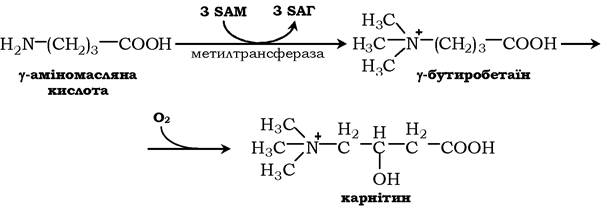
Carnitine is a transporter of Fatty acids across the mitochondrial membrane.
Creatine is necessary for the Formation of the high-energy compound Creatine phosphate in Muscles. The synthesis of creatine occurs in two stages involving Three amino acids: Arginine, Glycine, and methionine. Guanidinoacetate is formed in the Kidneys through the action of glycine amidinotransferase:
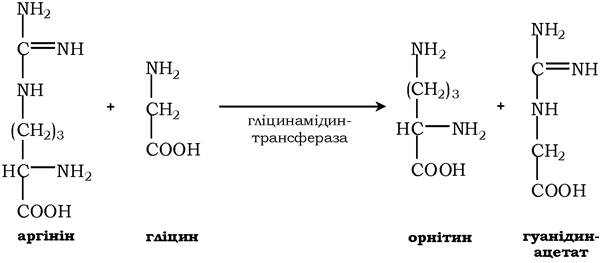
Guanidinoacetate is then transported to the Liver, where its methylation reaction takes place:
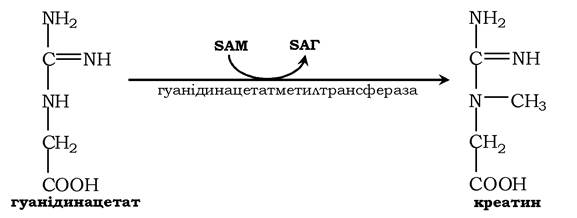
Creatine is carried via the bloodstream to the muscles and Brain Cells, where it is converted into the high-energy compound creatine phosphate:
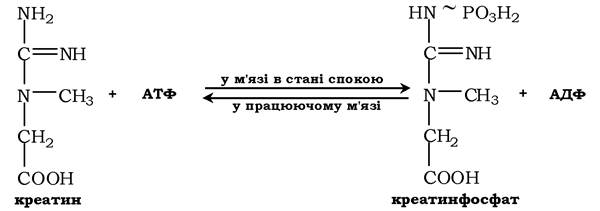
This reaction is readily reversible and is catalyzed by the enzyme creatine kinase, which is localized in the Cytosol and Mitochondria of cells and is organ-specific. Normally, The activity of this enzyme in the Blood is very low. Three isoenzyme forms of creatine kinase have been identified (see Chapter 7).
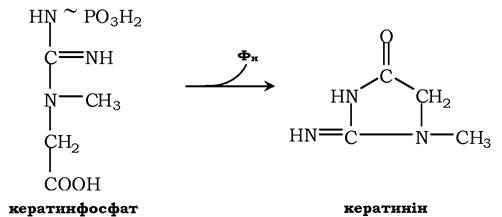
Creatine phosphate plays a vital role in supporting working Muscle during the initial period. Through non-enzymatic dephosphorylation, primarily in muscles, creatine phosphate is converted into creatinine and excreted in the urine. The daily excretion of creatinine is constant for each individual and proportional to total muscle mass:
The determination of Creatine and Creatinine levels in blood and urine is used to assess muscle performance intensity in sports medicine and under certain pathological conditions. Measuring the activity of the enzyme creatine kinase and its isoenzyme forms in blood is widely utilized in medical Diagnostics for conditions such as myocardial infarction, myopathies, and muscular dystrophies.
Transmethylation reactions are also utilized for:
✵ the synthesis of adrenaline from noradrenaline;
✵ the synthesis of anserine from carnosine;
✵ the methylation of nitrogenous bases in NUCLEOTIDES, etc.;
✵ the inactivation of metabolites (Hormones, mediators, etc.) and the detoxification of foreign compounds, including pharmaceutical drugs.
Methylation reactions play a crucial role in the Organism and proceed very intensively, leading to a high consumption of methionine. Since methionine is an essential amino acid (it cannot be synthesized de novo within cells), the possibility of its regeneration involving non-Essential Amino Acids (Ser, Gly) is of great significance. As a result of the cleavage of the methyl group, SAM is converted into S-adenosylhomocysteine (SAH), which is subsequently hydrolyzed into adenosine and homocysteine:

Homocysteine can be converted back into methionine through the action of homocysteine methyltransferase. In this process, N5-methyl-H4-folate serves as the methyl group donor:
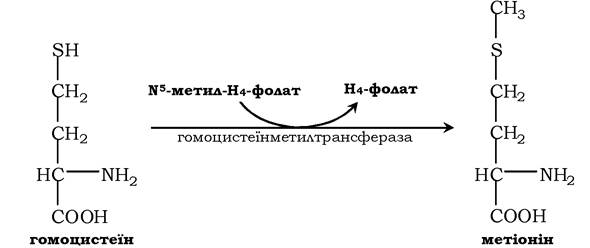
The intermediate carrier of the methyl group in this reaction is a vitamin B12 derivative, methylcobalamin, which Functions as a coenzyme.
Methionine is an essential amino acid; however, it can be regenerated from homocysteine. Consequently, homocysteine itself is indispensable, yet its sole source in the body is methionine. Because dietary homocysteine is scarce, human requirements for both methionine and homocysteine are met exclusively by dietary methionine.
The General Overview of Methionine METABOLISM, linked to single-carbon unit turnover, is illustrated in Fig. 6.27.
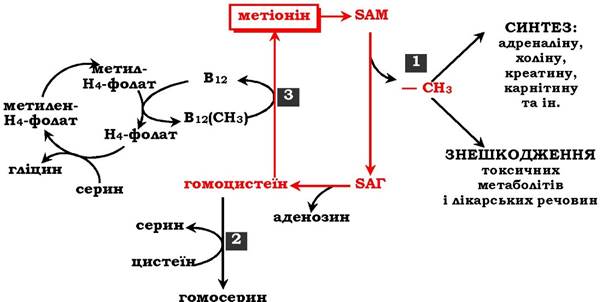
Fig. 6.27. Methionine metabolism:
1 - Transamination reactions; 2 - cysteine synthesis; 3 - methionine regeneration
Serine serves as the primary donor of single-carbon units. The resulting N5,N10-methylene-H4-folate is reduced to N5-methyl-H4-folate, which transfers its methyl group to cobalamin (B12). Methylcobalamin directly participates in methionine regeneration. Additionally, homocysteine can be utilized for cysteine synthesis.
Cysteine is the second sulfur-containing amino acid. It is classified as conditionally essential because its synthesis requires a sulfur atom, which is originally derived from the essential amino acid methionine.
The synthesis of cysteine requires Two amino acids:
✵ serine - the carbon Skeleton donor;
✵ methionine - the primary source of the S atom.

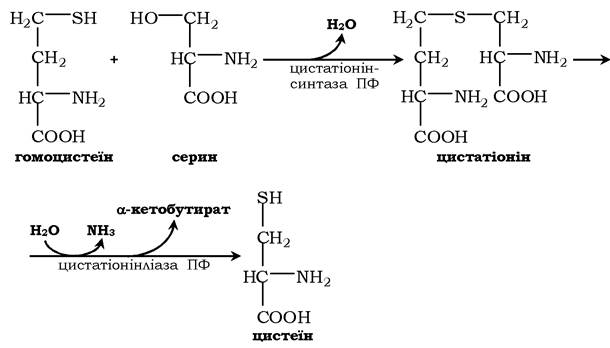
The synthesis of cysteine from homocysteine proceeds in two stages via the pyridoxal-dependent enzymes cystathionine $\beta$-synthase and cystathionine $\gamma$-lyase:
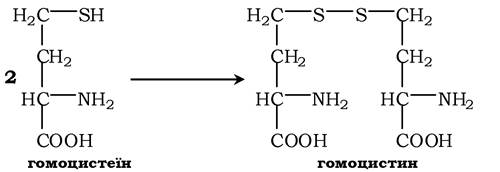
When homocysteine utilization is impaired in the body, it is converted into homocystine:
Homocystine can accumulate in the blood and Tissues and be excreted in the urine, causing homocystinuria. Potential causes include Inherited Disorders of homocysteine metabolism, Folic acid deficiency, or a shortage of Vitamins B12 and B6. Other biochemical abnormalities often associated with B-vitamin deficiencies include cystathioninuria.
The BIOLOGICAL FUNCTIONS OF cysteine are diverse and vital to the organism. For instance, cysteine residues incorporated into proteins play a crucial role in protein folding, as their thiol groups are capable of forming strong Disulfide Bonds. In this process, two cysteine residues combine to form a cystine molecule:
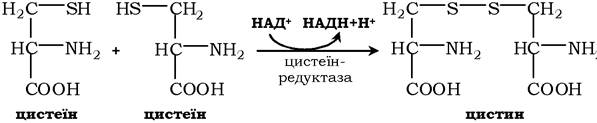
The oxidation reaction occurs either non-enzymatically or via the coenzyme NAD+ in a process mediated by cysteine reductase. Disulfide bonds stabilize the three-dimensional structure of polypeptide chains or link distinct chains together (such as the A- and B-chains of the hormone Insulin). Numerous Proteins and Enzymes feature active-site SH-groups that participate directly in catalysis. Oxidation of these groups leads to a loss of enzymatic activity. The reduction of SH-groups is frequently driven by Glutathione, an atypical tripeptide composed of γ-glutamic acid, cysteine, and glycine:

Glutathione exists in two forms: reduced (G-SH) and oxidized (G-S-S-G), functioning as a potent antioxidant in The Human Body.
Another major pathway of cysteine utilization is the synthesis of taurine in animal tissues, which proceeds through the decarboxylation of cysteine derivatives—namely, cysteic and cysteine sulfinic acids:
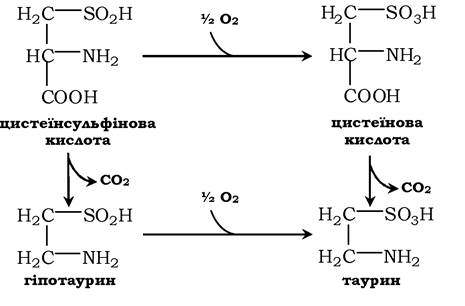
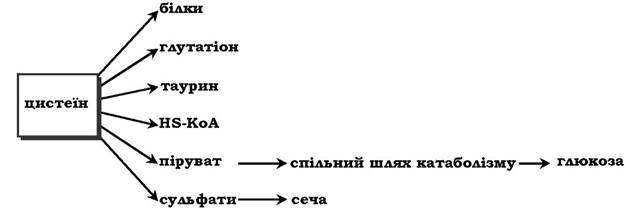
Taurine is essential for the hepatic synthesis of conjugated Bile acids. Furthermore, it acts as a crucial cellular antioxidant, helping to reduce Lipid Peroxidation (LPO) and scavenge hypochlorite ions (in the form of chloramine complexes).
Cysteine also serves as the precursor for the thioethanolamine moiety of HS-CoA (Coenzyme A).
The Catabolism of cysteine proceeds via an oxidative pathway:
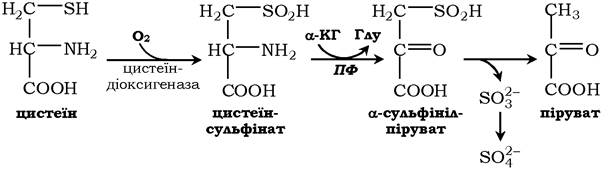
The sulfite generated in this reaction is converted into sulfate and excreted in the urine, or transformed into ethereal sulfates that are also eliminated by the kidneys. Cysteine is virtually the exclusive source of urinary sulfites; its Metabolic pathways are illustrated in the scheme below:
Last update: 06/08/2026
Editorial and Educational Adaptation: This material has been compiled based on the primary/original source text. The project team performed an editorial review, corrected technical inaccuracies, structured sections, and adapted the content for an educational format.
What was processed:
- elimination of formatting defects (OCR errors, structural breaks, corrupted characters);
- editorial organization of content;
- standardization of terminology in accordance with academic sources;
- verification of factual statements against the original source text.
All mentions of the author, publication year, and origin of the primary text have been preserved in accordance with the source.