MODERN BOTANY - P. RAVEN - 1990
SECTION II. ENERGY AND LIVING CELLS
CHAPTER 7. PHOTOSYNTHESIS
In the preceding chapter, we described The process of carbohydrate breakdown, which supplies the energy required for living systems to function. Here, we will examine how energy from sunlight is absorbed and converted into chemical energy.
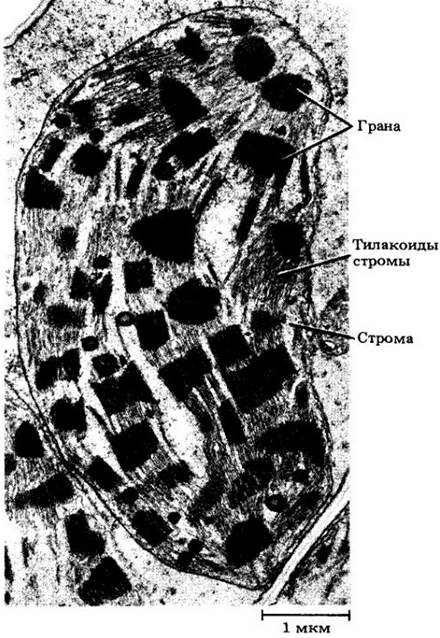
Photosynthesis is the primary pathway by which virtually all energy enters our biosphere. Every year, more than 150 billion tons of sugar are produced globally through photosynthesis. However, The Significance of photosynthesis extends far beyond The production of this substance. Without the continuous influx of solar energy—principally captured and converted within the METABOLISM/14.html">Chloroplasts of Eukaryotic Cells (Fig. 7-1)—life on our planet would gradually succumb to the inexorable second law of Thermodynamics and likely cease forever.
Class="center">Fig. 7-1. In eukaryotic organisms, photosynthesis takes place within chloroplasts. Light reactions occur in the thylakoids, which contain molecules of chlorophylls and other pigments. Within chloroplasts, thylakoids are stacked into disk-like structures known as grana. The series of reactions by which Energy is transferred to carbon-containing compounds takes place in the stroma surrounding the thylakoids.
An Overview of Photosynthesis
The true significance of photosynthesis was not recognized until relatively recently. Aristotle and other ancient Greek philosophers, observing that animal life depends on food consumption, assumed that plants obtained their "food" from the soil.
A little over 300 years ago, in one of the earliest carefully designed biological experiments, the Dutch physician Jan Baptist van Helmont (1577–1644) provided the first evidence that soil is not the sole source of plant nourishment. Van Helmont grew a small willow sapling in a clay pot, supplying it with nothing except Water. Over five years, the mass of the willow increased by 74.4 kg, whereas the mass of the soil decreased by a mere 57 g. Based on these findings, van Helmont concluded that all the plant's substances originated from water rather than from soil and air!
In the late 18th century, the English scientist Joseph Priestley (1733–1804) reported that he had "accidentally hit upon a method of restoring air which had been vitiated by the burning of candles." On August 17, 1771, Priestley "put a living sprig of mint into a Glass jar standing inverted in water, in which a wax candle had burned out," and by the 27th of the same month, he found that "another candle could burn perfectly well in the same jar." Priestley believed that "the plant is the restorative agent employed by nature for this purpose." He expanded his observations and soon demonstrated that air "restored" by a plant was equally capable of supporting the life of a mouse. Priestley's experiments offered the first logical explanation of how the Earth's air remains "pure" and able to sustain life despite the burning of countless fires and the Respiration of myriad animals. To quote from his medal acceptance speech: "By these discoveries we are assured that plants spring not in vain, but clean and refine our atmosphere." Today, we would explain Priestley's experiments simply by stating that plants absorb carbon dioxide produced by combustion or animal respiration, while animals, in turn, inhale the oxygen released by plants.
Later, the Dutch physician Jan Ingenhousz (1730–1799) corroborated Priestley's work and demonstrated that air is "restored" only in sunlight and exclusively by the green parts of plants. In 1796, Ingenhousz proposed that Carbon dioxide is split during photosynthesis to yield Carbon and Oxygen, with the oxygen being released as a gas. It was subsequently discovered that The ratio of carbon, hydrogen, and oxygen atoms in sugars and starches is such that there is one carbon atom for every molecule of water (CH2O), which is precisely what the term "CARBOHYDRATES" implies. Thus, in the overall equation for photosynthesis:
СО2 + Н2О + Light energy —> (СН2О) + О2
it was widely accepted that carbohydrates were formed from carbon and water, while oxygen was liberated from carbon dioxide. This highly plausible hypothesis gained widespread acceptance, but as later transpired, it was entirely incorrect.
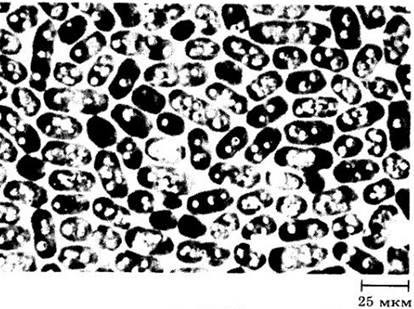
The researcher who disproved this established theory was Cornelis van Niel of Stanford University, who, while still a graduate student, studied the metabolism of various photosynthetic Bacteria. One such group, the purple sulfur bacteria, reduces carbon to carbohydrates but does not release oxygen. Purple sulfur bacteria require hydrogen sulfide for photosynthesis. As a result of this process, sulfur particles accumulate inside the bacterial cells (Fig. 7-2). Van Niel discovered that the photosynthetic equation for these bacteria could be written as follows:

Fig. 7-2. Purple sulfur bacterium. In these cells, hydrogen sulfide plays the same role as water does in plant photosynthesis. Hydrogen sulfide is split, and the liberated sulfur is accumulated as globules visible within the cells.
This fact attracted little attention until van Niel made a bold generalization and proposed the following general equation for photosynthesis:

In this equation, H2A represents either water or another oxidizable substance, such as hydrogen sulfide or free hydrogen. In Algae and green plants, H2A is water (Fig. 7-3). In short, van Niel hypothesized that water, rather than carbon dioxide, is split during photosynthesis.
This brilliant idea, put forward in the 1930s, was later proven experimentally when researchers, using a heavy isotope of oxygen (18О2), traced The pathway of oxygen from water to the gaseous state:

Fig. 7-3. Oxygen bubbles—one of the products of photosynthesis—on the leaves of underwater *Elodea*. Van Niel was the first to suggest that the oxygen released during photosynthesis originates from the splitting of water rather than The breakdown of carbon dioxide.

Thus, for algae or green plants, in which water serves as an electron donor, the overall equation for photosynthesis is written as follows:

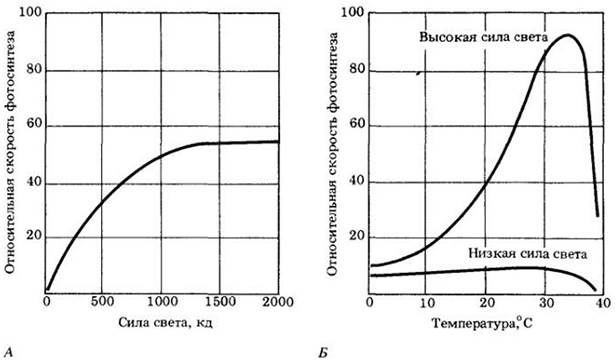
About two hundred years ago, as mentioned above, it was discovered that light is essential for the process now known as photosynthesis. It is currently understood that photosynthesis occurs in two stages, only one of which requires light. Evidence for this two-stage process was first obtained in 1905 by the British plant physiologist F. F. Blackman, who investigated the effects of light intensity and Temperature on The rate of photosynthesis.
Based on his experiments, Blackman drew the following Conclusions: (1) There is a set of light-dependent reactions that are independent of temperature. At low light intensities, the rate of these reactions could increase with increasing light intensity (Fig. 7-4, A), but not with increasing temperature (Fig. 7-4, B). (2) There is a second set of reactions that depend on temperature rather than light. Both sets of reactions were found to be necessary for photosynthesis to take place. Accelerating only one group of reactions increases the rate of the overall process, but only until the second group of reactions begins to hold back the first (i.e., becomes limiting). Once this point is reached, the second group of reactions must be accelerated for the first to proceed without restriction.
Fig. 7-4. A. At low light intensity, increasing light accelerates photosynthesis, but at high intensity, further increases have no effect. The curve shown here indicates that another factor is limiting the rate of photosynthesis in this experiment. Typically, the concentration of CO2 limits photosynthesis. B. At low light intensity, increasing temperature does not raise the rate of photosynthesis (lower curve). At high intensity, however, an increase in temperature has a significant effect (upper curve). Based on these data, Blackman concluded that photosynthesis consists of both light-dependent and Light-Independent Reactions.
Thus, it was demonstrated that both stages involve light dependencies—both the "light" and "dark" reactions. It is important to remember that dark reactions normally take place in the light and require the products generated during the light stage. The term "dark reactions" simply means that light itself is not directly involved in them.
The rate of dark reactions increases with rising temperature, but only up to 30°C, after which it begins to decline. Based on this observation, it was hypothesized that dark reactions are catalyzed by Enzymes, since the Rate of Enzymatic reactions exhibits this type of temperature dependence. Subsequent research proved this Conclusion to be correct.
In The First stage of photosynthesis (the light reactions), light energy is harnessed to produce ATP (from ADP) and high-energy electron carriers. In the second stage of photosynthesis (the dark reactions), the energy-rich products formed during the light reactions are utilized to reduce CO2 to a simple sugar (glucose). Consequently, the chemical energy of the carriers is stored in a form convenient for TRANSPORT AND STORAGE; at the same time, carbohydrates formed in the light reactions serve as Structural components of The Cell. The conversion of CO2 into Organic compounds is referred to as carbon fixation.
Last update: 07/08/2026
Editorial and Educational Adaptation: This material has been compiled based on the primary/original source text. The project team performed an editorial review, corrected technical inaccuracies, structured sections, and adapted the content for an educational format.
What was processed:
- elimination of formatting defects (OCR errors, structural breaks, corrupted characters);
- editorial organization of content;
- standardization of terminology in accordance with academic sources;
- verification of factual statements against the original source text.
All mentions of the author, publication year, and origin of the primary text have been preserved in accordance with the source.