Metabolism and Energy Transformation in Body Cells - Renata Armenakovna Petrosova 2004
Primary Synthesis of Organic Compounds. Photosynthesis
Light-Independent Reactions
Glucose is synthesized directly during the light-independent (dark) reactions of Photosynthesis. Light is not required for these reactions. This phase is also referred to as carbon dioxide fixation, as it involves the uptake and reduction of carbon dioxide.
The Reactions of the dark phase (Fig. 13) take place in the stroma of the METABOLISM/14.html">Chloroplasts, which receive NADPH · 2H and ATP molecules synthesized during the Light-dependent phase, along with atmospheric carbon dioxide. The sequence of cyclic reactions in this phase was described by the American biochemist Melvin Calvin and is known as The Calvin Cycle. During this process, CO2 molecules are bound, compounds are activated by ATP (phosphorylation), carbon is reduced by hydrogen from NADPH · 2H, and glucose is synthesized. ATP molecules produced in The First stage serve as the energy source.
Class="center">
Fig. 13. General Overview of the light-independent reactions of photosynthesis. The Calvin cycle
The chloroplast stroma constantly contains a five-carbon sugar (pentose) bonded to two phosphoric acid residues, known as ribulose diphosphate.
This compound essentially initiates the cycle. The first reaction involves the combination of carbon dioxide molecules with ribulose diphosphate, resulting in the fixation of inorganic carbon.
The resulting six-carbon compound is unstable and immediately breaks down into two triose phosphate molecules.
Next, these substances are activated by ATP molecules. The energy of ATP is consumed in the synthesis of triose diphosphates, which become activated (Fig. 14):
С5-углевод-2Ф + CO2

С6-углевод-2Ф
2С3-Ф
2С3Ф + 2АТФ
2АДФ + 2С3~2Ф.
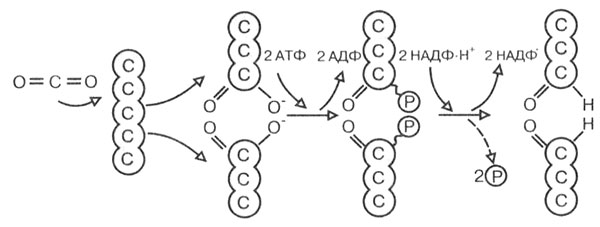
Fig. 14. Carbon fixation, phosphorylation, and reduction
Following this, the triose diphosphates are reduced by NADPH · 2H molecules:
2С3~2Ф + 2НАДФ · 2Н
2С3 + 2НАДФ+ + 2Ф.
Two triose molecules combine to form glucose, which can subsequently be converted into sucrose, starch, and other Polysaccharides:
2С3
С6Н12O6.
Some triose molecules can be used to synthesize Amino Acids, glycerol, and Higher Fatty acids.
Part of the trioses continues to participate in cyclic reactions, converting back into pentose, which completes the cycle.
Six molecules of each substance participate in the reaction simultaneously. Thus, for the synthesis of one entirely new glucose molecule, the cycle must repeat six times, i.e., six CO2 molecules must be assimilated.
The released ATP and NADP+ molecules return to the thylakoid membranes to participate in the light-dependent reactions.
Last update: 13/08/2026
Editorial and Educational Adaptation: This material has been compiled based on the primary/original source text. The project team performed an editorial review, corrected technical inaccuracies, structured sections, and adapted the content for an educational format.
What was processed:
- elimination of formatting defects (OCR errors, structural breaks, corrupted characters);
- editorial organization of content;
- standardization of terminology in accordance with academic sources;
- verification of factual statements against the original source text.
All mentions of the author, publication year, and origin of the primary text have been preserved in accordance with the source.