Practical Protein Chemistry - A. Darbre 1989
Analytical Methods
Sulfur-containing amino acids
Methods of Determination
8.9.1.1. Cysteine and cystine. According to the Procedure described in [262], the sum of cysteine and cystine residues is determined as cysteic acid, and Methionine is determined as sulfone. Carbohydrate-containing samples can also be analyzed, although Some Amino Acids (His, Trp, and Tyr) are partially degraded under these conditions [162].
Reagents. Performic acid. To 9 mL of 88% formic acid, add 1 mL of 30% H2O2. The mixture is left for 1 h at room Temperature and then cooled to 0 °C.
Standard solution. Dissolve 20 mg of cystine, 30 mg of methionine, and 20 mg of Alanine in 2 mL of 1 M NaOH and dilute to a final volume of 10 mL. Use 10 µL of this solution for the analysis.
Procedure. Add 2 mL of performic acid solution to a protein sample (containing approximately 0.1 mg of cystine) in a Pyrex test tube and incubate at 0 °C for 4 h (for soluble Proteins) or overnight (for insoluble proteins). Then, add 0.3 mL of 48% HBr while gently shaking the tube. Evaporate the mixture to dryness at 40 °C using a rotary evaporator. Hydrolyze the protein sample in 3 mL of 6 M HCl under vacuum at 110 °C for 18 h; dry the hydrolysate and analyze it by Ion-exchange Chromatography. The recoveries are 100±2% for methionine sulfone and 94±2% for cysteic acid. The number of half-cystine + cysteine residues, as well as methionine residues, is best calculated relative to the molar amounts of amino acids that remain stable under these conditions (Ala, Leu, Asp, and Glu).
8.9.1.2. Determination of sulfhydryl groups and half-cystine residues. The METHOD FOR DETERMINING both free sulfhydryl groups and half-cystine residues in a protein [343] is based on the reaction schematically shown in equation (8.1).
Class="center">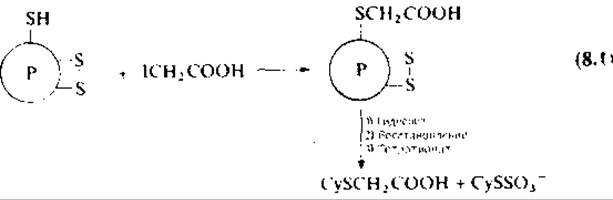
Determination of free SH groups. Dissolve the protein (0.3 µmol) in 0.1 M Tris-HCl buffer (pH 8.3) containing 1 mM EDTA at 4 °C in the absence or presence of 6 M guanidine·HCl and DTT (0.1 mL, 10 µmol), and add a 10-fold molar excess of recrystallized iodoacetic acid (ICH2COOH). Potassium phosphate buffer (pH 6.7) can also be used as an alternative. Hydrolyze with 4 M methanesulfonic acid (Section 8.7.2). Determine carboxymethylcysteine using an amino acid analyzer.
Determination of half-cystine residues. Cool 1 mL of the protein hydrolysate solution and add 0.3 mL of pyridine (distilled over ninhydrin), 0.9 mL of 4 M NaOH (to adjust the pH to 6.8), and then DTT (4 µL per 1 mL of Water). Purge with nitrogen, seal with Parafilm, and incubate at 37 °C for 1 h. Upon completion of reduction, add solid sodium tetrathionate (100 mg, 200 µmol) and leave at 25 °C for at least 5 h to convert all cysteine residues into 5-sulfocysteines. Evaporate the reaction mixture on a rotary evaporator under vacuum at 30 °C. Dissolve the evaporation residue in 0.5 mL of water and dry to dryness again (to remove traces of pyridine). Dissolve the residue in pH 2.2 buffer, filter, and determine S-sulfocysteine using an amino acid analyzer.
8.9.1.3. Determination of Disulfide Bonds. The procedure described below [365] is more convenient than previous Methods, offering higher sensitivity (10-8 mol of disulfide) and faster analysis times. The determination error is within ±3%.
The disulfide bond is cleaved by an excess of sodium sulfite [equation (8.2)]. The resulting thiol groups react with 2-nitro-5-thiosulfobenzoic acid (NTSB) [equation (8.3)] to form sulfo derivatives; the equimolar amount of released 2-nitro-5-thiobenzoic acid (NTB) is measured spectrophotometrically (ε412 nm = 13,600).
R—S—S—R+SО32- ⇄ R—S—SО3- + R'S- — (8.2)

Preparation of the reagent. The initial NTSB reagent is prepared as a 0.5 mM solution according to equation (8.4). Dissolve 0.1 g (2.5·10-4 mol) of 5,5'-dithiobis(2-nitrobenzoic acid) (DTNB) (Ellman's reagent; Aldrich) in 10.0 mL of 1 M Na2SO3 (1·10-2 mol) at 38 °C and adjust the pH to 7.5. Bubble oxygen through the solution, monitoring the reaction progress by the increase in NTB concentration via absorbance measurement at 412 nm (the NTB concentration reaches a maximum of ~99% after ~45 min). The NTSB solution is stored at -20 °C, remains stable for 6 months, and is used without further purification.

NTSB assay solution. Dilute the stock NTSB reagent 100-fold with a solution containing 0.2 M Tris (base), freshly prepared 0.1 M Na2S2O3, 3 mM EDTA, and 2–3 M guanidine thiocyanate (Eastman); adjust the pH of the mixture to 9.5 with HCl. This solution remains stable for two weeks at room temperature.
Disulfide analysis. Add 0.01–0.20 mL of the peptide or protein solution (with an S–S bond concentration of 0.5–2 mM) dropwise via pipette to 3 mL of the NTSB assay solution. Incubate the mixture in the dark for 5 min (for Peptides) and 25 min (for proteins). Measure the absorbance at 412 nm against a blank (3 mL of the NTSB assay solution in an equivalent volume of water).
Note. Guanidine is used for Protein Denaturation, which increases the accessibility of disulfide bonds. Urea cannot be used for this purpose because the ammonium cyanate present in it reacts with thiol groups. The sequential steps of disulfide bond Cleavage and thiol group titration are carried out in the same reaction vessel, eliminating the need to remove dissolved oxygen. This method can be applied in peptide mapping for the selective identification of cystine and cysteine residues followed by their isolation. Because the NTB anion undergoes a photochemical transformation yielding a product that no longer absorbs at 412 nm [88], the incubation must be performed in the dark.
Ellman's reagent was originally proposed for the direct titration of free thiol groups in proteins [105]; this reaction was later studied in greater detail [312].
8.9.1.4. HPLC determination of S-sulfinoalanine and cysteic acid [171]. S-Sulfinoalanine (L-cysteine sulfinic acid, Csa) and cysteic acid (Cya) (as well as O-phosphoserine) co-elute within a narrow time window on a cation-exchange Column; however, they are well resolved on a strongly basic anion-exchange resin (ISA-07/S2504, Shimadzu) using 0.05 M KH2PO4 as the eluent. Retention times are: Csa, 22 min; Cya, 35 min; Ser(P), 41 min.
For the identification of these amino acids, post-column derivatization with OPA + mercaptoethanol can be used (Section 8.16.3.1). The resulting derivatives exhibit a linear relationship between fluorescence peak area and yield in the ranges of 20 pmol to 5 nmol for Csa and 10 pmol to 5 nmol for Cya.
8.9.1.5. Determination of sulfhydryl groups using p-chloromercuribenzoate. Organomercury compounds, first introduced in 1937 [152], remain among the most specific and sensitive reagents for sulfhydryl groups in native proteins. Boyer's method [37] is described below.
Reagent
p-Chloromercuribenzoate. For purification, dissolve the reagent in 1 M NaOH and centrifuge if necessary. Add 1 M HCl until precipitation occurs, and repeat the reprecipitation twice. Wash the precipitate three times with distilled water. Dry in a thin layer under vacuum over P2O5. Dissolve in dilute acetate or phosphate buffer (pH 7–8).
Procedure. Acidify the protein solution to pH 4.6 and add the reagent (a 10-fold molar excess per SH group) in a dilute neutral or slightly alkaline solution at room temperature. Plot the increase in absorbance at 232 nm versus time. Determine the total increase in absorbance.
Note. Solutions of p-chloromercuribenzoate partially decompose upon storage for several days. Check the solutions (after centrifugation, if necessary) by measuring the absorbance at 232 nm at pH 7 (εM = 1.69·104) or at 234 nm at pH 4.6 (εM = 1.74·104). The presence of EDTA leads to overestimated results.
8.9.1.6. Determination of methionine and methionine sulfoxide. During periodate Cleavage of the carbohydrate chain in Glycoproteins [69, 95] and disulfide bonds in proteins, as well as oxidation of cysteine residues with performic acid [162], methionine is converted into methionine sulfoxide [411] and methionine sulfone. The formation of methionine sulfoxide occurs to a significant extent even at low periodate concentrations (5 mmol/L); upon acid Hydrolysis, it yields methionine, methylsulfone, homocysteine, and homocysteic acid [112]. Methionine sulfone is stable under acid hydrolysis conditions and can be quantitatively determined using an amino acid analyzer [116, 251]. For the analysis of methionine sulfoxide, alkaline hydrolysis is used, or its amount is determined indirectly as methionine sulfone [275].
Last update: 06/08/2026
Editorial and Educational Adaptation: This material has been compiled based on the primary/original source text. The project team performed an editorial review, corrected technical inaccuracies, structured sections, and adapted the content for an educational format.
What was processed:
- elimination of formatting defects (OCR errors, structural breaks, corrupted characters);
- editorial organization of content;
- standardization of terminology in accordance with academic sources;
- verification of factual statements against the original source text.
All mentions of the author, publication year, and origin of the primary text have been preserved in accordance with the source.