Biochemistry of Amino Acids - A. Majster 1961
Intermediate metabolism of amino acids
Methionine and cysteine
Degradation of cysteine
The biological degradation of Cysteine can proceed via several different pathways. Tapp [549] as well as Fromageot and co-workers [550–553] observed a cysteine desulfhydrase reaction in preparations of mammalian Liver, Kidney, and Pancreas, as well as in A number of microorganisms. As established in experiments using S35, this reaction is reversible [1110]; it can be expressed by the following equation:
Class="center">Cysteine + H2O → Pyruvate + H2S + NH3.
The simultaneous presence of other competing transformations of cysteine and pyruvic acid complicates The Study of this reaction. In some experiments, The formation of Alanine was observed, likely due to Transamination between pyruvic acid and cysteine or other free Amino Acids (e.g., glutamic acid) present in the enzyme system [554]. Pyridoxal phosphate has been found to activate enzyme preparations obtained from Tissues of B6-deficient animals [546, 555–560]. A mechanism for the desulfhydrase reaction has been proposed, based on the formation of a Schiff base from pyridoxal phosphate and cysteine; this mechanism was studied in non-enzymatic model systems (p. 255). Although this mechanism is plausible, it must be taken into account that the reaction has so far been studied only using crude enzyme preparations that also possess transaminase activity; The Role of pyridoxal phosphate in transamination reactions is well known (p. 248). Transamination between cysteine and an α-keto acid should yield ß-mercaptopyruvic acid. Various preparations from animal tissues and Bacteria desulfurize ß-mercaptopyruvic acid to pyruvic acid [561–563]:

In the presence of reducing agents, such as ß-mercaptoethanol, cysteine, or Glutathione, the sulfur liberated in this reaction is reduced to hydrogen sulfide [561]:

Thus, the formation of hydrogen sulfide from cysteine can occur As a result of deamination or transamination reactions, followed by The conversion of ß-mercaptopyruvic acid into pyruvic acid and sulfur or hydrogen sulfide. In the presence of excess cysteine, the sulfur is converted into hydrogen sulfide; investigations of the cysteine desulfhydrase reaction have shown the simultaneous conversion of cysteine into cystine. Interestingly, the cysteine desulfhydrase reaction does not go to completion; in most experiments, the reaction ceases after the formation of pyruvic acid and hydrogen sulfide in amounts not reaching half of the theoretical yield. In some bacterial systems, desulfurization proceeds in two steps: the first apparently involves the deamination of cysteine, and the second the release of hydrogen sulfide [555, 559, 564–566]. The formation of hydrogen sulfide is enhanced in the presence of keto acids, such as ketoglutaric acid [553, 1111]. These observations are consistent with the following type of mechanism:

Data from a number of experimental studies are in good agreement with the scheme presented above, and since crude enzyme preparations were used in these studies, such a mechanism of cysteine breakdown is quite probable. At the same time, it is possible that in some systems the elimination of sulfur is preceded by the formation of ammonia via the Oxidative Deamination of cysteine. The originally proposed mechanism of the desulfhydrase reaction is also not excluded, with the modification that The intermediate formation of a Schiff base with pyridoxal phosphate is now taken into account. It is possible that all these pathways of cysteine degradation occur under varying conditions1.
Early studies observed the formation of hydrogen sulfide from both D- and L-cysteine in the presence of Propionibacterium pentosaceum [567]. The rates of hydrogen sulfide formation from both isomers were approximately equal. It was recently found that extracts from certain strains of Escherichia coli catalyze the desulfurization of D-cysteine much more actively than the Cleavage of the L-isomer [568]; in both cases, roughly equimolar amounts of pyruvic acid, ammonia, and hydrogen sulfide were produced.
1 See note on p. 368.
The reaction catalyzed by aliinase is analogous to the cysteine desulfurization reaction [569, 570]. Alliin, found in garlic bulbs, is converted by the enzyme into allicin (which imparts the characteristic odor to garlic), pyruvic acid, and ammonia. Pyridoxal phosphate participates in this reaction [1112].

Cysteine is readily oxidized to cystine non-enzymatically, though it is known that this reaction, as well as the reduction of cystine to cysteine, can be catalyzed by Enzymes. As noted above, the conversion of cysteine to cystine can occur via a reaction with sulfur. Many years ago, Keilin [571] observed The oxidation of cysteine to cystine by cytochrome c and cytochrome oxidase. The reduction of cystine has recently been described in preparations from Yeast and higher plants involving diphosphopyridine nucleotide [572, 573].
Cystine + DPN-H + H+ → 2 mol cysteine + DPN+.
The action of the enzyme is specifically directed toward cysteine and diphosphopyridine nucleotide. A similar reaction is known involving glutathione (GSH) and triphosphopyridine nucleotide (TPN) [574–578]:
GSSG + TPN-H + H+ → 2GSH + TPN+.
One of the major pathways of cysteine METABOLISM is its oxidation to cysteine sulfinic acid. About 20 years ago, Pirie suggested that cysteine is converted upon oxidation into cysteine sulfinic acid, from which sulfite is subsequently cleaved and oxidized to sulfate [541, 579, 580]. It is possible that cysteine sulfenic acid is an intermediate in cysteine oxidation [582], though the latter has not been isolated:

Further oxidation of cysteine sulfinic acid to cysteic acid has been experimentally established (reaction 3). Cysteine sulfenic acid is presumably unstable; it is suggested that this compound spontaneously undergoes dismutation into cysteine sulfinic acid and cysteine:
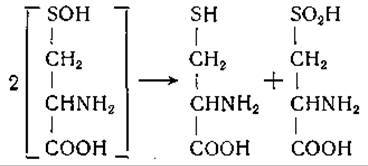
Cysteine sulfinic acid is among the principal intermediates of cysteine metabolism. In the rat Organism, cysteine sulfinic acid is not converted into cysteine in any significant amounts, as it cannot replace cysteine as a dietary growth factor [583].
The formation of sulfite and alanine from cysteine sulfinic acid has been described in rabbit liver preparations [553, 592, 593]. Subsequent studies established that this transformation occurs as a result of a transamination reaction between cysteine sulfinic acid and α-ketoglutaric or oxaloacetic acid, yielding ß-sulfinylpyruvic acid. Sulfinylpyruvic acid has not been isolated. Apparently, in the presence of certain Metal Ions (e.g., Mn++), it spontaneously breaks down into sulfite and pyruvate; this reaction is analogous to the non-enzymatic decarboxylation of oxaloacetic acid. The resulting sulfite is oxidized to sulfate. These reactions can be represented as follows [553, 584–591, 1113]:

An analogous transamination reaction was observed between cysteine sulfinic acid and oxaloacetic acid. The formation of alanine noted in earlier studies can be attributed to the transamination reaction between pyruvic and glutamic acids.
In rat liver preparations, cysteinesulfinic acid also undergoes a transamination reaction with pyruvic acid; unlike the analogous reaction with a-ketoglutaric acid, this transformation was found to be impaired in the tissues of V6-deficient rats.
Cysteinesulfinic acid can be oxidized to cysteic acid; this transformation is catalyzed by a reversibly acting dehydrogenase system [584]:

ß-Sulfinylpyruvic acid is presumably not oxidized to ß-sulfonylpyruvic acid, since the latter is not converted into pyruvic acid and sulfate by enzyme preparations that generate sulfate and pyruvic acid from cysteinesulfinic acid. There is Evidence for the existence of a reversible transamination between ß-sulfonylpyruvic and glutamic acids, yielding cysteic and a-ketoglutaric acids.
In addition, the oxidation of cysteinesulfinic acid to ß-sulfinylpyruvic acid by a rat liver enzyme operating in the presence of diphosphopyridine nucleotide has been described [584]. Apparently, at least two pathways exist for the conversion of cysteinesulfinic acid into ß-sulfinylpyruvic acid, namely oxidation and transamination. Parenteral administration of cysteine to rats increases the alanine content in the liver [594], just as the administration of cysteinesulfinic acid does [595]. Cysteinesulfinic acid has been detected in normal rat Brain tissue [596]. Consequently, there is compelling evidence supporting the role of this compound as a normal metabolite. The high biological reactivity of cysteinesulfinic acid is evidenced by its participation in transamination reactions, its oxidation to cysteic and ß-sulfinylpyruvic acids, and its decarboxylation, described below. In experiments using labeled sulfite, the formation of cysteinesulfinic acid was established, most likely through the reversal of one or more of the aforementioned reactions; this process is somewhat similar to the carbon dioxide fixation process [597]. Studies on chicken embryos have shown the incorporation of radioactive sulfate into the taurine molecule [598, 599]. The conversion of cysteinesulfinic acid into taurine has been established in dogs [600]; cysteic acid decarboxylase has been found in dog liver preparations [601]. Furthermore, There is a series of data on the presence and formation of hypotaurine (2-aminoethanesulfinic acid) in biological systems. For example, in rats, intravenous administration of cysteine resulted in elevated levels of alanine, hypotaurine, and taurine in the liver [594, 602]. Liver preparations exhibit enzymatic decarboxylation of cysteinesulfinic acid yielding hypotaurine [603]. Hypotaurine has been detected in the urine of normal rats, as well as rats maintained on high-cysteine diets [604, 605]. Hypotaurine has been obtained via chemical synthesis [602, 606—608]. Taurine is formed in the organism either by the decarboxylation of cysteic acid or by the oxidation of hypotaurine. The first of these reactions, as well as the decarboxylation of cysteinesulfinic acid, requires Pyridoxal phosphate as a coenzyme [1114]. It has been found that rats suffering from vitamin B6 deficiency excrete little or no taurine and hypotaurine [604, 609]. Hypotaurine is presumably readily subject to Biological Oxidation to taurine, but this reaction has not yet been studied in detail. The totality of experimental data indicates that the main pathway for taurine formation proceeds via cysteinesulfinic acid. However, a certain amount of taurine is likely formed through the decarboxylation of cysteic acid. These reactions can be represented as follows:

Another hypothetical pathway for taurine formation, already pointed out in early works [579, 580], consists of the conversion of cysteine to cystine, followed by the formation of cystine disulfoxide and its decarboxylation into taurine:

Observations consistent with this reaction sequence have been described. In particular, it has been noted that cystine disulfoxide undergoes oxidative decarboxylation in liver preparations and is readily converted into sulfate in the animal body [541, 610]. It has also been found that cystamine, possibly formed as a result of coenzyme A breakdown, is converted into taurine in various animals; hypotaurine appears to be an intermediate in this reaction [611, 612]:

Cystamine disulfoxide has been found in the urine and liver of rats following cysteine injection [612]. An enzyme that oxidizes cysteamine (2-mercaptoethylamine) in the presence of 2,3,5-triphenyltetrazolium chloride has been isolated in purified form from pigeon liver; the action of this enzyme requires the presence of diphosphopyridine nucleotide [1115].
Taurine, like Glycine, is present in Bile as a conjugate with cholic acid. The synthesis of taurocholic acid has been accomplished using guinea pig liver microsome preparations that catalyze the following reactions [1116]:
Cholic acid + Coenzyme A + ATP → Cholyl-coenzyme A
Cholyl-coenzyme A + Taurine → Taurocholic acid + Coenzyme A.
Following the injection of S-aminoethylcysteine, rats excrete S-aminoethylcysteine, its corresponding a-N-acetyl derivative, and cystamine in a bound form [613]. The formation of cystamine from S-aminoethylcysteine is compatible with the hypothesis that the latter is an intermediate in the proposed transfer of sulfur from cysteine to ethanolamine:

The oxidation of cysteine in the presence of formaldehyde yields N-formylcysteine. The same product is obtained upon the oxidation of thiazolidinecarboxylic acid, which is formed by the Condensation of cysteine with formaldehyde [614]. Similarly, the condensation of homocysteine with formaldehyde yields n-thiazin-4-carboxylic acid [615]. Condensations of this type occur non-enzymatically [616, 617], while the condensation products are susceptible to enzymatic action [614, 615].

The interaction of cysteine with cyanide yields a compound likely possessing The Structure of 2-imino-4-thiazolidinecarboxylic acid [618]. Rats excrete this compound in their urine following subcutaneous administration of NaCN. This reaction may account for the well-known protective effect of cysteine against cyanide poisoning [619].

The End products of sulfur metabolism in animals include sulfate and thiosulfate. Thiosulfate participates in the reaction
Thiosulfate + Cyanide → Thiocyanate + Sulfate,
the study of which has been the subject of numerous works. The formation of thiocyanate (rhodanide) in this reaction, which plays a role in cyanide detoxification, is catalyzed by the enzyme rhodanese, first discovered by Lang [620]. The enzyme is present in The Liver and other mammalian tissues [620—623]. Sörbo [623, 624] investigated rhodanese in detail and isolated the enzyme in crystalline form. He concluded that rhodanese possesses a disulfide group that reacts with thiosulfate in the following manner:
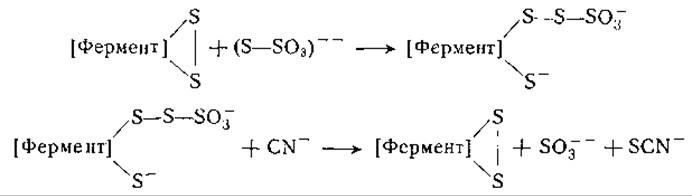

Fig. 17. Summary scheme of cysteine transformations.
According to Sörbo, the formation of thiocyanate from cyanide and elemental sulfur in liver preparations is catalyzed by an enzyme distinct from rhodanese. He arrived at a similar Conclusion regarding the formation of thiocyanate from ß-mercaptopyruvic acid, from which sulfur is enzymatically cleaved [561, 625]. Crystalline rhodanese does not utilize elemental sulfur.
The oxidation of sulfide to thiosulfate in rat liver preparations is catalyzed by thermolabile and thermostable fractions derived from this tissue. These enzyme systems are activated by chelating agents and apparently require cobalt ions. It is of interest to note that The activity of sulfide oxidase is significantly increased in starved animals compared to non-starved controls [1117].
It has recently been shown that the formation of phenol sulfuric acids (and presumably The Biosynthesis of other sulfuric acid esters) requires the preliminary activation of sulfate through a reaction involving adenosine triphosphate [1118]. Active sulfate has been identified as 3'-phosphoadenosine-5'-phosphosulfate (PAPS); its reaction with nitrophenol yields nitrophenyl sulfate and 3',5'-diphosphoadenosine (PAP) [1119]:

Last update: 06/08/2026
Editorial and Educational Adaptation: This material has been compiled based on the primary/original source text. The project team performed an editorial review, corrected technical inaccuracies, structured sections, and adapted the content for an educational format.
What was processed:
- elimination of formatting defects (OCR errors, structural breaks, corrupted characters);
- editorial organization of content;
- standardization of terminology in accordance with academic sources;
- verification of factual statements against the original source text.
All mentions of the author, publication year, and origin of the primary text have been preserved in accordance with the source.