Biochemistry of Amino Acids - A. Majster 1961
Intermediary Metabolism of Amino Acids
Histidine
Biosynthesis
Many experimental animals require dietary Histidine for normal growth and nitrogen balance (Table 10). However, evidence suggests that young, healthy humans can maintain nitrogen balance even on a histidine-free diet. While this indicates that human Tissues may be capable of synthesizing histidine, alternative explanations must be considered—for instance, that Histidine is synthesized by intestinal microflora or released during Hemoglobin breakdown (p. 124). Data concerning histidine synthesis in humans remain scarce. In rats, normal growth can be sustained when L-histidine is replaced in the diet by its a-keto or a-hydroxy analogue, or by D-histidine [626–629]. Interestingly, in mice, D-histidine and imidazolelactic acid are active only in the presence of small amounts of dietary L-histidine [630].
All current knowledge regarding histidine Biosynthesis is derived from studies on microorganisms. Broquist and Snell [631] demonstrated that various Bacteria can convert ß-imidazolepyruvic acid to histidine in the presence of Pyridoxal phosphate. According to their findings, Lactobacillus arabinosus requires histidine only when vitamin B6 is absent. Although these observations suggest that imidazolepyruvic acid serves as a histidine precursor, alternative interpretations should be kept in mind. The close metabolic link between Purines and histidine, noted in early studies, has now been at least partially elucidated through isotopic tracer experiments; these showed that the C-2 atom of the imidazole ring is derived from formic acid, which can be generated during purine Catabolism [632, 633] (cf., however, [481, 482]).
Using Neurospora mutant strains, Ames and co-workers [634–637, 1120] obtained pivotal data regarding the Water/144.html">Origin of the carbon chain of histidine. They isolated imidazoleglycerol, imidazoleacetol, and L-histidinol, as well as the phosphate esters of these compounds, from fungal cultures. Based on chemical and genetic evidence, they proposed the following pathway for histidine biosynthesis:
Class="center">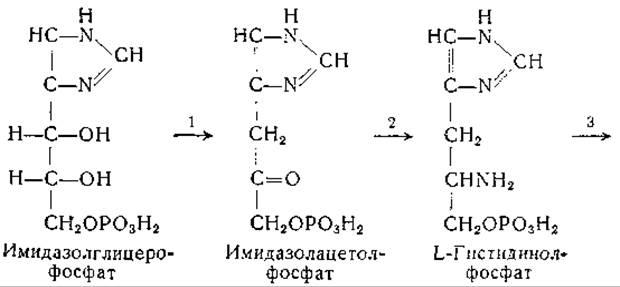
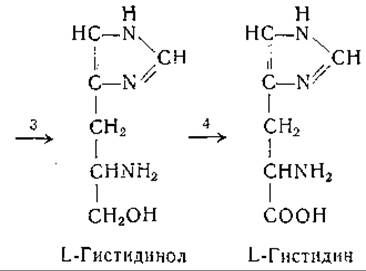
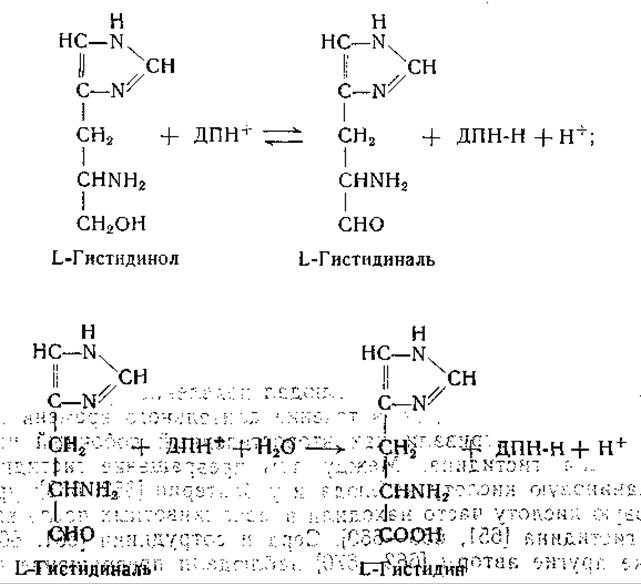
Prior to these findings, Vogel and colleagues isolated L-histidinol from cultures of an Escherichia coli histidine-requiring mutant [638]. Adams investigated the enzymatic conversion of histidinol to histidine, a reaction requiring diphosphopyridine nucleotide [639–641]. This transformation proceeds via The formation of histidinal as an intermediate [641]:
The conversion of imidazoleacetol phosphate to histidinol phosphate occurs via a Transamination reaction. The enzyme catalyzing this reaction has been isolated in purified form and shown to be dependent on pyridoxal phosphate (p. 232).
The precise origin of the five-carbon chain of histidine remains unclear. Neither glutamic acid nor acetic acid serves as an intermediate in this process [642]; pentose or hexose derivatives are considered likely carbon sources. In E. coli, the amide nitrogen of glutamine has been established to participate in histidine synthesis. Specifically, the amide group of glutamine proved to be a more efficient nitrogen source for the N-1 atom of the histidine molecule than the nitrogen from glutamic acid, asparagine, or ammonium ions [1121].
Recent findings indicate that the mechanisms of histidine biosynthesis in E. coli and Neurospora are strikingly similar. In both organisms, the biosynthetic pathway involves the formation of imidazoleacetol and L-histidinol, with the assembly of the five-carbon chain preceding the closure of the imidazole ring [643].
Last update: 06/08/2026
Editorial and Educational Adaptation: This material has been compiled based on the primary/original source text. The project team performed an editorial review, corrected technical inaccuracies, structured sections, and adapted the content for an educational format.
What was processed:
- elimination of formatting defects (OCR errors, structural breaks, corrupted characters);
- editorial organization of content;
- standardization of terminology in accordance with academic sources;
- verification of factual statements against the original source text.
All mentions of the author, publication year, and origin of the primary text have been preserved in accordance with the source.