Biochemistry - The Chemical Reactions of Living Cells, Volume 3 - D. Metzler 1980
Metabolism of Nitrogenous Compounds
Compounds Derived from Aspartate
Methionine Metabolism
Methionine is incorporated into Proteins both as such and as N-formylmethionine, serving as the N-terminal residue in bacterial proteins (Fig. 14-9, steps a and b). In both animal and plant Cells, methionine can undergo Transamination to the corresponding α-keto acid (step c), though this pathway is of minor quantitative importance. The primary route of methionine METABOLISM involves its conversion into S-adenosylmethionine (SAM, Fig. 14-9, step d). This reaction has been discussed previously (Chap. 11, Sec. B, 2); the function of SAM in Transmethylation (step e) was also examined (Chap. 7, Sec. C, 2). The transmethylation product, S-adenosylhomocysteine, is converted to homocysteine via an unusual hydrolytic Cleavage of adenosine (step f)1). Homocysteine can be reconverted into methionine, as indicated by the dashed line in Fig. 14-9 and in equation (8-85). Another important metabolic pathway for homocysteine leads to Cysteine (Fig. 14-9, steps g and h). This reaction sequence is discussed in Sec. G. Another product along this pathway is α-ketobutyrate, which can undergo oxidative decarboxylation to form propionyl-CoA for further metabolism, or can be converted to isoleucine (Fig. 14-10).
In plants, SAM can serve as a substrate in a fascinating reaction that yields Ethylene [59, 60]. As discovered as early as 1858, ethylene induces stem thickening and inhibits stem elongation in plants. In 1917, it was demonstrated that this compound is produced by fruits and that exogenous ethylene accelerates fruit ripening. It is now firmly established that ethylene Functions as a plant hormone1, eliciting a wide range of physiological responses, including the inhibition of mitosis. Ethylene synthesis is modulated in part by the plant hormone auxin (Chap. 16, Sec. A, 3) as well as by red light. It is known that the α-keto acid analogue of methionine undergoes oxidative decarboxylation in the presence of H2O2 to yield ethylene and two molecules of CO2. However, in plants, CO2 is derived from the C-1 atom of methionine, whereas C-2 is converted to formate (Fig. 14-9, step i). Furthermore, the —S—CH3 group is somehow recycled back into methionine. Assuming that SAM is the precursor of ethylene, the other product must presumably be 5'-thiomethyladenosine, as illustrated in Fig. 14-9. The latter compound is also formed in animal Tissues via an important catabolic reaction of SAM (Fig. 14-9, step j), which proceeds through an intramolecular Displacement of the γ-methylene group of SAM by the carboxylate group.
1) It has been shown that the enzyme contains tightly bound NAD+. This cofactor is presumably involved in The oxidation of adenosine at the 3'-position, facilitating the elimination of homocysteine. Subsequent Hydration and reduction yield adenosine [58a].
Class="center">
FIG. 14.9. Selected reactions of methionine metabolism.
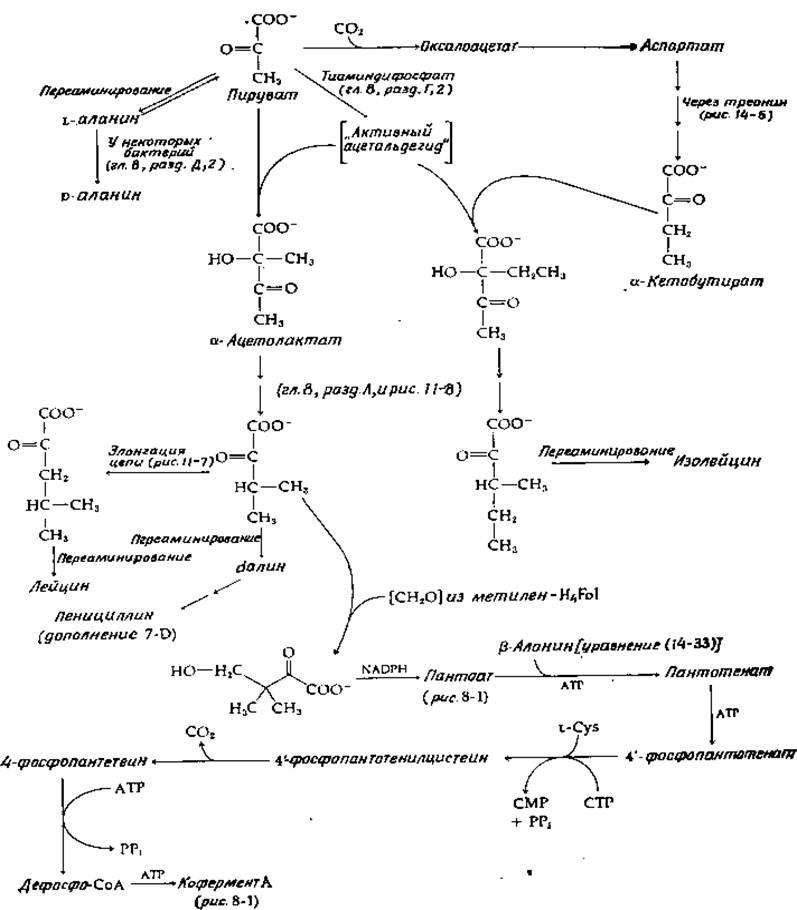
FIG. 14-10. Biosynthesis of leucine, isoleucine, valine, and coenzyme A.
Last update: 06/08/2026
Editorial and Educational Adaptation: This material has been compiled based on the primary/original source text. The project team performed an editorial review, corrected technical inaccuracies, structured sections, and adapted the content for an educational format.
What was processed:
- elimination of formatting defects (OCR errors, structural breaks, corrupted characters);
- editorial organization of content;
- standardization of terminology in accordance with academic sources;
- verification of factual statements against the original source text.
All mentions of the author, publication year, and origin of the primary text have been preserved in accordance with the source.