Biochemistry - The Chemical Reactions of Living Cells, Volume 3 - D. Metzler 1980
Metabolism of Nitrogen-Containing Compounds
Compounds Derived from Aspartate
Threonine Metabolism
Excess Threonine is degraded primarily through the action of L-Threonine dehydratase [Equation (14-29), step o] via a typical β-elimination reaction.
This Pyridoxal phosphate-dependent enzyme is synthesized in large quantities in E. coli Cells grown on a medium lacking glucose and oxygen. Under these conditions, this reaction serves as a source of propionyl-CoA, which can be converted to propionate with the generation of ATP. This biodegradative threonine dehydratase (threonine deaminase) [61, 62] is allosterically activated in the presence of AMP, as would be expected for a key enzyme of METABOLISM/26.html">Energy Metabolism. E. coli cells also produce another, biosynthetic threonine dehydratase, which selectively provides the α-ketobutyrate required for isoleucine Biosynthesis [63].
Class="center">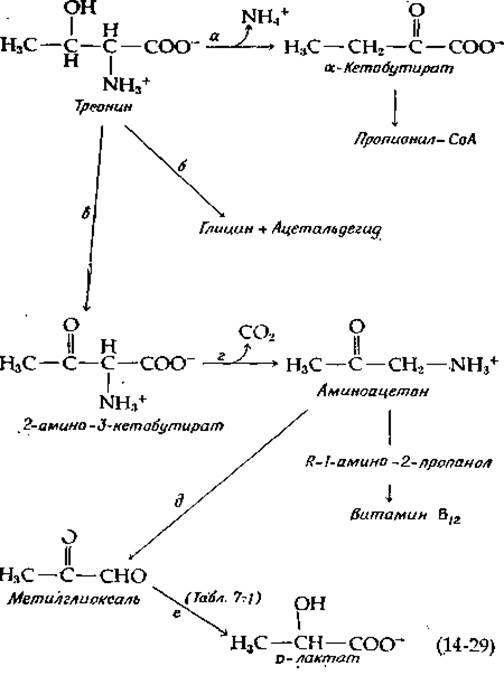
In 1956, Umbarger [63a] demonstrated that this enzyme is inhibited by isoleucine, the end product of this biosynthetic pathway. This discovery played a pivotal role in establishing The concepts of feedback inhibition (retroinhibition) as a factor in Metabolic Regulation (Chapter 6, Section E, 4), as well as the concepts of allostery.
Another catabolic pathway of threonine [Equation (14-29), step b] is its Cleavage into Glycine and acetaldehyde, catalyzed by Serine hydroxymethyltransferase [Equation (8-19)]. The third and quantitatively more significant pathway involves dehydrogenation [Equation (14-29), step c] and decarboxylation to form aminoacetone [Equation (14-29), step d]. Aminoacetone is excreted in the urine, but it can also be oxidized [Equation (14-29), step b] to methylglyoxal, which may be converted into D-lactate by the action of glyoxalase (Chapter 7, Section L). Aminoacetone also serves as a precursor of 1-amino-2-propanol in vitamin B12 biosynthesis (step e, Supplement 8-L). It has been postulated that methylglyoxal acts as a natural growth regulator that prevents excessive Cell proliferation in animals [63b].
Last update: 06/08/2026
Editorial and Educational Adaptation: This material has been compiled based on the primary/original source text. The project team performed an editorial review, corrected technical inaccuracies, structured sections, and adapted the content for an educational format.
What was processed:
- elimination of formatting defects (OCR errors, structural breaks, corrupted characters);
- editorial organization of content;
- standardization of terminology in accordance with academic sources;
- verification of factual statements against the original source text.
All mentions of the author, publication year, and origin of the primary text have been preserved in accordance with the source.