BIOCHEMISTRY in Questions and Answers - Alimov A.M. - 2016
SECTION 5. METABOLISM AND ENERGY
Question 1. What is METABOLISM?
Answer. Metabolism consists of two opposing processes—assimilation and dissimilation—and represents the totality of biochemical transformations that occur in an intact Organism, ensuring its vital activity, growth, reproduction, and interaction with the environment.
Question 2. What is Catabolism (dissimilation)?
Answer: Catabolism refers to the set of enzymatic reactions that ensure The breakdown of macromolecules and monomers into End products of Metabolism (СО2 and Н2О), accompanied by the release of energy and its storage in the form of ATP.
Question 3. What is anabolism (assimilation)?
Answer: Anabolism encompasses metabolic Reactions Involving the Biosynthesis of components for various cellular structures necessary to maintain organismal function.
Question 4. What are the MAIN STAGES OF metabolism?
Answer: The First stage is Digestion—The process of mechanical and chemical Processing of food components within the digestive Organs (breakdown of CARBOHYDRATES into Monosaccharides, Proteins into Amino Acids, Lipids into glycerol and Fatty acids) followed by absorption. The Second Stage is Intermediary Metabolism (tissue metabolism), which includes the breakdown of digestive products, The formation of various intermediates, and the generation of end products. The Third Stage is the formation and excretion of metabolic end products.
Question 5. What is meant by Biological Oxidation?
Ответ: Biological oxidation comprises redox reactions occurring within Cells with the participation of Enzymes, serving as the primary source of energy for the organism.
Question 6. What does the respiratory quotient signify?
Answer: The respiratory quotient is The ratio of the volume of carbon dioxide produced over a given period to the volume of oxygen consumed: RQ=СО2/О2.
Question 7. What is the respiratory quotient during The oxidation of carbohydrates (glucose)?
Ответ: The respiratory quotient for carbohydrates is 1. This means that when carbohydrates are oxidized in Tissues to Water and carbon dioxide, the volume of exhaled carbon dioxide equals the volume of consumed oxygen. For example, the oxidation of 1 molecule of glucose requires six molecules of oxygen and yields six molecules of carbon dioxide: С6Н12О6 +6О2=6СО2+6Н2О
Question 8. Which enzymes are involved in the digestion of carbohydrates within the gastrointestinal tract?
Answer: 1. Salivary and pancreatic α-amylase
2. Maltase
3. Lactase
4. Sucrase
5. Isomaltase
All of these enzymes are synthesized in the Cells of the intestinal wall.
Question 9. Which bonds are cleaved by α-amylase?
Answer: α (1 —> 4)-glycosidic bonds in Polysaccharides
Question 10. Which bonds are cleaved by isomaltase?
Answer: α (1 —> 6)-glycosidic bonds in isomaltose
Question 11. Which bonds are cleaved by maltase?
Answer. Α (1 —> 4)-glycosidic bonds in maltose
Question 12. Which bonds are cleaved by lactase?
Answer: β (1 —> 4)-glycosidic bonds in lactose
Question 13. Which bonds are cleaved by sucrase?
Answer: (α1 —> β2)-glycosidic bonds in sucrose
Question 14. Which enzymes are involved in Protein Digestion within the gastrointestinal tract?
Answer: Pepsin, Trypsin, Chymotrypsin, Carboxypeptidases, aminopeptidases, dipeptidases.
Question 15. What is The Nature and Structure of pepsin?
Answer: Pepsin is the primary enzyme of gastric juice that catalyzes the Hydrolytic Cleavage of Proteins. It is synthesized as a proenzyme, pepsinogen, with a Molecular Weight of 42,000 Da, which is subsequently converted into active pepsin upon the cleavage of a peptide fragment with a molecular weight of 7,000 Da.
Question 16. Which bonds within a protein molecule are hydrolyzed by pepsin?
Answer: Pepsin hydrolyzes peptide bonds formed by the amino groups of aromatic amino acids
Question 17. Where in the body and which bonds within a protein molecule are hydrolyzed by trypsin?
Answer: In the Small Intestine, trypsin hydrolyzes peptide bonds formed by the carboxyl groups of Arginine and Lysine.
Question 18. Which bonds within a protein molecule are hydrolyzed by chymotrypsin?
Answer: In the small intestine, chymotrypsin hydrolyzes peptide bonds formed by the carboxyl groups of aromatic amino acids
Question 19. What is the common intermediate metabolite produced during the breakdown of amino acids, glucose, and fatty acids?
Answer:
Class="center">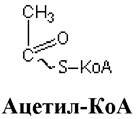
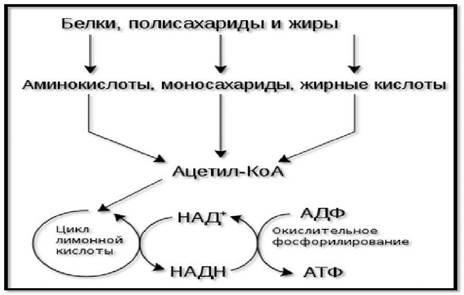
Question 20. What are the metabolic fates of acetyl-CoA?
Answer. Acetyl-CoA can enter The Citric Acid Cycle, or be utilized in the synthesis of Cholesterol, fatty acids, and Ketone Bodies According to the following scheme:
Question 21. What is the Catabolic Role of the TCA cycle?
Answer: During this cyclic process, two molecules of СО2 are formed, and reducing equivalents are generated in the form of 3 molecules of NADH and one molecule of FADH2.
Question 22. What is the anabolic role of the TCA cycle?
Answer: 1. Citrate, α-ketoglutarate, succinyl-CoA, and fumarate in the TCA cycle are converted into oxaloacetate, and glucose can be synthesized from oxaloacetate.
2. Citrate is involved in The transport of acetyl-CoA for lipid synthesis.
3. Citrate can bind Са2+ ions and participate in their transport and deposition processes (mineralization).
4. Through Transamination, aspartic acid is formed from oxaloacetate, and glutamic acid from 2-oxoglutarate.
5. Succinyl-CoA is involved in the Synthesis of Porphyrins.
6. Succinyl-CoA serves as a donor of HS-CoA in the reaction forming the active form of acetoacetate (a ketone body).
Question 23. Where do the Reactions of the citrate cycle take place?
Answer. In the mitochondrial matrix.
Question 24. What are high-energy compounds (macroergic compounds)?
Answer: Macroergic compounds are molecules containing energy-rich bonds. They store energy and release it during Chemical Reactions, with Hydrolysis yielding more than 4 kcal/mol of energy.
Question 25. Name the high-energy compounds.
Answer: ATP, GTP, phosphoenolpyruvate, creatine phosphate, 1,3-diphosphoglycerate.
Question 26. What is the Electron Transport Chain (ETC)?
Answer: The ETC is a set of enzymes located in The inner mitochondrial membrane that transfer reducing equivalents from NADH and FADH2 to molecular oxygen, coupled with the synthesis of ATP and H3PO4.
Question 27. What enzyme complexes are distinguished in the Respiratory Chain?
Answer. The respiratory chain comprises 5 complexes: I - NADH:ubiquinone oxidoreductase
II - succinate:ubiquinone oxidoreductase
III - ubiquinone:cytochrome c oxidoreductase
IV - cytochrome c oxidase
V - ATP synthase
Question 28. What determines The sequence of components in the respiratory chain?
Answer: The magnitude of their redox potentials; each respiratory complex is structured and localized in order of increasing redox potential.
Question 29. WHAT IS A redox potential?
Answer: Redox potential is the difference in energy levels between an oxidizing agent and a reducing agent
Question 30. What inhibitors are known for various segments of The electron transport chain?
Answer: 1. Rotenone and barbiturates block NADH dehydrogenase (complex I)
2. Antimycin A inhibits the respiratory chain between Cytochromes b and c.
3. Carbon Monoxide and cyanides inhibit cytochrome c oxidase (complex IV)
4. Oligomycin acts on complex V of cells.
Question 31. How can enzyme complex I of the ETC be characterized?
Answer: ETC complex I contains flavin mononucleotide (FMN) and iron-sulfur proteins (FeS proteins). It oxidizes NADH and directs electrons to ubiquinone (coenzyme Q); meanwhile, The energy released during electron transfer is used to transport H+ across the inner mitochondrial membrane into the intermembrane space
Question 32. What components does ETC complex III include?
Answer. Cytochromes b, c1, and an iron-sulfur center (FeS protein).
Question 33. What is the function of ubiquinone in the ETC?
Answer: Ubiquinone serves as a linking molecule in electron transport from complexes I and II to cytochromes
Question 34. What is The structure of coenzyme Q?
Answer:

Question 35. Which compounds make up complex IV?
Answer. Cytochromes a, a3, and 2 copper atoms (CuA and CuB).
Question 36. What is the function of complex IV?
Answer. It catalyzes The transfer of electrons from cytochrome c to molecular oxygen
Question 37. How does electron transfer to oxygen occur via complex IV?
Answer: Cytochrome c —> CuA —> heme a —> heme a3 —> CuB —> O2
Question 38. What compound is produced in the ETC?
Answer: Endogenous water: formed by adding two electrons to oxygen and reducing it to water within the matrix.
Question 39. How many Protons are pumped from the mitochondrial matrix into the intermembrane space during the oxidation of NADH in the ETC?
Answer: 10 H+
Question 40. What is the Electrochemical Potential?
Answer. The electrochemical potential is the sum of the chemical and electrical potentials resulting from the accumulation of H+ on the outer surface of the inner mitochondrial membrane.
Question 41. What is meant by Free Oxidation?
Answer: Free oxidation refers to oxidation that is not coupled with ATP synthesis. Examples of free oxidation include:
1. Oxidation involving mono- and Dioxygenases
2. Free radical oxidation (FRO)
3. Microsomal oxidation
Question 42. How do oxidases function?
Answer: Oxidases oxidize a substrate by utilizing molecular oxygen.
Question 43. What coenzyme do dehydrogenases use as an oxygen acceptor?
Answer: Flavin mononucleotide (FMN)
Question 44. What is the process of ATP Synthesis Coupled with The activity of mitochondrial respiratory enzymes called?
Answer: The process of ATP synthesis coupled with the activity of mitochondrial respiratory enzymes is called Oxidative Phosphorylation.
Question 45. What enzymes are called dehydrogenases?
Answer. Dehydrogenases are enzymes that catalyze the removal of hydrogen from a substrate.
Question 46. What reactions do peroxidases catalyze?
Answer. Oxidation-reduction reactions in which hydrogen peroxide is used as an electron acceptor.
Question 47. What enzymes are called oxygenases?
Answer: Oxygenases are enzymes that catalyze the direct incorporation of oxygen into a substrate molecule. They are divided into Monooxygenases and dioxygenases.
Question 48. What is The Role of monooxygenases?
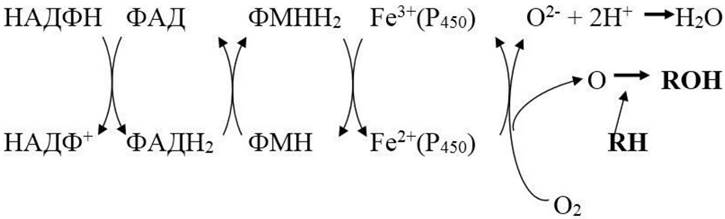
Answer: Monooxygenases (hydroxylases) catalyze the incorporation of only one atom of an oxygen molecule into the substrate, while the other oxygen atom is reduced to water.
Question 49. Name the monooxygenase systems.
Answer: 1. Microsomal systems, which carry out the metabolism of drugs and other xenobiotics
2. Mitochondrial systems, which are involved in the metabolism of Steroids and fatty acids
Question 50. What are the components of monooxygenase systems?
Answer:
Question 51. What is the Biological Role of microsomal oxidation?
Answer: Microsomal oxidation provides hydroxylation of
hydrophobic compounds: - cholesterol;
- polyunsaturated fatty acids;
- xenobiotics (drugs, insecticides, etc.);
- hydrophobic endogenous toxins (products of protein putrefaction, etc.)
Question 52. What reactive oxygen species exist?
Answer: *O2 - superoxide anion radical;
H2O2 - hydroperoxide;
*OH - hydroxyl radical;
*O22- - peroxide anion radical
Question 53. How does phosphorylation differ from free oxidation?
Answer: Oxidative phosphorylation takes place in Cell/35.html">Mitochondria during biological oxidation in the respiratory chain, with the released energy being stored as ATP. Free oxidation occurs without ATP synthesis on the outer surface of the mitochondrion involving enzymes similar to those inside the mitochondrion. Free oxidation also takes place in cytoplasmic Peroxisomes, where the main enzyme is prooxidase (catalase), which oxidizes hydrogen peroxide.
Question 54. What is The Significance of free oxidation?
Answer: Free oxidation is important for maintaining body Temperature in cold conditions, since the energy released in the process is dissipated as heat.
Question 55. Which biological processes are initiated by free-radical oxidation?
Answer: 1. Turnover of Phospholipids, proteins, and nitrogenous bases
2. Phagocytosis
Question 56. What does Lipid Peroxidation (LPO) mean?
Answer. LPO refers to a chain reaction of polyunsaturated Fatty acid oxidation accompanied by the formation of fatty acid peroxide radicals
Question 57. How does LPO proceed?
Answer: Oxidation begins with the abstraction of a hydrogen atom from the -CH2- group of a polyunsaturated fatty acid. The resulting free radical -CH*- adds an oxygen molecule and converts into a fatty acid peroxide radical (ROO*). Peroxides are unstable and break down to form the end product of lipid peroxidation, malondialdehyde (MDA).
Question 58. What are antioxidants?
Answer. Antioxidants are substances that inhibit the propagation of free radical chain oxidation reactions.
Question 59. Which antioxidants are classified as preventive?
Answer. Substances that bind transition metals capable of initiating lipid peroxidation (LPO):
1. Proteins: tissue thioneins, albumin, ceruloplasmin
2. Ethylenediaminetetraacetate
Question 60. Which antioxidants are classified as chain-breaking?
Answer: Vitamins E, A, C, and uric acid
Question 61. Which enzymes are involved in the inactivation of reactive oxygen species?
Answer: Superoxide dismutase, catalase, Glutathione peroxidase
Last update: 06/08/2026
Editorial and Educational Adaptation: This material has been compiled based on the primary/original source text. The project team performed an editorial review, corrected technical inaccuracies, structured sections, and adapted the content for an educational format.
What was processed:
- elimination of formatting defects (OCR errors, structural breaks, corrupted characters);
- editorial organization of content;
- standardization of terminology in accordance with academic sources;
- verification of factual statements against the original source text.
All mentions of the author, publication year, and origin of the primary text have been preserved in accordance with the source.