Principles of Biochemistry, Volume 2 - A. Lehninger 1985
Bioenergetics and Metabolism
Glycolysis as the Central Pathway of Glucose Catabolism
ATP Synthesis Coupled to Glycolysis
During Glycolysis, a significant portion of the Free energy contained within a glucose molecule is conserved in the form of ATP. This is easily demonstrated by writing the overall chemical equation for anaerobic glycolysis in vigorously exercising Skeletal Muscle:
Class="center">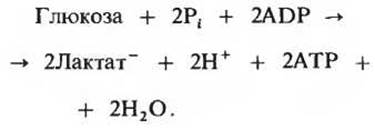
As this equation shows, for every molecule of glucose broken down, two molecules of ATP are formed from ADP and Pi. We can conceptually separate anaerobic glycolysis into two constituent processes and write a separate equation for each: (1) The conversion of glucose to lactate, accompanied by the release of free energy:
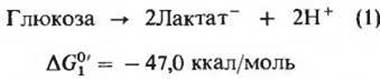
and (2) The formation of ATP from ADP and phosphate, which requires an input of energy:

These two processes cannot occur independently; they must be coupled. However, writing the two equations separately reveals that the conversion of 1 mol of glucose to lactate under standard conditions releases a substantially greater amount of free energy (47.0 kcal) than is required for the synthesis of 2 mol of ATP from ADP and phosphate (2 ∙ 7.3 = +14.6 kcal). In the living Cell, given the actual intracellular concentrations of ATP, ADP, Pi, glucose, and lactate, the METABOLISM/25.html">Efficiency of Energy conservation as ATP during glycolysis exceeds 60%.
Using equations (1) and (2), we can also determine the overall standard free-energy change for glycolysis, taking ATP formation into account. This change, designated as ∆G's, is equal to the algebraic sum of ∆G0'1 and ∆G0'2:
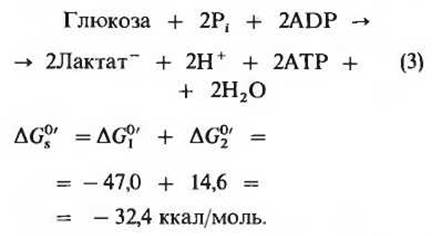
Thus, we see that the overall coupled reaction of glycolysis is accompanied by a very large decrease in free energy. Under both standard conditions and in living Cells, glycolysis is an essentially irreversible process that proceeds virtually to completion precisely because of this substantial drop in free energy.
Last update: 06/08/2026
Editorial and Educational Adaptation: This material has been compiled based on the primary/original source text. The project team performed an editorial review, corrected technical inaccuracies, structured sections, and adapted the content for an educational format.
What was processed:
- elimination of formatting defects (OCR errors, structural breaks, corrupted characters);
- editorial organization of content;
- standardization of terminology in accordance with academic sources;
- verification of factual statements against the original source text.
All mentions of the author, publication year, and origin of the primary text have been preserved in accordance with the source.